How to Appear in ChatGPT Results for Your Category
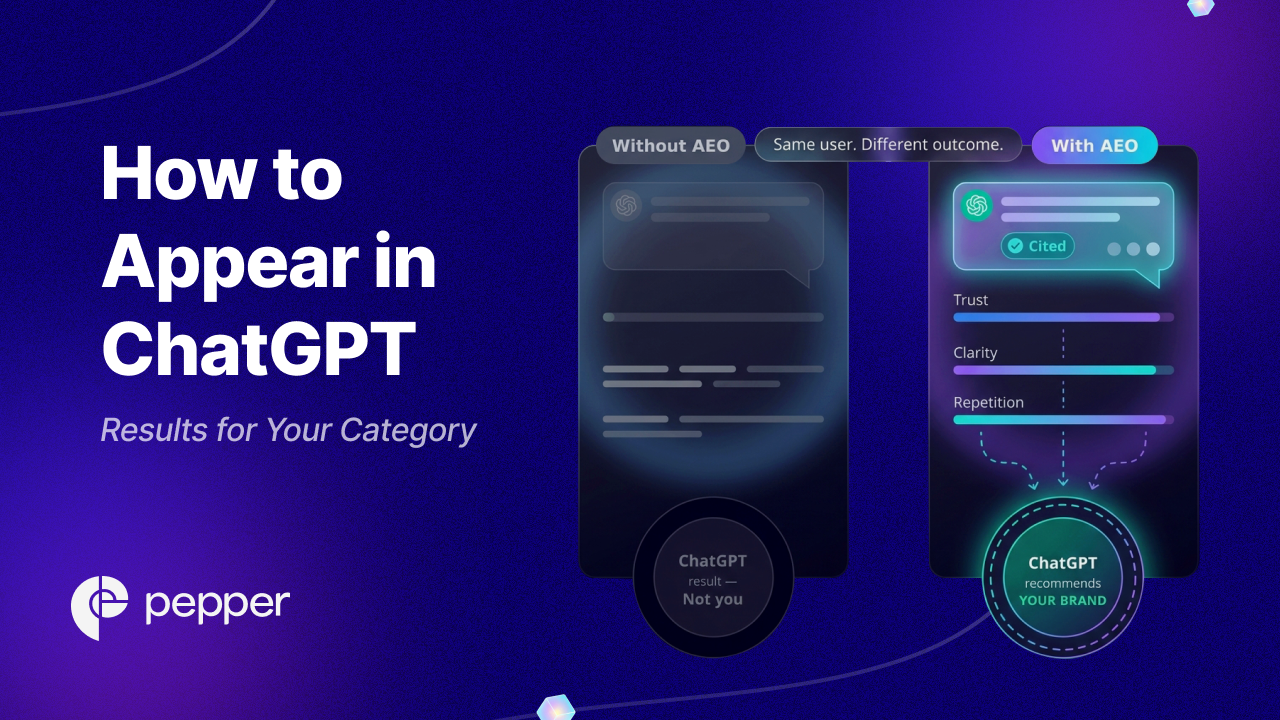
| ⚡ TL;DR – Key Takeaways→ ChatGPT controls roughly 80% of the AI search market – and it uses Bing’s index, not Google’s, to source real-time citations.→ 87% of ChatGPT citations align with Bing’s top results. If you’re not optimizing for Bing, you’re fighting the wrong battle.→ Cross-source consensus is ChatGPT’s primary trust signal – what matters is whether multiple independent sources say the same thing about your brand.→ Topical breadth beats single-query dominance: a brand ranking 4th–5th across five related queries outperforms a brand ranking #1 on just one.→ This guide includes a step-by-step implementation checklist you can use to audit and close your ChatGPT visibility gap today. |
Most Brands Are Optimizing for the Wrong Search Engine
Here’s the insight most marketing teams miss: ChatGPT Search doesn’t run on Google’s index. It runs on Bing’s. And according to Seer Interactive’s case study across 68 prompt iterations, 87% of ChatGPT citations align with Bing’s top results – not Google’s.
That single fact changes your entire strategy. If you’ve spent the last two years building Google rankings and none of that effort touched Bing, you’ve built a foundation for the wrong platform.
ChatGPT controls roughly 80% of the AI search market. More than 200 million people use it every week to find products, compare vendors, and make decisions (LLM Pulse, 2026). When your buyer types ‘What’s the best [your category] tool for enterprise?’ into ChatGPT – the answer either contains your brand or it doesn’t. There’s no page two.
This guide is specifically about ChatGPT – its retrieval model, its trust signals, the content formats it favors, and the exact steps to get your brand into its category answers.
| 📌 Definition: Cross-Source Consensus Cross-source consensus is ChatGPT’s primary mechanism for determining whether a brand is trustworthy enough to recommend. It measures whether multiple independent, high-authority sources – editorial publications, review platforms, community discussions, and directories – describe your brand consistently. When sources agree, ChatGPT treats your brand as a reliable entity. When sources conflict or are absent, it defaults to competitors with stronger corroboration. – Pepper Inc., 2026 |
How ChatGPT Actually Decides What to Recommend
ChatGPT’s recommendation logic runs on two distinct tracks that operate simultaneously: training-time knowledge and retrieval-time knowledge.
Track 1: Training-Time Knowledge
During pre-training, GPT-4 and its successors ingested hundreds of billions of web pages – Wikipedia, Reddit, G2 reviews, long-form blog posts, and PR coverage from high-authority domains. Brands that appear in that training data with consistent, positive associations are already baked into the model’s category knowledge. This is why legacy brands often appear in ChatGPT without any active GEO strategy: they were in the training data before the game started.
The implication: building a broad, consistent digital footprint isn’t just a short-term tactic. It’s a long-term training data investment that compounds with every model update.
Track 2: Retrieval-Time Knowledge (ChatGPT Search)
When ChatGPT Search is enabled – which it is by default for Plus and Team subscribers – it performs a live Bing search, fetches the top 10–20 pages, chunks them into 300–500 word segments, and synthesises a grounded answer. Citations come from the sources used in that retrieval pass.
The key insight from a University of Toronto study (Chen et al., arXiv:2509.08919): ChatGPT cited earned (third-party) sources 93.5% of the time for well-known brand queries and 95.1% for niche brand queries. Your own product pages are one signal. Third-party editorial sources are the dominant driver of ChatGPT citations.
| 93.5%of ChatGPT citations come from third-party earned sources, not brand-owned pages (University of Toronto, 2025). Your website alone will never be enough. |
The RRF Advantage: Why Breadth Beats #1 Rankings
ChatGPT’s retrieval model uses a scoring mechanism called Reciprocal Rank Fusion (RRF). You don’t need to memorize the formula – but you need to understand what it means strategically.
RRF Score = Σ [1 / (60 + SERP position)]. This formula means ChatGPT aggregates ranking signals across multiple queries, not just one. A brand that ranks 4th or 5th consistently across five related queries will outperform a brand that ranks #1 on only one query.
At Index ’26, Kishan Panpalia, GEO Lead at Pepper, made this concrete with a real-world example: “For a search like ‘best travel credit cards’ – on Google, Chase, BofA, and Amex dominate. But all banks combined don’t own 8% of share of voice on LLMs for the same query. It’s NerdWallet and Bankrate that come up instead. The brands winning on AI search are the ones with topical authority across the full cluster of related queries – not just the primary keyword.”
| “A brand that ranks 4th or 5th consistently across five related queries will outperform a brand ranking #1 on only one. That’s the RRF advantage.”– Kishan Panpalia, GEO Lead, Pepper – Index ’26 |
The practical implication: build a pillar-and-cluster content architecture. Own the parent topic deeply, then fan out to every sub-query in your category. Breadth of topical coverage is now a direct input into ChatGPT recommendation frequency.
Cross-Source Consensus: The Signal ChatGPT Trusts Most
ChatGPT doesn’t just evaluate your content – it evaluates agreement across sources. If your website describes your product one way but your G2 reviews say something different, or if you’re mentioned on three domains but absent from fifteen that cover your category, ChatGPT treats your brand as ambiguous. Ambiguous brands don’t get recommended.
The 6 source tiers that feed ChatGPT’s consensus signal – ranked by trust weight:
| Source Type | Examples | ChatGPT Trust Weight |
| Your own website | Brand homepage, product pages, blog posts | Low – owned sources are discounted |
| Third-party editorial | Forbes, Search Engine Land, MarTech, G2 blog | Very High – cited 93.5% of the time |
| Review platforms | G2, Capterra, Trustpilot, TrustRadius | High – aggregated signals, high trust |
| Community platforms | Reddit threads, Quora, LinkedIn articles | High – peer validation, RAG-indexed |
| YouTube | Video transcripts, descriptions, chapters | Very High – #2 most-cited domain overall |
| Bing-indexed pages | Any well-linked page ranking in Bing’s index | Critical – ChatGPT Search uses Bing’s index |
Building cross-source consensus means making your brand description consistent – same core claim, same category language, same key differentiators – across all six tiers. Not word-for-word identical, but semantically consistent. The moment ChatGPT detects agreement, it increases citation probability.
| “The brands winning AI visibility today are securing placements in tier-1 publications, structuring content for AI citation, and tracking metrics like AI citation frequency. They’re not just ranking on Google – they’re dominating the conversations that happen before users visit a website.”– AuthorityTech.io, 2026 |
Content Formats ChatGPT Cites Most – Platform Specifically
Not all content formats are equally retrievable by ChatGPT. Its RAG pipeline prefers content that is modular, explicitly structured, and citation-ready. Here are the formats that consistently outperform in ChatGPT’s retrieval model:
| Content Format | Why ChatGPT Cites It |
| “Best X for Y” listicles | Top recommendation lists that directly match purchase-intent prompts |
| Comparison guides | Head-to-head comparisons that surface when buyers evaluate alternatives |
| FAQ-style articles | Q&A format with explicit definitions – highest single-format citation rate |
| How-to guides with numbered steps | Procedural content maps cleanly to task-based ChatGPT queries |
| Original data studies / reports | Stats and proprietary insights are the most-quoted content type in ChatGPT |
| Case studies with named outcomes | Cited as proof when ChatGPT validates vendor recommendations |
| Category definition pages | DefinedTerm schema + definitional copy = LLM authority signal for your category |
AI rewards three things in content: clarity over length, definition over fluff, and precision over prose. A short, explicit 50-word answer to a buyer question will be cited more often than a 1,500-word post that buries the answer in paragraph four.
Brand Recall Optimization: How ChatGPT Learns Your Category Association
Brand recall optimization is the practice of building consistent, positive category associations across the web so that ChatGPT surfaces your brand when a buyer describes what they need – even without mentioning your name.
There are three levers:
1. Claim your category language
Define your category explicitly on your own pages and seed that definition into third-party coverage. If you’re a ‘content-led organic growth engine,’ that phrase should appear in your G2 listing, your LinkedIn about section, your Wikipedia entity description, and in guest articles you’ve authored. ChatGPT pattern-matches against consistently repeated category language.
2. Own the comparison queries
ChatGPT is heavily used for vendor comparisons. A buyer asking ‘What’s better, [Competitor A] or [your brand]?’ is a direct purchase-intent query. Build dedicated comparison pages on your site for every major competitor. Structure them with a clear answer in the first paragraph, a feature comparison table, and an FAQ block. These are among the highest-citation-rate pages in any category.
3. Appear in the right third-party lists
ChatGPT synthesises ‘best of’ answers directly from listicles on authoritative domains – Forbes, G2, Capterra, Search Engine Land, industry-specific review sites. Being absent from those lists is a citation gap you can close. The action: identify every authoritative ‘best [your category]’ article ranking in Bing’s top 10, then pursue inclusion through outreach, updated G2 data, and PR pitches.
| 67%of all information discovery will happen via LLM interfaces by 2026 (ConvertMate, 2026). Category ownership in AI answers is now brand ownership. |
The Bing-First Imperative: ChatGPT’s Hidden Distribution Channel
This is the most underused insight in ChatGPT optimization and the one with the fastest payoff.
ChatGPT Search is powered by Bing. When a user submits a query to ChatGPT Search, it performs a live search via Bing’s index – not Google’s. The pages that rank well in Bing for the fan-out queries ChatGPT generates are the ones that get cited. Seer Interactive’s research found that Bing rank strongly predicts ChatGPT mentions: 87% of ChatGPT citations align with Bing’s top results.
The four Bing-specific actions that matter most are:
• Submit your sitemap to Bing Webmaster Tools – most brands have done this for Google but skipped Bing. Log in to bing.com/webmasters and submit today.
• Use IndexNow – the protocol Bing created for instant URL submission. It’s also adopted by Yandex and Seznam. When you publish or update a page, push it via IndexNow and it’ll be indexed in hours.
• Verify your brand on Bing Places / Bing Entity Recognition – this is Bing’s equivalent of Google’s Knowledge Graph. A verified entity on Bing directly improves how Copilot and ChatGPT Search represent your brand.
• Check your Bing ranking for every target query – you may rank #1 on Google but #12 on Bing for the same query. That Bing gap is a direct ChatGPT visibility gap.
| “You can dominate query fanouts on Google SERPs and still underperform in ChatGPT brand mentions. Bing matters most.”– Search Engine Land, 2026 |
Industry Updates: What’s Changed for ChatGPT Visibility in 2026
🔔 ChatGPT now processes over 1 billion queries per day: OpenAI confirmed in early 2026 that ChatGPT crossed 1 billion daily queries, cementing its position as the world’s most-used AI search interface. For brands, this means ChatGPT category answers now reach more buyers than most category-specific Google searches combined.
🔔 ChatGPT’s memory feature changes brand recall dynamics: ChatGPT’s persistent memory (rolled out broadly in 2025) means returning users get answers influenced by their history. Brands that appear positively in early interactions with a user have a compounding recall advantage over time. Getting into ChatGPT’s first answer for a category query is now more valuable than it was 12 months ago.
🔔 OpenAI is testing SearchGPT product pages: OpenAI’s SearchGPT interface now includes enhanced product-level pages for brands with verified merchant data. Early tests show these pages significantly increase brand mention frequency in follow-up queries. Verify your brand in OpenAI’s merchant data layer if you’re in e-commerce or SaaS.
🔔 Reddit’s citation share in ChatGPT dropped 50% overnight: After Google removed the num=100 parameter on September 11, 2025, Reddit’s ChatGPT citation rate fell from ~60% to ~10%. The brands that built their citation strategy on Reddit-only presence lost significant visibility. The lesson: diversify across multiple source tiers, never rely on a single platform.
🔔 Bing’s AI citation data is now auditable via Webmaster Tools: Bing Webmaster Tools added a ‘Copilot impressions’ dashboard in late 2025 that shows which of your pages are being retrieved by Copilot/ChatGPT Search. This gives marketers direct visibility into which URLs are driving AI citations – use it to find gaps and prioritise page updates.
Myth vs. Reality: ChatGPT Visibility Edition
| ❌ MYTH | ✅ REALITY |
| If I rank #1 on Google, I’ll appear in ChatGPT. | 87% of ChatGPT citations align with Bing’s top results, not Google’s. Bing is ChatGPT’s primary search index. |
| Publishing AI-generated content at scale will help. | ChatGPT cited third-party sources 93.5% of the time – earned media outweighs owned content every time. |
| ChatGPT rewards the brand with the best website. | ChatGPT rewards the brand with the most cross-source consensus. Your site is one signal. Third-party coverage is the dominant driver. |
| Getting mentioned once in a major publication is enough. | Consistency matters more than a single spike. A brand ranked 4th–5th consistently across 5 queries outperforms a brand ranked 1st on just one. |
| You need to be on every platform to win. | Depth on the right platforms (G2, LinkedIn, YouTube, Reddit) beats shallow presence everywhere. ChatGPT weights source authority, not source count. |
Step-by-Step Implementation Checklist
Use this checklist to audit and close your ChatGPT visibility gap. Each item maps to a specific lever in ChatGPT’s recommendation model. Work through Phase 1 in Week 1, Phase 2 in Weeks 2–4, and Phase 3 as an ongoing monthly cadence.
| ✅ Phase 1: Foundation (Week 1)☐ Run 10 target buyer prompts in ChatGPT. Document which brands appear and which don’t. This is your baseline.☐ Submit your sitemap to Bing Webmaster Tools if not already done.☐ Enable IndexNow on your site (Yoast, Rank Math, and most major CMSes support it natively).☐ Verify your brand on Bing Places and/or Microsoft Bing Entity Recognition.☐ Check your Bing ranking for every target query – compare to your Google rankings and flag gaps.☐ Implement Organization schema with sameAs links to LinkedIn, Wikidata, Crunchbase, and YouTube.☐ Create or claim your Wikidata entity and ensure your brand’s description matches your website. |
| ✅ Phase 2: Content & Consensus Building (Weeks 2–4)☐ Audit every page for the ‘one fact per block’ rule. Restructure any section with more than one core claim.☐ Add FAQPage schema to every content page with a Q&A block. Validate with Google’s Rich Results Test.☐ Build comparison pages for your top 3 competitors. Structure: direct answer → feature table → FAQ.☐ Publish or update a ‘best [your category]’ guide with your brand prominently featured and ranked.☐ Identify top 10 Bing-ranking ‘best of’ articles in your category. Pursue inclusion in all that list competitors.☐ Add Article schema with dateModified to every blog post. Ensure a visible ‘Last updated’ timestamp.☐ Get to 50+ reviews on G2 at 4.3+ average. This is the #1 B2B citation source across all major LLMs.☐ Publish one original data point per month (a stat, benchmark, or research finding). These are the most-quoted content units.☐ Seed your category language and brand description across G2, LinkedIn About, Crunchbase, and Reddit profiles — consistent phrasing across all. |
| ✅ Phase 3: Ongoing Cadence (Monthly)☐ Track your Share of Answer: run baseline prompts monthly and measure your mention rate, sentiment, and position.☐ Refresh your top 5 most-cited pages with new data, updated examples, or revised comparisons.☐ Publish one YouTube video per month with keyword-matched title, full transcript, and chapter markers.☐ Publish one LinkedIn long-form article per month from a named executive (not the brand page).☐ Monitor Bing Webmaster Tools ‘Copilot Impressions’ dashboard for new gaps and opportunities.☐ Check for new ‘best of’ articles in your category that have been indexed in Bing and pursue inclusion.☐ Run a competitor audit: which brands gained or lost ChatGPT visibility this month and why? |
FAQ
How do I get my brand to appear in ChatGPT results?
There are five steps: (1) Optimize for Bing – submit your sitemap to Bing Webmaster Tools and enable IndexNow. 87% of ChatGPT citations align with Bing’s top results. (2) Build cross-source consensus – get your brand mentioned consistently across G2, LinkedIn, YouTube, and authoritative editorial sites. (3) Publish comparison pages for your top competitors – these are among the highest-citation-rate content formats in ChatGPT. (4) Structure every page with one fact per block, FAQ schema, and a direct answer in the first paragraph. (5) Build topical authority across the full cluster of queries in your category, not just one primary keyword.
Does ranking on Google affect ChatGPT results?
Partially. ChatGPT Search uses Bing’s index as its primary retrieval source, not Google’s. A 2026 case study found that Bing rank is a stronger predictor of ChatGPT mentions than Google rank. That said, high-quality content that ranks on Google often ranks on Bing too – but you need to verify and optimize for Bing specifically. Check your Bing rankings for every target query and address any gaps directly.
How does ChatGPT’s retrieval model work?
ChatGPT uses a Retrieval-Augmented Generation (RAG) architecture. When ChatGPT Search is active, it performs a live Bing search, fetches the top 10–20 pages, breaks them into 300–500 word chunks, scores each chunk for relevance, and synthesises an answer from the highest-scoring segments. Citations reflect the sources used in that retrieval pass. ChatGPT also uses Reciprocal Rank Fusion (RRF) to aggregate signals across multiple related queries – meaning brands with consistent rankings across a topic cluster outperform brands with single-query dominance.
What content formats does ChatGPT cite most?
Seven content formats consistently outperform in ChatGPT’s retrieval model: ‘best X for Y’ listicles, head-to-head comparison guides, FAQ-style articles with explicit definitions, step-by-step how-to guides, original data studies with quotable statistics, case studies with named outcomes, and category definition pages with DefinedTerm schema. All should follow the one-fact-per-block rule and open with a direct 15–25 word answer to the target question.
How do I measure my ChatGPT visibility?
Start by manually running your top 10 buyer prompts in ChatGPT and documenting which brands appear. For systematic tracking, use tools like Pepper’s Atlas platform, Profound, Semrush AI Toolkit, Ahrefs Brand Radar, or SE Ranking’s AI Visibility Tracker. The key metrics to track are: mention rate (how often your brand appears), top-3 recommendation rate (how often you’re the primary recommendation), citation share (percentage of citations going to your domain), and sentiment drift (how ChatGPT describes your brand over time).
Your First Action: The 15-Minute ChatGPT Audit
Open ChatGPT right now. Type the five most important queries your buyers use to discover brands in your category. Document every brand that appears. Note whether your brand is mentioned, how it’s described, and which sources are cited.
That 15-minute exercise will tell you more about your ChatGPT visibility gap than hours of speculation. It’ll also show you which competitors have already built the cross-source consensus you need and which content formats and source types are driving their inclusion.
Once you have your baseline, the checklist above is your execution roadmap. The window to build a compounding advantage in ChatGPT results is still open. But the brands investing now are the ones that will be hardest to displace when your buyers search tomorrow.
| “ChatGPT doesn’t care which brand ranks #1 on Google. It cares which brand is mentioned everywhere, consistently, with nothing contradicting it.”– Anirudh Singla, CEO, Pepper Inc. |
Latest Blogs
Discover the 10 best financial SEO agencies to elevate your banking and finance digital presence. Expert strategies tailored to your success.
You can find out today, for free, in about half an hour. Open a logged-out session, ask ten category questions, repeat across three engines, and tally the answers. Here is the method, what the result means, and when it is worth paying for something deeper.
Every SEO platform comparison ranks features you already know you get. So we scored 11 of them on the only question a B2B marketer gets asked in a board meeting: can this thing reach the pipeline data? The answer is that none of them publishes organic-to-revenue attribution. One names a CRM integration, and it puts deal data beside your SEO data rather than through it. Four claim revenue outcomes and none of the four says how the number was calculated.
Get your hands on the latest news!

Similar Posts

Artificial Intelligence
12 mins read
How to check whether your brand appears in AI search

Artificial Intelligence
19 mins read
Best SEO platforms for B2B in 2026: 11 tools compared for pipeline, not traffic

Artificial Intelligence
16 mins read