Enterprise SEO pricing in 2026: what large organizations actually pay
The short answer
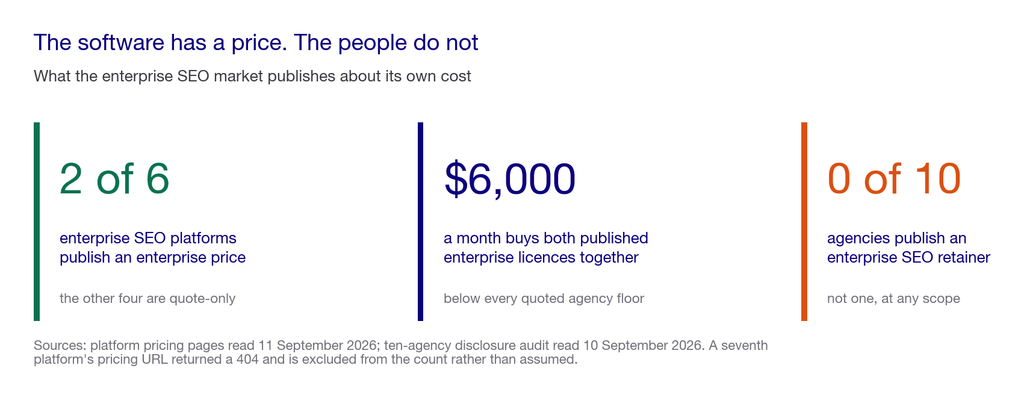
Two enterprise SEO platforms publish a price you can budget from: Ahrefs Enterprise at $1,499 a month and seoClarity Enterprise from $4,500 a month. Four more platforms are quote-only. No agency publishes an enterprise SEO retainer at all. Both published enterprise licences together come to roughly $6,000 a month, below the bottom of every agency range in circulation. So the software is not what makes enterprise SEO expensive. People are, and nobody prices those in public.
Key takeaways
- The top-ranking page for this 2026 question was last dated 19 March 2025. It is the first result and it is eighteen months old.
- The circulating numbers are agencies citing agencies. That same page attributes “55% of enterprise businesses invest $20,000+ per month” to one agency and “45% of enterprise-level companies spend more than $20,000 per month” to another. Same claim, ten points apart, both in circulation.
- 2 of 6 enterprise SEO platforms publish an enterprise figure. Ahrefs and seoClarity. Conductor, Lumar, Botify and Semrush Enterprise are all quote-only, and a seventh check returned a 404.
- 0 of 10 agencies publish an enterprise retainer. We audited ten yesterday. Two publish any figure at all and neither is enterprise-specific.
- The published software stack is the cheap part. About $6,000 a month buys both published enterprise licences, against agency ranges that start at $7,000 and run past $60,000.
- Pepper is an agentic organic growth engine and an organic growth partner. Agent Atlas gives your team the agents. Pepper’s GEO platform reports Brand Visibility, Domain Prompt Presence and Share of Voice. A growth team works alongside yours. Eight years, more than 250 enterprises, more than 10 million tracked prompts.
A note on where this comes from. I look at pricing before positioning, because what a company will put in writing tells you what it is confident about. Pepper runs organic for more than 250 enterprises over eight years and tracks more than 10 million prompts across every major engine. I also sit in the budget conversations where a number from one of these guides has already set the finance director’s expectation, which is usually the problem.
Disclosure: Pepper sells organic growth services to large organisations and published this guide. We publish no pricing, so we appear in no figure here rather than as an estimate. We read every price below on that company’s own pricing page on 11 September 2026, and we state the date. Where a company publishes nothing, we record that rather than guessing. Competitors are named but never linked.
What is enterprise SEO pricing, and what are you actually buying?
Enterprise SEO pricing is the total recurring cost of running organic search for a large organisation. That is three things, and only one of them is ever published.
- Platform licences. Crawling, rank tracking, log analysis, content tooling, and increasingly AI search visibility. Published sometimes.
- Agency or consultancy fees. Strategy, technical work, content production, link acquisition. Published for small and mid-market. Never published for enterprise.
- Your own people. In-house SEO leads, engineers who ship the fixes, writers, and the review time of everyone who has to approve a change. Never published by anyone, including us.
The word enterprise changes the shape of all three. At scale you are not buying a service, you are buying capacity to coordinate: multiple markets, multiple stakeholders, a release train you do not control, and a site large enough that template decisions matter more than page decisions. Our complete guide to enterprise SEO covers how that work actually runs, and our SEO agency pricing benchmarks cover retainer pricing by model for organisations below this scale. This article is about what the enterprise version costs, and how little of it anyone will put in writing.
Why every enterprise SEO number you have read is unreliable
Start with the page ranking first for this question. It is a dedicated enterprise SEO pricing guide, positioned for 2026, and it was last dated 19 March 2025. Read that again before you quote anything from it in a budget meeting.
It does attribute its ranges, which puts it ahead of most of this category. The problem is what it attributes them to.
- It sources a $7,000 to $60,000+ per month range to another agency’s pricing breakdown.
- It cites one agency for the claim that 55% of enterprise businesses invest $20,000+ per month on SEO.
- It cites a different agency’s research for the claim that 45% of enterprise-level companies spend more than $20,000 per month.
Those last two are the same claim measured against the same threshold, and they are ten percentage points apart. Both are circulating. Neither is a primary study you can inspect. This is a category citing itself, and the citations disagree.
So we did not build a range. We read the pricing pages.
Where this falls short: we checked what one top-ranking page attributes its numbers to. We did not audit every enterprise SEO pricing guide on the internet, and some may cite genuine primary research. What we can say is that the most visible one does not.
If you want your own category sized before you set a budget, book a growth audit and we will show you what the work involves at your scale.
What enterprise SEO platforms actually publish
The two that publish an enterprise figure
1. Ahrefs
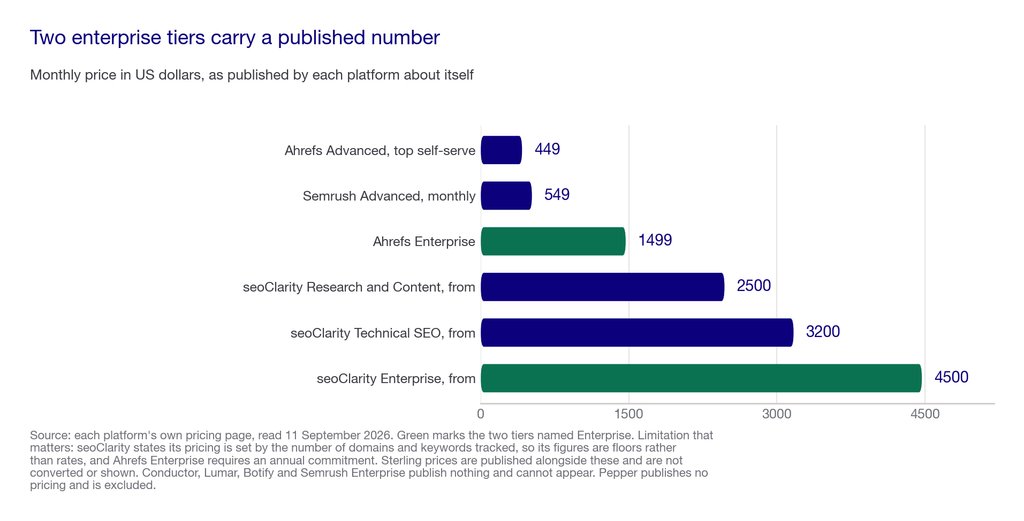
- Enterprise: $1,499 a month, annual commitment required.
- What it adds over the tier below: all Advanced features plus uncapped API access and unlimited historical data.
- The self-serve ladder underneath it: Starter $29, Lite $129, Standard $249, Advanced $449 a month, with up to 17% off annually.
- Scale limits published per tier: Advanced covers 50 projects and 5,000 tracked keywords. The page states no per-seat limit for Enterprise.
- Where it falls short for a large organisation: it is a research and tracking toolset rather than a workflow platform, so it does not replace a dedicated enterprise crawler or a content operations layer.
2. seoClarity
- Enterprise: from $4,500 a month, published alongside a sterling figure of £3,600.
- The two tiers below it, also published: Technical SEO from $3,200 (£2,400), Research and Content from $2,500 (£1,800).
- How they actually set the price: the page states plainly that “all packages are priced based on the number of domains and keywords tracked”, and that a custom quote is necessary. So the figure is a floor, not a rate card.
- Rankings plan: custom pricing, minimum 2,000 keywords.
- Where it falls short for a large organisation: a floor tells you whether to start the conversation, not what you will pay. At enterprise domain counts the real number could be a multiple of it.
The four that publish nothing
- Semrush. Publishes its self-serve ladder in full, from $139 to $549 a month monthly, or $117.33 to $455.67 annually, with tier limits stated down to daily AI prompts tracked. Enterprise is quote-only, described as being for “complex organizations managing multiple brands, regions, and teams”.
- Conductor. Three tiers named, Essentials, Growth and Enterprise, and no dollar figure anywhere. The page describes a “usage-based model” and a pricing philosophy that is “flexible” and “value focused”.
- Lumar. Quote-based, no tier names published, no crawl limits published. A form.
- Botify. No prices, no tier names, no crawl limits. Product features and a demo request.
- BrightEdge we could not check: its pricing URL returned a 404 on 11 September 2026, so we record it as unverified rather than assuming either way.
Where this falls short: absence of a published price is not evidence of a high one. These firms negotiate on volume and every one of them will quote. What the absence tells you is that you cannot benchmark before you enter a sales process, which is a real cost in itself.
What agencies publish for enterprise, which is nothing
We audited ten agencies serving B2B and enterprise buyers on 10 September 2026, reading each firm’s own site. Not one publishes an enterprise SEO retainer.
Two publish a commercial figure of any kind, and neither is enterprise-specific:
- NoGood: “our average retainer is above $20,000 a month”, which describes their client base rather than your scope.
- Omniscient Digital: “full-service engagements start at $10,000 a month”, published on its homepage while its dedicated pricing page publishes nothing.
Below enterprise scale, more is available. WebFX publishes an SEO ladder from $2,900 to $9,200 a month with a two-month setup fee of $5,900 to $12,200, verified 8 September 2026. That is a real published ladder and it stops well short of enterprise.
The pattern across both halves of the market is consistent, and it is the most useful thing on this page: the moment scope becomes genuinely enterprise, publication stops. Our full ten-agency disclosure audit covers what else these firms do and do not publish.
How we built this benchmark
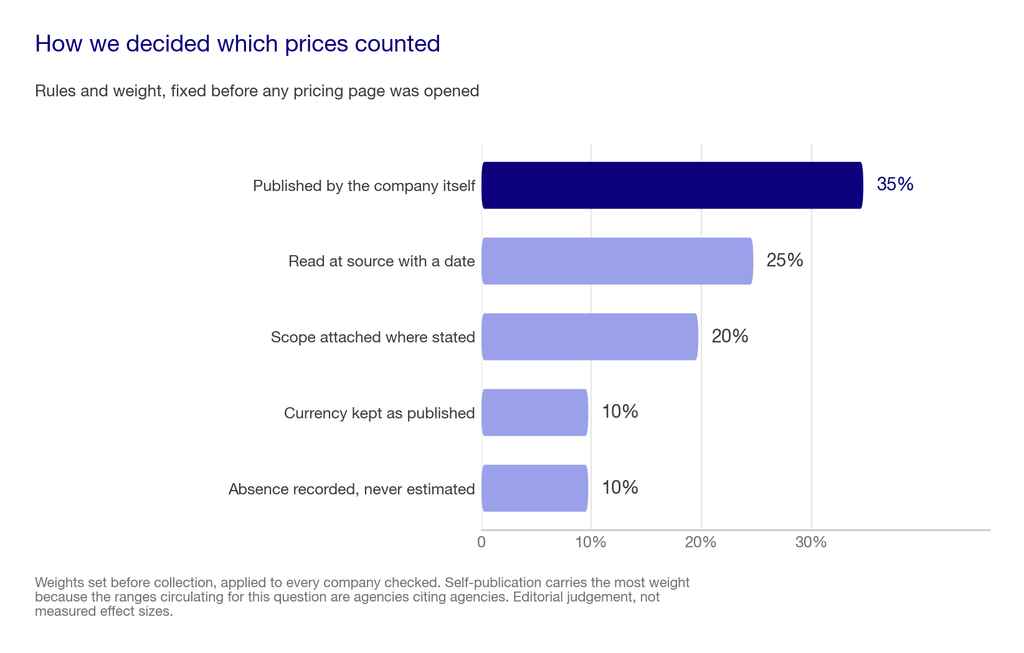
Five rules, fixed before any page was opened.
| Rule | Weight | What it means |
|---|---|---|
| Published by the company itself | 35 | The figure is on that company’s own pricing page, not in a roundup, a directory or another agency’s guide |
| Read at source with a date | 25 | We loaded the page and recorded the day, because this category reprices and re-dates constantly |
| Scope attached where stated | 20 | Keyword counts, project limits, domains or commitment terms recorded alongside the price, so a floor is not mistaken for a rate |
| Currency kept as published | 10 | Sterling figures stay in sterling and never appear on a dollar axis, because we do not invent exchange rates |
| Absence recorded, never estimated | 10 | A company publishing nothing is recorded as publishing nothing, and a page that fails to load is recorded as unverified |
Where this falls short: this is a census of published prices, not of the market. It skews toward companies choosing to publish, and at enterprise scale that is a small minority. Anyone quoting privately is invisible to it, and that is most of the spend.
Enterprise SEO pricing at a glance
| What you are buying | Published price | Who publishes it | Where it falls short |
|---|---|---|---|
| Research and tracking, top self-serve | $449 to $549 a month | Ahrefs Advanced, Semrush Advanced | Caps on projects and keywords bite at enterprise scale |
| Enterprise research licence | $1,499 a month, annual commitment | Ahrefs Enterprise | A toolset, not a workflow platform |
| Enterprise SEO platform, entry modules | $2,500 to $3,200 a month | seoClarity Research and Content, Technical SEO | Modular, so a full programme needs more than one |
| Enterprise SEO platform, full | From $4,500 a month | seoClarity Enterprise | A floor. Actual price scales with domains and keywords |
| Enterprise platform, quote-only | Nothing published | Conductor, Lumar, Botify, Semrush Enterprise | No benchmark before you enter a sales cycle |
| Enterprise agency retainer | Nothing published, anywhere | Nobody | Every figure in circulation is a range citing another agency |
| Mid-market agency retainer | $2,900 to $9,200 a month, plus $5,900 to $12,200 setup | WebFX | Published, but it stops below enterprise scope |
| Full-service, not SEO-specific | $10,000 a month minimum, $20,000 a month average | Omniscient Digital, NoGood | Whole-engagement figures, not an SEO line |
| Your own team and engineering time | Nothing published, by anyone | Nobody, us included | The largest line in every programme we have seen |
| Pepper, own row | Not published | Nobody, including us | Budget discovery is a conversation rather than a page |
What actually drives an enterprise SEO budget
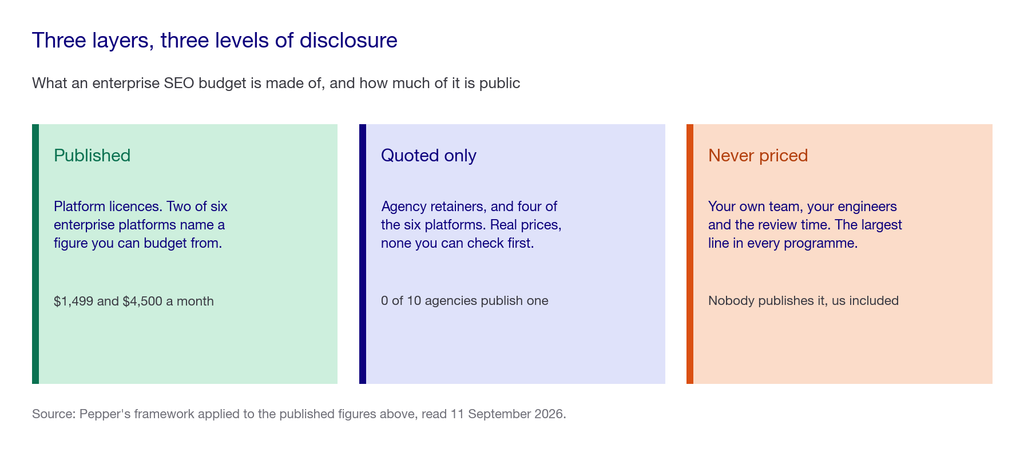
Add the layers rather than the labels.
- Platforms: $1,500 to $5,000 a month for a serious enterprise stack, based on the two published figures. Real, budgetable, and the smallest line.
- Agency or consultancy: unknown, and deliberately so. Every published range starts at $7,000 and runs past $60,000, and none of them is sourced to anything you can inspect. Treat all of them as anchoring, not information.
- Your own people: the largest line, and nobody prices it. In-house specialists, the engineering time to ship template changes, and the review cycles that decide the real timeline. We are not going to invent a salary benchmark, because we have no 2026 primary source for one and this category has enough invented numbers.
- The cost nobody puts in a budget: coordination. At enterprise scale the constraint is rarely knowing what to do. It is getting a template change through a release process owned by someone whose objectives do not include organic. Our enterprise SEO audit framework groups findings by unit of fix for exactly this reason.
The practical consequence: if a proposal is dominated by the platform line, it is priced for a smaller organisation than yours. If it is dominated by the agency line with no view on your internal capacity, it will stall in month three.
How Pepper prices against this
Pepper is an agentic organic growth engine and an organic growth partner, and the honest reason we appear in no figure above is that we publish no tiers.
- Agent Atlas gives your team the agents, not a report. Agents are workflows. System agents stay fixed, user agents stay editable and versioned, and customers log in and build and run their own inside Atlas. At enterprise scale that matters because the coordination cost above is a throughput problem, and throughput is what agents change.
- Pepper’s GEO platform reports Brand Visibility for how often engines mention you, Domain Prompt Presence for how often they cite a page from your domain, and Share of Voice for your slice of the category. The gap between the first two is the citability diagnostic. See the platform.
- A growth team works alongside yours, which addresses the people layer that no published price covers. Agents for scale, experts for judgement, one team accountable for the number.
- Proof rather than adjectives. Acceldata went from 85 to more than 300 top-three keywords with 6X organic traffic growth, and one hero guide carried over 260,000 impressions. More in our case studies.
Where it falls short, and on this page it needs saying twice: we publish no pricing. On an article that scores companies for publishing, that is a real gap and we are not exempt from it. If your approval process needs a published figure before a first call, two of the platforms above give you one and we do not. We are also built for organic as a long-term function with an internal team to work alongside, so a licence with nobody attached is not what we are for.
How to choose what to spend
I would not start from any benchmark, this one included. I would start by working out which of the three layers is actually constraining you, because a budget that fixes the wrong layer is wasted at any size.
Here is the 100-point scorecard I would run over any enterprise SEO proposal, ours included.
| Area | Weight | What a strong proposal demonstrates |
|---|---|---|
| All three layers priced separately | 30 | Platform, external help and internal time each appear as a line, and if one is excluded the proposal says so rather than leaving you to find out |
| Volumes and limits attached | 25 | Domains, keywords, crawl budget, markets and article counts stated, so cost per unit is computable and two quotes are comparable |
| Implementation ownership stated | 20 | The proposal says who ships template changes, and if it is your engineers, it estimates those hours instead of omitting the largest cost |
| Coordination plan, not just a strategy | 15 | It names the approval path and the stakeholders, because at enterprise scale that decides the timeline |
| Measurement included, not extra | 10 | Reporting across search and AI answers sits inside the fee, with a straight answer on what it adds over free first-party data |
Then run the live test, on us as readily as on anyone else. Take 25 questions and queries that matter commercially in your category, give the same list to every provider, and ask what they would do about them in the next 90 days, layer by layer, with a cost against each layer. For example: “what would you change on our top template”, “how many engineering hours does that need”, “what does the platform licence cost at our domain count”, “who writes the content and who approves it”.
Ask each one to come back with five things. Where you stand today across search and AI answers. Which competitors hold the positions you want. What they would change in the first 90 days. Who does each piece of work, you or them. What every layer costs, and what is excluded.
Five questions worth asking, and what a good answer sounds like.
- “Break this fee into platform, people and our internal time.” A good provider does it on the call. A single monthly number means the layers were never costed.
- “What volumes am I buying?” Domains, keywords, crawl budget, markets. Without volumes there is no cost per unit and no honest comparison.
- “Who ships the changes?” If the answer is your engineers, ask for an hours estimate. A refusal to estimate is the answer.
- “What is not in this price?” The honest answer is long. A short one means you find out in month three.
- “What would you cut if our budget halved?” This shows what they believe is load-bearing, which tells you more than the price does.
Red flags, each one seen in a real enterprise procurement.
- A market range quoted at you with no primary source. That is most of what ranks for this question, including the top result.
- A benchmark from a page dated more than a year ago, presented as current. Check the date before you quote it internally.
- A single monthly figure with no layer breakdown, so you cannot tell what is software and what is people.
- No implementation position, which quietly moves the largest cost onto your engineering team.
- A platform floor presented as a rate. seoClarity says plainly that its price scales with domains and keywords. A provider who does not say that is hiding the variable.
- No coordination plan. At enterprise scale, a strategy without an approval path is a document, not a programme.
- A guarantee of rankings, which Google itself advises against, because no third party has access to the ranking systems.
The weaker way to set this budget, and it is the common one. Read a cost guide. Take the middle of the range. Request three proposals. Pick the one nearest that number. Every step feels sensible, and the whole exercise is anchored to a figure nobody can defend.
The stronger sequence inverts it. Identify the constrained layer. Price the platform layer from published figures, because you can. Get external help quoted against explicit volumes. Then estimate your own team’s time honestly, because it is the biggest line and the one that decides whether anything ships.
If I reduce this to one principle: price the layers, not the label. Enterprise SEO is three different purchases wearing one name, and only the cheapest one has a public price.
The honest closing note, and it costs us something. Very few providers are equally strong at platform, execution and coordination, ourselves included, and the good ones will tell you which is weakest. Ask, and treat a straight answer as a positive signal.
What nobody should promise you
Nobody should quote you a market range as though it were a benchmark. The ranges circulating for enterprise SEO are agencies citing agencies, and where two of those sources measure the same thing they are ten points apart.
Nobody should promise rankings for a fee. Google advises against providers who guarantee rankings, because no external party has access to the ranking systems.
Nobody should tell you the platform line is the programme. It is the smallest of the three layers and the only one that is published, and mistaking one for the other is the most common budgeting error at this scale. We will not, and we would rather lose the deal than let a budget be set that way.
Where this stops working, including for us
If your site is under about 10,000 pages, most of this does not apply to you. You do not need an enterprise platform and you should not buy one. The self-serve tiers at $129 to $549 a month cover the work, and our retainer pricing by model and scope is the right guide for your scope.
If your constraint is engineering throughput rather than SEO knowledge, no agency spend fixes it. That is an internal prioritisation problem, and buying more recommendations makes the queue longer rather than shorter.
Where Pepper falls short: we publish no pricing, on an article about published pricing. If a public figure is what your approval process needs, two of the platforms above give you one and we do not.
Where to go next
Work out which layer is your constraint before you request a single proposal. Platform, external help, or internal time. The answer changes what you should spend and who you should talk to.
Then price the layer you can price. Platform figures are published and checkable, so start there and treat everything else as a conversation. For the adjacent decisions, our guide to running SEO at scale covers how the work runs, the 47-check audit framework for large sites covers what to fix first, GEO cost benchmarks cover the AI search side of the budget, and the best AI search visibility tools compares what the monitoring layer actually buys. To see where you stand first, see where you show up.
Frequently asked questions
How much does enterprise SEO cost in 2026?
Only the platform layer has published prices. Ahrefs Enterprise is $1,499 a month with an annual commitment, and seoClarity Enterprise starts at $4,500 a month. No agency publishes an enterprise retainer, so every agency range you have read is unsourced or sourced to another agency.
Why does no agency publish enterprise SEO pricing?
Because enterprise scope is genuinely variable and every deal is quoted. That is a defensible reason. The consequence for you is that there is no published benchmark to negotiate against, which is a real cost of the way this market works.
Is $20,000 a month a normal enterprise SEO budget?
It circulates widely, but no measured benchmark supports it. One agency claims 55% of enterprise businesses spend $20,000 or more, another claims 45%, and the same guide quotes both. Treat the threshold as anchoring, not data.
What should an enterprise SEO platform cost?
Between roughly $1,500 and $5,000 a month on the two published figures. Note that seoClarity says its pricing scales with domains and keywords tracked, so treat the published number as a floor rather than a rate.
Do we need an enterprise platform, or will Ahrefs or Semrush do?
It depends on your page count and whether you need workflow rather than research. The self-serve tiers cap at 50 projects and 5,000 tracked keywords, which is a real ceiling for a large multi-market site but ample for many organisations that call themselves enterprise.
What is the biggest line in an enterprise SEO budget?
Your own people, including the engineering time to ship changes and the review cycles to approve them. Nobody publishes it, ourselves included, and most proposals leave you to discover it.
How do I compare two enterprise SEO proposals fairly?
Split each into platform, external help and internal time, then divide by the volumes each provides. Cost per market or per tracked keyword tells you far more than the monthly total.
Is enterprise SEO more expensive than enterprise GEO?
On published evidence they overlap. The two agencies publishing a GEO retainer both start at $3,000 a month, and enterprise SEO platform licences run $1,499 to $4,500. The expensive part in both cases is people, and in neither case is that published.
Sources and further reading
- Platform pricing pages, read at source on 11 September 2026. Publishing an enterprise figure: Ahrefs ($1,499 a month Enterprise, annual commitment; self-serve ladder $29 to $449) and seoClarity (Enterprise from $4,500 or £3,600, Technical SEO from $3,200 or £2,400, Research and Content from $2,500 or £1,800, with pricing stated to scale by domains and keywords). Quote-only: Semrush Enterprise (self-serve ladder $139 to $549 monthly, $117.33 to $455.67 annually), Conductor, Lumar and Botify. BrightEdge’s pricing URL returned a 404 and is recorded as unverified. Not linked, per our policy of naming competitors without passing them authority.
- Agency disclosure audit of ten firms serving B2B and enterprise buyers, read at source 10 September 2026 and reported in our B2B and enterprise AEO agency ranking. Two publish any commercial figure, neither enterprise-specific. Zero publish an enterprise SEO retainer.
- WebFX pricing page, read 8 September 2026 and reported in our SEO agency pricing benchmarks: $2,900 to $9,200 a month with a two-month setup fee of $5,900 to $12,200. Published, and below enterprise scope.
- The top-ranking enterprise SEO pricing guide for this query, read 11 September 2026 and last dated 19 March 2025. Named in the text but deliberately not linked. It attributes a $7,000 to $60,000+ range to another agency, a “55% invest $20,000+” claim to a second agency, and a “45% spend more than $20,000” claim to a third party’s research. We treat all three as unusable: they are marketing pages citing marketing pages, and two of them contradict each other.
- Microsoft, AI Performance in Bing Webmaster Tools, public preview announced 10 February 2026. The free first-party citation data referenced in the measurement criterion.
- Google Search Central, guide to optimizing for generative AI features, 15 May 2026. Source of the advice against providers who guarantee rankings. Applies to Google Search only.
- Pepper, Acceldata case study. Source of the 85 to 300+ top-three keywords and 6X organic growth figures. One account, not a benchmark.
What is not here, and why. No market average and no range of our own invention, because the bands this category quotes are unsourced or circular and repeating one would launder a number nobody can defend. No in-house salary benchmark, because we have no 2026 primary source for one and this article is not going to add an invented figure to a category already full of them. We report sterling prices in sterling and never convert them. Where a pricing page failed to load, we record it as unverified rather than assuming a figure. Pepper publishes no pricing and therefore appears in no figure.
Latest Blogs
Most advice on this is inference dressed as fact. OpenAI documents exactly one thing clearly, which is access. Here is what is documented, what is inferred, and how to verify the rest for yourself.
Being named in an AI answer and having your page used as its source are different outcomes with different causes and different fixes. The gap between them is the most useful diagnostic in AI search, and most reporting collapses it into one number.
Every platform reports share of voice and almost none of them define it the same way. Here is the definition worth using, the three choices that change the number, and how to measure it yourself without buying anything.
Get your hands on the latest news!

Similar Posts
GEO / AI Search
10 mins read
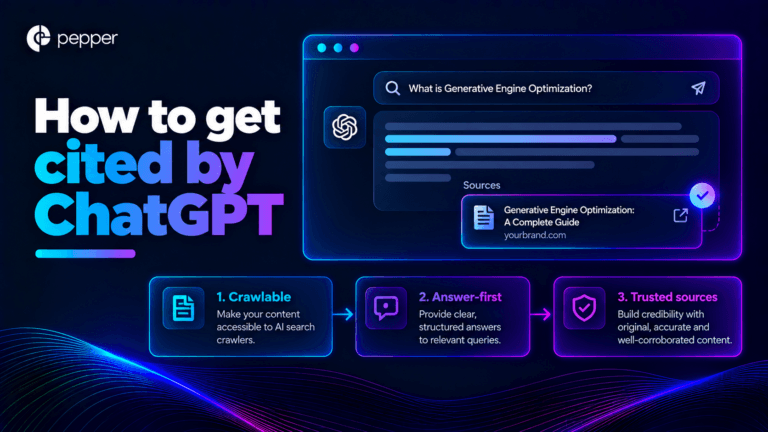
How to get cited by ChatGPT
GEO / AI Search
10 mins read
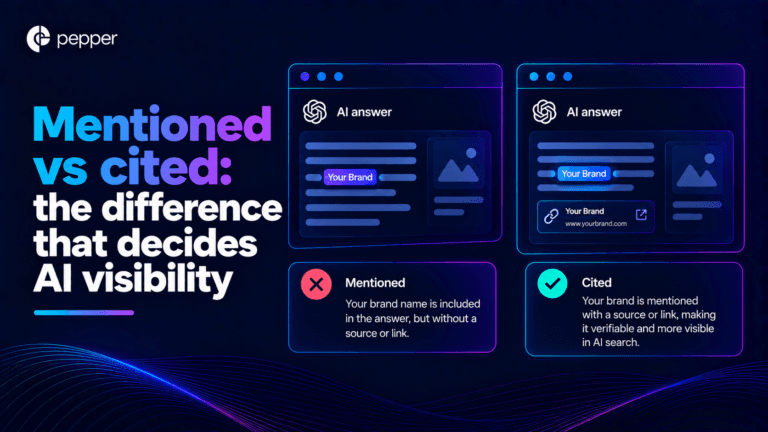
Mentioned vs cited: the difference that decides AI visibility
GEO / AI Search
13 mins read