The types of SEO in 2026, and which of them are actually types
The short answer
There is no agreed list of the types of SEO, and the disagreement is not sloppiness.
We read five published lists, including the version of this page we are replacing. Between them they name twenty different types. The counts they give range from five to fourteen. Only two terms appear on all five: on-page and off-page.
They cannot agree because they are not listing the same kind of thing. Sort the twenty terms by what kind of noun each one is and the argument mostly dissolves.
- Practices. Things a person does: on-page, off-page, technical, local, international, ecommerce, entity work.
- Surfaces. Places an answer appears: voice, video, image, AI Overviews, ChatGPT, Perplexity.
- Ethics labels. How the work is done rather than what it is: white hat, black hat, grey hat, negative.
- Coinages. A name for an existing practice aimed at a new surface: AEO, GEO, AIO, LLMO, AI SEO.
The practical version: you staff and budget for practices, you measure surfaces, and you treat coinages as vocabulary rather than as work. Ethics labels are not types of anything, they are a description of whether you are cheating.
Key takeaways
- Twenty distinct terms across five lists, and only two are on all of them. The published lists range from five types to fourteen, and one of them is ours.
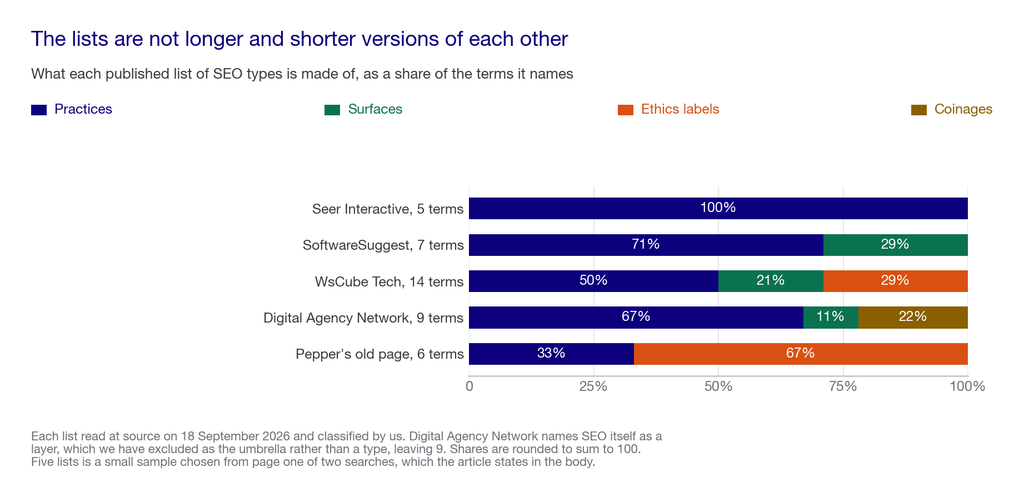
- The lists are made of different ingredients. Our old version was two practices and four ethics labels. A 2025 list was seven practices, three surfaces and four ethics labels. A 2026 list was six practices, one surface and two coinages. They are not longer or shorter versions of each other.
- AEO and GEO are coinages, not new disciplines. Google’s own guidance states that optimizing for generative AI search is still SEO. That does not make the terms useless, it makes them surface names.
- The ethics labels belong to a different era. White hat and black hat describe whether you are breaking guidelines. They were on our 2021 page as two of the four headline types, and that framing has not been useful for years.
- What changed is not the vocabulary. It is that citations from third-party sources now decide a growing share of visibility, which is the part Pepper’s agentic organic growth engine is built around.
A note on where this comes from. We run organic for more than 250 enterprises and track more than 10 million prompts across every major engine. This read is shaped by that, by the briefs we are handed in client reviews most weeks, and by what buyers ask us at the events we run. It is our opinion about a vocabulary we sell into, not a neutral glossary.
Book a growth audit if what you actually need is to find out which of these practices your site is short of.
What are the types of SEO, and why does every list differ?
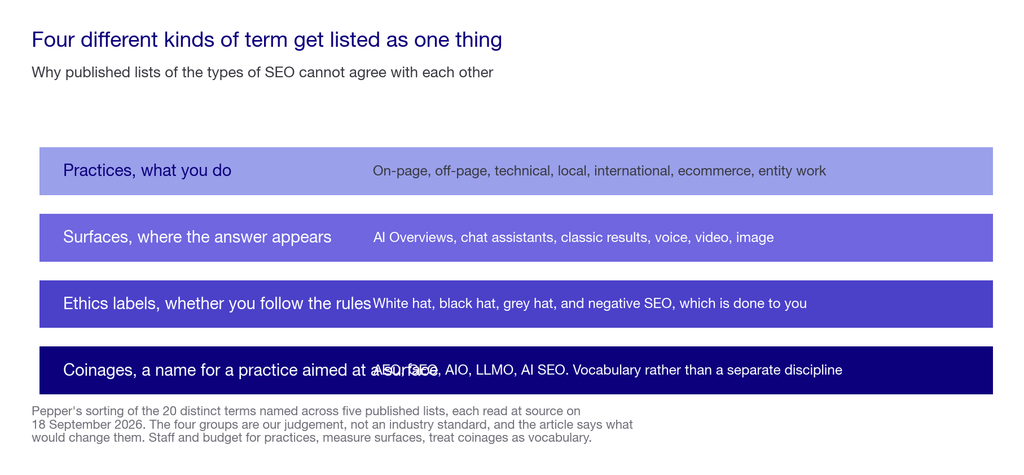
Search engine optimization is the work of making a page findable and quotable by the systems people use to find things. Everything below is a subdivision of that, but the subdivisions are cut along four different lines at once.
- Practices are cut by what the work is. On-page work changes the page. Off-page work changes what other sites say about you. Technical work changes what a crawler can reach. These are genuinely different jobs, done by different people, and they belong on a budget.
- Surfaces are cut by where the answer appears. Voice, video, image, AI Overviews and chat assistants are places, not jobs. You do not hire a voice SEO. You do the practices and then check the voice surface.
- Ethics labels are cut by whether you are following the rules. White hat, black hat and grey hat describe conduct. Negative SEO is not something you do for yourself at all, it is something done to you.
- Coinages are cut by marketing. AEO, GEO, AIO, LLMO and AI SEO name the act of doing existing practices with a new surface in mind.
None of these four cuts is wrong. A list becomes confusing when it puts one item from each cut in the same numbered sequence. That is what almost every list on this subject does, ours included until today.
If you want the four AI-era acronyms specifically, with the differences between them set out properly, AEO vs GEO vs AIO vs LLMO does that job. If you want the head-to-head on whether AEO is separate from SEO at all, AEO vs SEO covers what Google settled and what still differs. This page is the map that sits above both.
What five published lists actually name
| List | Publisher | Date read at source | Types named | Covers AI-era terms |
|---|---|---|---|---|
| Types of SEO | Seer Interactive | Published 31 August 2021 | 5 | No |
| Types of SEO | SoftwareSuggest | Published 16 February 2024, updated 17 December 2025 | 7 | No |
| All Types of SEO | WsCube Tech | Published 25 October 2025 | 14 | No |
| AEO vs SEO vs GEO | Digital Agency Network | Published 1 May 2026 | About 10 | Yes |
| The 4 Types of SEO | Pepper, the page this replaces | Published 28 December 2021 | 6 | No |
Twenty distinct terms across the five. **On-page and off-page are the only two that appear on every list.** Technical SEO appears on three. Local SEO appears on four. AEO and GEO appear on one.
The ingredients differ more than the counts do. Seer’s five are five practices and nothing else. WsCube’s fourteen are seven practices, three surfaces and four ethics labels. Digital Agency Network’s list is six practices, one surface and two coinages. Our old page was two practices and four ethics labels, which is why it reads as though it were written for a different question. It was.
Where this count falls short. Five lists is a small sample, and we chose them from page one of two searches rather than at random. A sixth list would add terms and would not change the shape. The lists that predate 2026 contain no AI-era terms at all, and the ones that postdate it often drop the classical practices instead.
The map
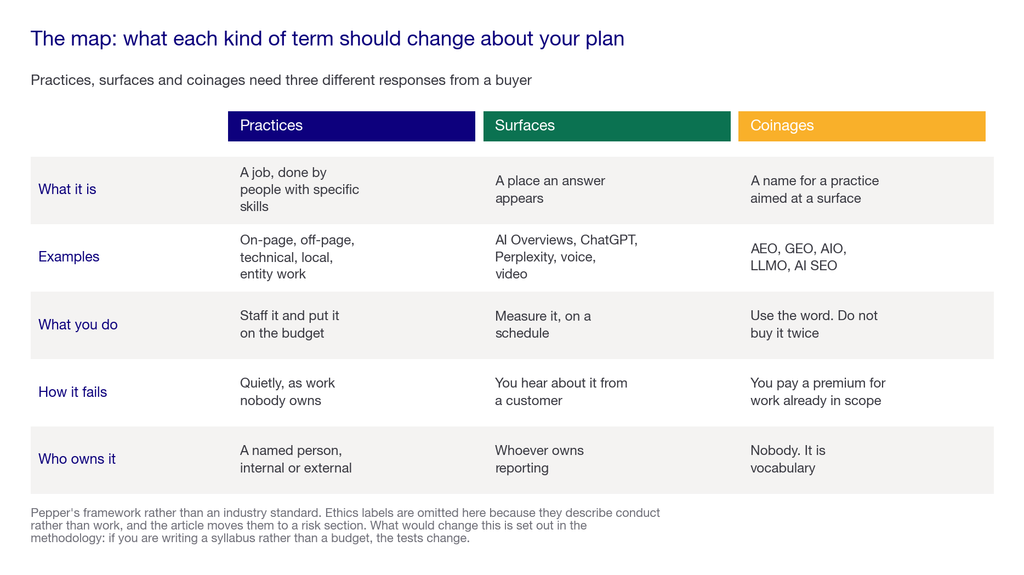
Practices: the things you staff and budget
These are genuinely distinct jobs. A team that is good at one is often weak at another, and they fail in different ways.
- On-page. What is on the page: structure, headings, internal links, schema, how quotable a passage is. Fails quietly, as pages that rank but never get cited.
- Off-page. What other sites and forums say about you: digital PR, earned mentions, reviews, citations. This is the practice that has grown most in importance and it is the one most often left out of a scope.
- Technical. What a crawler can reach and parse: rendering, speed, crawl paths, status codes, feeds. Fails loudly and blocks everything else.
- Local. Business profiles, citations, reviews and proximity signals. A separate discipline with its own tooling, not a subset of on-page.
- International. Hreflang, market-level content, local intent differences. Multiplies every other practice rather than sitting beside them.
- Ecommerce. Product and category pages at scale, feeds, faceted navigation. Mostly technical and on-page under pressure of volume.
- Entity work. Making sure the systems can tell who you are and what you do, consistently, across sources. The newest of the practices and the one that most directly serves the AI surfaces.
Surfaces: the things you measure
You do not do voice SEO. You do the practices, then look at whether you appear when somebody asks by voice.
- Classic results. Blue links and features on a results page.
- AI Overviews and AI Mode. Google’s generated answers above the results.
- Chat assistants. ChatGPT, Perplexity, Claude, Gemini, Copilot.
- Voice, video and image. For image search, image compression can also improve page performance and help images load efficiently.
The reason this distinction matters commercially: a supplier charging you a premium for a surface should be able to say which practice they are changing to reach it. If they cannot name the practice, you are paying for the surface’s name.
Ethics labels: not types at all
White hat, black hat and grey hat describe whether you are within search engine guidelines. Negative SEO is an attack carried out against you by somebody else.
These were two of the four headline types on the version of this page we are replacing, which is the clearest sign of how old that framing is. They belong in a section about risk, not in a list of disciplines, and we have moved them accordingly.
Coinages: vocabulary, not work
AEO, GEO, AIO, LLMO and AI SEO are names for doing the practices above with a specific surface in mind.
That is not a criticism. Vocabulary is useful, teams need words for what they are prioritising, and a brief that says “we are working on GEO this quarter” communicates something real. It becomes a problem only when a coinage is sold as a separate discipline with a separate price attached to the same work.
Google’s own guidance states that optimizing for generative AI search is still SEO. That is the cleanest test available: if a supplier charges a premium for a coinage, they should be able to name what changed in the delivery.
Which terms deserve a line in your budget
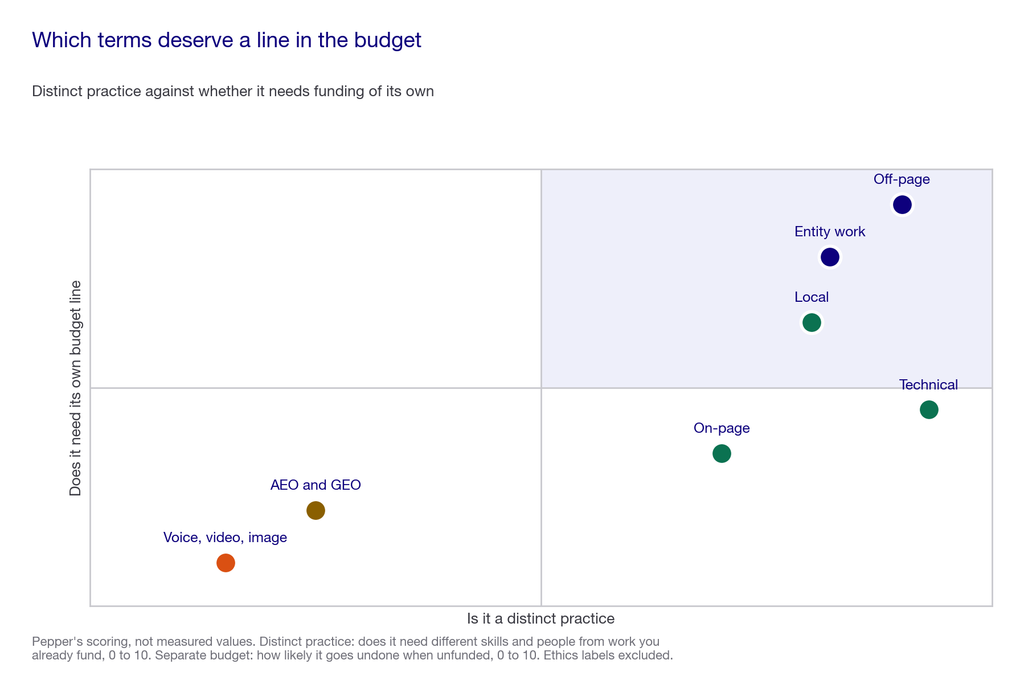
Two questions decide whether a term belongs on a plan, and neither is whether it is fashionable.
The first is whether it is a distinct practice, meaning it needs different skills and different people from the work you already fund. The second is whether it needs its own budget line, meaning it will not happen if it is left as somebody’s secondary responsibility.
- Off-page and entity work score high on both. They need different people and they never happen by accident.
- Technical scores high on distinctness and lower on separate budget, because it is usually engineering time you already pay for and need to reserve rather than buy.
- AEO and GEO score low on distinctness and low on separate budget. They are the practices above, aimed at a surface.
- Voice, video and image score lowest on both. They are measurement surfaces. Watch them, do not fund them.
Our methodology: how we sorted the twenty terms
| Criterion | Weight | Why it carries that weight |
|---|---|---|
| Does it need different people and skills | 35 | The clearest test of a genuine discipline. If the same person does it with the same skills, it is the same practice with a new label on it. |
| Is it a job or a place | 25 | A surface is somewhere an answer appears. Confusing a place with a job is the single most common error in these lists. |
| Does it have a definition independent of one vendor | 20 | A term used consistently across the industry is a term worth adopting. A term used mainly by the firm that coined it is positioning. |
| Does it fail on its own | 10 | A practice that can break independently of the others is usually a real practice with its own owner. |
| Is it about conduct rather than work | 10 | Ethics labels describe how you behave, not what you do. They belong in a risk section, not a discipline list. |
Weights sum to 100. Skills and the job-versus-place test carry 60 between them, which is our judgement rather than a fact, and it is the judgement this page rests on. We publish our weightings the same way we publish [how we rank GEO agencies](https://www.pepper.inc/blog/geo-agency-ranking-methodology/), so you can argue with them precisely.
What would change these weights. If you are writing a syllabus rather than a budget, the independent-definition test matters more and the budget test matters not at all. If you are a one-person team, everything collapses into a single practice and the map is mostly useful for knowing what you are not doing.
The types of search optimisation at a glance
| Term | What kind of thing | Needs its own budget | What it actually costs you to ignore |
|---|---|---|---|
| On-page | Practice | Usually inside content cost | Pages that rank and are never quoted |
| Off-page | Practice | Yes, and it is the largest line | Engines cite competitors because third parties talk about them |
| Technical | Practice | Reserved engineering time | Everything else stops working |
| Local | Practice | Yes, if you have locations | Invisible in the queries closest to purchase |
| International | Practice | Yes, per market | Duplicate and competing pages across markets |
| Ecommerce | Practice | Inside technical and content | Category pages that cannot be crawled or compared |
| Entity work | Practice | Yes, and it is newly important | Engines cannot tell who you are or what you sell |
| AI Overviews, chat assistants | Surface | No, measure it | You find out from a customer rather than a dashboard |
| Voice, video, image | Surface | No, measure it | Rarely material on its own |
| White, black, grey hat | Ethics label | No, it is a policy | A penalty, which is a different conversation |
| AEO, GEO, AIO, LLMO, AI SEO | Coinage | No, it is vocabulary | Paying twice for work you already fund |
## What a full programme costs to run
This page is a map rather than a price list. The honest answer is that the practices carry the cost, while the coinages carry the markup.
- Off-page and earned media is the largest single line, and the most frequently quoted separately. Stackmatix sells AI search services and publishes its rates. Reddit and Quora seeding runs $500 to $2,000 a month, and backlink building $500 to $5,000, on top of a retainer it prices at $3,000 to $15,000.
- Technical is usually engineering time you already pay for, which is why it gets skipped. It needs reserving, not buying.
- Entity work is cheap to start and slow to finish. It is mostly consistency across sources, which costs coordination rather than money.
- A coinage should not add a line. If a quote for GEO is higher than the same supplier’s SEO quote, ask which practice changed.
For real figures rather than shapes, our generative engine optimization cost benchmarks collects 30 published prices. Below a retainer, GEO agency pricing at the budget end covers what exists.
Where Pepper fits
Pepper sells the practices, not the coinages, and we think the distinction is the whole point of this page.
We are an agentic organic growth engine, and that means three things working together.
- An organic growth partner. A growth team is attached to your account, a senior strategist plus always-on agents, accountable for the number rather than for a list of deliverables.
- Pepper’s GEO platform. Genuinely self-serve and included rather than billed as a separate licence. You log in and set up a workspace. Define your brand profile, competitors and personas, connect GA4 and Search Console, then manage your own themes, prompts and analytics across six engines including ChatGPT, Perplexity, Gemini, Claude and Google AI Overviews.
- The Agent Atlas. Your team builds, versions and runs its own agents, and keeps them.
The measurement follows the same logic. Brand Visibility is how often engines mention you by name. Domain Prompt Presence is how often they cite a page from your domain. The gap between them separates an awareness problem from a citability problem, which are two different practices with two different fixes. For what that produces, the Acceldata case study records 6X organic traffic and top-three keywords rising from 85 to more than 300.
Where it falls short: we do not publish pricing, so you cannot compare us on a page the way this article recommends you compare suppliers. We are built for teams running organic as a long-term function, so a one-off technical audit is not what we are for. Our depth sits in content, authority and AI search rather than large technical migrations or local at scale. If local is your main practice, a specialist will serve you better than we will.
How to choose which types to invest in
I will write this in the first person, because a recommendation nobody will defend is worth nothing.
Start by refusing the list. The question “which types of SEO should we do” has no answer, because the list mixes jobs, places, conduct and vocabulary. The answerable question is narrower: which practice is your programme short of, and which surface is telling you so. Those two have answers, and you can get them this week for nothing.
So my order is: find the failing practice, fund it, then watch the surface that exposed it. Here is the scorecard I would use on any proposed line of work, on a 100 point scale.
| Area | Weight | What a line of work has to demonstrate |
|---|---|---|
| It is a practice, not a surface or a label | 30 | Somebody does something differently as a result. If the output is a report about a surface, it is measurement and belongs in tooling. |
| You are currently short of it | 25 | Evidence from your own diagnostic that this is the constraint, rather than the thing you are most comfortable buying. |
| It has a named owner | 20 | One person accountable, internal or external. Practices without owners become everybody’s secondary priority and nobody’s job. |
| It can be measured on a surface you care about | 15 | A way to tell whether it worked, on a surface your buyers actually use, within a quarter. |
| It is not already funded under another name | 10 | The coinage trap. Check the quote against what your current supplier already does before adding a line. |
Five questions I would ask before funding any of these, in this order.
- “Which of the seven practices does this change?” A stronger answer names one or two. A weaker one names a surface, or names the coinage back to you.
- “Who does it, and is that a different person from who does our content?” If it is the same person with the same skills, it is not a new discipline. It should not carry a new price either.
- “What breaks if we do not do it?” Technical failures break everything. A missing surface usually breaks nothing measurable for a quarter.
- “Is this already inside our current scope?” The single most common waste at this layer is paying twice for off-page work under two names.
- “How will we know in 90 days?” Name the surface and the measure before the work starts, not after.
Red flags, each one something a supplier actually says. “You need a separate GEO retainer”, offered without naming which practice changes. “AI readiness” with no measurement attached. A list of twelve types of SEO in a proposal, which is a scoping document written to look comprehensive. A price for a coinage that is higher than the same firm’s price for the identical practice under its old name. And any guarantee of citations, which nobody can promise.
Before funding anything, run the diagnostic yourself. Write 25 real commercial questions your buyers would type. Run each of those 25 prompts three times across every surface you care about, because engines are probabilistic and one run is an anecdote. Then give any fix 90 days before you judge it. Four worked examples for a mid-market B2B software company:
- “best data observability platform for enterprise”
- “how do I monitor data quality across Snowflake and Databricks”
- “what should I look for in a data observability vendor”
- “who competes with Monte Carlo in data observability”
Read which sources the engines cited. If they are review sites, forums and press rather than vendor sites, your constraint is off-page, and no amount of on-page work will move it. Checking whether your brand appears in AI search walks through it properly, and the Visibility, Citability and Retrievability framework is the model underneath.
And the answer that loses Pepper the sale: if your diagnostic says technical, you do not need us and you do not need a GEO supplier. You need engineering time and a technical SEO, and buying content or citations before the crawler can reach your pages is money set on fire. We would rather tell you that than take the brief.
It comes down to one principle: fund practices, measure surfaces, and never buy a coinage. Every confused budget we have inherited failed that test somewhere, ours included in the years when we described this work the way the old version of this page did.
What nobody should promise you
- A definitive list of the types of SEO. There is no governing body. Any list, including this one, is an argument about how to cut the work.
- That a coinage is a new discipline. Google’s own guidance says optimizing for generative AI search is still SEO. Ask which practice changed.
- A guaranteed citation or position in an AI answer. Engines are probabilistic and nobody controls their ranking systems.
- Results from one surface or one run. Three runs across the surfaces you care about is the floor before you read anything into it.
- That white hat and black hat still describe your choices. They describe whether you are within guidelines, which is a compliance question rather than a strategy.
Frequently asked questions
What are the main types of SEO?
On-page, off-page and technical appear on almost every credible list, with local close behind. Beyond those four, published lists diverge sharply. We counted twenty distinct terms across five lists, and only on-page and off-page appeared on all of them.
What is the difference between SEO, AEO and GEO?
SEO is the discipline. AEO and GEO are names for doing that discipline with a specific surface in mind, answer engines and generative engines respectively. Google’s own guidance states that optimizing for generative AI search is still SEO.
How many types of SEO are there?
There is no agreed number. The five lists we read at source named five, six, seven, ten and fourteen. The disagreement comes from mixing practices, surfaces, ethics labels and coinages in one sequence rather than from anyone being wrong.
Is AI SEO a real type of SEO?
It is a useful phrase and not a separate discipline. It describes doing on-page, off-page, technical and entity work with AI surfaces in mind. Treat it as vocabulary for a priority, and be wary of paying a premium for the label.
What are white hat, black hat and grey hat SEO?
They describe conduct rather than work. White hat follows search engine guidelines, black hat breaks them, grey hat sits between. They are risk categories rather than disciplines, which is why they no longer belong in a list of types.
Which type of SEO is most important in 2026?
Off-page, on the evidence we see. Engines cite third-party sources far more often than brand-owned ones, so what other sites say about you increasingly decides whether you appear. Technical still outranks it whenever the technical layer is actually broken.
Do I need separate suppliers for SEO, AEO and GEO?
Almost never. They are the same practices aimed at different surfaces, so separate retainers usually mean paying twice for off-page and content work. Ask any supplier quoting separately which practice differs between the two lines.
What is entity SEO and where does it fit?
It is the practice of making your identity consistent and machine-readable across sources, so systems can tell who you are and what you sell. It is the newest genuine practice on this page and the one that most directly serves AI surfaces.
Where to go next
For the four AI-era acronyms specifically, the alphabet soup explained sets out the differences properly. For the head-to-head on whether answer engine work is separate from SEO at all, what Google settled between answer engines and search is the page. For the definition of the generative side, what GEO is is the short version.
Once you know which practice you are short of, the best AEO platforms compared covers the software. For the people, the AEO agencies more than one list agrees on does the same job.
Sources and further reading
The five lists counted in Figure 2, each read at source on 18 September 2026 and deliberately not hyperlinked, per our policy of not linking competitors:
- Seer Interactive, “Types of SEO”, published 31 August 2021. Five types: on-page, off-page, local, international, technical. No AI-era terms. Generative engine optimization appears in the site navigation as a service, not in the article.
- SoftwareSuggest, “The Most Important Types of SEO”, Rohit Rajpal, published 16 February 2024 and updated 17 December 2025. Seven types: on-page, off-page, local, mobile, international, video, voice. No AI-era terms.
- WsCube Tech, “All Types of SEO”, Ashima Jain, published 25 October 2025. Fourteen types: on-page, off-page, technical, local, ecommerce, mobile, international, image, voice, video, negative, white hat, black hat, grey hat. No AI-era terms.
- Digital Agency Network, “AEO vs SEO vs GEO”, Cansu Ekren, published 1 May 2026. Names SEO, AEO and GEO as three layers plus roughly ten sub-disciplines including on-page, technical, local, voice search, entity optimization, keyword research and backlink acquisition. States no total.
- Pepper, “The 4 Types of SEO”, published 28 December 2021 under a team byline, the page this replaces. Six terms: white hat, black hat, grey hat, negative, on-page, off-page. No AI-era terms, no named author, no sources.
Competitor pricing quoted in the costs section, read at source on 17 September 2026 and not hyperlinked:
- Stackmatix, “AEO Optimization Cost”, Matt Pru, published 11 March 2026. Monthly retainer $3,000 to $15,000. Reddit and Quora seeding $500 to $2,000 a month and backlink building $500 to $5,000 a month, listed as separate costs.
Research sources, checked at the original on 18 September 2026:
- Google Search Central, “Optimizing your website for generative AI features on Google Search”, announced 15 May 2026, last updated 10 July 2026. The position that optimizing for generative AI search is still SEO, which is the basis for treating AEO and GEO as surface names rather than disciplines.
Further reading on Pepper, each checked live on 18 September 2026:
- The four AI-era acronyms compared, in detail.
- Answer engine work against search work, the head-to-head and what Google settled.
- What GEO is, the short definition.
- Generative engine optimization cost benchmarks, 30 published prices.
A note on scope and on corrections. This page is the map above our two comparison pages. It does not repeat the four-acronym comparison or the AEO against SEO head-to-head, both of which are linked. Three things from the previous version have been removed rather than updated. The framing of white hat, black hat and grey hat as headline types. The team byline. And the omission of every AI-era surface. The sample of five lists is small and chosen from page one of two searches, which is stated in the body rather than only here.
Latest Blogs
Most advice on this is inference dressed as fact. OpenAI documents exactly one thing clearly, which is access. Here is what is documented, what is inferred, and how to verify the rest for yourself.
Being named in an AI answer and having your page used as its source are different outcomes with different causes and different fixes. The gap between them is the most useful diagnostic in AI search, and most reporting collapses it into one number.
Every platform reports share of voice and almost none of them define it the same way. Here is the definition worth using, the three choices that change the number, and how to measure it yourself without buying anything.
Get your hands on the latest news!

Similar Posts
GEO / AI Search
10 mins read
How to get cited by ChatGPT
GEO / AI Search
10 mins read
Mentioned vs cited: the difference that decides AI visibility
GEO / AI Search
13 mins read