GEO agency pricing at the budget end: what a small budget actually buys
The short answer
We went looking for an affordable GEO agency and could not verify that one exists.
GEO agency pricing starts higher than almost every published guide implies. The cheapest genuine monthly retainer we could verify on a supplier’s own pricing page sits at $3,000. Below that you are not buying an agency. You are buying software, freelance hours, a one-off project, or your own weekends, and each of those is a different purchase with a different failure mode.
That is not a reason to give up. Three of the four cheap options are genuinely useful. The free diagnostic at the end of this page costs nothing, and it will tell you whether you need to spend at all. It is a reason to stop comparing a $500 package against a $6,500 retainer as though they are the same product at different prices.
Key takeaways
- The affordable agency on our previous version was not affordable. AnswerManiac’s published tiers are a $2,997 one-time sprint, then $6,500, $9,997 and $14,997 a month. The $497 figure we published does not appear anywhere on its pricing page.
- $3,000 a month is the floor for a real retainer, from the only two guides we could verify at source. Stackmatix publishes retainers from $3,000. Digital Elevator publishes mid-market from $2,000 and its own managed service from $3,500.
- A cheap retainer buys hours, and not many. At the $100 to $250 an hour that Stackmatix publishes for consultation, $500 a month is two to five hours of somebody’s attention.
- The free tier is real and worth using. AthenaHQ gives five engines free, HubSpot gives 25 prompts free across three, and Otterly starts at $29. You can size your own problem this week without spending anything.
- Earned media is the line that decides the outcome, and it is priced separately almost everywhere. Stackmatix lists Reddit and Quora seeding at $500 to $2,000 a month and backlink building at $500 to $5,000 a month, on top of the retainer.
A note on where this comes from. We run organic for more than 250 enterprises and track more than 10 million prompts across every major engine. This read is shaped by that, by the budget conversations we have in client reviews most weeks, and by the buyers we talk to at the events we run. It is our opinion about a market we sell into, not a neutral directory.
Book a growth audit if you want your own category sized before you decide what to spend. Or use the free sequence at the end of this page and spend nothing.
The correction: the affordable pick was not affordable
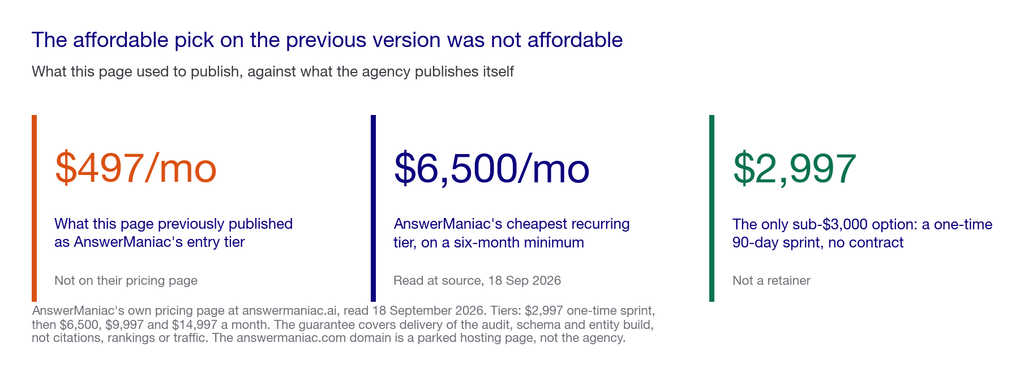
The version of this page you are reading replaced a list whose headline recommendation was AnswerManiac, presented as the affordable option at $497 a month.
Here is what AnswerManiac publishes on its own pricing page, read on 18 September 2026.
| Tier | Price | Contract | What is included |
|---|---|---|---|
| 90-Day AI Visibility Sprint | $2,997 one-time | None | Full AI visibility audit, entity and schema setup, AI-readiness build |
| Growth Engine | $6,500 a month | 6-month minimum | Citation asset creation, competitor displacement, authority signals, strategy calls |
| Monopoly | $9,997 a month | 6-month minimum plus a 90-day proof gate | Citation production, authority building, reputation monitoring, dedicated manager |
| Dominance | $14,997 a month | 6-month minimum plus a 90-day proof gate | Multi-market strategy, dedicated team, competitive displacement, custom reporting |
Two further things the site says that our previous version did not.
The guarantee covers delivery, not results: the audit, the schema and the entity build are guaranteed to be delivered, and citations, rankings and traffic explicitly are not. And **the number of engines tracked and the content volume are not published at any tier.**
We have no criticism of the pricing. A $2,997 fixed-scope sprint with no contract is a reasonable product, and the honesty about what the guarantee does not cover is better than most of this category manages. The criticism is of our own page, which published a number that is not on their site and built a recommendation on it.
One more thing worth knowing if you go looking. The agency is at answermaniac.ai. The .com is a parked hosting page, and we spent ten minutes reading it before realising it was not them.
What is GEO agency pricing actually made of?
Generative engine optimization is the work of getting your brand named and cited in AI-generated answers. When an agency prices it, four things sit inside the number, and only the first is always included.
- Measurement. Tracking where you appear across ChatGPT, Perplexity, Gemini, Google AI Overviews and Copilot, and which prompts you lose. This is the cheapest part and the part you can do yourself.
- Content and entity work. Producing or rewriting pages so engines can read, attribute and quote you, plus schema and internal structure.
- Technical readability. Making sure crawlers can reach and parse the pages at all.
- Earned media and citations. Getting your brand into the third-party sources engines quote. This is the expensive part, the part that moves citations most, and the part most often priced separately. It is also the part Pepper weights heaviest, in this page’s methodology and in how we scope an account.
Stackmatix sells AI search services and publishes a pricing guide. It lists Reddit and Quora seeding at $500 to $2,000 a month, and backlink building at $500 to $5,000 a month, as separate lines to watch for. Read alongside its $3,000 to $15,000 retainer range, that means the advertised retainer can be half the real number.
Google’s own guidance states that optimizing for generative AI search is still SEO. Applied to a quote, that means a supplier charging a GEO premium over their old SEO rate should be able to name what changed in the delivery. If they cannot, you are paying for the acronym.
For the full benchmark set rather than the budget end, our generative engine optimization cost benchmarks collects 30 published prices. That is the better page if you want figures across the whole market. For what a proper engagement contains, what GEO services include covers the deliverables.
What each budget actually buys, in hours
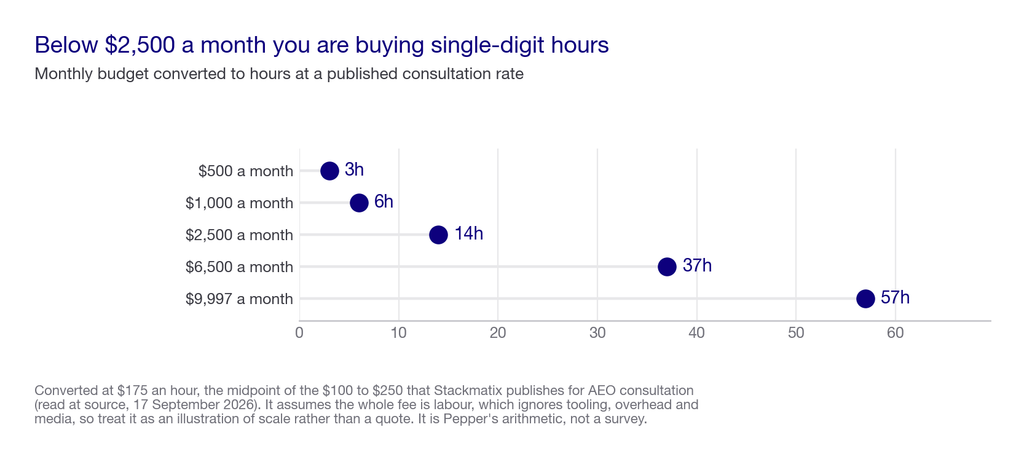
The clearest way to see why the cheap end is thin is to convert the money into time.
Stackmatix publishes hourly AEO consultation at $100 to $250 an hour. That is the only hourly range we could verify on a supplier’s own site. Taking the $175 midpoint, and assuming the whole retainer is labour, which is generous to the cheap tiers because it ignores tooling and media:
- $500 a month buys roughly three hours. That is a call and a document.
- $1,000 a month buys roughly six hours. That is a call, a document and one page rewritten.
- $2,500 a month buys roughly fourteen hours, which is the first point at which a repeatable monthly process is possible.
- $6,500 a month buys roughly thirty-seven hours, about a week of one person.
- $9,997 a month buys roughly fifty-seven hours, which is where a team rather than an individual becomes plausible.
The assumption is doing work here and you should treat it as an illustration. A real agency has a blended cost lower than its consultation rate, so the hours at each band are probably somewhat higher. It also has tooling, overhead and often media spend inside the number, which pushes them lower. The point survives either way: below about $2,500 a month you are buying attention in single-digit hours, and nobody rebuilds a citation profile in three hours.
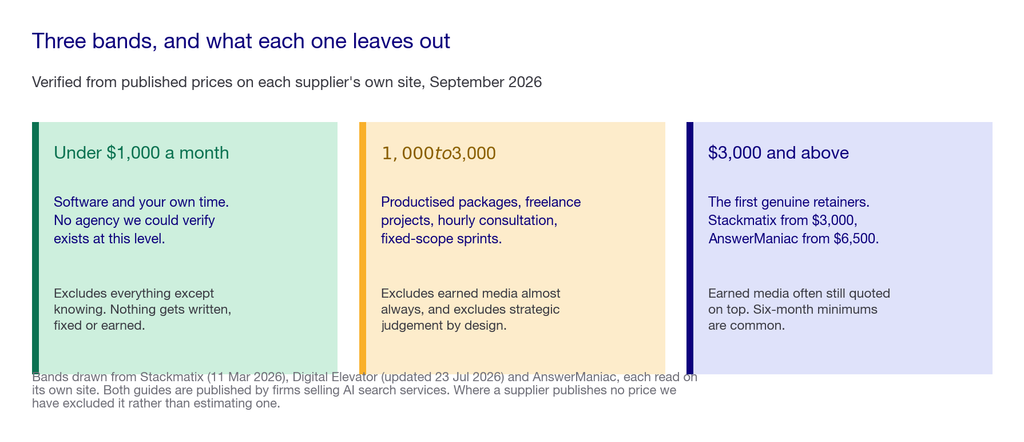
The three real bands, and what each one excludes
Under $1,000 a month: tools and your own time
There is no agency here that we could verify, Pepper included. What exists is software, and a surprising amount of it is free or nearly free.
- AthenaHQ Essential. Free, with a $25 credit, tracking five models: ChatGPT, Perplexity, Google AI Overviews, Gemini and Copilot.
- HubSpot AEO. 25 prompts free across ChatGPT, Gemini and Perplexity, no card required. Then $50 a month, or $45 billed annually.
- AirOps Solo. Free, ChatGPT insights only.
- Profound. A free trial covering ChatGPT only, ten prompts run once.
- Otterly Lite. $29 a month for 15 prompts across four engines. Claude, Google AI Mode and Gemini are paid add-ons at $29, $9 and $9, so full coverage is about $76.
- Semrush AI Visibility Toolkit. $99 a month for 25 prompts tracked daily across four engines.
- AthenaHQ Starter. $295 a month for 11 models, which is the widest engine coverage at a published price anywhere in this category.
What this band excludes: everything except knowing. No content gets written, no page gets fixed, no citation gets earned. You are buying a diagnosis and doing the treatment yourself.
$1,000 to $3,000 a month: productised packages and project work
This is where services start, and where the labels get slippery.
- Productised retainers. Digital Elevator publishes a productised tier at $500 to $2,500 a month. Fixed scope, fixed deliverables, little judgement included.
- Freelance project work. Digital Elevator publishes freelance at $150 to $2,000 per project, which is a real option for a one-off fix such as schema or a site audit.
- Hourly consultation. Stackmatix publishes $100 to $250 an hour, which suits a specific question rather than an ongoing programme.
- Fixed-scope sprints. AnswerManiac’s $2,997 one-time 90-day sprint sits at the top of this band and has no contract attached.
What this band excludes: earned media, almost always. At these prices nobody is doing digital PR, and digital PR is the lever. It also excludes strategic judgement, because a productised package is productised precisely by removing it.
$3,000 a month and above: the first real retainers
- Stackmatix publishes monthly retainers at $3,000 to $15,000 and project work at $5,000 to $15,000.
- Digital Elevator publishes mid-market at $2,000 to $8,000 and enterprise at $10,000 to $30,000 and above. Its own managed service starts at $3,500 a month, with AI Visibility from $3,000.
- AnswerManiac publishes $6,500 as its first recurring tier, on a six-month minimum.
What this band excludes: less, but still something. Earned media is frequently quoted on top even here, contracts often run six months or longer, and the engines and content volumes covered are usually not published. Ask for all three in writing.
GEO agency pricing at a glance
| Band | What you are buying | Verified examples | Earned media included | Best for |
|---|---|---|---|---|
| Free | Measurement only | AthenaHQ Essential, HubSpot 25 prompts, AirOps Solo, Profound trial | No | Finding out whether you have a problem |
| $29 to $300 a month | Better measurement | Otterly $29, Semrush $99, AthenaHQ Starter $295, Scrunch Starter $300 | No | A team that can act on data itself |
| $500 to $2,500 a month | Productised delivery | Digital Elevator productised tier | Almost never | Fixed, known, repeatable tasks |
| $150 to $2,000 per project | A one-off fix | Digital Elevator freelance range | No | Schema, an audit, a migration |
| $2,997 one-time | A fixed-scope sprint | AnswerManiac 90-day sprint | Partly, as citation assets | A defined start with no contract |
| $3,000 a month and up | A real retainer | Stackmatix $3,000 to $15,000, Digital Elevator from $3,500, AnswerManiac $6,500 | Sometimes, ask | An ongoing programme |
| Pepper | Growth team plus platform | Not published | Yes, core to the model | Organic as a long-term function |
The free sequence, which costs nothing
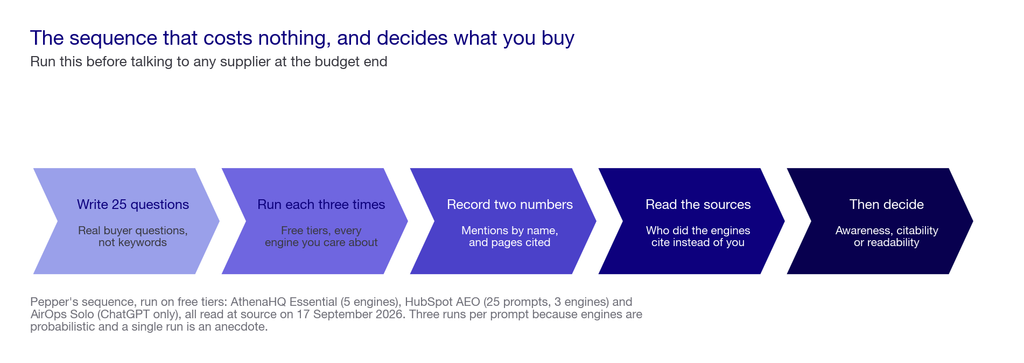
If your budget is genuinely small, do this before you talk to anyone. It takes an afternoon and a fortnight of patience.
- Write 25 real commercial questions your buyers would type. Not keywords. Questions, in their words.
- Run each one three times across every engine you care about, using a free tier. Once is an anecdote, because engines are probabilistic.
- Record two numbers. How often you are mentioned by name, and how often a page from your domain is cited. The gap between those two is the diagnosis.
- Read which sources the engines did cite. If they are review sites, forums and press rather than vendor sites, your problem is earned media and no amount of on-site content will fix it.
- Decide what to buy, now that you know which of the three problems you have.
Pepper runs a version of that same sequence at the start of every engagement, and it is deliberately reproducible without us. It tells you whether engines do not know you, know you but cite somebody else, or cannot read your site. Those three have completely different fixes and completely different suppliers, and buying before you know which one you have is how small budgets get wasted. Checking whether your brand appears in AI search walks through it in more detail, and the Visibility, Citability and Retrievability framework is the model underneath it.
Our methodology: how we sorted the bands
| Criterion | Weight | Why it carries that weight |
|---|---|---|
| Published on the supplier’s own page | 35 | A price we could read at source on a dated visit. Everything else is somebody’s estimate, including the estimate this page previously published. |
| Whether earned media is in scope | 25 | The largest lever on citations and the most commonly excluded line. A band that never includes it is capped in what it can achieve. |
| What the money buys in hours | 20 | Converting the fee to time exposes which bands can support a repeatable process and which buy a document. |
| Contract and exit terms | 10 | Minimum terms, proof gates and notice periods decide what a wrong choice costs you. |
| Engine and volume disclosure | 10 | Whether you can tell what you are getting before you sign, rather than after. |
Weights sum to 100. Published pricing and earned media carry 60 between them. That is Pepper’s judgement rather than a fact, and it is the judgement this page rests on. We publish our weightings the same way we publish [how we rank GEO agencies](https://www.pepper.inc/blog/geo-agency-ranking-methodology/), so you can argue with them precisely.
What would change these weights. If you already have earned media in-house, that 25 moves into hours and contract terms. If you are buying a one-off fix rather than a programme, contract terms stop mattering almost entirely.
Where Pepper fits, and where it does not
Pepper is not in the budget bands above, and we are not going to pretend otherwise.
We are an agentic organic growth engine, and that means three things working together.
- An organic growth partner. A senior strategist and always-on agents are attached to your account. They do the work alongside your team and they are on the hook for the number, rather than handing you a report to act on.
- Pepper’s GEO platform. Genuinely self-serve and included rather than billed as a separate licence. You log in and set up a workspace. Define your brand profile, competitors and personas, connect GA4 and Search Console, then manage your own themes, prompts and GEO analytics across six engines including ChatGPT, Perplexity, Gemini, Claude and Google AI Overviews.
- The Agent Atlas. Your team builds, versions and runs its own agents on a visual canvas, and keeps them.
The measurement is Pepper-native. Brand Visibility is how often engines mention you by name. Domain Prompt Presence is how often they cite a page from your domain. The gap between those two is the diagnostic in step three above, and it separates an awareness problem from a citability problem. For what the combination produces, the Acceldata case study records 6X organic traffic and top-three keywords rising from 85 to more than 300.
Where it falls short: we do not publish pricing. So on the criterion this page weights highest we score worse than Stackmatix, Digital Elevator and AnswerManiac, all of which publish figures we could read. We are built for teams running organic as a long-term function, so a one-off audit or a single-quarter spike is not what we are for. And on the specific question this page asks, we are not the affordable option and we will not pretend to be. If your budget is under $3,000 a month, the free sequence above plus a $29 tracker will serve you better than a conversation with us.
How to choose what to spend
I will write this in the first person, because a recommendation nobody will defend is worth nothing.
Start by refusing to shop before you have diagnosed. This is the order Pepper uses when we scope an account, and it is the order we would use if we were spending our own money at this level. The single most expensive mistake at the budget end is buying content when the problem is citations. The second is buying a tracker when you already know the answer and cannot act on it. Run the free sequence first. It costs an afternoon and it changes what you buy.
Then decide the shape before the number. A one-off schema fix, a three-month sprint and an ongoing retainer are different products. Comparing their prices against each other is how the published ranges in this category came to look so chaotic. Here is the scorecard I would use, on a 100 point scale.
| Area | Weight | What a strong offer demonstrates |
|---|---|---|
| A price you can read before contact | 30 | A published figure or range on their own site, with what changes between tiers stated in writing. |
| Earned media named and costed | 25 | Either in scope with a number attached, or explicitly out of scope. Silence here is the most expensive ambiguity in the category. |
| Hours or output you can count | 20 | A stated number of deliverables, hours, or pages per month. A retainer with no countable output is a subscription to optimism. |
| An exit that does not punish you | 15 | Notice periods, what you keep, and whether prompt sets and content are portable. Six-month minimums are common here. |
| Engines and volumes disclosed | 10 | Which engines are tracked and how much content is produced, before you sign rather than after. |
Five questions I would ask any supplier at this end of the market, in this order.
- “Is this price on your website, and can you send me the link?” A stronger supplier says yes in one line. A weaker one explains why pricing is bespoke for a $500 package, which it is not.
- “Is earned media included, and at what figure?” If the answer is no, the price is not comparable to one that includes it. The ceiling on what you can achieve is lower too.
- “How many hours or deliverables does this buy in a month?” Hold the answer against the arithmetic in Figure 2. If it sounds generous against the hourly rates published in this category, ask who is doing the work.
- “What is the minimum term, and what happens at the end of it?” AnswerManiac publishes a six-month minimum with a 90-day proof gate. That is clearer than most. Get yours in writing.
- “Which engines do you track, and how often do you re-run a prompt?” One run a month is an anecdote. If they cannot answer, the reporting is not stable enough to act on.
Red flags, each one something a supplier actually says at this end of the market. “We guarantee citations in ChatGPT”, which nobody can promise. “AI readiness” with no measurement attached, which is a workshop sold as a programme. A monthly price with no countable output. An annual lock-in offered before anyone has looked at your site. And a published figure on a roundup that is not on the supplier’s own site, which is the specific error the previous version of this page made, ours included.
Before you brief anyone, run the live test yourself. Write 25 real commercial questions your buyers would type. Run each of those 25 prompts three times across every engine you care about. Then give any fix 90 days before you judge it. Four worked examples, for a mid-market B2B software company:
- “best data observability platform for enterprise”
- “how do I monitor data quality across Snowflake and Databricks”
- “what should I look for in a data observability vendor”
- “who competes with Monte Carlo in data observability”
If the engines name a competitor on all four, you have a citability problem rather than a content problem, and that changes the supplier you want.
And the answer that loses Pepper the sale: if your budget is under $3,000 a month, you do not need an agency and you certainly do not need us. Take the free tier, run the sequence, and fix the two or three things it surfaces. Come back in two quarters, when you have evidence that the work is worth funding properly. We would rather tell you that than take a retainer that cannot succeed.
It comes down to one principle: at the budget end, buy the diagnosis before the delivery. The diagnosis is nearly free, it is the part that decides everything else, and it is the only purchase at this level that cannot be wasted.
What nobody should promise you
- A guaranteed citation or position in an AI answer. Engines are probabilistic and nobody controls their ranking systems. AnswerManiac says this plainly on its own site, and more suppliers should.
- Meaningful results on a few hundred dollars a month. At published rates that is a handful of hours, and citation profiles are not rebuilt in a handful of hours.
- A single number that captures AI visibility. The useful diagnosis lives in the gap between two numbers, not in one composite.
- A published price from a third-party roundup. Check it on the supplier’s own site. Ours was wrong by a factor of thirteen.
- Clean attribution from a citation to closed revenue. Nobody has this yet, including us.
Frequently asked questions
How much does a GEO agency cost?
The cheapest genuine monthly retainer we could verify on a supplier’s own pricing page is $3,000, from Stackmatix. Digital Elevator publishes mid-market from $2,000 and its own managed service from $3,500. AnswerManiac’s first recurring tier is $6,500 a month.
Is there an affordable GEO agency?
We could not verify one. Below roughly $3,000 a month, what exists is software, freelance project work, hourly consultation and productised packages. Those are useful purchases, but they are not agencies and they should not be priced against one.
What is the cheapest way to start with GEO?
Free. AthenaHQ’s Essential tier tracks five engines at no cost, HubSpot gives 25 free prompts across three, and AirOps Solo is free on ChatGPT. Run 25 real buyer questions three times each and read which sources the engines actually cite.
What does a $500 a month GEO package include?
At the $100 to $250 an hour that Stackmatix publishes, roughly two to five hours of work. Realistically that is reporting plus one small task. It will not include earned media, which is the largest single lever on whether engines cite you.
Why do published GEO prices vary so much?
Because guides compare different shapes: a project fee against a monthly retainer against an hourly rate. They also repeat figures that are not on the supplier’s site. The previous version of this page quoted $497 for an agency whose cheapest recurring tier is $6,500.
Should I hire a freelancer instead of an agency?
For a bounded fix, often yes. Digital Elevator publishes freelance project work at $150 to $2,000, which suits schema, an audit or a migration. For ongoing citation building across engines, a single freelancer will run out of capacity quickly.
Is GEO just SEO with a new name?
Largely, and Google says so. Its own guidance states that optimizing for generative AI search is still SEO. That matters for pricing, because a supplier charging a GEO premium over their old SEO rate should be able to name what changed in their delivery.
How long before a small GEO budget shows anything?
Give any change 90 days and establish a baseline first by running your prompt set at least three times per engine. At small budgets the honest expectation is a few specific fixes landing, not a visible shift in how often engines name you.
Where to go next
For the full benchmark set across the whole market rather than the budget end, our generative engine optimization cost benchmarks collects 30 published prices. If you are choosing between buying software and buying help, the agency against tool decision sits underneath this page.
If you have decided you do want an agency, the AEO agencies more than one list agrees on covers who is in the market. For the software side, the best AEO platforms compared does the same job.
Sources and further reading
Supplier pricing, each read on that company’s own site and deliberately not hyperlinked, per our policy of not linking competitors:
- AnswerManiac pricing page, read 18 September 2026, at answermaniac.ai. 90-Day AI Visibility Sprint $2,997 one-time with no contract. Growth Engine $6,500 a month, six-month minimum. Monopoly $9,997 a month, six-month minimum plus a 90-day proof gate. Dominance $14,997 a month. The guarantee covers delivery of the audit, schema and entity build, and explicitly not citations, rankings or traffic. Engines tracked and content volume are not published at any tier. The answermaniac.com domain is a parked hosting page and is not the agency.
- Stackmatix, “AEO Optimization Cost”, Matt Pru, published 11 March 2026, read 17 September 2026. Monthly retainer $3,000 to $15,000, project $5,000 to $15,000, hourly consultation $100 to $250, tool subscriptions free to $2,000 and above. Reddit and Quora seeding $500 to $2,000 a month and backlink building $500 to $5,000 a month listed as separate costs. Stackmatix sells AI search services and does not publish its own pricing.
- Digital Elevator, “AEO and GEO Pricing Guide”, Kenneth Faveron, last updated 23 July 2026, read 17 September 2026. Freelance $150 to $2,000 per project, productised $500 to $2,500 a month, mid-market $2,000 to $8,000, enterprise $10,000 to $30,000 and above. Digital Elevator sells AI search services and does publish its own pricing: AI Visibility from $3,000, Managed SEO from $3,500 a month.
- Software pricing, each read on the vendor’s own pricing page on 17 September 2026: AthenaHQ Essential free with a $25 credit and five models, Starter $295 a month with eleven models. HubSpot AEO free for 25 prompts across three engines, then $50 a month or $45 annual. Otterly Lite $29 a month for 15 prompts and four engines, with Claude, Google AI Mode and Gemini as paid add-ons at $29, $9 and $9. Semrush AI Visibility Toolkit $99 a month. Scrunch Starter $300 a month, or $250 annual, six engines at every tier. AirOps Solo free, ChatGPT only. Profound free trial, ChatGPT only, ten prompts run once.
Research sources, checked at the original:
- Google Search Central, “Optimizing your website for generative AI features on Google Search”, announced 15 May 2026, last updated 10 July 2026. The position that optimizing for generative AI search is still SEO.
Further reading on Pepper, each checked live on 18 September 2026:
- Generative engine optimization cost benchmarks, 30 published prices across the whole market.
- What GEO services include, the deliverables you are paying for.
- The AEO agencies more than one list agrees on, if you have decided to hire.
- Best AEO platforms compared, if the answer is software.
A note on scope and on corrections. This page covers the budget end of GEO agency pricing: what exists below a full retainer and what each option leaves out. It does not republish the 30-price benchmark set in our cost benchmarks page, which is the better read if you want figures across the whole market. Two things from the previous version have been removed rather than updated. The first is the $497 a month figure attributed to AnswerManiac, which is not on their site. The second is the framing of that agency as the affordable pick, which its published tiers do not support.
Latest Blogs
Most advice on this is inference dressed as fact. OpenAI documents exactly one thing clearly, which is access. Here is what is documented, what is inferred, and how to verify the rest for yourself.
Being named in an AI answer and having your page used as its source are different outcomes with different causes and different fixes. The gap between them is the most useful diagnostic in AI search, and most reporting collapses it into one number.
Every platform reports share of voice and almost none of them define it the same way. Here is the definition worth using, the three choices that change the number, and how to measure it yourself without buying anything.
Get your hands on the latest news!