Google AI Overviews vs Featured Snippets: What Changed and What to Do Now
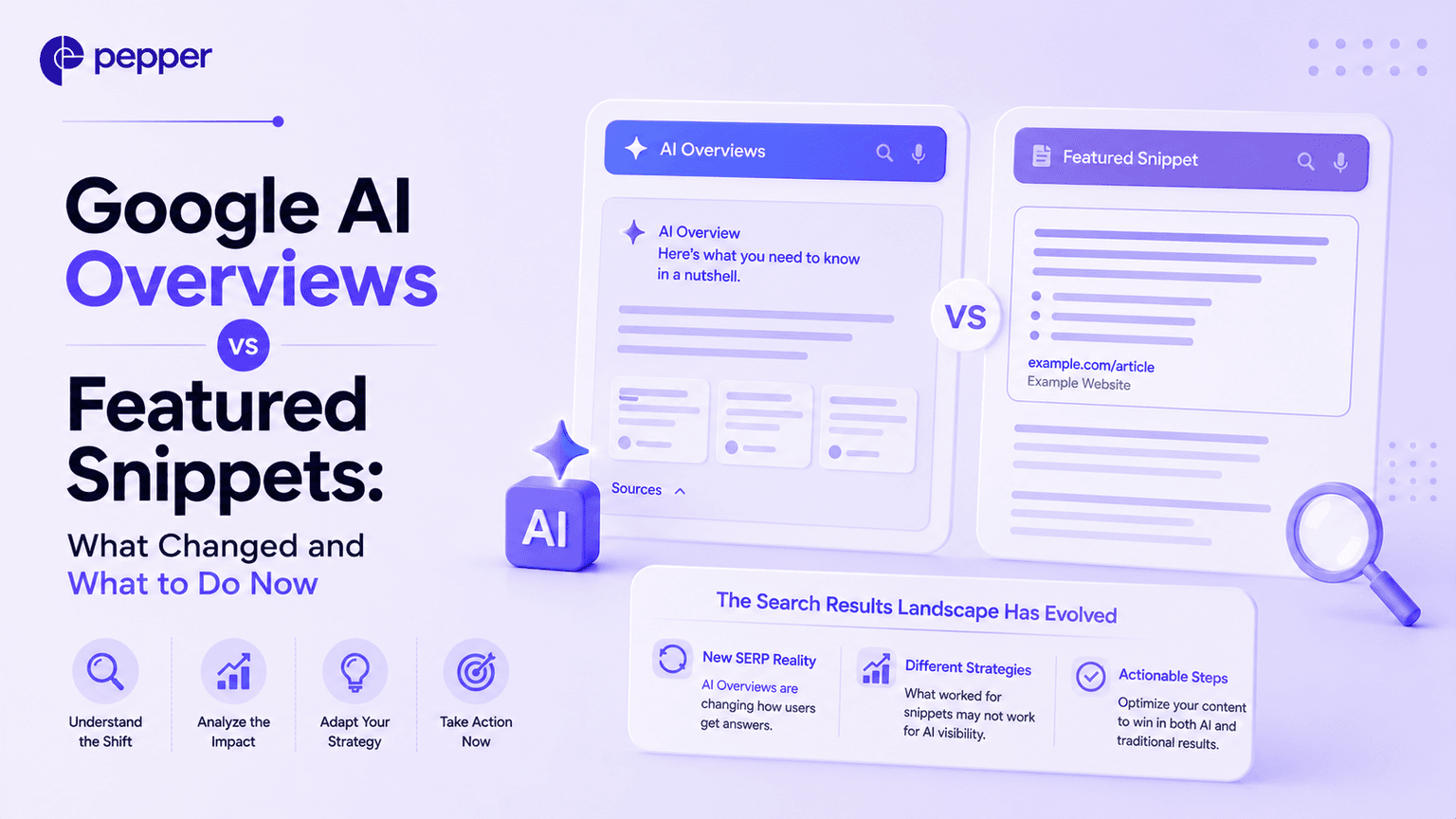
TL;DR: AI Overviews and Featured Snippets aren’t the same feature at different stages of the same evolution. A 2026 academic audit of 1,508 real queries found AI Overviews appearing in 84 percent of results versus 32.5 percent for Featured Snippets on the same query set, and when both appeared together, they contradicted each other 32.3 percent of the time. The two formats reward different content shapes, and treating them as interchangeable is the fastest way to optimize for the wrong one.
Ask the same question twice on the same Google results page, once as an AI Overview and once as a Featured Snippet, and there’s roughly a one-in-three chance the two answers disagree. That’s not a rare edge case. It’s a measured, published finding from a systematic audit. It says something more useful than “AI Overviews are replacing snippets”: these are two different systems, built on different logic, that don’t always reach the same conclusion from the same underlying pages.
Here’s the real story behind AI Overviews vs Featured Snippets: what actually changed, what the data shows about when each format wins, and what that means for what to build next.
Where to Jump In
- AI Overviews vs Featured Snippets: Two Different Systems
- When They Disagree, and Why
- AI Overviews vs Featured Snippets: Which Format Wins Which Content
- What This Means for Traffic and Conversion
- What to Do Now
- FAQ
AI Overviews vs Featured Snippets: Two Different Systems
AI Overviews and Featured Snippets are frequently treated as the same optimization target at two points in time, but they’re built on different retrieval logic and increasingly show up for different query types. A Featured Snippet pulls one passage from one page and displays it directly. An AI Overview synthesizes across multiple sources into a single generated answer, which is a fundamentally different task, prone to different failure modes.
The prevalence gap between them is now stark. A 2026 university-affiliated audit of 1,508 real baby care and pregnancy queries (arXiv:2511.12920) found AI Overviews present in 84 percent of results, against just 32.5 percent for Featured Snippets on the identical query set. Both appeared together about 22 percent of the time.
Google’s own AI Overview saturation has moved with real volatility. Coverage reportedly grew to nearly 25 percent of all searches by mid-2025 before pulling back to around 16 percent by November, evidence that Google is still actively tuning when the feature fires, not treating it as a settled rollout.
Takeaway: stop thinking of Featured Snippets as the thing AI Overviews replaced. They’re increasingly separate features answering different portions of the query landscape, sometimes on the very same page.
When They Disagree, and Why
The most important finding in the 2026 audit isn’t the prevalence gap. It’s what happens on the 22 percent of pages where both features appear together. Full answers disagreed 32.3 percent of the time, and the specific highlighted portions disagreed even more often, 40.7 percent.
The disagreements sorted into recognizable patterns. Some were binary contradictions, one format saying yes, the other no, to the same safety question (the audit’s own example: whether feta cheese is safe during pregnancy). Others were numeric mismatches, like conflicting guidance on when to start a baby on solid food.
Perhaps most concerning for anyone relying on either format at face value: 89.4 percent of AI Overviews and 92.8 percent of Featured Snippets carried no safeguard cue recommending a reader consult a professional, on exactly the kind of query where that matters most.
Takeaway: a page ranking well enough to feed both features doesn’t guarantee those features will say the same thing about it. Content that’s genuinely precise and current reduces the odds of being the source behind a contradiction; vague or dated content increases them.
AI Overviews vs Featured Snippets: Which Format Wins Which Content
The two formats consistently favor different content shapes, and the split lines up with what each is structurally built to do.
- Featured Snippets win on: definitions and short explanations, data tables, ordered lists for processes and procedures, and unordered lists for options or examples. All of these are single-passage, single-source answers by design.
- AI Overviews win on: “why” questions specifically, appearing in 80 to 92 percent of that query type versus just 15.7 percent for snippets, plus complex queries that require synthesizing more than one source.
- Source pools differ too. Reddit, Wikipedia, and YouTube dominate AI Overview citations across multiple independent studies; Featured Snippets historically leaned harder on Wikipedia and YouTube with noticeably fewer Reddit citations.
Despite the visibility AI Overviews get, breaking into them remains genuinely hard. Only an estimated 0.5 to 1.5 percent of domains appear in AI Overviews at all, against roughly 18 million domains competing in organic results.
Takeaway: match the format to the question. A clean definition or a step-by-step process is still snippet territory. A “why does this happen” or “how do these factors interact” question is where AI Overviews increasingly take over.
What This Means for Traffic and Conversion
Featured Snippets historically carried a strong click-through rate, around 35.1 percent by some measures. But Adobe’s Q1 2026 AI traffic analysis found AI-referred visitors converting 42 percent better than non-AI traffic, generating 37 percent more revenue per visit and spending 48 percent longer on-site. That’s a full reversal from converting worse than non-AI traffic just a year earlier.
Read together, that’s a real trade-off, not a straightforward downgrade. Featured Snippets may still send more raw clicks; AI Overview citations increasingly send fewer, higher-intent visitors who’ve already done comparison research inside the answer itself before clicking through.
Takeaway: don’t judge an AI Overview citation purely on click volume against an old snippet benchmark. The visitor behind that click is behaving differently, and the data suggests better, not worse, once they arrive.
What to Do Now
- Build for both, but don’t conflate them. Keep clean, single-passage answers (definitions, steps, tables) for snippet-shaped queries, and build broader synthesis content, comparisons, explainers, “why” pieces, for AI Overview-shaped ones.
- Tighten precision on anything safety- or advice-adjacent. With safeguard cues missing from the vast majority of both formats today, content that’s specific, dated, and sourced reduces the odds of becoming the wrong half of a contradiction.
- Track AIO and snippet visibility separately. They respond to different signals and different query types; a single blended “search visibility” number will hide which one is actually moving.
- Expect volatility, not a settled state. AI Overview prevalence swung from roughly 25 percent to 16 percent of queries within months in 2025. Build a monitoring habit, not a one-time optimization pass.
For the deeper mechanics of what triggers Google AI Overviews specifically, see our How Google AI Overviews Work guide and the full 2026 AI Overviews playbook.
How Pepper Does It
Pepper’s platform tracks Brand Visibility and Domain Prompt Presence across the specific engines and features that matter for a category. A brand can see whether it’s showing up in AI Overviews, traditional snippets, or both, rather than working from one blended number. Citation Analysis then shows which domains and pages are actually winning each format for a given query set, the concrete list of what to study or outrank.
Pepper’s agents produce the differently-shaped content each format rewards, and Pepper’s growth team decides where the gap is largest and worth closing first.
FAQ
AI Overviews vs Featured Snippets, what’s the main difference?
Featured Snippets pull one passage from a single page. AI Overviews synthesize an answer across multiple sources. That structural difference is why they favor different content types and sometimes disagree even when pulling from overlapping source pages.
How often do AI Overviews and Featured Snippets contradict each other?
A 2026 academic audit of 1,508 real queries found that when both appeared on the same results page, full answers disagreed 32.3 percent of the time. The specific highlighted portions disagreed even more, 40.7 percent of the time.
Which is more common now, AI Overviews or Featured Snippets?
AI Overviews appear far more often. The same 2026 audit found AI Overviews in 84 percent of the queries tested versus 32.5 percent for Featured Snippets on an identical query set.
Do AI Overviews convert better than Featured Snippets or traditional organic traffic?
Adobe’s Q1 2026 data found AI-referred traffic overall converting 42 percent better than non-AI traffic and generating 37 percent more revenue per visit. This reflects AI-referred traffic broadly, though, not an isolated AI-Overview-versus-snippet comparison.
How hard is it to actually appear in an AI Overview?
Very. Estimates put only 0.5 to 1.5 percent of domains appearing in AI Overviews at all, against roughly 18 million domains competing in traditional organic results for the same queries.
See How Pepper Can Help
Knowing whether you’re missing from AI Overviews, Featured Snippets, or both, and why, is the first real decision point. See how Pepper’s platform tracks both, or browse Pepper’s case studies to see how the platform, Pepper’s agents, and Pepper’s growth team turn that visibility gap into content that actually closes it.
Latest Blogs
Most advice on this is inference dressed as fact. OpenAI documents exactly one thing clearly, which is access. Here is what is documented, what is inferred, and how to verify the rest for yourself.
Being named in an AI answer and having your page used as its source are different outcomes with different causes and different fixes. The gap between them is the most useful diagnostic in AI search, and most reporting collapses it into one number.
Every platform reports share of voice and almost none of them define it the same way. Here is the definition worth using, the three choices that change the number, and how to measure it yourself without buying anything.
Get your hands on the latest news!