
The short answer
Two findings published this year should change how you audit.
The first is that content decays far faster than audit calendars assume. Across 719 pieces tracked over 28 months, the typical page lost 76 percent of its peak traffic within three months of peaking. An annual audit catches that long after the page died.
The second is more useful. Of the pages LLMs cite, 75 percent were updated in the last year. But only 42 percent were actually published recently. As the researchers put it, the freshness these engines reward is manufactured by updates, not by new publishing.
So the audit is not housekeeping. It is the cheapest growth work available to you.
Key takeaways
- Decay is format-specific. Research and data pieces peak at one month, then lose 89 percent by month three. How-to content peaks at five months and still holds roughly 30 percent a year later.
- So audit cadence should follow format, not the calendar. A quarterly sweep is too slow for research and about right for guides.
- Updating beats publishing for AI citation. Over a quarter of the “fresh” pages LLMs cite were originally published more than two years ago.
- Age is close to a hard cut-off. 88 percent of cited pages had an update within two years. Beyond three years, citation is essentially non-existent.
- Four verdicts, not two. Keep, update, merge, prune. Most audits only use the last one and lose the compounding.
Where this comes from. We run organic for more than 250 enterprises at Pepper and track over 10 million prompts across every major engine. This audit is what we run on an existing library before writing anything new. That work shapes the view below, along with the client reviews we sit in every week and the conversations we have with operators at the events we run.
What is an SEO growth audit?
An SEO growth audit is a review of the pages you already own, asking which ones still earn their place and which ones could earn more with work.
It differs from a technical audit in what it assumes. A technical audit asks whether engines can reach and read your site at all. A growth audit assumes they can, then asks a harder question: of everything you have published, what should you keep, improve, combine or remove?
For AI search that question gains a third dimension. A page can be invisible in your analytics and still be quoted in an answer, so the audit has to look at citations alongside sessions.
How do I audit my site for AI search?
Four questions per page, in this order. The order matters because each one makes the next cheaper to answer.
- Can engines reach and read it at all? An unindexed page, or one whose answer appears only after JavaScript runs, makes everything else moot. That is a separate technical pass, and we published the crawler-level version in the free AI visibility audit.
- Is it still earning anything? Traffic, rankings, conversions. This is the classic content audit question, and it remains the fastest filter. If clicks fell while rankings held, read this first, because the cause may not be the page.
- Is it fresh enough to earn a citation? New in 2026, and the section below shows why it now outranks almost everything else.
- Is it the best page you have on that subject? If three pages answer the same question adequately, none answers it well. Merging beats maintaining, and topical authority explains what the consolidated page has to do.
Score each page against those four, then assign one of four verdicts. That is the whole method.
See where you show up. Pepper’s GEO platform tracks Brand Visibility, Domain Prompt Presence and Share of Voice across ChatGPT, Perplexity, Gemini, Claude and Google AI Overviews. Your team can log in, connect Search Console and GA4, manage the prompt set and run your own agents in the Agent Atlas. A growth team works the same account alongside you. Book a growth audit or see where you show up.
Content decays faster than your audit calendar
Fractl published an analysis on 14 September 2026 covering 719 editorial pieces across three client portfolios. The verticals were business finance, energy and home security, using GA4 monthly views from March 2024 through June 2026.
The headline is that the median piece peaked at four months and then lost about 76 percent of its peak traffic within three months of peaking.
The breakdown by format is where it becomes actionable:
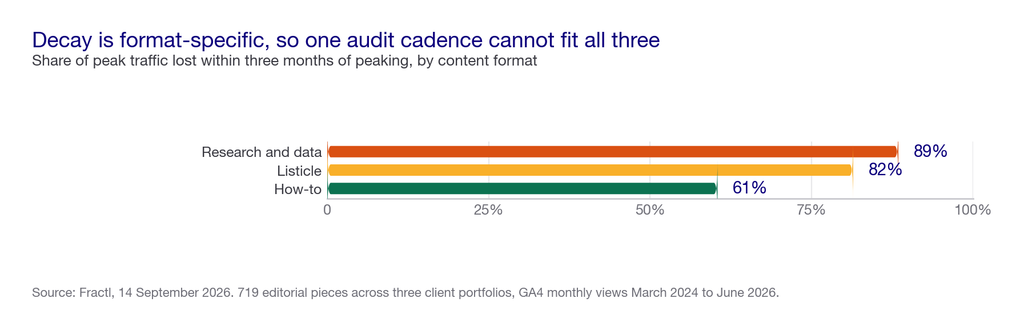
- Research and data pieces, 107 of them, peaked at one month. By month three they had lost 89 percent of peak traffic. Fastest to climb, fastest to fall.
- How-to content, 309 pieces, peaked at five months and lost 61 percent by month three. It also holds roughly 30 percent of peak traffic a full year later, the best long-term performance of the three.
- Listicles, 303 pieces, peaked at five months and lost 82 percent by month three.
Read those three lines as an audit schedule rather than a curiosity. Publish original research and audit annually, and you review the page eleven months after it stopped working. Publish how-to guides, and an annual pass is roughly sensible while a quarterly one is better.
Why updating beats publishing
This is the finding that changes the economics of an audit.
Seer Interactive analysed 7,683 dated pages carrying 47,097 citations across ChatGPT, Gemini and Perplexity between March and June 2026. The four verticals were a national pet retailer, a vacation rental marketplace, a retail energy provider and a commercial bank.
What they found about age:
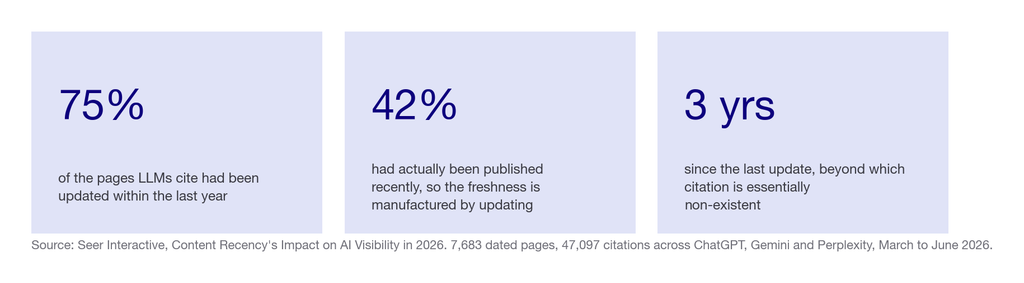
- 75 percent of the pages LLMs cite were updated within the last year.
- 88 percent were updated within two years.
- Beyond three years, citation is essentially non-existent.
And then the part worth reading twice. Among pages where both publication and update dates were readable, 72 percent looked fresh by last-updated date, but only 42 percent had actually been published recently. Over a quarter of the cited “fresh” pages were originally published more than two years earlier.
The authors’ own summary: the freshness these engines reward is being manufactured by updates rather than by new publishing.
Engines differ a little in how much they care. Gemini cited recently-updated pages 78 percent of the time, ChatGPT 73 percent and Perplexity 65 percent. The authors attribute that to content-type preferences rather than different recency rules.
What this means for a budget. Updating a page that already has authority costs less than a new page, and engines cite it more often. Most content teams fund the opposite.
The four verdicts at a glance
Two verdicts is the common mistake. Keep or kill produces a tidier site and leaves most of the value on the floor.
| Verdict | When it applies | What you actually do | Typical cost | Where it falls short |
|---|---|---|---|---|
| Keep | Earning, fresh, and the best page you have on the subject | Nothing. Re-check on the format’s decay schedule | Free | Doing nothing is only right if you checked, and most “keeps” are unchecked |
| Update | Earning or ranking, but stale, or losing ground to newer pages | Refresh the substance rather than the date. New data, new examples, corrected claims | Cheapest real work available | A date change with no substance change is visible to readers and useless to engines |
| Merge | Several pages answering the same question adequately | Consolidate into one strong page, redirect the rest | Moderate, plus redirect care | Done carelessly it loses the equity it was meant to concentrate |
| Prune | No traffic, no rankings, no links, no strategic role | Remove, and redirect if anything points at it | Low, and it frees attention | Pruning is the most over-used verdict, because it looks decisive |
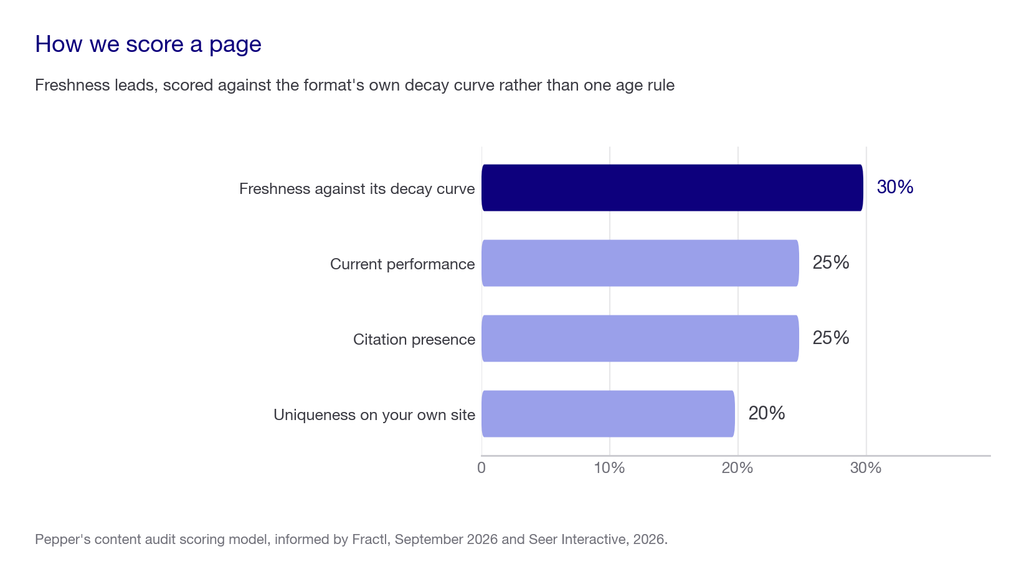
Our methodology: how we score a page
| Input | Weight | What that means here |
|---|---|---|
| Freshness against its format’s decay curve | 30% | A research piece four months old is overdue. A how-to at four months is mid-life |
| Current performance | 25% | Traffic, rankings and conversions. Still the fastest filter, and no longer the only one |
| Citation presence | 25% | Whether engines quote the page today, tracked separately from whether they name your brand |
| Uniqueness on your own site | 20% | Whether another page on your domain already answers this better |
The audit, step by step
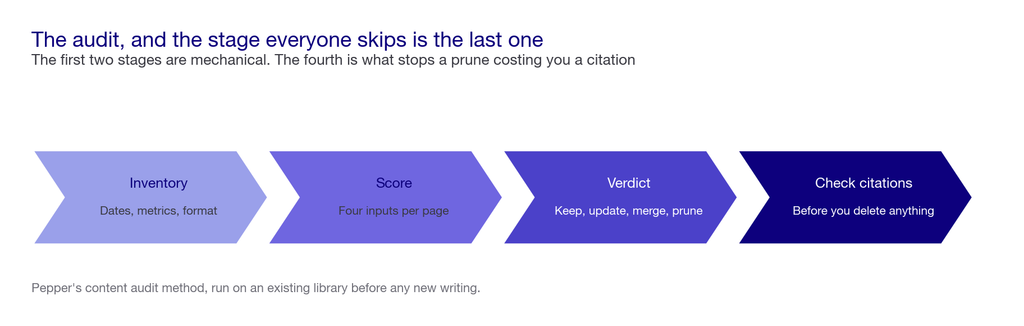
Four stages, and the first two are mechanical.
1. Inventory every page with its dates
Export your URLs with publication date, last-updated date, sessions, impressions and conversions. Then add one column most exports omit: content format, tagged as research, how-to, listicle or other.
That format column is what lets you apply the right decay curve rather than one blanket rule. If you are choosing what to write next as well as what to fix, topic research covers the other half.
2. Score each page
Apply the four inputs from the methodology table. You are producing a number per page, not a feeling.
The freshness input changes most from a classic audit. Score it against the format’s own curve. A four-month-old research piece is late. A four-month-old how-to is not. For what makes a refreshed page quotable, see how to structure content for AI citation.
3. Assign a verdict
Keep, update, merge or prune. Force every page into one. Pages without a verdict are pages nobody will action.
Expect the distribution to surprise you. On most libraries we audit, update is the largest group by some distance. Prune is far smaller than people expect going in.
4. Check the citation column before you act
For anything you are about to prune, run the question it answers through ChatGPT and Perplexity first.
A page with no Google traffic can still earn citations in AI answers. Pruning it removes you from a surface your analytics never showed you. This is the newest failure mode in content auditing, and we have watched it happen twice this year. The free method for checking is in how to measure AI search visibility without expensive tools.
What this looked like on a real account
SalesHood is the clearest example we have published of refresh sitting alongside new work rather than behind it.
The content engine produced 20 new pieces and refreshed 8 existing ones, alongside technical fixes resolving 10 issues and GEO tracking in Atlas. AI Overview visibility went from 14 keywords to 97. Blog impressions rose from 200,000 to 417,000. Rich results grew 291 percent in five months, and clicks rose 20 percent against an industry-wide decline.
Note the ratio. Roughly a third of the content work was refreshing pages that already existed, which is a far higher proportion than most content plans allocate.
Where this evidence is limited. One account, published on our own case study page, and not a controlled study. The case studies above are, which is why the numbers driving this article come from them rather than from us.
How to evaluate an audit before you act on it
The audit produces a list. This is how to check the list is worth executing.
The scorecard
Score the audit itself out of 100 before anyone starts deleting.
| Check | Weight | How to score it honestly |
|---|---|---|
| Format-aware freshness | 30% | Pages are scored against their own decay curve rather than one blanket age rule |
| Citation column present | 25% | Someone checked every prune candidate against AI answers, rather than analytics alone |
| All four verdicts used | 20% | Update is the largest group. If prune is, someone is optimising for a tidy site |
| Merge targets identified | 15% | Duplicate coverage on your own domain is named, page by page |
| Redirects planned | 10% | Every prune and merge has a destination, decided before anything is removed |
The live test, over 90 days
Fix 30 prompts covering the subjects your library should own, phrased as buyers ask them. Real questions, such as “how do I run a content audit”, “what is content decay”, “which data observability platform suits a small team” and “how often should I update blog posts”.
Run them across Google, ChatGPT and Perplexity before you touch anything, and record which of your pages each engine quotes. That is your pre-audit baseline, and it is the only way to know whether a prune cost you something.
Rerun the identical set monthly for 90 days. Three readings is the shortest honest window: one is a snapshot, two could be noise, three shows direction.
Weak approach versus strong approach
The weaker approach: export everything, sort by sessions ascending, delete the bottom quartile and report the tidy-up. It removes pages that engines were quoting, and produces a smaller site with the same problems.
The stronger approach: tag by format, score against the right decay curve, check citations before pruning, and spend most of the effort on updates rather than deletions.
The difference is which verdict gets the budget. The weak version funds deletion, which costs little and returns little. The strong version funds updating, which the recency data says is what engines actually reward.
Red flags
- An audit with only two verdicts. Keep or kill throws away the update work that the recency evidence says matters most.
- One age threshold for all content. Research decays five times faster than how-to guides, so a single rule is wrong for both.
- Pruning without checking AI citations. Analytics cannot show you a page that is being quoted but not clicked.
- Republishing with a new date and no new substance. Readers notice, and there is no evidence engines reward a date alone.
- Deletion counts as the headline metric. Pages removed is an input, and a misleading one.
- Guaranteed recovery percentages. The figures circulating for pruning and refresh outcomes do not carry traceable methods.
Five questions worth asking
- “How did you score freshness?” If the answer is a single age cut-off, the audit is wrong for at least one format on your site.
- “Which prune candidates are cited in AI answers today?” If nobody checked, do not let anyone delete yet.
- “What proportion of the list is update versus prune?” Update should dominate. If it does not, ask why.
- “Where are the merge opportunities?” Duplicate coverage is usually the biggest single win and the least often named.
- “What is the redirect plan?” Decided before removal, not after.
Reduced to one principle: audit to find what to update, not what to delete.
One closing note that costs us something. An audit that concludes “update forty pages” is a smaller engagement than one concluding “write forty pages”, ours included in the general point that agencies are paid more for the second. If a partner’s audit consistently recommends new production over refreshing what you have, the recency evidence above is worth putting to them.
What does a content audit cost?
| What you are buying | Typical 2026 cost | What it covers |
|---|---|---|
| The inventory export | Free, an afternoon | URLs, dates, sessions, impressions, conversions, format tag |
| Pre-audit citation baseline | Free, about two hours | Thirty prompts across three engines, recording which pages are cited |
| Scoring the library | Internal, scales with page count | Four inputs per page, producing a verdict |
| Updating a page properly | The main cost, and the main return | New data, new examples, corrected claims. Not a date change |
| Merging and redirects | Moderate, plus developer time | Consolidation without losing the equity |
| Platform plus a growth team | Custom | Pepper: tracking, plus the people and agents doing the work it points at |
The first two rows are free, and the second one is the one people skip. It is also the only thing that tells you whether a deletion cost you a citation.
What nobody should promise you
A specific recovery percentage from pruning. The figures circulating do not carry a traceable sample or method.
That republishing with a fresh date improves citation odds. The evidence points to substantive updates, not date changes.
That a smaller site ranks better by default. Pruning helps when pages are genuinely dead, and it is over-prescribed because it is easy to sell.
A guaranteed citation for a refreshed page. Nobody controls generated output, and Google warns against providers guaranteeing rankings.
When not to audit at all
The answer that costs us the sale. If you have published fewer than about thirty pages, you do not need a content audit yet and we would tell you not to commission one.
With a small library the answer is almost always “update the five that matter and write the ones you are missing”. An audit is a prioritisation tool, and prioritisation only pays once there is more to do than time to do it.
Frequently asked questions
How do I audit my site for AI search?
Four questions per page, in order. Can engines reach and read it, is it still earning, is it fresh enough to earn a citation, and is it your best page on that subject. Then assign one of four verdicts: keep, update, merge or prune.
How often should I run a content audit?
Follow the format rather than the calendar. Research and data pieces peak at one month and lose 89 percent of peak traffic by month three, so they need attention quarterly at the latest. How-to content peaks at five months and holds up far better.
Does updating old content help with AI citations?
The evidence says yes, and strongly. Across 7,683 cited pages, 75 percent had an update within the last year, while only 42 percent had a recent publication date. Updates, not new publishing, manufacture the freshness engines reward.
How old is too old for AI search?
88 percent of pages cited by LLMs had been updated within two years, and citation beyond three years is essentially non-existent. Treat three years since the last substantive update as the practical cut-off.
Should I delete underperforming content?
Sometimes, and less often than people think. Check whether engines quote the page before removing it. A page with no Google traffic can still appear in an answer your analytics never recorded.
What is content decay?
The predictable fall in traffic after a page peaks. Across 719 tracked pieces the median page peaked at four months, then lost about 76 percent of that peak within three months. The rate varies sharply by format.
Is a content audit the same as a technical audit?
No, and they run in that order. A technical audit checks whether engines can reach, read and lift your pages. A content audit assumes they can and asks which pages are worth keeping.
Which content format lasts longest?
How-to content, by a clear margin. It peaks later, loses less in the first three months, and retains roughly 30 percent of peak traffic a full year after peaking, which is the best long-term retention of the three formats measured.
Where to go next
Export your pages with both dates and tag each one by format. That single column is what turns a generic age filter into an audit that matches how your content actually decays.
Then run thirty prompts and record which of your pages are cited, before you delete anything.
Learn AI Search · Run the technical audit first · Book a growth audit
Sources and further reading
- Fractl. Content decay analysis, published 14 September 2026. 719 editorial pieces across three client portfolios in business finance, energy and home security, using GA4 monthly views from March 2024 through June 2026. Median peak at four months, 76 percent of peak traffic lost within three months of peaking. Research and data pieces, 107 of them, peaked at one month and lost 89 percent by month three. How-to, 309 pieces, peaked at five months, lost 61 percent, and retained roughly 30 percent a year later. Listicles, 303 pieces, peaked at five months and lost 82 percent. Link
- Seer Interactive. “Content Recency’s Impact on AI Visibility in 2026.” 7,683 dated pages carrying 47,097 citations across ChatGPT, Gemini and Perplexity, March to June 2026, across a national pet retailer, a vacation rental marketplace, a retail energy provider and a commercial bank. 75 percent of cited pages updated within a year, 88 percent within two, citation beyond three years essentially non-existent. 72 percent appeared fresh by update date against 42 percent actually published recently. Gemini 78 percent, ChatGPT 73 percent, Perplexity 65 percent. Link
- Google Search Central. AI search optimisation guidance, 15 May 2026. Confirms AI Overviews and AI Mode run on core Search ranking and quality systems with no separate AI index, and warns against guaranteed-ranking claims.
- Pepper. SalesHood case study. Figures as published on the page.
- Pepper. The free AI visibility audit for the technical pass that runs before this one, and topical authority for AI search for what to do with the subjects that survive.
- Deliberately excluded: the claim that updating and republishing grows organic views by an average of 106 percent, and the claim that pruning delivers a 15 to 30 percent traffic increase within three months. Neither traces to a 2026 source with a stated sample and method.
Latest Blogs
Most advice on this is inference dressed as fact. OpenAI documents exactly one thing clearly, which is access. Here is what is documented, what is inferred, and how to verify the rest for yourself.
Being named in an AI answer and having your page used as its source are different outcomes with different causes and different fixes. The gap between them is the most useful diagnostic in AI search, and most reporting collapses it into one number.
Every platform reports share of voice and almost none of them define it the same way. Here is the definition worth using, the three choices that change the number, and how to measure it yourself without buying anything.
Get your hands on the latest news!

Similar Posts

Artificial Intelligence
11 mins read
What is anchor text, and does it still matter in 2026?
SEO
11 mins read
What is internal linking? Meaning, and what changed for AI search
SEO
15 mins read