
The short answer
Keyword tools measure what people type into a search box. AI answers get composed for what people ask in a sentence. Those are different corpora, and most topic research still only looks at the first one.
The fix is not a better keyword tool. It is to harvest the questions from the engines themselves, then score each topic by whether there is a seat available in the answer.
Key takeaways
- Every answered question has a finite number of citation slots. ChatGPT carries a citation in 96 percent of responses and averages around five sources. Gemini cites in 82 percent and averages around eight.
- So the best topics are not the highest-volume ones. They are the ones where an answer already exists, few sources are cited, and those sources are beatable.
- Harvest questions from the engines, not from a keyword database. The phrasing people use with an assistant is longer and more specific than anything a keyword tool records.
- 84 percent of citations come from earned media, so a topic where the cited sources are all third-party publications is a harder win than one citing vendor pages.
- Depth wins the seat. On one account a single hero guide produced more than 260,000 impressions on its own, outperforming a quarter of the scheduled calendar.
Where this comes from. We run organic for more than 250 enterprises at Pepper and track over 10 million prompts across every major engine. This method is what we run at the start of an engagement. The view below is shaped by that, by the client reviews we sit in every week, and by conversations with operators at the events we run.
What is topic research for AI search?
Topic research is the work of deciding which subjects to write about. For AI search it has one extra job: finding out whether there is room for you in the answer that already exists.
Classic topic research asks two questions. What do people search for, and can we rank for it? This method adds a third, and it is the one that changes the output:
- Does an answer already exist? Run the question. If an engine composes an answer, that answer has a fixed shape you are trying to get inside.
- How many sources does it cite? That is your seat count, and it varies enormously by engine and by question.
- Are those sources beatable? Three major publications is a hard win. Two thin vendor pages and a forum thread is an open door.
Everything below is a way of answering those three at scale.
What content performs best in AI search?
The honest answer is narrower than the listicles suggest, because very little of what circulates on this question has a study behind it.
What the evidence does support:
- Content that contains something an engine cannot generate on its own. Original numbers, named methods, dated observations, real results. A model can paraphrase a definition without you. It cannot invent your sample size.
- Content a model can lift cleanly. A self-contained passage that answers one question without requiring the rest of the page. Being comprehensive and being extractable are different properties, and the second one wins the citation.
- Content that credible third parties already echo. Muck Rack analysed more than 25 million cited links in May 2026. Earned media accounted for 84 percent of AI citations, against 0.3 percent for paid or advertorial. Topics where independent sources already discuss you are easier to win.
- Depth on a narrow subject rather than coverage of a broad one. This is the pattern we see most consistently on our own accounts. The next section quantifies it.
What we are not going to tell you, because we could not verify it. That original research performs at 82 percent. That comparison content sits at 76 percent. That pages containing numbers do 60 percent better. Those figures circulate widely here with no stated sample, method or date attached to any of them.
See where you show up. Pepper’s GEO platform tracks Brand Visibility, Domain Prompt Presence and Share of Voice across ChatGPT, Perplexity, Gemini, Claude and Google AI Overviews. Your team can log in, connect Search Console and GA4, manage the prompt set and run your own agents in the Agent Atlas. A growth team works the same account alongside you. Book a growth audit or see where you show up.
Why keyword research misses the topics that matter now
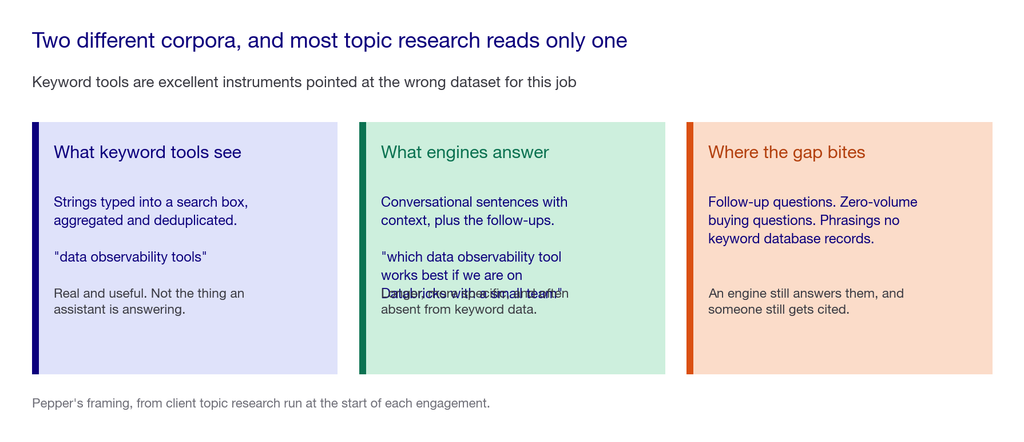
Keyword tools are excellent instruments pointed at the wrong corpus.
They record strings typed into a search box, aggregated and deduplicated. That is a real and useful dataset. It is also not what an assistant is answering. People talk to assistants in sentences, with context, in phrasings that never appear in a keyword database at scale.
The gap shows up three ways:
- Length and specificity. A buyer types “data observability tools” into Google. The same buyer asks an assistant “which data observability tool works best if we are already on Databricks and have a small team”. Only one of those appears in a keyword report.
- Follow-up questions. Assistants are conversational, so the second and third questions in a thread matter commercially and are invisible to every keyword tool.
- Questions with no search volume at all. Plenty of high-intent buying questions get asked a few hundred times a month across the whole internet. A keyword tool rounds them to zero. An engine still answers them, and someone still gets cited.
None of this makes keyword research obsolete. Google confirmed in May 2026 that AI Overviews and AI Mode run on the core Search ranking and quality systems, with no separate AI index. So the classic signals still matter. What keyword research is, is incomplete as a topic selection method. That is a narrower and more fixable problem.
The method: five stages
This is what we run in week one. It takes about a day and costs nothing.
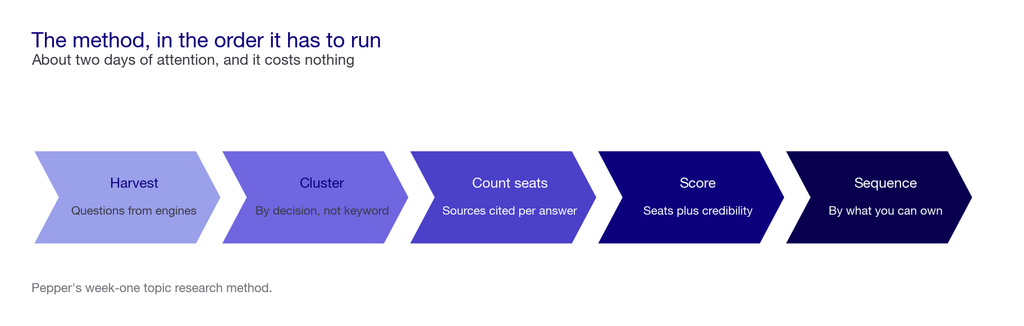
1. Harvest questions from the engines themselves
Start with fifteen seed questions your sales team actually hears. Put each into ChatGPT, Perplexity and Google. Then do the thing most people skip: read the follow-up questions the engine suggests, and ask the obvious next one yourself.
Record every question that comes back. You are building a corpus of real phrasings rather than a keyword list. Expect 60 to 100 questions from 15 seeds.
2. Cluster them by the decision they serve
Group the questions by what the asker is trying to decide, not by keyword similarity. Four groups cover most of it:
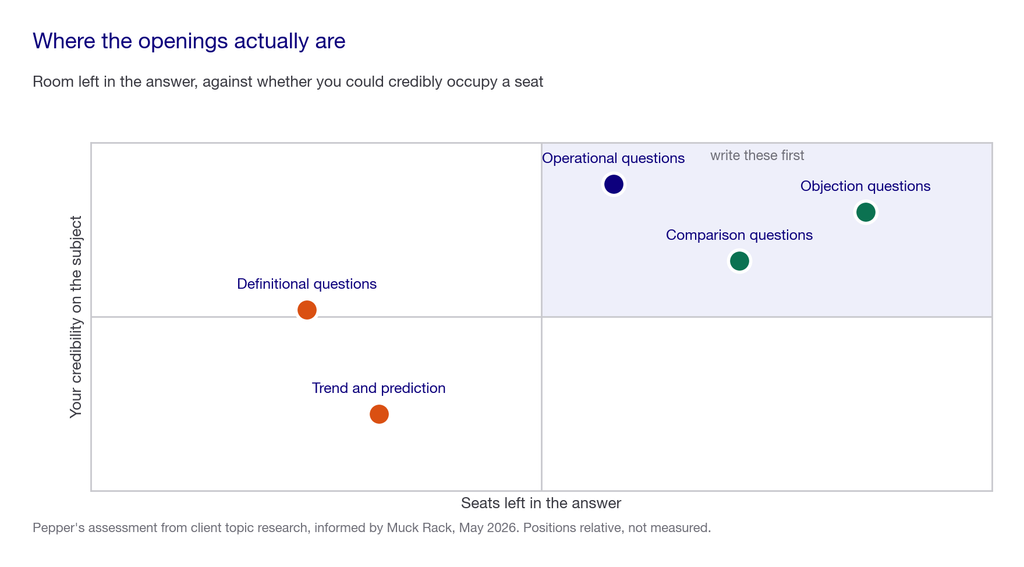
- Definitional. “What is X.” Entry points, usually well answered already, and rarely where a deal turns.
- Comparison. “X versus Y”, “best X for Y”. Commercially decisive, and the group most brands avoid publishing on. Our own AEO vs SEO is an example of answering one properly.
- Objection. “Is X worth it”, “problems with X”. High intent, almost never addressed on vendor sites.
- Operational. “How do I actually do X”. The most citable, because the answer contains specifics nobody can paraphrase. Making those specifics liftable is covered in how to structure content for AI citation.
3. Count the seats
This is the stage that makes the method different, and it takes the longest.
For every question, run it and record how many sources the answer cites, and which ones. You are looking for the size of the opening. Doing this at volume is what AI visibility trackers automate, though the first pass is worth doing by hand.
- ChatGPT cites in 96 percent of responses, averaging around five sources.
- Gemini cites in 82 percent, averaging around eight.
- Claude cites in just 55 percent, so nearly half its answers name nobody at all.
A question answered with eight citations has more room than one answered with three. And three cited major publications is a harder win than two vendor blogs and a forum thread.
4. Score the topic
Put the two things together. A topic is worth writing when an answer exists, the seats are winnable, and you could credibly occupy one.
We use four inputs, weighted, and the scoring model is in the methodology section below. The short version: seats and credibility outrank volume.
5. Sequence by what you can actually own
Order the surviving topics by where you have genuine depth, then publish in that order rather than by volume.
On Acceldata, a single hero guide produced more than 260,000 impressions on its own. That beat a quarter of the scheduled calendar. The page won because it owned its question completely, not because the question was popular.
Scoring topics: where the openings are
Plot your candidate topics on two axes and the priorities become obvious.
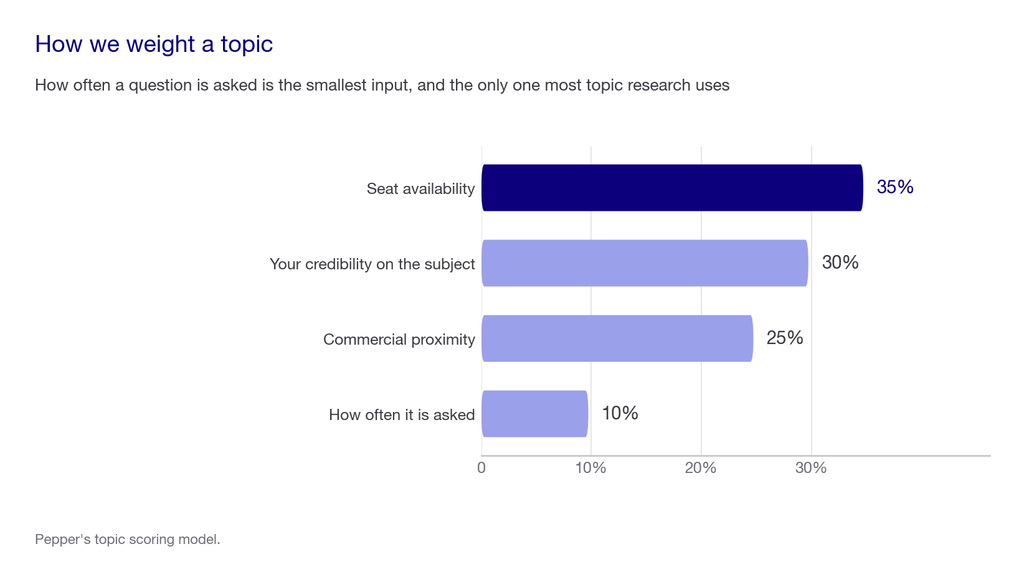
Our methodology: how we weight a topic
| Input | Weight | What that means here |
|---|---|---|
| Seat availability | 35% | How many sources the answer cites, and how beatable they are. More seats and weaker incumbents beat a bigger question |
| Your credibility on the subject | 30% | Whether you have genuine depth, a named expert, or a result to point at. Without one of the three, you are guessing |
| Commercial proximity | 25% | How close the question sits to a buying decision. Comparison and objection questions outrank definitional ones |
| How often it is asked | 10% | It matters least, and it is the only input most topic research uses |
Topic types at a glance
| Question type | What it is worth | Typical seat competition | Typical cost to win | Where it falls short |
|---|---|---|---|---|
| Definitional | Entry visibility, weak commercial signal | Crowded. Usually answered from encyclopedic sources | Low, and easily matched | Rarely where a deal turns, so high volume misleads here |
| Comparison | The highest commercial value on this list | Moderate. Often cited from review sites and forums | High. Needs real positions on named competitors | Most brands flinch at naming rivals, which is why the seats stay open |
| Objection | High intent, very low competition | Thin. Frequently answered from forums alone | Moderate. Needs honesty more than production | Uncomfortable to publish, and that discomfort is the moat |
| Operational | The most citable of the four | Moderate, and often vendor-dominated | High. The answer has to contain real specifics | Slow to produce properly, and impossible to fake |
| Trend and prediction | Low. Cheap to produce, cheap to replace | Crowded with undated aggregations | Low | Dates badly, and nothing in it is unmatched |
—
How to choose which topics to write first
The scoring model gives you an ordered list. This is how to sanity-check it before anyone starts writing.
The scorecard
Score each candidate topic out of 100.
| Factor | Weight | How to score it honestly |
|---|---|---|
| Seats available in the answer | 30% | The engines cite several sources on this question and at least one looks beatable |
| Your depth on the subject | 25% | You have a named expert, a real result or first-hand data. Not an opinion assembled from other articles |
| Commercial proximity | 20% | Someone asking this is closer to a decision than to idle curiosity |
| Nobody credible owns it yet | 15% | The cited sources are forums, thin vendor pages or nothing at all |
| You can maintain it | 10% | The answer will still be true in a year, or you are willing to update it |
### The live test, over 90 days
Fix 30 prompts drawn from your harvested corpus, phrased exactly as they came back from the engines. Use real questions. “Which data observability tool works best on Databricks”. “Is sales enablement software worth it for a ten-person team”. “How do I measure AI search visibility without paying”. “What is the difference between AEO and GEO”.
Run them across Google, ChatGPT and Perplexity, and log three things per prompt: how many sources were cited, whether you were among them, and who was.
Rerun the identical set monthly for 90 days. Three readings is the shortest honest window: one is a snapshot, two could be noise, three shows direction. Keep the prompt set fixed, because changing it resets the comparison.
Watch the source list rather than your own position. Topics where the cited sources churn between runs have unstable seats, and those are the easiest to take.
Weak approach versus strong approach
The weaker approach: export the top 200 keywords by volume, sort descending, brief the top 40 and publish against a calendar. It produces pages competing for definitional questions that are already answered perfectly well.
The stronger approach: harvest 60 to 100 real questions from the engines and count the seats on each. Then write the ten where you have genuine depth and the incumbents are weak.
The weak version optimises for how often a question is asked. The strong version optimises for whether you can win the answer, which is the only thing producing a citation.
Red flags
- A content plan built only from keyword volume. It cannot see the conversational phrasings, the follow-ups, or the zero-volume questions that still get answered.
- No comparison topics in the plan. These are the most commercially valuable and the most commonly avoided, which is exactly why the seats stay open.
- Performance percentages by content type. The figures circulating on this question have no stated method, and a plan built on them is built on nothing.
- Topic counts as the deliverable. Forty briefs is an input. Ten topics you can genuinely own is an outcome.
- No check on who is currently cited. If nobody looked at the existing source list, nobody knows whether there is room.
- Guaranteed citations for a topic. Nobody controls generated output, and Google warns against providers guaranteeing rankings.
Five questions worth asking
- “How many sources does the answer currently cite?” If nobody counted, the topic was picked on volume alone.
- “Who is cited today, and why them?” The answer tells you whether the seat is winnable.
- “What do we know here that nobody else can write?” If there is no answer, pick a different topic.
- “Which comparison questions are we refusing to answer?” Those are usually the best openings on the list.
- “What would you cut from this plan?” A good partner cuts. A weak one adds volume.
Reduced to one principle: pick topics by how much room is left in the answer, not by how often the question is asked.
One closing note that costs us something. This method produces a shorter content plan than the one you probably have. A shorter plan is harder for an agency to bill against, ours included. If a partner’s topic research consistently concludes that you need more pieces, that conclusion is worth examining.
What does this cost?
| What you are buying | Typical 2026 cost | What it covers |
|---|---|---|
| Harvesting the question corpus | Free, about a day | 15 seeds into 60 to 100 real phrasings across three engines |
| Counting the seats | Free, a second day | Recording how many sources each answer cites, and which |
| Search Console and Bing Webmaster Tools | Free | Your own impression and click data on the topics you already cover |
| Ongoing prompt tracking | Free by hand, or roughly $99 to $400 a month | Watching the source list change on a fixed prompt set |
| Content with genuine depth | Front-loaded, then maintenance | The pages that actually take the seat |
| Platform plus a growth team | Custom | Pepper: tracking, plus the people and agents doing the work it points at |
The first two rows are the entire method, and they cost two days of somebody’s attention.
What nobody should promise you
A guaranteed citation on a chosen topic. Nobody controls generated output.
A performance percentage for a content type. The figures circulating on this question carry no stated sample or method.
That volume data alone can select topics for AI search. It measures a different corpus from the one assistants answer.
That more topics produce more citations. Seats are finite per answer, and depth is what takes one.
When this method is not worth running
The answer that costs us the sale. Do you have fewer than about twenty pages worth optimising? Can nobody internally write with genuine authority on any subject? Then you do not need a topic research method yet, and we would tell you not to buy one.
Write three pages properly on the one thing you know better than your competitors. Topic research allocates attention across subjects you can credibly own. With one subject and no expert there is nothing to allocate, and a longer list will not help.
Frequently asked questions
What content performs best in AI search?
Content containing something an engine cannot generate alone, structured so a passage lifts cleanly, on subjects credible third parties already discuss. Muck Rack found 84 percent of AI citations come from earned media, against 0.3 percent from paid.
How do I find topics AI engines actually answer?
Harvest questions from the engines rather than a keyword database. Put fifteen seed questions into ChatGPT, Perplexity and Google, then follow the suggested next questions. Record every phrasing that comes back. Expect 60 to 100 from 15 seeds.
Why is keyword research not enough for AI search?
Keyword tools record strings typed into a search box. Assistants answer conversational sentences that are longer, more specific and often have no measurable volume. A keyword report cannot see them.
What is seat availability in a topic?
How many sources an engine cites when it answers a question, and how beatable they are. ChatGPT averages around five sources per cited answer and Gemini around eight. Some questions have far more room than others.
Should I write comparison content about competitors?
Yes, and most brands do not. Comparison questions are commercially decisive and get answered by somebody regardless. Declining to publish hands the citation to whoever does, including your competitors.
How many topics should a content plan contain?
Fewer than keyword volume suggests. Ten subjects you can genuinely own will outperform forty covered thinly, because depth takes the citation seat while breadth simply fills a calendar. The practical limit is how many subjects you can staff a real expert on.
Does search volume still matter at all?
Yes, but less than the other inputs. We weight it at 10 percent, behind seat availability, your credibility on the subject and how close the question sits to a buying decision.
How long before a new topic earns citations?
Plan on three monthly readings of a fixed prompt set before judging anything, so roughly 90 days for direction. Watch the cited source list rather than your own traffic. The source list moves first.
Where to go next
Take fifteen questions your sales team hears every week and run them through ChatGPT, Perplexity and Google this afternoon. Record the follow-ups and the source lists.
You will finish with a better topic list than any keyword export, and you will know which answers have room in them.
Learn AI Search · Book a growth audit · Read the case studies
Sources and further reading
- Muck Rack. “What Is AI Reading?” May 2026. More than 25 million cited links across ChatGPT, Claude and Gemini, 17 industries. Source of the 84 percent earned media, 0.3 percent paid, and the per-engine citation rates and average source counts. Link
- Google Search Central. AI search optimisation guidance, 15 May 2026, filed under SEO fundamentals. Confirms AI Overviews and AI Mode run on core Search ranking and quality systems with no separate AI index, and warns against guaranteed-ranking claims.
- Pepper. Acceldata case study. Figures as published on the page.
- Pepper. Topical authority for AI search, for what to do once the topics are chosen, and how to structure content for AI citation for making each page extractable.
- Pepper. How to measure AI search visibility without expensive tools, for running the fixed prompt set described above.
- Deliberately excluded: the content-type performance percentages circulating on this question, including original research at 82 percent, comparison content at 76 percent, pages with numbers performing 60 percent better and an optimum length near 2,000 words. None carries a stated sample, method or publication date.
Latest Blogs
Most advice on this is inference dressed as fact. OpenAI documents exactly one thing clearly, which is access. Here is what is documented, what is inferred, and how to verify the rest for yourself.
Being named in an AI answer and having your page used as its source are different outcomes with different causes and different fixes. The gap between them is the most useful diagnostic in AI search, and most reporting collapses it into one number.
Every platform reports share of voice and almost none of them define it the same way. Here is the definition worth using, the three choices that change the number, and how to measure it yourself without buying anything.
Get your hands on the latest news!

Similar Posts
Artificial Intelligence
11 mins read
What is anchor text, and does it still matter in 2026?
SEO
11 mins read
What is internal linking? Meaning, and what changed for AI search
SEO
15 mins read