AI trust signals: why LLMs cite some brands and ignore others
The short answer
AI trust signals split in two, and most brands only earn one of them.
An engine can trust your page enough to use it. That is a citation. It can also trust your brand enough to say your name. That is a mention. They are different judgements, and the gap between them is large.
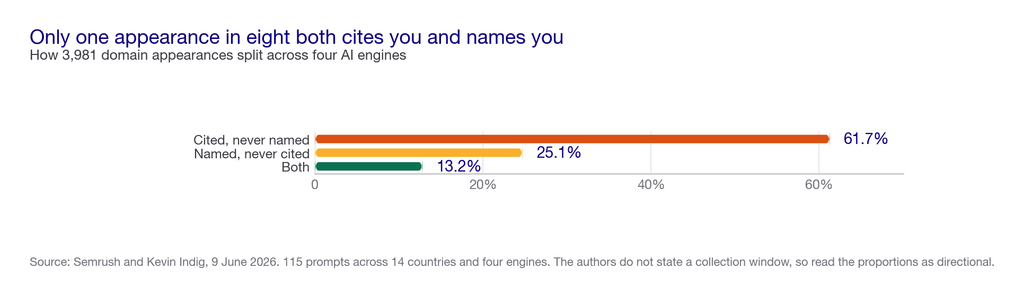
Semrush and Kevin Indig measured 3,981 domain appearances across 115 prompts, 14 countries and four engines. Only 13.2 percent were both cited and mentioned. 61.7 percent were citations with no mention at all.
They call those ghost citations. Your work is in the answer. Your name is not.
Key takeaways
- Being used is not being credited. Nearly two thirds of appearances cite a source without naming the brand behind it.
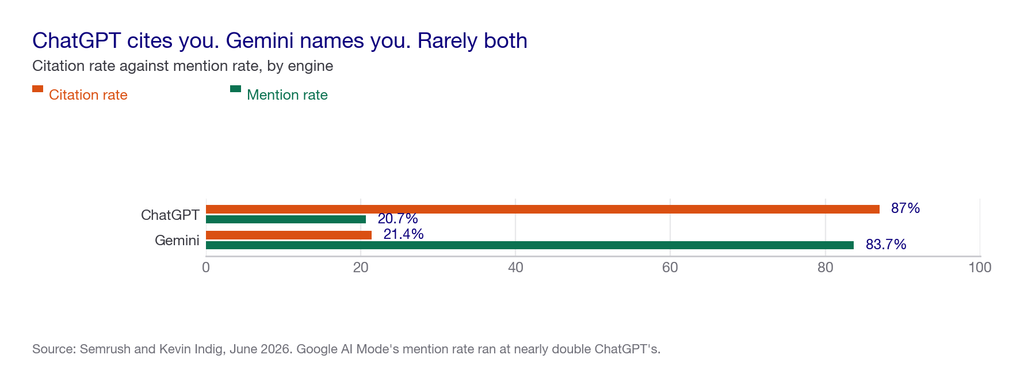
- The engines are near mirror images. ChatGPT cites at 87 percent and mentions at 20.7 percent. Gemini mentions at 83.7 percent and cites at 21.4 percent.
- Query shape changes everything. Short conversational prompts produced 30 to 50 times more brand mentions than long structured ones.
- Comparison content earns names. Comparative queries generated 2.4 times more mentions than informational ones.
- So the fix depends on which half you are missing. Citations are a content problem. Mentions are a brand problem.
Where this comes from. We run organic for more than 250 enterprises at Pepper and track over 10 million prompts across every major engine. We see this split on live accounts every week. That work shapes the view here, along with the client reviews we sit in and the talks we have at the events we run.
What are AI trust signals?
AI trust signals are the things an engine reads to decide two separate questions. Can it use your page, and can it name your brand.
Most writing on this subject treats trust as one thing. The data says otherwise.
The two judgements
- Trust in the page. Is this source good enough to draw an answer from? This is about the content itself. Clear structure, specific claims, and a domain the engine can retrieve.
- Trust in the brand. Is this name worth saying out loud? This is about how often other people describe you, and how consistently.
A page can clear the first bar and never clear the second. That is the ghost citation, and it is the normal case rather than the exception. E-E-A-T covers the framework behind the first judgement.
See where you show up. Pepper’s GEO platform tracks Brand Visibility, Domain Prompt Presence and Share of Voice across ChatGPT, Perplexity, Gemini, Claude and Google AI Overviews. Your team can log in, connect Search Console and GA4, manage the prompt set and run your own agents in the Agent Atlas. A growth team works the same account alongside you. Book a growth audit or see where you show up.
The size of the gap
This is the finding that reframes the whole subject.
Semrush published the study on 9 June 2026, run with Kevin Indig and Growth Memo using the Semrush AI Visibility Toolkit. It covered 3,981 domain appearances across 115 prompts, 14 countries and four engines: ChatGPT, Google AI Overviews, Gemini and Google AI Mode.
The split came out like this.
- 61.7 percent were ghost citations. Cited, never named.
- 25.1 percent were mentions with no citation. Named, never linked.
- 13.2 percent were both.
What that means in practice
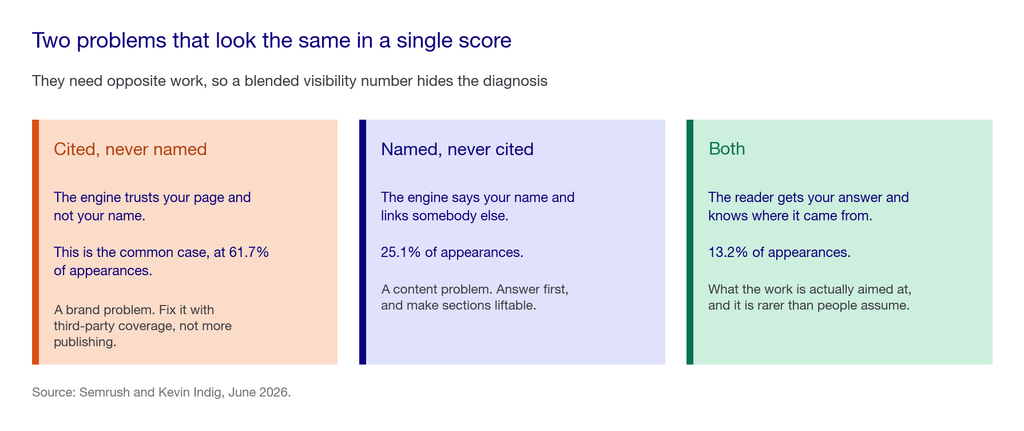
Think about what each row costs you. A ghost citation gives the reader your answer and no way to find you. A mention without a citation gives you the credit and sends the traffic elsewhere.
Only the last row does both jobs. It happens about one time in eight.
On the study’s limits. The authors do not state a data collection window, only the publication date. A 115-prompt set is small, and prompt selection shapes results heavily in this field. We are using the proportions as directional and the engine comparison as the useful part, because that comparison holds within one consistent sample.
The engines behave like mirror images
This is the most practical finding in the data, and it is not what most people expect.
- ChatGPT cites but rarely names. An 87 percent citation rate against a 20.7 percent mention rate.
- Gemini names but rarely cites. An 83.7 percent mention rate against a 21.4 percent citation rate.
- Google AI Mode names roughly twice as often as ChatGPT.
Why that changes your plan
If your buyers use ChatGPT, you will be read far more often than you are credited. Tracking brand mentions alone will tell you almost nothing is working.
If your buyers use Gemini, the reverse holds. You will hear your name in answers while your pages go unlinked, and traffic will not follow.
Measuring both separately is the only way to see either. We set out how in brand visibility in AI search.
What the user types changes the outcome
Two more findings, and both are usable this week.
- Short beats long. Short conversational prompts produced 30 to 50 times more brand mentions than long structured prompts.
- Comparison beats explanation. Comparative queries generated 2.4 times more mentions than informational ones.
How to use that
You do not control how buyers phrase things. You do control which questions you answer well.
Comparison pages earn names. A page that sets your category out honestly, including where rivals win, is far likelier to put your brand in an answer than another explainer. That is why we publish comparison content even when it sends readers elsewhere, as our tooling reviews do.
How to fix each half
The two problems need different work, and doing the wrong one wastes a quarter.
If you are cited but never named
This is a brand problem. The engine trusts your page and does not think your name is worth saying.
- Get described by other people. Repeatedly visible brands draw 70 to 80 percent of their mention footprint from third parties. Rarely visible ones are owned-heavy.
- Be consistent about what you are. One description, in buyer language, on every property you control. An engine that cannot place you in a category will not name you in it.
- Publish comparisons. They earn 2.4 times more mentions than explainers.
If you are named but never cited
This is a content problem, and it is cheaper to fix.
- Answer in the first two sentences. Engines score passages, so a buried answer loses.
- Make sections liftable. Each one should survive being cut out and read alone.
- Add what a model cannot write. A price, a sample size, a named method. The evidence sits in our analysis of 1.4 million prompts.
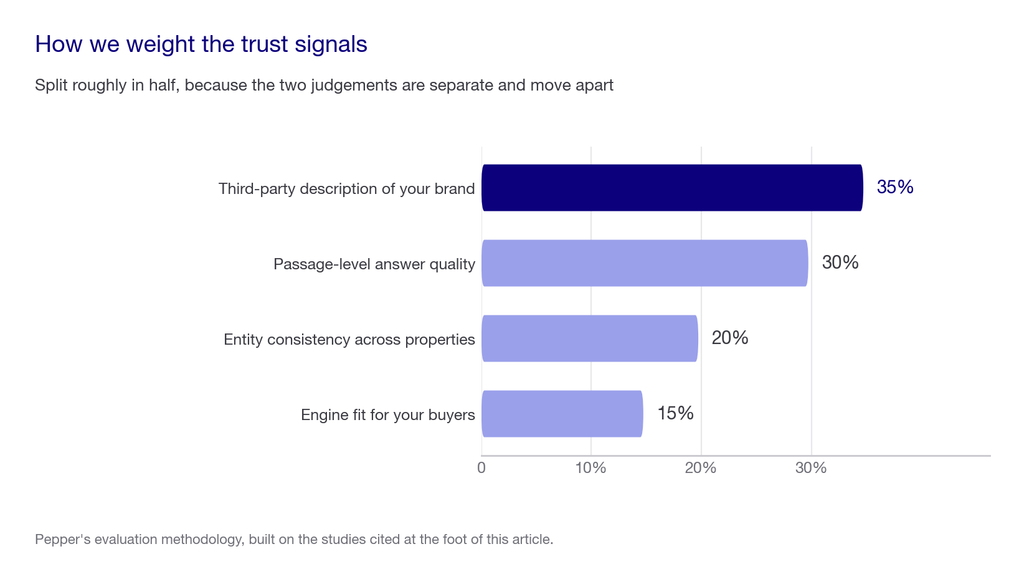
Our methodology: how we weight the signals
| Signal | Weight | Why it carries this much |
|---|---|---|
| Third-party description of your brand | 35% | Drives the mention half, where 84 percent of citations come from earned media |
| Passage-level answer quality | 30% | Drives the citation half, and it is the cheapest thing to change |
| Entity consistency across properties | 20% | An engine that cannot categorise you will not name you |
| Engine fit for your buyers | 15% | ChatGPT and Gemini sit at opposite ends of this split |
Trust signals at a glance
| Signal | Which half it moves | Typical 2026 cost | How fast it moves | Where it falls short |
|---|---|---|---|---|
| Third-party coverage | Mentions | The largest line item, and slowest | Three to six months | You do not control what they write |
| Review platform presence | Mentions | Time, plus listing fees | One to three months | Buying reviews is detectable |
| Comparison content | Mentions | A few days per page | Weeks | Only works if it is honest about rivals |
| Entity consistency | Mentions | Internal, about a day | Slow, but it gates the rest | Invisible in every dashboard |
| Answer-first structure | Citations | A day of editing per page | Weeks | Does nothing for the naming half |
| Original data | Both | The real cost, and the real return | Months | You have to actually have something |
| Platform plus a growth team | Both | Custom | Varies | Still gated by how fast others publish |
How to choose which half to fix
The diagnosis takes an afternoon and it decides the whole quarter.
The scorecard
Score your position out of 100.
| Factor | Weight | How to score it honestly |
|---|---|---|
| You track named and cited separately | 30% | Two numbers per engine appear in the report, rather than one blended score |
| You know which engines your buyers use | 25% | Checked rather than assumed, since the two leaders behave in opposite ways |
| Third parties describe you accurately | 20% | You can name three independent sources and you have read what they say |
| Your pages answer in the first two sentences | 15% | Someone has checked under every heading, not just the first |
| Your category description is consistent | 10% | The same sentence appears on every property you own |
The live test, over 90 days
Fix 30 prompts in your buyers’ words. Real ones, such as “best data observability tool for a small team”, “how much does sales enablement software cost”, “what are AI trust signals” and “Pepper vs other GEO platforms”.
Run them on Google, ChatGPT and Perplexity. Record two columns, kept apart: were you named, and was a page of yours cited.
Rerun the same set monthly for 90 days. Three readings is the shortest honest window. One is a snapshot, two could be noise, three shows direction. Keep the set fixed, because changing it resets the comparison.
Then read the two columns against each other. A wide gap in either direction tells you which half to fund, and that is the point of the exercise.
One caution on reading it. Check the gap per engine rather than pooled, because ChatGPT and Gemini pull in opposite directions. An average across both describes neither. A brand that looks balanced overall is often badly short on one surface and perfectly fine on the other. The free method for running this split sits in how to measure AI search visibility without expensive tools.
Weak approach versus strong approach
The weaker approach: track one blended visibility score, watch it stay flat, and add more content. A single number cannot tell a ghost citation from a missing one, so the work never gets aimed.
The stronger approach: split the number in two, find which half is short, then fund only that half.
One hides the diagnosis. The other produces a budget line you can defend.
Red flags
- A single visibility score. It cannot separate cited from named, which is the only question that matters here.
- Brand mention tracking on ChatGPT alone. It names brands about one time in five, so the number will look worse than reality.
- Citation tracking on Gemini alone. It cites about one time in five, for the same reason in reverse.
- More explainers as the answer to invisibility. Comparisons earn 2.4 times more mentions.
- Buying mentions. Paid and advertorial content is 0.3 percent of AI citations.
- Guaranteed mentions. Nobody controls generated output, and Google warns against guaranteed rankings.
Five questions worth asking
- “Are we cited, named, or neither?” Three different problems with three different fixes.
- “Which engines do our buyers use?” The two largest behave in opposite ways.
- “Who describes us besides us?” If nobody, the naming half has nothing to work with.
- “Do we publish honest comparisons?” They earn names better than explainers.
- “What would you stop doing?” Usually, publishing more of what is already cited and never named.
Reduced to one principle: measure cited and named apart, then fix only the one that is short.
One closing note that costs us something. If you are already cited often and simply not named, no amount of new content will fix it, ours included. That is earned-coverage work, it is slow, and it is a smaller engagement than a content retainer.
What does this cost?
| What you are buying | Typical 2026 cost | What it covers |
|---|---|---|
| The two-column diagnosis | Free, an afternoon | Thirty prompts, three engines, named and cited apart |
| Entity consistency | Internal, about a day | One description everywhere you control |
| Comparison content | A few days per page | The format that earns names |
| Answer-first editing | A day per page | The citation half |
| Earned third-party work | The largest line item | The mention half, where it actually lives |
| Multi-engine tracking | Roughly $99 to $400 a month | Both numbers, per engine, with history |
| Platform plus a growth team | Custom | Pepper: tracking, plus the people and agents doing the work |
The first row is free and it tells you which of the rows below you need.
What nobody should promise you
A guaranteed mention. Nobody controls generated output, and Google warns against providers guaranteeing rankings.
That citations turn into mentions on their own. Nearly two thirds of appearances are citations with no mention, and that is the steady state.
One number that captures AI trust. The two halves move apart, and often in opposite directions on different engines.
That paid placement buys trust. Paid and advertorial content accounts for 0.3 percent of AI citations.
When this is not your problem
The answer that costs us the sale. If you are both cited and named on most of your thirty prompts, you do not need this work and we would tell you to spend the budget elsewhere.
That is rarer than you would think, since the measured rate is about one in eight. Check before you assume either way. The test above is free, takes an afternoon, and it is the same first step we would run on your account.
Frequently asked questions
What are AI trust signals?
The things an engine reads to decide two separate questions: whether to use your page as a source, and whether to say your brand name. Those are different judgements, and most brands earn the first without the second.
What is a ghost citation?
A ghost citation is when an AI cites your site without naming you, so the reader gets your answer with no way to recognise you. Across 3,981 measured appearances, 61.7 percent were ghost citations.
How often do AI engines name the brands they cite?
Rarely. Only 13.2 percent of appearances in the study were both cited and mentioned, while 61.7 percent were citations without a mention and 25.1 percent were mentions without a citation.
Which engine mentions brands most?
Gemini, by a wide margin. It showed an 83.7 percent mention rate against a 21.4 percent citation rate. ChatGPT runs the other way, citing at 87 percent and mentioning at 20.7 percent.
Why am I cited but never mentioned?
Because the engine trusts your page and not your name. That is a brand problem rather than a content one, and it is fixed by other people describing you accurately, not by publishing more yourself.
Does content format affect brand mentions?
Yes, measurably. Comparative queries produced 2.4 times more brand mentions than informational ones, so honest comparison pages earn names better than another explainer does.
Do short or long prompts produce more mentions?
Short ones, by a wide margin. Short conversational prompts generated 30 to 50 times more brand mentions than long structured prompts in the same study.
How do I fix low AI trust?
Diagnose first. If you are cited and not named, work on third-party coverage and entity consistency. If you are named and not cited, make your pages answer in the first two sentences and add something a model cannot compose.
Where to go next
Run thirty of your buyers’ questions and record two columns: were you named, and were you cited.
If one column is far shorter than the other, you have your answer and your budget line. That check costs an afternoon and it is the only way to tell the two problems apart.
Learn AI Search · Fix the mention half · Book a growth audit
Sources and further reading
Primary studies
- Semrush and Kevin Indig. “The Ghost Citations Study”, published 9 June 2026, run with Growth Memo using the Semrush AI Visibility Toolkit. 3,981 domain appearances across 115 prompts, 14 countries and four engines: ChatGPT, Google AI Overviews, Gemini and Google AI Mode. 61.7 percent ghost citations, 13.2 percent both cited and mentioned, 25.1 percent mentions without citations. Gemini 83.7 percent mention rate against 21.4 percent citation rate. ChatGPT 87 percent citation rate against 20.7 percent mention rate. Google AI Mode mention rate nearly double ChatGPT’s. Short conversational queries produced 30 to 50 times more brand mentions than long structured prompts, and comparative queries 2.4 times more than informational ones. The authors do not state a data collection window, and 115 prompts is a small set, so we treat the proportions as directional. Link
- Muck Rack. “What Is AI Reading?” May 2026. More than 25 million cited links across ChatGPT, Claude and Gemini. 84 percent of citations from earned media, 0.3 percent from paid. Link
- BrandMentions, 21 September 2026. Roughly 410,000 brand mentions across 240 brands. Repeatedly visible brands drew 70 to 80 percent of their mention footprint from third parties, against 30 to 40 percent for rarely visible ones. Link
Further reading
- Google Search Central. AI search optimisation guidance, 15 May 2026. Warns against providers guaranteeing rankings.
- Pepper. Brand visibility in AI search for measuring the two halves apart, earned authority for the mention half, and what AI engines actually cite for the citation half.
- Deliberately excluded: an analysis of 23,000 AI citations reporting earned media at 48 percent of citations on branded queries, because the source returned an error when we tried to open it. Also excluded, any brand authority correlation coefficient, since the ones circulating do not publish their samples.
Latest Blogs
The research pulls in two directions. Fan-out rewards covering many adjacent questions; absorption research finds longer pages get used. The resolution is that the passage competes, not the page.
Seven documented changes, not seven predictions. Google switched two rich results off, shipped two new AI reports, and added a channel to Analytics. Here is what actually moved and what it means.
Content chunking is the process of splitting a page into smaller pieces so a machine can retrieve one of them. Here is the part most articles get wrong: chunking is something engines do to your page, not something you do to it. You do not choose the chunk size.
Get your hands on the latest news!