The short answer
“What are the best AI SEO tools” has no single answer, and the honest reason is structural rather than evasive.
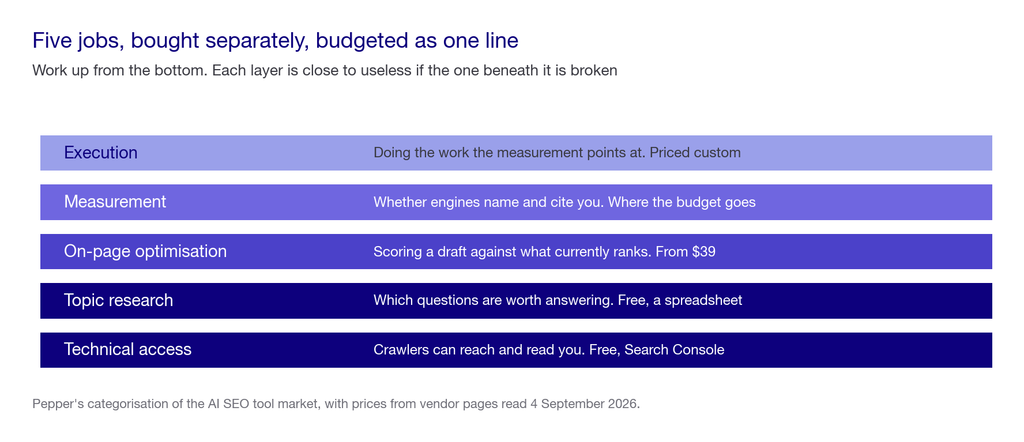
The category is not one market. It is five different jobs, bought separately and often from different vendors. Most teams bundle them into one budget line by accident. Two of those five jobs are completely free and most teams have not switched them on.
Key takeaways
- Five jobs, not one category. Measurement, on-page optimisation, technical access, topic research and execution. Different winners in each.
- Two of the five cost nothing. Technical access and basic research run on Search Console, Bing Webmaster Tools and a spreadsheet.
- Measurement is where the money goes, and where the prices vary most. Entry plans run from $29 to $295 a month depending on vendor.
- Integration is the question nobody asks in a demo. Whether a tool reads your Search Console, exposes an API and lets you export your history matters more at month twelve than the dashboard does at month one.
- Buying one tool for all five jobs is the common mistake. No vendor is best at all of them. The ones claiming to be are usually strongest at exactly one.
Where this comes from. We build one of these tools, and we run organic for more than 250 enterprises at Pepper while tracking over 10 million prompts across every major engine. That work shapes the view here, along with the client reviews we sit in every week and the conversations we have with buyers at the events we run. So weigh it as our read rather than a neutral survey. Every price below was read from the vendor’s own pricing page, and the dates are stated.
What are the best AI SEO tools?
By job, because that is the only way the question has an answer.
- Measurement, and you want coverage: AthenaHQ, at ten models on its Starter plan and five on a genuinely free tier.
- Measurement, and you want value: Trakkr, at $100 a month for 50 prompts. All eight models are included on every tier.
- Measurement, and you want the cheapest real entry: Otterly, at $29 a month for 15 prompts across four engines.
- Measurement, and you need enterprise depth: Profound, reaching up to nine answer engines on Enterprise with agent analytics.
- On-page optimisation: Clearscope for editorial quality at $129 a month, Surfer for breadth at $49 to $299, Frase for value at $39.
- Technical access and first-party data: Google Search Console and Bing Webmaster Tools. Free, permanently, and the only tools here reporting your own data rather than a sample. The audit that uses them is in the free AI visibility audit.
- Topic research: a spreadsheet and thirty prompts. Free, and better than any paid alternative because you choose the questions. The method is in how to find the topics AI engines answer.
- Execution: AirOps, or Pepper where you want the team alongside the tooling.
Nobody wins two categories outright. That is the finding, and it is why the stack matters more than the shortlist.
See where you show up. Pepper’s GEO platform tracks Brand Visibility, Domain Prompt Presence and Share of Voice across ChatGPT, Perplexity, Gemini, Claude and Google AI Overviews. Your team can log in, connect Search Console and GA4, manage the prompt set and run your own agents in the Agent Atlas. A growth team works the same account alongside you. Book a growth audit or see where you show up.
The five jobs, and which layer you are actually shopping for
Most confusion in this category comes from buying at the wrong layer.
Work up from the bottom. Each layer is close to useless if the one beneath it is broken, and the bottom two are free.
What each job costs to enter
The spread is the point. Two jobs are free, one is cheap, and one carries almost all the budget.
Technical access and topic research cost nothing. On-page optimisation starts at $39 a month. Measurement starts at $29 and rises fast once you need real prompt volume and more engines.
Execution is the odd one out, because it is priced as custom almost everywhere and is really a people question wearing a software label.
Where the engine counts mislead you
Headline engine coverage is the most commonly misread number in this category.
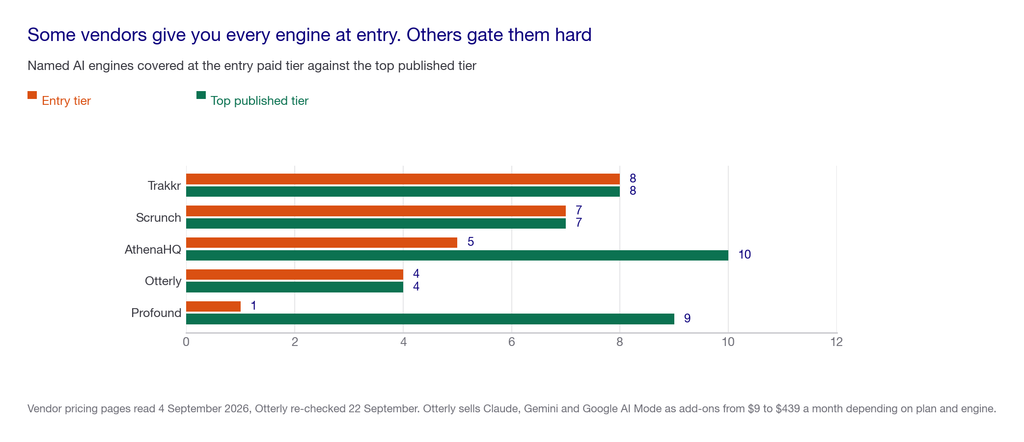
Otterly advertises four engines as standard: ChatGPT, Google AI Overviews, Perplexity and Copilot. Claude, Google AI Mode and Gemini are paid add-ons ranging from $9 to $439 a month, depending on plan and engine. So a four-engine tool becomes a seven-engine bill, and the size of that bill depends on your tier.
Trakkr goes the other way, including all eight models on every tier at $100 a month. Profound covers up to nine on Enterprise but tracks ChatGPT only on its $99 Starter plan.
The engines also differ in how often they cite anybody at all, which is why a blended cross-engine score means little. We set that out in the top AI search engines.
The question nobody asks in a demo
This is the Integrations half, and it is where a tool becomes useful or becomes a screenshot.
Three questions decide it, and none of them is about the dashboard.
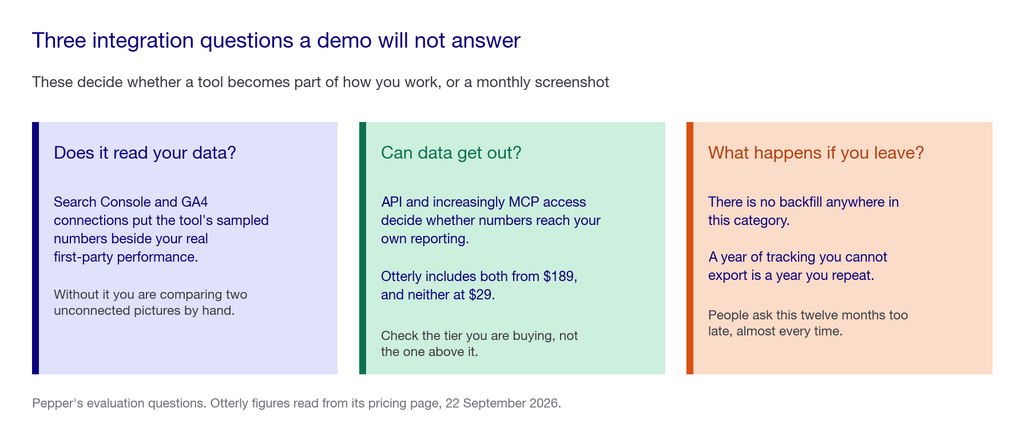
- Does it read what you already have? Search Console and GA4 connections let the tool see your real first-party performance beside its own sampled data. Without that you compare two unconnected pictures by hand.
- Can you get data out? API access, and increasingly MCP access, decide whether the numbers reach your own reporting. Otterly includes both from its $189 Standard plan and neither on its $29 Lite tier. That gap is easy to miss when comparing prompt counts alone.
- What happens to your history if you leave? There is no backfill anywhere in this category. A year of tracking you cannot export is a year you repeat. People ask this twelve months too late.
A tool that scores well on all three becomes part of how you work. A tool that scores badly becomes a monthly screenshot in a slide.
Our methodology: how we weighted the tools
| Criterion | Weight | What that means here |
|---|---|---|
| Fit for a named job | 35% | We scored tools within their layer rather than against each other across layers |
| Integration and data portability | 25% | Search Console and GA4 connections, API or MCP access, and whether history exports |
| Published, comparable pricing | 25% | A price on the vendor’s own page with a countable allowance beside it |
| Engine coverage after add-ons | 15% | Named engines at the price you would actually pay |

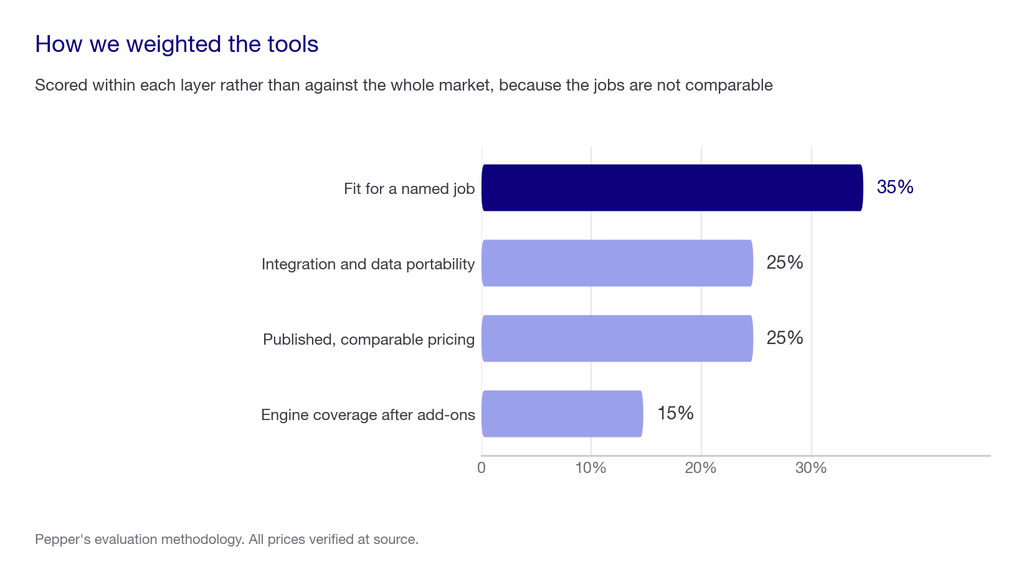
Figure 4: Tools scored within their layer rather than against the whole market, because the five jobs are not comparable. Source: Pepper’s evaluation methodology.
The best AI SEO tools of 2026, at a glance
| Job | Best for coverage | Best for value | Entry price | Free option | Where it falls short |
|---|---|---|---|---|---|
| Measurement | AthenaHQ, 10 models | Trakkr, 8 models at $100 | $29 to $295/mo | AthenaHQ Essential, 5 engines | Polling, not analytics, so two tools disagree |
| On-page optimisation | Surfer, 5 engines tracked | Frase at $39 | $39 to $129/mo | None ongoing | Scores similarity to ranking pages, not quality |
| Technical access | Search Console and Bing | Both, they are free | Free | Yes, permanently | Google and Microsoft surfaces only |
| Topic research | A spreadsheet | A spreadsheet | Free | Yes | Does not scale past a few hundred prompts |
| Execution | AirOps, agent workflows | Depends on your team | Custom | None | Priced as software, resourced as people |
Prices read from each vendor’s own pricing page on 4 September 2026, with Otterly re-checked on 22 September 2026 and unchanged. This category repackages often, so confirm before committing.
Where Pepper sits, and where it does not
We build in the measurement and execution layers, so apply the scepticism you would to any vendor writing this article.
Pepper tracks Brand Visibility, Domain Prompt Presence and Share of Voice across five engines. It connects to Search Console and GA4, and runs the work the tracking points at through the Agent Atlas. Customers log in and run it themselves, with a growth team on the same account.
- Where that is the right fit: when the constraint is closing the gap rather than seeing it, and nobody internally has the hours.
- Where it is not, stated plainly: buy Otterly at $29 or Trakkr at $100 if you want the cheapest dashboard and already have a capable team. Trakkr includes eight models on every tier, which is better raw coverage per pound than we sell.
- Where we are equally blind: Microsoft Copilot usage inside enterprise tenants is invisible to every external tool, including ours.
Deeper comparisons live in citation tracking tools for the ranked pricing analysis, and AI visibility trackers for how the mechanism works.
How to choose an AI SEO tool stack
Buy by layer, in order, and stop when the next layer does not yet have a job to do.
The scorecard
Score any candidate out of 100, within its layer rather than against the whole market.
| Factor | Weight | How to score it honestly |
|---|---|---|
| Solves one named job well | 30% | You can say which of the five jobs this replaces, in one sentence |
| Reads your first-party data | 20% | Search Console and GA4 connect, so its sample sits beside your real numbers |
| Data gets out | 20% | API or MCP access on the tier you are actually buying, not two tiers up |
| Allowance matches your real need | 20% | Prompt counts and engine coverage priced after add-ons |
| History survives departure | 10% | You can export a year of tracking without asking permission |
The live test, over 90 days
Before any demo, fix 30 prompts in your buyers’ words. Real questions, such as “what are the best AI SEO tools”, “which platform tracks Claude and Perplexity together”, “how much does data observability cost” and “how do I check if AI bots can crawl my site”.
Hand the identical list to every vendor on the shortlist. Ask each to show you, inside the trial, where you appear today and which sources are influencing the answers you are missing from.
Then run the same thirty yourself, monthly, for 90 days. Three readings is the shortest honest window. One is a snapshot, two could be noise, three shows direction. Keep the set fixed, because changing it resets the comparison.
This does two things at once. It shows whether each vendor’s numbers match what you see yourself, and it stops you buying volume you never use.
Weak approach versus strong approach
The weaker approach: search for the best AI SEO tool, shortlist five from a roundup and sit four demos. Buy the best dashboard, and you get a tool doing one job well and four badly.
The stronger approach: name which of the five jobs you actually have a problem in. Switch on the two free layers first. Then buy only for the layer that is genuinely blocked.
The weak version buys a product. The strong version buys a missing capability, and most teams find the missing capability is free.
Red flags
- A tool claiming to cover all five jobs. Nobody is best at all of them, and the claim usually means strong at one.
- Engine counts quoted before add-ons. Otterly’s headline four becomes seven only if you pay between $9 and $439 more.
- API access two tiers above the one you are buying. Check which plan actually carries it.
- No Search Console or GA4 connection. The tool’s sample will never sit beside your real performance.
- No export path. A year of tracking you cannot take with you is a year you will repeat elsewhere.
- Guaranteed citations or visibility scores. Nobody controls generated output, and Google warns against providers guaranteeing rankings.
Five questions worth asking
- “Which of the five jobs does this replace?” If the answer is all of them, it is a marketing answer.
- “Does it connect to Search Console and GA4, on our tier?” The qualifier matters.
- “Is API or MCP access on the plan we are buying?” Not on the plan above it.
- “Which engines cost extra, and how much on our tier?” The add-on price varies by plan.
- “How do we export a year of history if we leave?” Ask before you have a year in there.
Reduced to one principle: buy for one named job at a time, and switch on the free layers first.
One closing note that costs us something. Two of the five jobs are free and most teams have not enabled them, ours included in the general point that every vendor in this category would rather sell you the paid layer. Enable Search Console and Bing Webmaster Tools before you buy anything from anyone, us included.
What does a full stack cost?
| What you are buying | Verified 2026 price | What it covers |
|---|---|---|
| Technical access | Free | Search Console and Bing Webmaster Tools, your own first-party data |
| Topic research | Free, about two hours a month | Thirty prompts across three engines in a spreadsheet |
| A measurement baseline | Free credits | AthenaHQ Essential, five engines, enough for one proper reading |
| Entry measurement | $29 to $100 a month | Otterly Lite or Trakkr Growth |
| On-page optimisation | $39 to $129 a month | Frase Starter through Clearscope Essentials |
| Serious measurement | $189 to $500 a month | Otterly Standard or Premium, Trakkr Scale, Scrunch Growth |
| Platform plus a growth team | Custom | Pepper: tracking, plus the people and agents doing the work it points at |
A realistic small-team stack is two free tools, one $39 editor and one $100 tracker. That is roughly $139 a month, and it covers four of the five jobs.
What nobody should promise you
A single tool that covers all five jobs well. The category does not work that way, and the vendors making the claim are strongest in one layer.
Complete coverage of AI search. Copilot inside enterprise tenants is invisible to every external tool.
A precise visibility percentage. These tools poll rather than observe, so they sample, and samples carry error nobody in the category publishes.
Historical data from before you started. There is no backfill anywhere here, which is the one honest argument for starting sooner.
When you do not need any of this
The answer that costs us the sale. If nobody has time booked to act on what a dashboard shows, you do not need a paid tool in any of these five layers and we would tell you not to buy one.
Switch on Search Console and Bing Webmaster Tools, which are free. Run thirty prompts by hand once a month. That covers two of the five jobs properly and costs two hours. Buy software when the manual run stops fitting in an afternoon, or when somebody asks for history you did not capture.
Frequently asked questions
What are the best AI SEO tools in 2026?
There is no single best, because the category splits into five jobs. AthenaHQ leads on engine coverage, Trakkr on value and Otterly on cheapest entry. Clearscope leads on editorial quality, and Search Console on first-party data. Pick by job rather than by ranking.
How much do AI SEO tools cost?
Measurement starts at $29 a month with Otterly Lite and runs past $500 for serious prompt volume. On-page editors start at $39 with Frase. Technical access and topic research cost nothing, on Search Console, Bing Webmaster Tools and a spreadsheet.
Which AI SEO tools are free?
Google Search Console and Bing Webmaster Tools are permanently free and report your own data rather than a sample. AthenaHQ offers a genuinely free tier across five engines, which is enough to establish one baseline.
Do I need separate tools for AI search and traditional SEO?
Usually not at the technical layer, since Search Console covers both. You may need a separate measurement tool. Classic rank trackers do not report whether engines name or cite you across ChatGPT, Perplexity and Claude.
Which tool covers the most AI engines?
AthenaHQ lists ten models on its Starter plan and Profound reaches nine on Enterprise. Trakkr includes eight on every tier, which is unusual. Most vendors reserve full coverage for higher plans, or sell engines as add-ons.
What should I check that a demo will not show me?
Three things. Whether it connects to Search Console and GA4 on your tier, whether API or MCP access sits on the plan you are buying, and how you export a year of history if you leave.
Why do engine counts vary so much between vendors?
Because add-ons are common. Otterly advertises four engines as standard and sells Claude, Gemini and Google AI Mode separately, at between $9 and $439 a month depending on plan and engine.
Can one tool replace my whole SEO stack?
No, and claims to the contrary usually mean the vendor is strong in one layer. The five jobs are bought separately and two of them are free. A single-vendor stack normally means overpaying for a layer you already had.
Where to go next
Before you shortlist anything, name which of the five jobs is actually blocked. Most teams find the answer is measurement, and that the two free layers beneath it were never switched on.
Then price only that layer, with add-ons included, on the tier you would really buy.
Learn AI Search · Compare citation tracking tools · Explore Pepper’s platform
Sources and further reading
- Otterly. Pricing page, read 4 September 2026 and re-checked 22 September 2026 with no change. Lite $29 with 15 prompts, Standard $189 with 100 prompts, Premium $489 with 400, Enterprise from 1,000 prompts. Four engines standard: ChatGPT, Google AI Overviews, Perplexity and Copilot. Claude, Google AI Mode and Gemini sold as add-ons ranging from $9 to $439 a month depending on plan and engine. API and MCP access included from the Standard plan.
- Trakkr. Pricing page, read 4 September 2026. Growth $100 with 50 prompts and all eight models on every tier, refreshed daily. Scale $500 with ten brands. Enterprise from $790 billed annually.
- Profound. Pricing page, read 4 September 2026. Starter $99 with 50 prompts tracking ChatGPT only. Growth $399 with 100 prompts across three engines. Enterprise up to nine answer engines.
- Scrunch. Pricing page, read 4 September 2026. Starter $250 billed annually or $300 monthly, Growth $417 or $500, across seven named engines. Prompt allowances not published.
- AthenaHQ. Pricing page, read 4 September 2026. Essential free with roughly 300 credits across five engines. Starter $295 with 3,600 credits across ten models.
- Surfer, Clearscope, Frase and MarketMuse pricing pages, read 4 September 2026. Surfer $49 to $299 with AI Search Analytics sold separately at $158. Clearscope $129 Essentials and $399 Business. Frase $39 Starter to $239 Scale. MarketMuse publishes no pricing.
- Google Search Central. AI search optimisation guidance, 15 May 2026. Warns against providers guaranteeing rankings.
- Pepper. Citation tracking tools compared on price per tracked prompt, how AI visibility trackers work, and the free measurement method.
- Deliberately excluded: any vendor’s own accuracy or coverage benchmark, and any figure for the share of AI traffic each engine represents. Neither is externally checkable.
Latest Blogs
Most advice on this is inference dressed as fact. OpenAI documents exactly one thing clearly, which is access. Here is what is documented, what is inferred, and how to verify the rest for yourself.
Being named in an AI answer and having your page used as its source are different outcomes with different causes and different fixes. The gap between them is the most useful diagnostic in AI search, and most reporting collapses it into one number.
Every platform reports share of voice and almost none of them define it the same way. Here is the definition worth using, the three choices that change the number, and how to measure it yourself without buying anything.
Get your hands on the latest news!