Profound pricing, reviews and alternatives: a 2026 buyer’s breakdown
The short answer
Profound does not publish prices any more. Its pricing page today shows a free trial and a custom Enterprise tier. The $99 and $399 plans still quoted across the web, including on one of our own pages, are gone. The trial is specified precisely and is worth taking: 50 prompts run daily for seven days across three engines, with unlimited seats and unlimited domains. On reviews, the counts in circulation disagree by roughly eight to one, so we publish no rating.
Key takeaways
- The published tiers are withdrawn. Read at source on 29 September 2026, the pricing page shows Trial: Free and Enterprise: Custom. Nothing else.
- What is gone: Starter at $99 a month with 50 prompts on ChatGPT only, and Growth at $399 a month with three engines and 9,000 monthly responses.
- Our own page is stale on this, and we say so below. It still quotes the old tiers, and it needs updating.
- The trial is genuinely good and precisely specified. 50 unique prompts, run daily for seven days, across ChatGPT, Gemini and Google AI Overviews, with unlimited seats and unlimited domains tracked.
- Enterprise is well described even without a price. Up to nine answer engines, plus SSO, SAML, SOC 2, full data history, CSV and JSON export, and API access.
- On reviews we publish nothing. Counts in circulation run from 140 to more than 1,100 for the same product, and the source that would settle it blocks automated checking.
- Pepper is an agentic organic growth engine and an organic growth partner. Agent Atlas puts the agents in your team’s hands. Pepper’s GEO platform reports Brand Visibility, Domain Prompt Presence and Share of Voice. A growth team works alongside yours. Eight years, more than 250 enterprises, more than 10 million tracked prompts.
A note on where this comes from. I spend my time on why buyers choose what they choose. The most common reason a platform evaluation goes wrong is that somebody compared a price from one source with a feature list from another. Pepper runs organic for more than 250 enterprises over eight years and tracks more than 10 million prompts across every major engine, and Profound is a company we come up against regularly.
Disclosure: Pepper competes with Profound. That is the most important sentence on this page. We have therefore restricted ourselves to what Profound publishes on its own site, read on 29 September 2026. We have not rated it, ranked it or scored it against ourselves. Where we could not verify something, we say so rather than filling the gap. Competitors are named but never linked.
What is Profound pricing in 2026, and why is there no figure?
Nothing published. The pricing page shows two options and neither carries a figure.
That is the honest answer, and it is a change. Earlier in 2026 Profound published a self-serve ladder. Most comparison pages on the web still quote it.
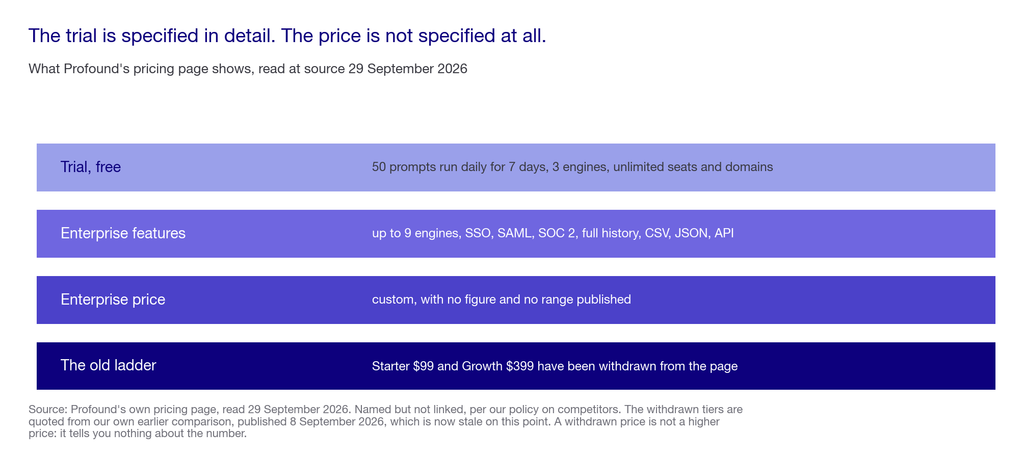
What the page shows today.
- Trial, free. Limited AI Marketer credits, 50 unique prompts run daily for seven days, across ChatGPT, Gemini and Google AI Overviews, with unlimited seats and unlimited domains tracked.
- Enterprise, custom. AI Marketer credits for the whole team, a tailored prompt tracking plan, up to nine answer engines, dedicated support, SSO and SAML, SOC 2, custom tracking across multiple languages and regions, full data history, CSV and JSON exports, and API access.
What has gone. The tiers that most pages still quote were Starter at $99 a month, ChatGPT only, 50 tracked prompts and 1,500 monthly responses; and Growth at $399 a month, three answer engines, 100 prompts and 9,000 monthly responses.
Including on one of ours. Our own comparison of Profound alternatives was published on 8 September 2026, and it still quotes those figures. They were correct when it published and they are not correct now. That page needs updating, and saying so here is cheaper than leaving a reader to find the contradiction.
If you would rather know what your own category’s answers look like than chase a competitor’s price list, book a growth audit and we will run your prompts with you.
Where it falls short: a withdrawn price is not a higher price. Enterprise pricing may be lower or higher than the old ladder implied, and a page with no figure tells you nothing about the number, only that you will have to ask for it.
What the free trial actually gives you
This is the part of Profound’s pricing page that is most useful and least discussed, so it is worth pulling out.
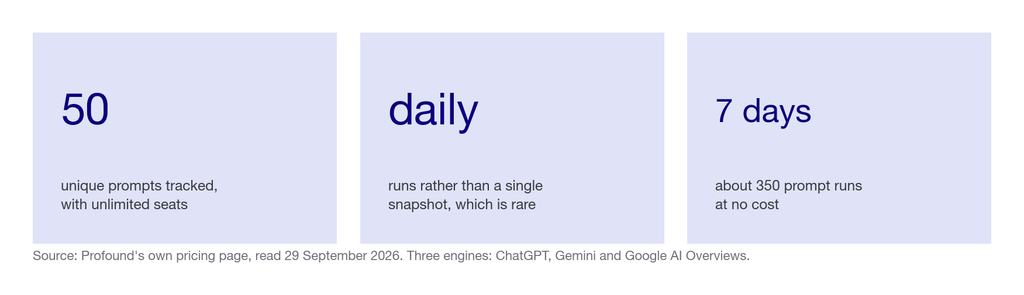
Fifty prompts, run daily, for seven days, is about 350 prompt runs at no cost. So for a buyer trying to answer the existence question in their category, that is a meaningful sample rather than a demonstration.
Three things make it more useful than most trials in this category.
- Daily runs. Most trials give you a snapshot. By contrast, a daily run for a week lets you see how much the answer moves between runs, which is the thing almost nobody in this category publishes. Our own sampling arithmetic explains why that variation matters more than the headline number.
- Three real engines. ChatGPT, Gemini and Google AI Overviews rather than one.
- Unlimited seats and domains. You can put the whole team in it and look at competitors as well as yourself.
What to do with it. Load the 25 buying questions your sales team actually gets asked. Run them for the full seven days, and record how much the answer changes between day one and day seven. You will learn two things. First, whether engines answer questions in your category at all. Second, how noisy the signal is before you commit to any platform.
Where it falls short: seven days is not long enough to see a trend, only variation, and the trial covers three of the nine engines the Enterprise tier reaches. Treat it as a diagnostic rather than a pilot.
On reviews, we are publishing nothing, and here is why
The commissioned question asked about reviews. We looked, and then decided not to give you a number.
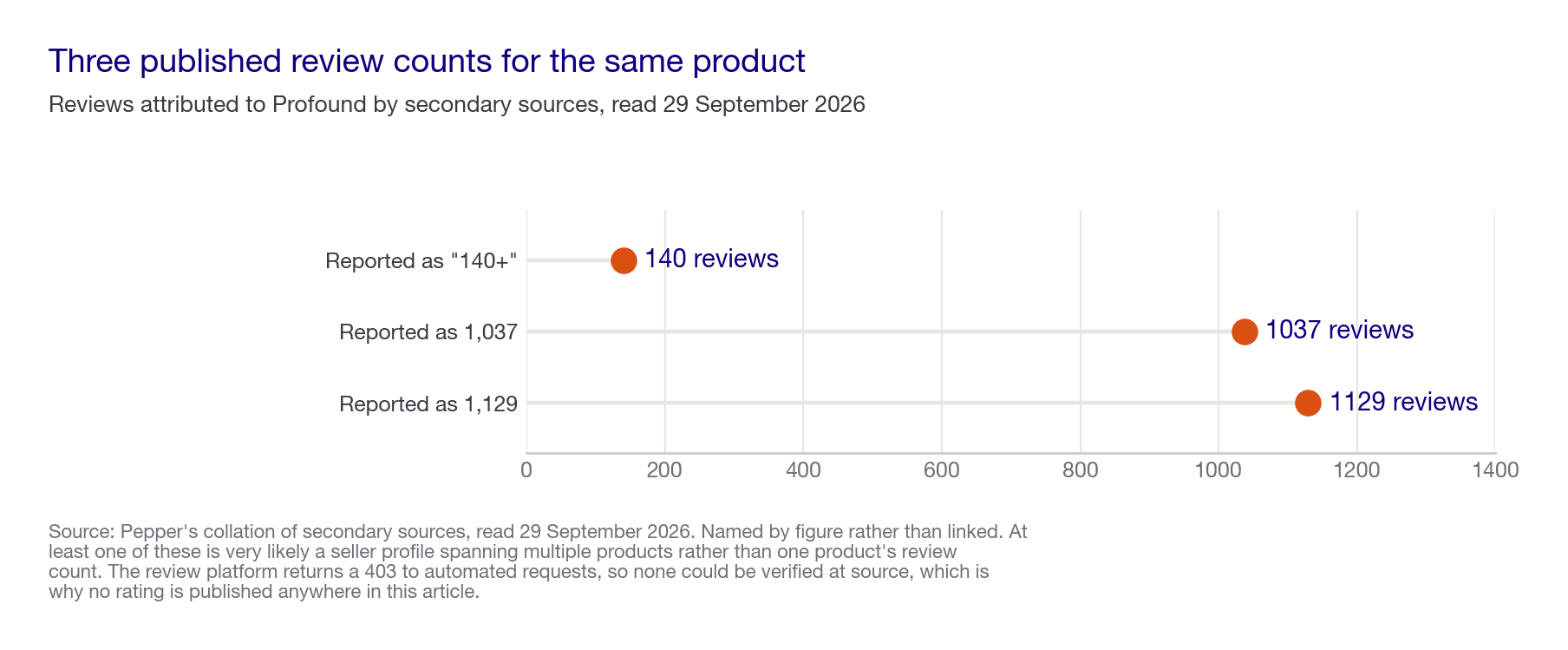
The counts in circulation for Profound do not agree. Secondary sources variously report more than 140 reviews, 1,037 reviews and 1,129 reviews, with ratings quoted at 4.5 and 4.6 out of five. Those cannot all describe the same thing. In fact at least one is very likely a seller profile spanning multiple products rather than a single product’s review count.
And the source that would settle it blocks automated checking. The review platform returns a 403 to any automated request, so we could not verify any figure at source.
So we publish no rating. This run of articles has spent several weeks criticising vendors for quoting numbers with no verifiable method. Publishing an aggregate rating we could not check would be the same error with our name on it.
What to do instead, and it is better anyway. Read ten recent reviews yourself and ignore the average. Averages in this category are dominated by how hard a vendor pushes for reviews rather than by product quality. The useful signal sits in what the negative reviews complain about, whether those complaints touch things you care about, and whether they are recent.
Where it falls short: this is an absence rather than a finding. Profound may well have an excellent and well-earned rating. We are saying we could not verify one, not that it is bad.
How we weighted this assessment
Four criteria, fixed before we read anything. They are our priorities, not measured coefficients.
| Criterion | Weight | What it means |
|---|---|---|
| Verifiable at source | 40 | We read it on the company’s own page today, rather than repeating a number from a comparison site |
| Useful before a sales call | 25 | A buyer can act on it without entering a pipeline, which is the whole point of published information |
| Stated with its unit | 20 | A figure comes with what it buys, so 50 prompts means 50 prompts run at a stated frequency |
| Current, with a read date | 15 | The claim carries the date it was checked, because this category changes within weeks |
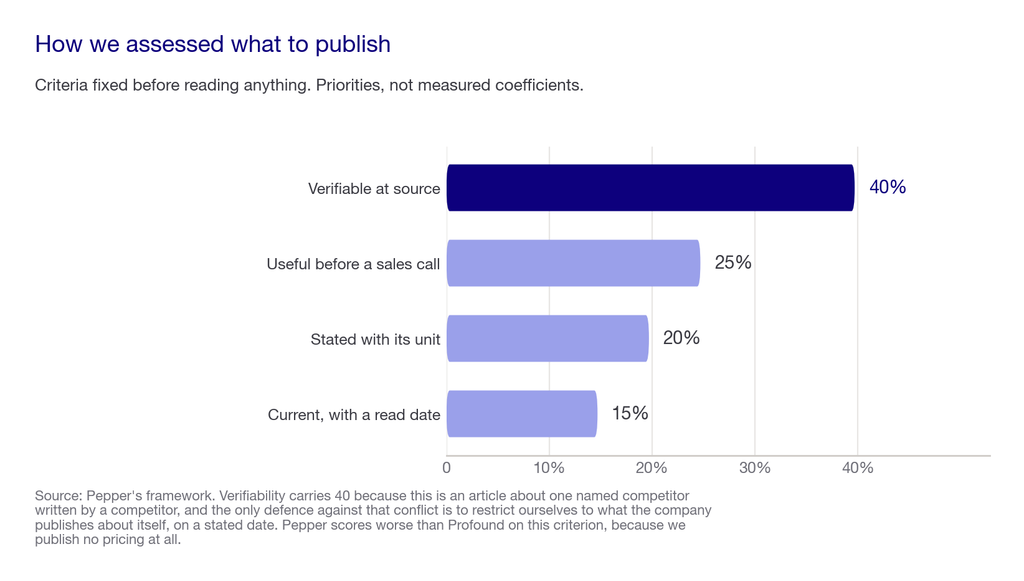
Why verifiability is weighted so heavily here. This is an article about one named competitor, written by a competitor. So the only defence against that conflict is to restrict ourselves to what the company says about itself, in public, on a stated date.
Where it falls short: these criteria guarantee accuracy rather than completeness. Everything Profound does not publish stays invisible to this method, and a great deal of what matters about any platform sits in that category.
Profound at a glance
| What a buyer wants | What Profound publishes | Verified | Where it falls short |
|---|---|---|---|
| A price | Nothing. Trial free, Enterprise custom | 29 Sep 2026 | You cannot budget without a call |
| Trial scope | 50 prompts, daily, 7 days, 3 engines, unlimited seats and domains | 29 Sep 2026 | Seven days shows variation, not trend |
| Engine coverage | Up to 9 on Enterprise, including Perplexity, Copilot, DeepSeek and Claude | 29 Sep 2026 | The nine are an Enterprise feature, not a trial one |
| Enterprise controls | SSO, SAML, SOC 2, multi-language and region | 29 Sep 2026 | Strong, and typical of the tier |
| Data portability | Full history, CSV and JSON export, API access | 29 Sep 2026 | Better disclosed than most of this category |
| Measurement method | No run-to-run variance figure published | 29 Sep 2026 | Same as every platform we have checked, ours included |
| Reviews | Not assessed here | Could not verify | Counts in circulation differ by roughly eight to one |
What this means for cost
- The old ladder is the wrong anchor. If you are budgeting from a $99 or $399 figure you read somewhere, you are budgeting from a page that is out of date.
- A withdrawn price usually means the buyer profile moved, not that the number rose. Treat it as a signal that self-serve is no longer the focus rather than as a price rise.
- The comparable market still publishes. Entry tiers elsewhere start around $29 a month, covered in our comparison of AI SEO tools, and several competitors publish full ladders.
- The trial is the cheapest evaluation available. 350 prompt runs across three engines for nothing is more than most paid entry tiers give you in a week.
- Budget for the engine add-ons wherever you land. Across this category the engine list moves the bill more than the prompt count does.
Alternatives, and how to think about them
We already publish a fuller treatment of this, so this section points rather than repeats. Our comparison of eight Profound alternatives covers Otterly, HubSpot AEO, Semrush AI Visibility, AthenaHQ, Scrunch, Peec AI, AirOps and Bluefish, with Pepper in a separate category. Note that its Profound pricing figures are the withdrawn ones, for the reason given above.
The more useful framing is what you are replacing. These products are not substitutes for each other.
- If you want cheaper prompt tracking, several platforms publish entry tiers and refresh rates, and our review of AI visibility platforms ranks them.
- If you want a defensible measurement method, ask every candidate for a run-to-run variance figure. None of the nine platforms we checked publishes one, so the vendor who will compute it on your prompt set during evaluation is telling you something real.
- If you want the work done rather than measured, a platform is the wrong purchase. That is a service question.
How Pepper fits
Pepper is an agentic organic growth engine and an organic growth partner, and we are a competitor to Profound, so treat this section as what it is.
- We are not a self-serve tracker and we are not trying to be. If you want the cheapest per-prompt tracking with a published ladder, several tools do that better than we do and two of them publish more about their sampling than we do.
- Pepper’s GEO platform reports three separated metrics. Brand Visibility for how often engines mention you, Domain Prompt Presence for how often they cite a page from your domain, and Share of Voice for your slice of the category. The gap between the first two is the citability diagnostic, described on our citation analysis page. See the platform.
- Agent Atlas puts the workflows in your team’s hands. System agents stay fixed, user agents stay editable and versioned, and customers log in and build and run their own inside Atlas.
- A growth team works alongside yours, which is the actual difference rather than a feature comparison.
- Proof rather than adjectives. Acceldata went from 85 to more than 300 top three keywords with 6X organic traffic growth. More in our case studies, and the B2B SaaS practice.
Where Pepper falls short, on this article’s own criteria. We publish no pricing at all, which scores worse than a company publishing a free trial and an Enterprise tier. We publish no run-to-run variance figure either. So on the two things this article treats as most important, Profound discloses more than we do on one and the same as us on the other.
How to evaluate Profound, or any platform in this category
I would run the trial before reading a single review, because seven days of your own data beats any aggregate rating.
The framing judgement first, anchored outside my own view. The IAB’s measurement framework, released 3 August 2026, splits AI visibility measurement into Directional and Decision-Grade, and reserves the second for methods with stated query volume, sample size and reproducibility. Read that as the question to put to every vendor. Then hold the other half, which is that the framework is voluntary and new, so nobody is obliged to answer it yet.
The Pepper view on top is narrower. In a category where nobody publishes variance, the trial is the only place you can measure it yourself, and Profound gives you seven days of daily runs to do exactly that.
Here is the 100 point scorecard I would run over any platform, including ours.
| Area | Weight | What a strong platform demonstrates |
|---|---|---|
| You can measure variance during the trial | 30 | Daily runs over enough days that you can see how much the same question moves without any work from you |
| Price is published with its unit | 25 | A figure attached to a prompt count and a refresh rate, so you can compare before entering a pipeline |
| Data is portable | 20 | Full history, a named export format and API access, confirmed in writing before you sign |
| Engine coverage is stated per tier | 15 | The engines are listed against the plan you would actually buy, not against the top plan |
| They will place themselves against the IAB tiers | 10 | Directional or Decision-Grade, with a reason, rather than treating the question as unfair |
Then run the live test, on us as readily as on anyone else. Take 25 buying questions from your own category, load them into every trial you can get, and run them for the full period. Hold the comparison for 90 days before committing, because engine behaviour drifts and one week shows variation rather than trend. Ask each vendor the same four questions. For example: “how much did our answers move between day one and day seven”, “what is the price for the plan that covers the engines we need”, “what do we keep if we leave”, “Directional or Decision-Grade”.
Ask them to come back with five things. The variance they observed on your set. The price with the unit attached. The export format. The engines on your likely tier. And their own tier placement under the IAB framework.
A vendor who shows you your own variance beats one with a better dashboard. And one whose price you cannot establish without three calls is telling you something real about how they sell.
The weaker way to buy this, and it is the common one. Read a comparison page. Take the prices from it. Shortlist on rating. Book demos. Then discover the prices came from an old page, the rating covered a different product surface, and the engines you need sit on a tier nobody quoted.
The stronger sequence. Run the free trials first. Measure your own variance. Get prices with units attached, from the vendor. Confirm export terms. Then compare. The distinction matters. The first sequence compares other people’s numbers. The second compares your own.
Red flags, each one something that actually happens in this category.
- A price quoted from a comparison page. Including ours. Check the vendor’s own page and note the date.
- A rating with no verifiable review count, where the counts in circulation differ by an order of magnitude.
- A trial that runs once rather than daily, which shows you a snapshot and hides the variance.
- Engine coverage quoted from the top tier when you will buy a lower one.
- No published export format, which means your history is not portable.
- No variance figure and no willingness to compute one during the trial.
- A guarantee of citations, which Google itself advises against in the equivalent case.
Five questions worth asking, and what a good answer sounds like.
- “What is the price for the tier that covers our engines?” A good answer is a number. A bad answer is a discovery call.
- “How much did our prompts move day to day in the trial?” A good answer is computed from your own trial data. A bad answer is that engines vary.
- “What do we keep if we leave?” A good answer names a format. A bad answer is a dashboard.
- “Which engines are on the tier we would actually buy?” A good answer distinguishes the tiers. A bad answer lists all nine.
- “Directional or Decision-Grade?” A good answer engages with the framework. A bad answer has not read it.
If I reduce this to one principle: use the trial to measure the thing nobody publishes. Every platform will show you a number. Only your own trial shows you how much that number moves.
The honest note that costs us something. Very few platforms are strong at data depth, sampling rigour, engine coverage and portability at once, and we would not claim uniform strength across all four either. On published disclosure specifically, Profound currently tells a buyer more about its trial than we tell a buyer about our pricing.
What nobody should promise you
Nobody should quote you Profound’s $99 or $399 tiers as current. They are not on the pricing page as of 29 September 2026. Any comparison still showing them has not been checked recently. That includes one of ours.
Nobody should publish an aggregate review rating without a verifiable count. The counts in circulation for this product differ by roughly eight to one.
Nobody should sell Decision-Grade measurement without publishing reproducibility, which no platform in this category currently does.
Nobody should promise a citation for a fee. Google advises against providers who guarantee rankings, because no external party has access to the ranking systems.
Where this stops working, including for us
If you need a published price to get budget approval before any vendor conversation, you do not need to shortlist Profound at all, and you should not shortlist us either. A company that has withdrawn its ladder is a poor fit for that process regardless of product quality, and several competitors still publish full tiers.
If your category has no measurable prompt demand, the trial will tell you that in a week and you should stop there rather than shortlisting anyone.
If you are already mid-contract, the switching cost is your lost baseline rather than the licence. Platforms count differently, so the trend does not travel.
Where Pepper falls short. We publish no pricing at all, which is worse on this article’s first criterion than publishing a trial and an Enterprise tier. We also publish no variance figure. This article is by a competitor, and those two facts are the fairest thing we can put next to it.
Where to go next
Start the trial this week, and load your own 25 buying questions rather than the sample set. Seven days of daily runs will tell you more than every comparison page combined, this one included.
Then get prices with units attached from every shortlisted vendor. For the adjacent decisions, our comparison of eight alternatives covers the field, our review of AI visibility platforms ranks them, our cost per tracked prompt comparison covers the cheaper end of the field, and which KPIs to use covers what to report once you have chosen. To see your own picture, see where you show up.
Frequently asked questions
How much does Profound cost in 2026?
It no longer publishes prices. As of 29 September 2026 the pricing page shows a free trial and a custom Enterprise tier. The Starter at $99 and Growth at $399 that many comparison pages still quote have been withdrawn.
What does Profound’s free trial include?
Fifty unique prompts run daily for seven days across ChatGPT, Gemini and Google AI Overviews, with limited AI Marketer credits, unlimited seats and unlimited domains tracked. That is roughly 350 prompt runs at no cost.
What is in Profound’s Enterprise tier?
A tailored prompt tracking plan, up to nine answer engines including Perplexity, Copilot, DeepSeek and Claude, dedicated support, SSO and SAML, SOC 2, multi-language and region tracking, full data history, CSV and JSON export, and API access.
Why did Profound stop publishing prices?
The company has not said. A withdrawn ladder usually signals a shift away from self-serve rather than a price rise, but that is an inference. What is certain is that a buyer can no longer budget without a conversation.
What is Profound’s review rating?
We are not publishing one. The review counts in circulation for this product range from more than 140 to over 1,100, the ratings quoted differ, and the platform that would settle it blocks automated verification. Read ten recent reviews yourself instead.
What are the best alternatives to Profound?
It depends what you are replacing. Our fuller comparison covers eight platforms including Otterly, Semrush AI Visibility, AthenaHQ, Scrunch and Peec AI. For cheaper prompt tracking, several publish entry tiers from around $29 a month.
Is Profound worth it for enterprise buyers?
The Enterprise tier is well specified on engine coverage, security controls and data portability, which are the things enterprise buyers usually check. Whether it is worth the unpublished price is a question only a quote can answer.
How should I evaluate any AI visibility platform?
Run the free trials with your own buying questions, measure how much your answers move between runs, get prices with units attached, and confirm what you keep on exit. Do that before reading any aggregate rating.
Sources and further reading
- Profound’s own pricing page, read at source on 29 September 2026 and named but not linked, per our policy on competitors. Source of the free trial specification (50 unique prompts run daily for seven days across ChatGPT, Gemini and Google AI Overviews, limited AI Marketer credits, unlimited seats, unlimited domains) and of the Enterprise description (up to nine answer engines, dedicated support, SSO and SAML, SOC 2, multi-language and region tracking, full data history, CSV and JSON export, API access). The page shows no prices. Limitations: this records what the page published on one day, and this category changes within weeks.
- Pepper, alternatives to Profound: eight modern AEO platforms compared, published 8 September 2026. Source of the withdrawn tiers quoted in this article, namely Starter at $99 a month and Growth at $399 a month. Those figures were correct on publication and are no longer current, which this article states and that page should be updated to reflect.
- Review counts for Profound as reported by secondary sources, read 29 September 2026: more than 140 reviews, 1,037 reviews and 1,129 reviews, with ratings quoted at 4.5 and 4.6 out of five. The review platform returns a 403 to automated requests, so none of these could be verified at source and no rating is published here.
- IAB, Measuring Visibility in the AI Era, released 3 August 2026. Source of the Directional and Decision-Grade distinction used in the evaluation section.
- Pepper, the AI visibility platforms we reviewed and the citation monitoring price comparison. The ranked field and the cost-per-tracked-prompt view.
- Pepper, AI search tracking and the sampling arithmetic. Why run-to-run variation matters more than the headline number, and what to measure during a trial.
- Google Search Central, guide to optimizing for generative AI features, page last updated 10 July 2026. Source of the advice against providers guaranteeing rankings.
Latest Blogs
Most advice on this is inference dressed as fact. OpenAI documents exactly one thing clearly, which is access. Here is what is documented, what is inferred, and how to verify the rest for yourself.
Being named in an AI answer and having your page used as its source are different outcomes with different causes and different fixes. The gap between them is the most useful diagnostic in AI search, and most reporting collapses it into one number.
Every platform reports share of voice and almost none of them define it the same way. Here is the definition worth using, the three choices that change the number, and how to measure it yourself without buying anything.
Get your hands on the latest news!
