Best AI tools for SEO in 2026: 15 tools across research, content and tracking
The short answer
Fifteen tools, grouped by the three jobs people actually buy for, with every price re-read on 22 September 2026. Two things matter more than the rankings. First, this category rots fast: of the eight external tools on our own August list, two have withdrawn published pricing, one has changed its product line and one has moved domain. Second, three vendors now publish how often they sample a prompt, and that number matters far more than price. On published figures, a $99 plan can sample seven times less often than a $29 one.
Key takeaways
- We could not test fifteen tools in production and we are not going to claim we did. What we did was re-read every published page on one day and compute what the published numbers imply. The method is stated in full below.
- Our own August list did not hold. Profound and AirOps have withdrawn published pricing. Surfer has changed its product line and prices. Scrunch has moved domain. Four held unchanged.
- Refresh rate is the spec nobody looks at. Surfer publishes weekly refresh at $99 and daily at $182. Otterly publishes daily at every tier from $29.
- So a cheaper plan can produce better data. Otterly Lite at $29 samples each prompt about 30 times a month. Surfer Standard at $99 samples about 4 times.
- Only three of fifteen publish enough to work this out. The rest give a prompt count with no refresh rate, which makes their number uninterpretable.
- Pepper is an agentic organic growth engine and an organic growth partner. Agent Atlas gives your team the agents. Pepper’s GEO platform reports Brand Visibility, Domain Prompt Presence and Share of Voice. A growth team works alongside yours. Eight years, more than 250 enterprises, more than 10 million tracked prompts.
A note on where this comes from. I care about what survives contact with a real team, and a tools list that was accurate five weeks ago and wrong today is a good example of something that does not. Pepper runs organic for more than 250 enterprises over eight years and tracks more than 10 million prompts across every major engine, so we buy and retire these tools ourselves.
Disclosure: Pepper sells a platform in one of these three categories and published this comparison. We publish no pricing, so we appear in no figure here. Every figure was read on that company’s own page, with the date stated per tool. Competitors are named but never linked.
What this article can and cannot tell you
The commissioned brief asked for fifteen tools tested. We should be straight about what that would mean and what we actually did.
Genuinely testing fifteen tools means running each in production against the same site for a quarter, with the same prompt set, and comparing outcomes. Nobody publishing a tools list does that, ourselves included, and any list claiming it should be asked for the test protocol.
What we did instead was read every vendor’s own published pages on 22 September 2026, record what each states, and compute what those statements imply. Then we re-read the nine tools on our own August comparison to see whether that guide still held.
That second part is a real test, just not the one the word usually implies. It tests durability, it is reproducible in an afternoon, and it turned out to be the most useful thing in this article.
What are AI SEO tools, and what are the three jobs they do?
An AI SEO tool is software that either uses a language model to do SEO work for you, or watches what language models say about you, or both. The label covers three genuinely different products, and most disappointment in this category comes from buying in the wrong column.
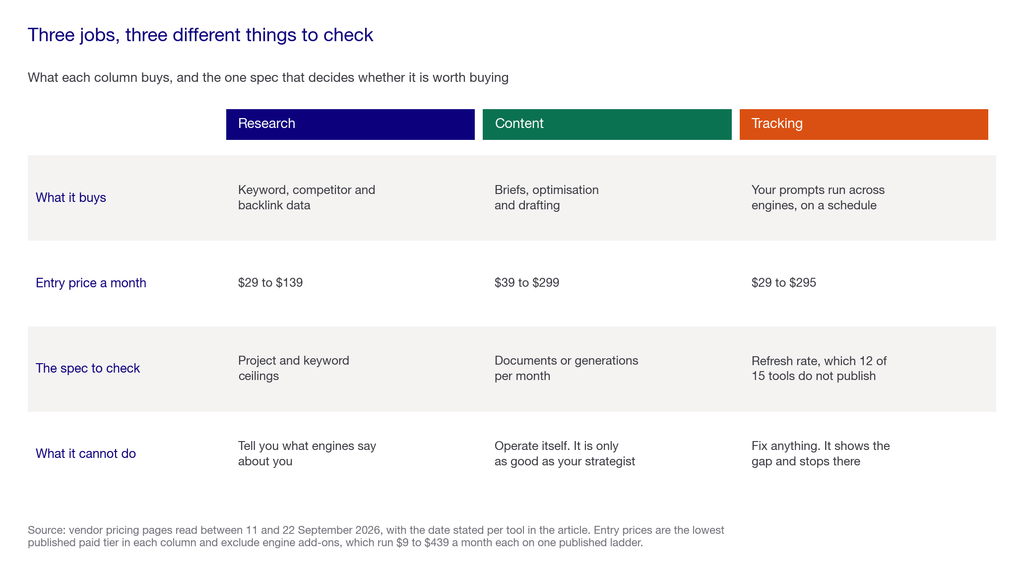
- Research tools tell you what to write and where you stand. Keywords, competitors, backlinks, and increasingly a view of which prompts mention you. The unit you buy is projects and tracked keywords. Ahrefs, Semrush, seoClarity, Similarweb and Conductor sit here.
- Content tools produce and optimise the pages. Briefs, outlines, drafts, on-page scoring, and in two cases a workflow builder your own team operates. The unit you buy is documents, generations or tasks a month. Surfer, Clearscope, Frase, Writesonic and AirOps sit here.
- Tracking tools tell you whether any of it worked, by asking engines your questions on a schedule and recording the answers. The unit you buy is prompts, and the spec that decides whether those prompts are worth anything is how often each one is run. Otterly, Scrunch, AthenaHQ, Profound and Rankability sit here, and so does Pepper.
Two things follow from the split. A suite that claims all three is usually strong in one, because the underlying work is unrelated: crawling an index, generating text and polling engines are three different engineering problems. And the tracking column is the only one where the published number can be meaningless, because a prompt count without a refresh rate does not tell you how much data you are buying. That is the subject of most of this article.
What five weeks did to our own list
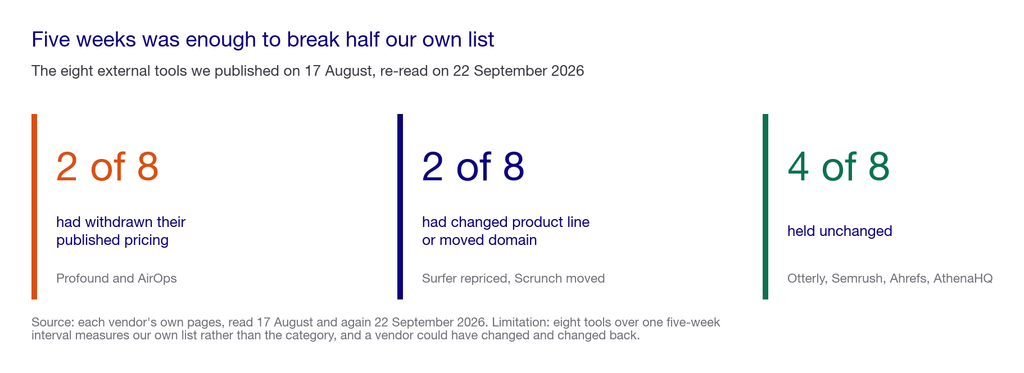
We published nine tools on 17 August. One is ours, so eight are testable. Re-reading them today:
- Profound. Published self-serve tiers are gone. Today the page shows a free trial with 10 prompts on ChatGPT only, and a custom Enterprise tier.
- AirOps. Publishes no prices at all now. Solo and Pro both say “Start for free”, Enterprise says “Work with us”. Task limits are published: 35,000 for Solo, 100,000 for Pro, with insights across “7+ answer engines” on Pro.
- Surfer. Materially changed. It now sells a separate AI Search Analytics product at $82 a month, and its main tiers carry AI prompt allowances with stated refresh rates. Discovery $49, Standard $99, Pro $182, Peace of Mind $299, Enterprise $999.
- Scrunch. Moved domain. The old address now redirects. Pricing held: $250 a month annual or $300 monthly at Starter, $417 or $500 at Growth.
- Otterly, Semrush, Ahrefs and AthenaHQ held, with Otterly unchanged at $29, $189 and $489 and AthenaHQ unchanged at $295 Starter, now stating 11 models.
Where this falls short: five weeks is one interval and eight tools is a small sample, so this measures our own list rather than the category. It is also possible a vendor changed and changed back. What it does establish is that a tools guide has a short shelf life, which is the main reason to check the date on any list including this one.
If you would rather see what engines say about your brand than read about tools, book a growth audit and we will show you today’s answers.
The spec that decides whether the data is usable
Here is the finding that came out of the re-read, and it is not about price.
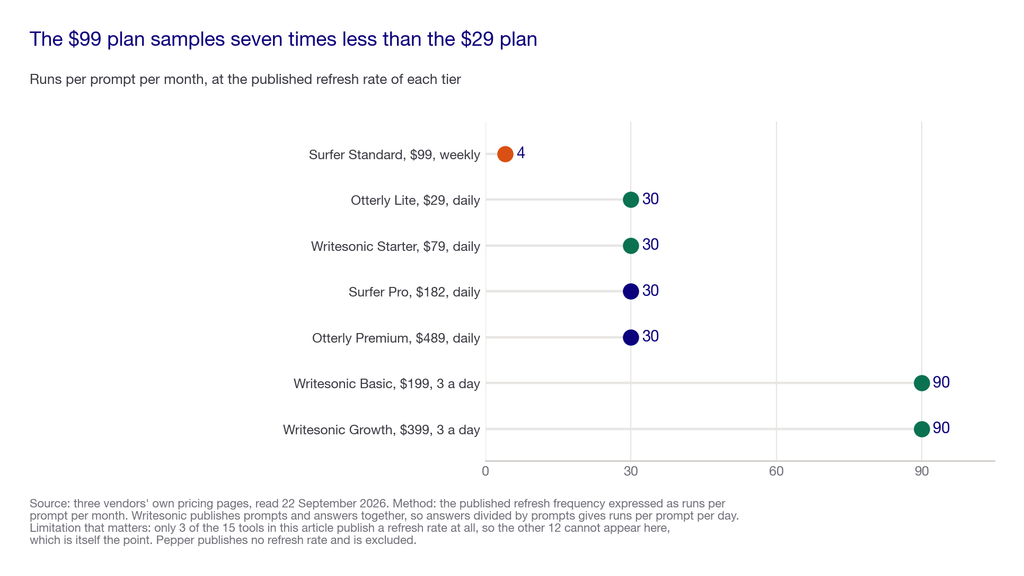
Engines answer the same question differently each time, so a tracked prompt is only as good as the number of times it gets asked. Three of the fifteen publish enough to work that out, and they have three different policies:
- Otterly states daily tracking on every tier. So about 30 runs per prompt a month whether you pay $29 or $489.
- Surfer states weekly refresh at Standard ($99, 25 prompts) and daily at Pro ($182, 50 prompts) and Peace of Mind ($299, 100 prompts). Weekly is about 4 runs a month.
- Writesonic publishes prompts and answers together: 50 prompts and 50 answers daily at Starter ($79), which is one run per prompt per day, and 100 prompts with 300 answers daily at Basic ($199), which is three.
Run those through the standard margin-of-error arithmetic and the ranking inverts:
| Tier | Price a month | Runs per prompt a month | Approximate error on one prompt |
|---|---|---|---|
| Surfer Standard | $99 | about 4 | about ±50 points |
| Otterly Lite | $29 | about 30 | about ±18 points |
| Writesonic Starter | $79 | about 30 | about ±18 points |
| Surfer Pro | $182 | about 30 | about ±18 points |
| Otterly Premium | $489 | about 30 | about ±18 points |
| Writesonic Basic | $199 | about 90 | about ±10 points |
| Writesonic Growth | $399 | about 90 | about ±10 points |
A $29 plan sampling daily beats a $99 plan sampling weekly, by a wide margin, on the only number that decides whether a movement is real.Our separate piece on [how we ranked AI search visibility tools](https://www.pepper.inc/blog/best-ai-search-visibility-tools/) works through why.
Where this falls short: the error figures are our arithmetic, using the standard approximation of one over the square root of the sample size at a worst-case 50% mention rate. They assume independent samples and a stable underlying rate. And twelve of the fifteen tools publish no refresh rate at all, so they cannot appear on this chart, which is itself the point.
How we evaluated these tools
Five criteria, fixed before any page was opened.
| Criterion | Weight | What it means |
|---|---|---|
| Refresh rate published | 30 | The vendor states how often a prompt is actually run, so sampling reliability can be computed |
| Price published with limits | 25 | A figure attached to a stated allowance, so cost per unit is calculable |
| Stable across five weeks | 20 | The page said the same thing in August as it does today, which is what makes a guide worth writing |
| Job clearly defined | 15 | It is obvious whether this is a research, content or tracking tool, rather than all three by assertion |
| Free tier or trial that answers something | 10 | You can establish whether the tool sees anything in your category before paying |
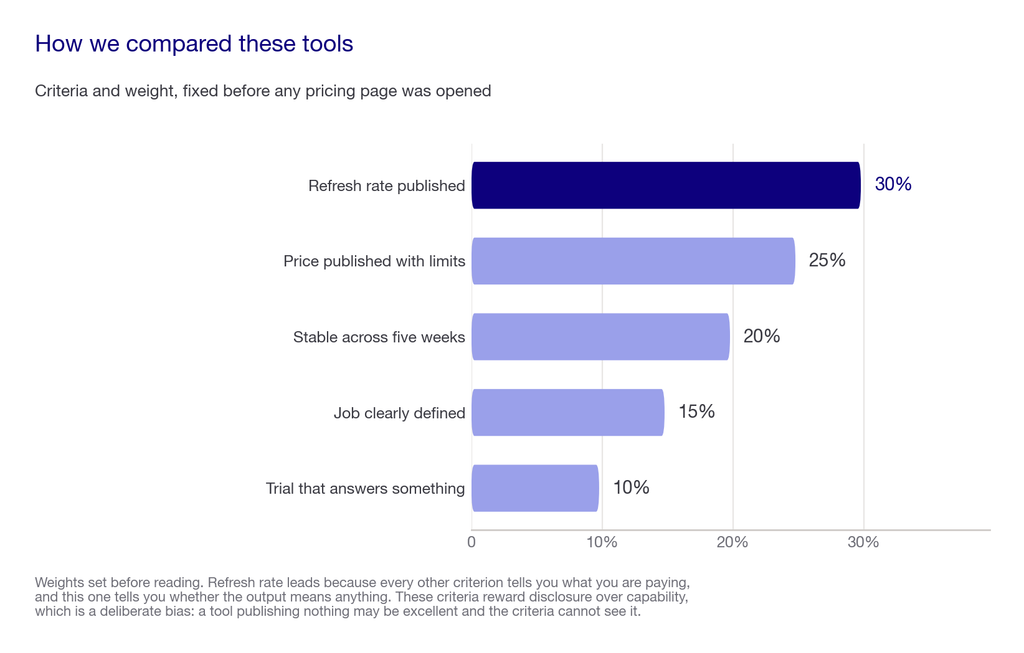
Why refresh rate leads. Every other criterion tells you what you are paying. This one tells you whether the output means anything, and twelve of fifteen vendors do not disclose it.
Where this falls short: these criteria reward disclosure over capability, which is a deliberate bias and a real limitation. A tool that publishes nothing may be excellent, and the criteria cannot see that. What they test is whether you can judge it before you buy.
The fifteen, by job
Research: finding what to write and where you stand
- Ahrefs. $29 Starter to $449 Advanced, Enterprise $1,499 a month with an annual commitment. Brand Radar from $199 adds AI visibility. Advanced covers 50 projects and 5,000 keywords. Where it falls short: research and tracking rather than workflow, and no refresh rate published for Brand Radar. Read 11 September 2026.
- Semrush. $139 to $549 a month monthly, or $117.33 to $455.67 annually, with 50 to 200 AI prompts a day by tier. Enterprise quote-only. Where it falls short: engine coverage is gated by tier. Read 11 September 2026.
- seoClarity. Enterprise from $4,500 a month, Technical SEO from $3,200, Research and Content from $2,500, priced by domains and keywords. Where it falls short: those are floors, not rates. Read 11 September 2026.
- Similarweb. No price published. Strong on company-level and intent data, with CRM enrichment claimed. Where it falls short: market intelligence with SEO attached rather than an SEO tool. Read 11 September 2026.
- Conductor. No price published. Three tiers named, usage-based model described. Integrations include Google Analytics, Search Console, Jira and Asana. Where it falls short: no CRM in the integration list, and nothing you can budget from. Read 11 September 2026.
Content: producing and optimising the pages
- Surfer. Discovery $49, Standard $99, Pro $182, Peace of Mind $299, Enterprise $999, plus AI Search Analytics at $82. Documents run 120 to unlimited. Where it falls short: the $99 tier refreshes AI prompts weekly, which is not enough to trust a trend. Read 22 September 2026.
- Clearscope. Essentials $129, Business $399, Enterprise custom. Where it falls short: no CRM, no analytics connector and no AI refresh rate published. Read 11 September 2026.
- Frase. $39, $103 and $239 billed yearly, or $49, $129 and $299 monthly, with 25, 100 and 350 AI generations and 2, 2 and 5 engines tracked. Where it falls short: the allowance unit changed between our readings, so check it yourself. Read 17 September 2026.
- Writesonic. $79, $199 and $399 billed annually, Enterprise custom. Publishes prompts and answers together, plus 15 to 50 AI articles a month and site audits. Where it falls short: three engines on all self-serve tiers, with all ten reserved for Enterprise. Read 22 September 2026.
- AirOps. No prices published. Solo 35,000 tasks, Pro 100,000 tasks, insights across 7+ answer engines, Enterprise custom. Where it falls short: a workflow builder rather than a finished product, so it is only as good as the strategist you point at it. Read 22 September 2026.
Tracking: knowing whether any of it worked
- Otterly. $29 Lite with 15 prompts, $189 Standard with 100, $489 Premium with 400, Enterprise from $1,000. Daily tracking on every tier. Four engines included; Claude, Google AI Mode and Gemini cost $9 to $439 a month extra. Where it falls short: the add-ons can nearly double the bill. Read 22 September 2026.
- Scrunch. Starter $250 annual or $300 monthly with 350 custom and 1,000 industry prompts; Growth $417 or $500 with 700 and 2,500. Where it falls short: no refresh rate published, and the domain moved this month. Read 22 September 2026.
- AthenaHQ. Free Essential with a $25 credit and 300 credits; Starter $295 with 3,600 credits and 11 models; Enterprise custom. Where it falls short: credits rather than prompts, so cost per tracked question needs working out from your own usage. Read 22 September 2026.
- Profound. Free trial with 10 prompts on ChatGPT only, Enterprise custom. Where it falls short: the published self-serve ladder we listed in August no longer exists. Read 17 September 2026.
- Rankability. Pricing page now resolves to a demo booking form with no tiers. Where it falls short: nothing published to compare. Read 17 September 2026.
Pepper sits in the tracking column and is not ranked here, because ranking our own product in our own comparison is the move we criticise elsewhere. We publish no pricing, which by this article’s own criteria costs us 25 of 100 points.
AI SEO tools at a glance
| Job | Entry price | What the money buys | The spec to check | Where the category falls short |
|---|---|---|---|---|
| Research | $29 to $139 a month | Keyword, competitor and backlink data | Project and keyword ceilings | Enterprise tiers are quote-only almost everywhere |
| Research, enterprise | From $2,500 a month | Domain-level scale and workflow | Whether the figure is a floor or a rate | Two of five publish no price at all |
| Content | $39 to $299 a month | Briefs, optimisation and drafting | Documents or generations per month | Allowance units change between readings |
| Content, workflow | No price published | A builder your team operates | Task limits | Only as good as the strategist assigned |
| Tracking | $29 to $295 a month | Prompts run across engines | Refresh rate, which 12 of 15 omit | Engines are often a paid add-on |
| Tracking, add-ons | $9 to $439 a month each | Extra engines | Per-tier pricing that rises as you scale | Can nearly double a top self-serve plan |
| Free tiers | Free | Whether you appear at all | Prompt count and engine count | 10 prompts on one engine is a demonstration |
| Pepper, own row | Not published | Brand Visibility, Domain Prompt Presence, Share of Voice | Not applicable | We publish no pricing |
What a working stack costs
- The minimum useful stack is about $60 a month. One research tool at the entry tier and one tracking tool with daily refresh.
- A realistic mid-market stack is $200 to $600 a month. Research, a content optimiser and tracking with enough prompts to cover your category.
- Engine add-ons are the line people miss. On one published ladder a single extra engine runs $9 to $439 a month depending on tier.
- Enterprise research platforms start at $2,500 a month and are quoted above that, which is a different budget conversation covered in our enterprise pricing work.
- The free layer is genuinely useful and almost always skipped. Google’s Search Console generative AI report and Bing’s AI Performance report cost nothing and answer the existence question.
How Pepper fits
Pepper is an agentic organic growth engine and an organic growth partner, and we sit in one of these three columns rather than all of them.
- Agent Atlas covers the content and workflow job, with the agents in your team’s hands. Agents are workflows. System agents stay fixed, user agents stay editable and versioned, and customers log in and build and run their own inside Atlas. The workflow tools in this list are sandboxes, and the difference is who is expected to operate them.
- Pepper’s GEO platform covers the tracking job. Brand Visibility for how often engines mention you, Domain Prompt Presence for how often they cite a page from your domain, and Share of Voice for your slice of the category. The gap between the first two is the citability diagnostic. See the platform.
- A growth team works alongside yours, which is the part no tool in any of these three columns does.
- Proof rather than adjectives. Acceldata went from 85 to more than 300 top-three keywords with 6X organic traffic growth. More in our case studies.
Where Pepper falls short. We publish no pricing and no refresh rate, which are the two criteria worth 55 of the 100 points in this article. Several tools above disclose more than we do. We also do not cover the research job at all, so a team that needs keyword and backlink data needs one of the tools in that column regardless of what else they buy.
How to choose the best AI tools for SEO, and what to ask
I would not start from a tools list, including this one. I would start by naming which of the three jobs is actually unsolved, because most teams already own something in two of the columns.
Here is the 100-point scorecard I would run over any AI SEO tool, ours included.
| Area | Weight | What a strong tool demonstrates |
|---|---|---|
| Refresh rate stated in writing | 30 | You can compute how often a prompt runs and therefore how much a movement means |
| Price with the allowance attached | 25 | A figure next to a limit, so cost per prompt or per document is calculable before a call |
| Engines included, not sold separately | 20 | The engines you care about are in the price, or the add-on cost is published |
| A trial that answers the real question | 15 | Enough prompts on enough engines to tell whether you appear in your category at all |
| Export and exit | 10 | Your prompt set and history come with you if you leave |
Then run the live test, on us as readily as on anyone else. Take the 25 questions your buyers actually ask, load them into each trial, and run them for 90 days. Record what each tool reports and how often it refreshed. For example: “how many times was this prompt run”, “which engines were included”, “what does this cost with the engines we need”, “what do we keep if we cancel”.
Ask each vendor five things. How often a prompt is run. What that costs per prompt. Which engines are in the price. What happens to the number if you halve the plan. And what you keep on exit.
Five questions worth asking, and what a good answer sounds like.
- “How often is each prompt actually run?” Daily is roughly 30 times a month, weekly about 4. Only three of fifteen publish this, so ask.
- “Is that the same on every tier?” One vendor says yes, another varies it by tier, and the difference is larger than the price difference.
- “Which engines are included and what do the rest cost?” On one published ladder the add-ons run to $439 a month each.
- “What did this page say five weeks ago?” Two vendors on our August list have since withdrawn pricing. A vendor who has repriced recently should say so.
- “What do we keep if we leave?” Prompt sets and history are the asset, and almost nobody publishes an export policy.
Red flags, each one visible on a pricing page today.
- A prompt count with no refresh rate, which is twelve of the fifteen tools here and makes the number uninterpretable.
- Weekly refresh sold at a mid-tier price, which produces data too noisy to act on.
- Engines as unpriced add-ons, so the real bill is unknowable until you are in a sales process.
- Pricing withdrawn between visits. Two did it in five weeks on our own list.
- A free trial of 10 prompts on one engine, which is a demonstration rather than a diagnostic.
- A single composite visibility score with no method, which hides the sampling entirely.
- A guarantee of rankings or citations, which Google itself advises against, because no third party has access to the ranking systems.
The weaker way to buy this, and it is the common one. Read a list. Shortlist on features and price. Buy the mid tier because it feels safe. Then discover the prompts refresh weekly, the engine you care about is extra, and the number moves too much to report.
The stronger sequence. Name the unsolved job. Check the refresh rate before anything else. Price your own prompt list including engine add-ons. Then buy the cheapest tier that samples daily, because sampling beats breadth until you have more than one reliable number.
If I reduce this to one principle: buy the refresh rate, not the feature list. Everything else on a pricing page is comparable between vendors, and this one thing decides whether the output is worth reading.
The honest closing note, and it costs us something. If you have not yet checked whether engines answer questions in your category, do not buy anything from any of these three columns. The two free first-party reports will tell you in an afternoon, and if the answers come back empty then the right spend this quarter is zero.
What nobody should promise you
Nobody should claim to have tested fifteen tools without publishing a test protocol. We did not test them in production and we say so at the top, because the word does real work and most lists using it have done what we did.
Nobody should sell a tracked prompt without stating how often it is run. Twelve of the fifteen tools here publish a prompt count with no refresh rate, which makes the number uninterpretable.
Nobody should promise rankings or citations for a fee. Google advises against providers who guarantee rankings, because no external party has access to the ranking systems.
Where this stops working, including for us
If engines are not answering questions in your category, skip the tracking column entirely and re-check next quarter.
If you already own a research platform and a content optimiser, the honest advice is to buy nothing else until the tracking question is answered by a free report.
Where Pepper falls short: we publish neither pricing nor refresh rate, the two criteria worth most in this article, and we do not compete in the research column at all.
Where to go next
Name the unsolved job first. Research, content or tracking. Most teams already own something in two of them and are shopping in the wrong column.
Then check the refresh rate before the price. For the adjacent decisions, our August tools comparison is the previous version of this list and worth reading for what changed, visibility tools ranked by sampling rate goes deeper on the tracking column, SEO platforms scored on pipeline reach covers the research column for B2B, and agency or tool covers whether to buy software at all. To see where you stand, see where you show up.
Frequently asked questions
What are the best AI tools for SEO in 2026?
It depends which of three jobs is unsolved. For research, Ahrefs from $29 and Semrush from $139. For content, Frase from $39 and Surfer from $49. For tracking, Otterly from $29 with daily refresh on every tier. Check the refresh rate before the price.
How much do AI SEO tools cost?
Entry tiers run $29 to $139 a month across all three jobs, and a realistic mid-market stack is $200 to $600. Enterprise research platforms start around $2,500 a month, and engine add-ons can add $9 to $439 each.
What is the most important spec when buying a tracking tool?
Refresh rate. A prompt refreshed weekly gives about four samples a month and a margin of error around 50 points, while daily gives about 30 and roughly 18 points. Only three of the fifteen tools here publish it.
Can a cheaper tool give better data?
Yes, and that is the main finding here. On published figures a $29 plan refreshing daily samples each prompt about seven times more often than a $99 plan refreshing weekly.
Did you actually test these tools?
No, and we say so at the top. We read every vendor’s published pages on one day and computed what those statements imply, then re-read our own August list to see what had changed. Testing fifteen tools properly means running each in production for a quarter, which no published list does.
How often do AI SEO tool prices change?
Faster than most guides are updated. Of eight external tools on our own August list, two had withdrawn published pricing within five weeks, one had changed its product line and one had moved domain.
Do I need separate tools for research, content and tracking?
Usually yes at the moment, because the tools that claim all three tend to be strong in one. Name the unsolved job and buy for that rather than buying a suite to avoid a decision.
Is there a free way to start?
Yes. Google’s Search Console generative AI performance report and Bing’s AI Performance report are both free and first-party, and several vendors offer trials. Use those before paying for anything.
Sources and further reading
- Vendor pricing pages, read at source with the date stated per tool in the list above. Read 22 September 2026: Surfer (Discovery $49, Standard $99 with 25 AI prompts at weekly refresh, Pro $182 with 50 at daily, Peace of Mind $299 with 100 at daily, Enterprise $999, plus AI Search Analytics at $82); Writesonic ($79, $199, $399 billed annually, with 50 prompts and 50 answers daily at Starter and 100 prompts with 300 answers daily at Basic, three engines on self-serve and ten at Enterprise); Otterly ($29, $189, $489, Enterprise from $1,000, daily tracking on all tiers, engine add-ons $9 to $439); Scrunch ($250 annual or $300 monthly Starter with 350 custom and 1,000 industry prompts, $417 or $500 Growth, domain moved this month); AthenaHQ (free Essential with a $25 credit and 300 credits, Starter $295 with 3,600 credits and 11 models); AirOps (no prices published, Solo 35,000 tasks, Pro 100,000 tasks, 7+ answer engines). Read 17 September 2026: Profound (free trial, 10 prompts, ChatGPT only, Enterprise custom); Rankability (pricing URL resolves to a demo booking page); Frase. Read 11 September 2026: Ahrefs, Semrush, seoClarity, Similarweb, Conductor, Clearscope. Named but not linked, per our policy on competitors.
- Pepper, our AI SEO tools comparison of 17 August 2026. The list re-tested in this article. That page states it verified published claims rather than running lab tests, and this article keeps the same standard.
- All sampling and margin-of-error figures are our own arithmetic. Method: runs per prompt per month is the published refresh frequency expressed monthly, and the approximate 95% margin of error for a proportion is one over the square root of the sample size at a worst-case 50% rate. Limitations: it assumes independent samples and a stable underlying rate, and twelve of the fifteen tools publish no refresh rate and therefore cannot be assessed this way.
- Google Search Central, guide to optimizing for generative AI features, page last updated 10 July 2026. Source of the advice against providers who guarantee rankings and of the Search Console generative AI performance report. Applies to Google Search only.
- Pepper, our ranking of AI search visibility tools. Source of the earlier finding that none of the fourteen platforms assessed disclosed run-to-run variance, which is the same disclosure gap this article measures at fifteen.
- Google, Search Console Help on impressions, position and clicks, read 22 September 2026. Source for how AI Mode appearances are counted in the free first-party report, which is the basis for recommending it before any paid tracking tool.
- Microsoft, AI Performance in Bing Webmaster Tools, public preview announced 10 February 2026.
Latest Blogs
Most advice on this is inference dressed as fact. OpenAI documents exactly one thing clearly, which is access. Here is what is documented, what is inferred, and how to verify the rest for yourself.
Being named in an AI answer and having your page used as its source are different outcomes with different causes and different fixes. The gap between them is the most useful diagnostic in AI search, and most reporting collapses it into one number.
Every platform reports share of voice and almost none of them define it the same way. Here is the definition worth using, the three choices that change the number, and how to measure it yourself without buying anything.
Get your hands on the latest news!
