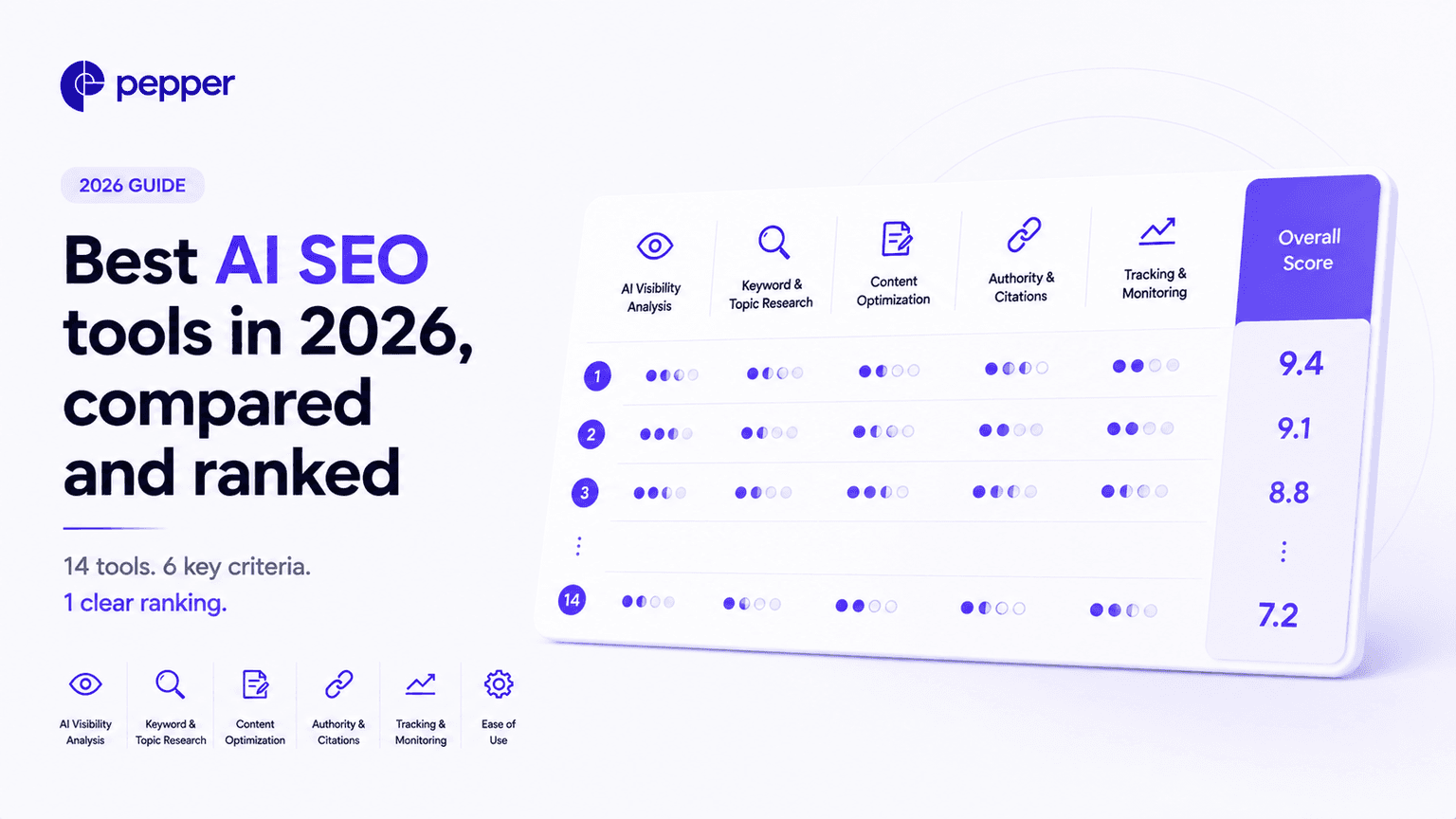
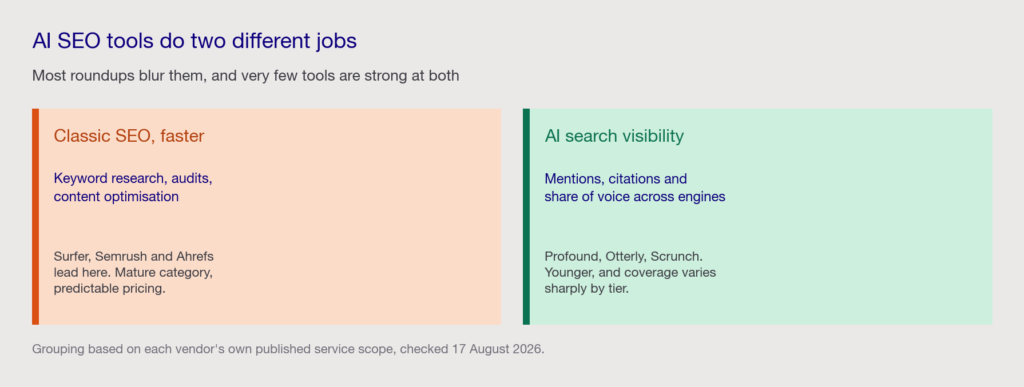
AI SEO tools now do two different jobs, and most roundups blur them. The first is classic SEO work made faster: keyword research, audits, content optimisation. The second is AI search visibility: tracking whether ChatGPT, Perplexity, Gemini and AI Overviews mention and cite you.
Very few tools are genuinely strong at both. So the useful question is not which tool is best. It is which of the two jobs you are buying.
Disclosure: Pepper is included on this list and published the guide, so we have placed ourselves in a separate category rather than ranking ourselves against tools we do not directly compete with. We have also applied the same scrutiny to ourselves as to everyone else, including a “where it falls short” section. Every tool description and price is based on that company’s own website as of 17 August 2026, rather than another roundup or secondary source. Where a company does not publish pricing, we have said so rather than estimating it.
Key takeaways
- Every price here was checked at source on 17 August 2026. Pricing in this category changes fast, and most roundups carry figures that are months stale.
- Two tools started publishing pricing this year. Profound now lists $99 for a ChatGPT-only Starter tier, and AthenaHQ lists $295 for Starter. Several published comparisons still describe both as gated.
- Engine coverage is where the real differences sit. Cheap tiers often track one engine. Otterly’s base plans cover four, while Claude and Gemini cost extra.
- Refresh rate matters as much as prompt count. Semrush’s Starter and Profound’s Starter both advertise 50 prompts. However, one refreshes daily and the other monthly, so the same advertised number yields about thirty times the observations.
- Nobody should promise you a single AI visibility score. Composite numbers hide the diagnostic you actually need.
How we compared these tools
We did not run a 90-day lab test, and we should be direct about that, because most articles on this SERP claim exactly that and it is worth asking what it means. A “test” that produces a ranked list of nine tools with no reproducible method is a review, not a test.
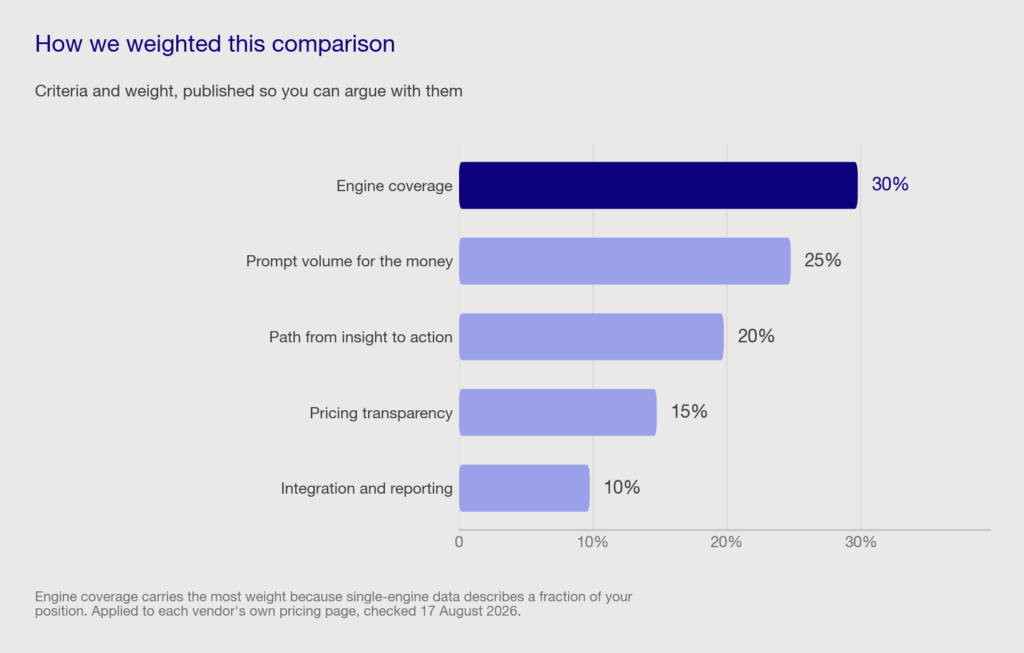
What we did instead is checkable. We verified every published price, plan name, engine list and prompt limit against each vendor’s own pricing page on 17 August 2026. Then we weighted the comparison against what actually decides outcomes in the accounts we run.
| Criterion | Weight | What a strong tool shows |
|---|---|---|
| Engine coverage | 30% | Tracks the engines your buyers actually use, not just ChatGPT |
| Prompt volume for the money | 25% | Enough tracked prompts to represent a real category, at a price that scales |
| Path from insight to action | 20% | Tells you what to change, not only what happened |
| Pricing transparency | 15% | Publishes a real number rather than gating everything behind a demo |
| Integration and reporting | 10% | Connects to the analytics stack you already run |
Engine coverage carries the most weight because a tool tracking one engine gives you a view of one engine. Research on generative engines consistently finds they vary substantially and overlap little in cited sources. Consequently, single-engine data describes a fraction of your position.
Our view comes from running organic for more than 250 enterprises over eight years and tracking over 10 million prompts across every major engine.
AI SEO tools at a glance
| Tool | Entry price | Prompts tracked | Engines at entry tier | Best for |
|---|---|---|---|---|
| Pepper (own category) | Not published | Custom | ChatGPT, Perplexity, Gemini, Claude, AI Overviews | Organic run as one function, platform plus growth team |
| Otterly | $29/mo | 15 | ChatGPT, AI Overviews, Perplexity, Copilot | Smallest viable budget, widest entry coverage |
| Surfer SEO | $49/mo | 25 from $99 tier | ChatGPT at $99, five engines at $182 | Content optimisation with visibility attached |
| Profound | $99/mo | 50 per month | ChatGPT only at entry | Enterprise depth, if you can reach the top tier |
| Semrush | $117.33/mo | 50 daily from $165.17 | Google, ChatGPT, Perplexity, Gemini | One platform for classic SEO plus AI visibility |
| Ahrefs | $129/mo | Brand Radar AI from $199 | Multi-engine via Brand Radar | Backlink and technical depth, AI added on |
| AirOps | Free ($0) tier | 100 prompts on Solo | ChatGPT only on Solo | Workflow automation at content scale |
| Scrunch | Not published | Custom | ChatGPT, Perplexity, Claude, Gemini, Copilot | Persona-based monitoring and agent delivery |
| AthenaHQ | $295/mo Starter | Credit-based, 3,600 credits | ChatGPT, Perplexity, AI Overviews, Gemini, Claude | Monitoring with built-in citation audits |
Six of the nine publish real numbers: Otterly, Surfer, Profound, Semrush, Ahrefs and AthenaHQ. That is unusually transparent for this category, and two of those six did not publish pricing earlier in 2026.
The nine, in detail
1. Pepper
Pepper is an agentic organic growth engine rather than a monitoring tool, which is why we sit apart from this list rather than on top of it. The product is genuinely two things at once. Customers log in and run it themselves, so they set up a workspace, define brand profile, competitors and personas, connect GA4 and Search Console, manage themes and prompts, and build and run their own agents in the Agent Atlas. In addition, a growth team is attached to the account and does the work alongside them.
The measurement side tracks Brand Visibility, Domain Prompt Presence and Share of Voice across ChatGPT, Perplexity, Gemini, Claude and Google AI Overviews. The gap between the first two is the diagnostic most tools cannot give you, because it separates an awareness problem from a citability problem.
We suit teams that want organic run as one function over time, rather than a dashboard subscription plus a content agency plus a PR firm. Where we fall short: we do not publish pricing, so budget discovery is a conversation rather than a page. We are also not the right shape if you want a self-serve monitoring tool and nothing else, and a $29 tracker will serve that need better.
2. Otterly
Otterly is the most accessible entry point in this category and unusually generous on engines at the low end. Lite is $29 per month for 15 prompts, Standard is $189 for 100, and Premium is $489 for 400. All tiers cover ChatGPT, Google AI Overviews, Perplexity and Microsoft Copilot. Standard adds API access, MCP capabilities and agent analytics.
It suits solo marketers and small teams who need real multi-engine data without a four-figure commitment.
Where it falls short: Claude, Google AI Mode and Gemini are add-ons rather than included, priced between $9 and $439 a month depending on your base plan. So the sticker price and the real price can diverge sharply once you cover the engines you actually need.
3. Surfer SEO
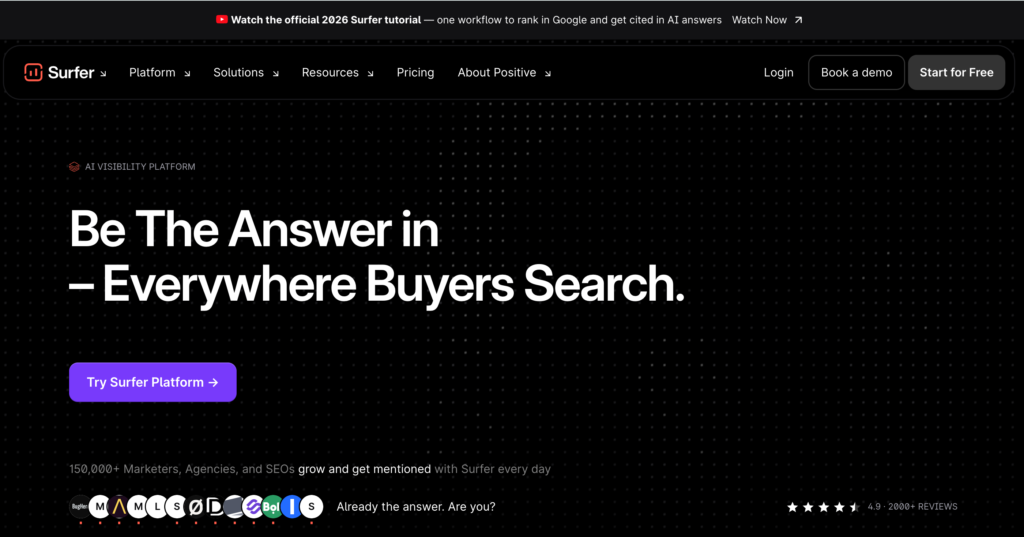
Surfer remains the strongest content optimisation tool in this comparison, and it has folded AI visibility in rather than bolting it on. Discovery is $49 per month for 120 documents. Standard at $99 adds AI visibility tracking across ChatGPT with 25 prompts refreshed weekly. Pro at $182 extends to ChatGPT, Perplexity, Google AI Mode, AI Overviews and Gemini with 50 prompts refreshed daily. There is also a standalone AI Search Analytics product at $158 per month for 100 daily prompts.
It suits teams whose main job is producing and optimising content, with visibility tracking as a useful second function.
Where it falls short: the entry visibility tier covers ChatGPT only, so meaningful multi-engine coverage starts at $182. Furthermore, the tool’s centre of gravity is on-page optimisation, so it will not tell you much about the earned-media sources that decide most citations.
4. Profound
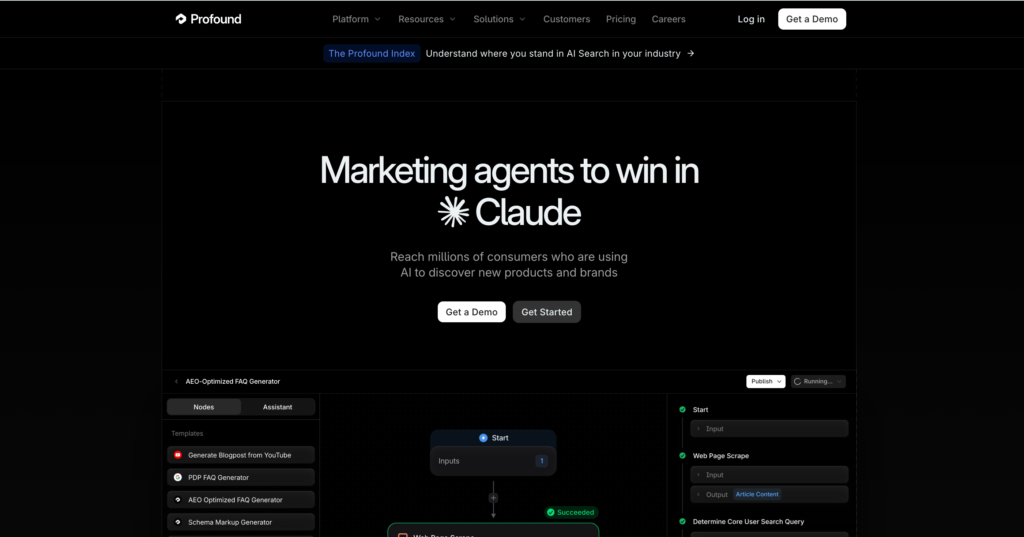
Profound is the enterprise name in AI search monitoring, covering Prompt Volumes, Answer Engine Insights, Agent Analytics and Agents that generate content. It now publishes pricing, which it did not earlier in 2026. Starter is $99 per month, Growth is $399, and Enterprise is custom.
Read the tiers carefully, though. Starter tracks ChatGPT only with 50 prompts per month. Growth covers three answer engines with 100 prompts monthly. The nine-engine coverage the brand is known for sits at Enterprise.
It suits large organisations that will land at the Enterprise tier and want depth rather than breadth of tooling.
Where it falls short: at 50 prompts a month, the Starter plan is a demonstration rather than a measurement programme. Moreover, several published comparisons still describe Profound as having no public pricing, so verify current tiers yourself before quoting anything.
5. Semrush
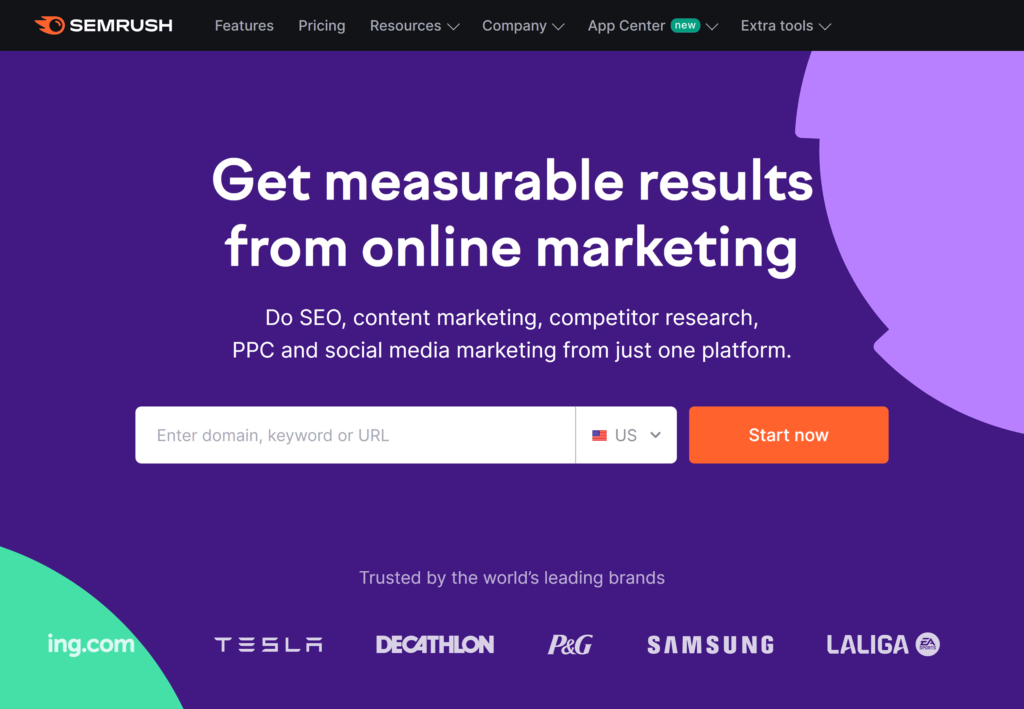
Semrush is the most complete single platform here, because it covers classic SEO and AI visibility in one subscription. Plans run from $117.33 per month for SEO, through Starter at $165.17, Pro+ at $248.17, and Advanced at $455.67, billed annually. AI prompt tracking scales with tier: 50 daily on Starter, 100 on Pro+, 200 on Advanced. Coverage spans Google, ChatGPT, Perplexity, Gemini and other LLM platforms.
It suits teams that want one contract, one login and one reporting layer rather than three tools stitched together.
Where it falls short: you are paying for a large platform whether or not you use most of it. In addition, the AI visibility module is solid at measurement but does not carry you into execution, so the work of actually changing anything still sits with you.
6. Ahrefs
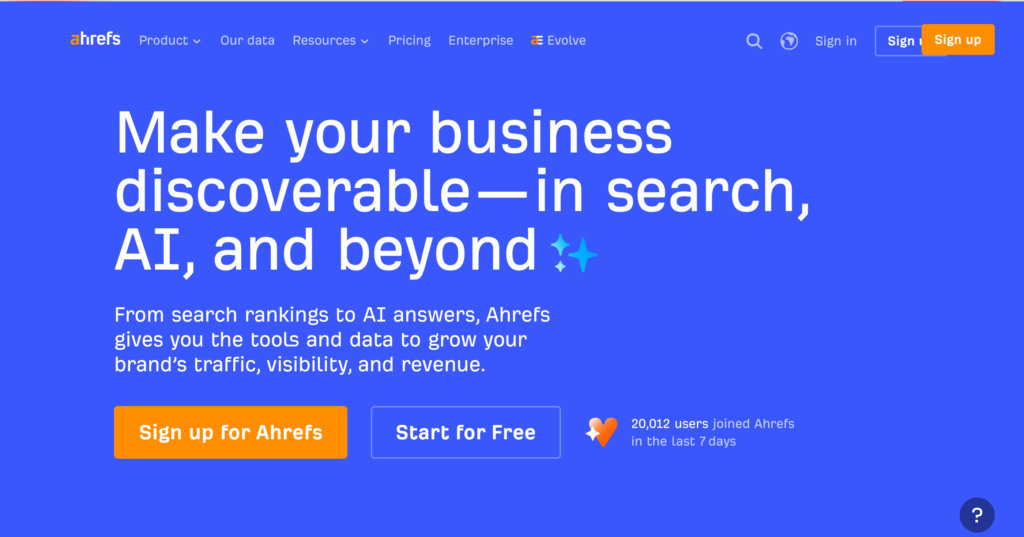
Ahrefs remains the strongest backlink and technical dataset in the category, which matters more for AI search than it used to, given how much of citation behaviour tracks authority. Plans are Lite at $129, Standard at $249, Advanced at $449 and Enterprise at $1,499 per month with an annual commitment. Brand Radar is included from the Lite tier, and a separate Brand Radar AI product starts at $199 per month with access to a database of 271 million organic prompts.
It suits teams whose bottleneck is authority and technical diagnosis rather than content production.
Where it falls short: meaningful AI prompt tracking sits in a separate product with its own price, so the real cost of full coverage is higher than the headline tier. Additional prompt packages run $50 to $250 a month on top.
7. AirOps
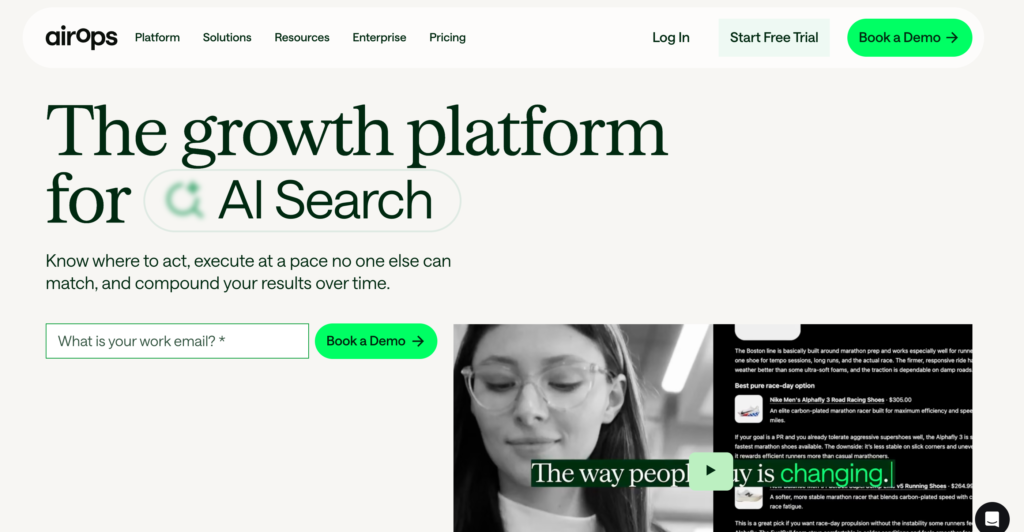
AirOps describes itself as the growth platform for AI Search, combining Insights with Action through workflows, grids and its Quill agent. There is a free Insights tier at $0 with 1,000 tasks a month. Solo covers 20,000 tasks and 100 prompts, though ChatGPT only. Pro covers 75,000 tasks and 250 prompts with multi-engine insights across Google, Perplexity, OpenAI and Google AI Studio. Solo and Pro prices are not shown on the pricing page, and Pages and Enterprise are gated behind sales.
It suits content teams that need programmatic production at volume, with visibility data feeding the workflow.
Where it falls short: the pricing structure is the least legible here, because task consumption is hard to forecast before you build workflows and the paid tiers show no price at all. Furthermore, the Solo tier tracks ChatGPT insights only.
8. Scrunch
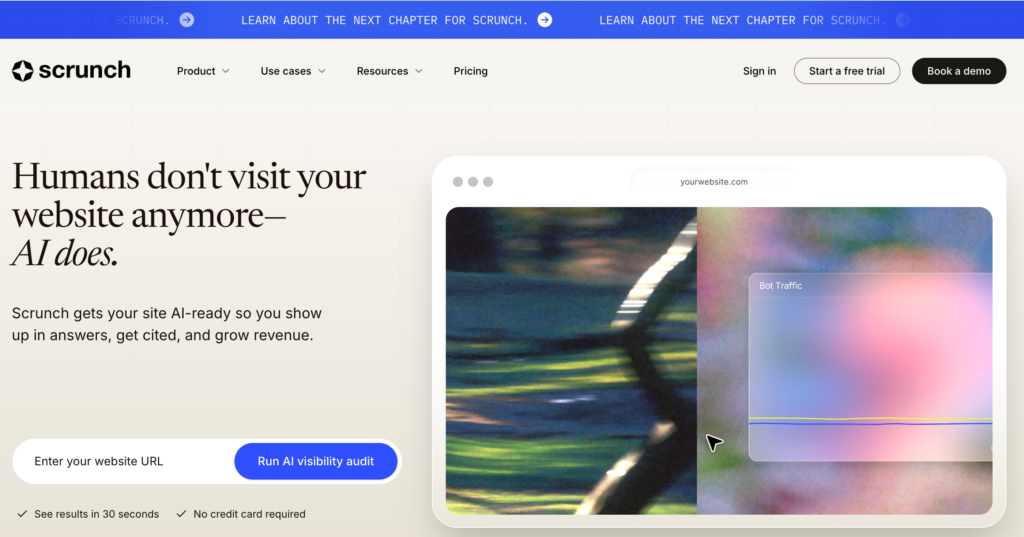
Scrunch now calls itself “the AI customer experience platform” and runs three modules: Monitoring, which tracks brand presence and position across every LLM, Insights, which shows how AI interprets your site, and an Agent Experience Platform that serves machine-readable pages to agents. Tracking benchmarks by competitor, persona, topic and geography, targeting high-intent prompts like “best”, “vs” and “pricing”. Coverage spans ChatGPT, Perplexity, Claude, Gemini and Copilot.
It suits organisations that think in buyer personas and want delivery as well as measurement.
Where it falls short: pricing is gated behind a demo or a seven-day trial, so you cannot size a budget from the website. The persona model also takes longer to configure than a straightforward prompt list, which slows time to first insight. Note too that the company moved from scrunchai.com to scrunch.com, so older comparisons link to the wrong domain.
9. AthenaHQ
AthenaHQ positions as “the command center for AEO and GEO”, combining visibility tracking across eight or more LLMs with automated optimisation recommendations, citation source analysis and sentiment monitoring. Ask Athena is an agentic copilot, and AthenaHQ Content identifies citation gaps. It publishes credit-based pricing, with a free Essential tier carrying $25 of credit, Starter at $295 a month for 3,600 credits, and custom Enterprise. One credit equals one AI response. All plans cover ChatGPT, Perplexity, AI Overviews, Gemini and Claude, while higher tiers add AI Mode, Copilot and Grok.
It suits teams that want a single tool to both diagnose and prescribe, with a free audit as a low-commitment entry point.
Where it falls short: credit-based pricing is harder to forecast than a flat prompt allowance, because usage scales with how much you query rather than how much you track. It is also a younger product than most here, so expect a faster-moving roadmap.
What do AI SEO tools cost?
The honest range is wider than most roundups suggest, because the tiers are not comparable.
Entry level runs $29 to $129 a month. Otterly at $29 and Surfer at $49 are genuinely usable. However, entry tiers usually restrict engines, prompts or both.

Figure 3: Entry prices, verified at source on 17 August 2026.
Serious multi-engine tracking starts around $180 to $400. Surfer Pro at $182, Semrush Pro+ at $248.17, Profound Growth at $399 and Otterly Premium at $489 are where most mid-market teams land.
Enterprise runs $1,000 and up, often custom. Ahrefs Enterprise is $1,499. Profound and Scrunch quote on request.
Watch refresh rate, not just prompt count. Semrush’s Starter and Profound’s Starter both advertise 50 prompts. However, Semrush refreshes daily and Profound refreshes monthly, so the same advertised number yields roughly thirty times the observations.

Figure 4: Two plans called Starter, thirty times the data.
And budget for the work, not just the tool. This is the cost nobody quotes. A dashboard surfacing two hundred fixes nobody has time to make has added a backlog, not a capability. If you are spending more on measuring than on changing anything, the ratio is wrong.
How to choose an AI SEO tool
Start by naming which of the two jobs you are buying. Classic SEO work made faster, or AI search visibility. Tools that claim both usually lead on one.
One shift is worth reading first. Google’s AI search guidance, published 15 May 2026, states that optimising for AI search is still SEO, and that AI Overviews and AI Mode run on core Search ranking systems with no separate AI index. Therefore a tool selling you a wholly separate AI discipline is overstating the split, at least where Google is concerned.
However, Google is one engine. ChatGPT, Perplexity and Claude retrieve differently, so single-engine tooling leaves you blind where a lot of research now happens.
Five questions to ask before you buy
- “Which engines does my tier actually cover?” Not the marketing page, the tier you are buying. Entry tiers are frequently ChatGPT only.
- “How many prompts, and refreshed how often?” Daily on 50 prompts beats monthly on 200 for spotting movement.
- “How do you select prompts?” If the tool cannot explain a methodology, your visibility number is whatever the prompt list flatters.
- “Can I see the raw answers?” You need the actual response and cited URLs, not a score. A tool that only shows a number cannot be audited.
- “What does this tell me to do?” Measurement without a path to action produces a backlog. Ask what changes as a result of the data.
Red flags
A tool guaranteeing citations should end the conversation. Google explicitly advises against providers guaranteeing rankings, because third parties cannot access internal ranking systems, and nobody has that access for ChatGPT either.
I would also be cautious about a few other things. A single composite visibility score with no breakdown. Tracking that covers branded prompts only, which will always look healthy. No competitor share of voice alongside citation counts. Pricing that cannot be established without three calls. Finally, a roundup claiming months of testing with no reproducible method.
If I reduced the decision to one principle: buy the tool that shows you the raw answer, not the one that shows you the prettiest number.
What nobody should promise you
Guaranteed citations or AI rankings. Nobody controls the ranking systems.
A single score that means something. Composite numbers hide the gap between being mentioned and being cited, which is the most actionable finding available.
A universal benchmark. No good number exists for these metrics. Track your own trend and your gap to the category leader instead.
Complete coverage of every engine. Coverage varies by tier and changes monthly. Verify at the tier you are buying.
That the tool will fix anything. Measurement is not execution. The tool tells you where you stand, and someone still has to do the work.
Frequently asked questions
What are AI SEO tools?
AI SEO tools do one of two jobs. Some accelerate classic SEO work like keyword research, audits and content optimisation. Others track AI search visibility, monitoring whether ChatGPT, Perplexity, Gemini and AI Overviews mention your brand and cite your pages.
What is the best AI SEO tool in 2026?
It depends which job you are buying. Semrush is the most complete single platform, Surfer is strongest for content optimisation, Otterly offers the widest engine coverage at entry price, and Ahrefs leads on authority data. No tool is genuinely best at everything.
How much do AI SEO tools cost?
Entry tiers run $29 to $129 monthly, serious multi-engine tracking lands around $180 to $400, and enterprise plans reach $1,499 or custom pricing. Otterly starts at $29, Surfer at $49, Profound at $99 and Semrush at $117.33.
Do free AI SEO tools exist?
Partly. AirOps offers a free tier with 1,000 tasks, and Bing’s AI Performance report provides first-party citation data at no cost. However, multi-engine prompt tracking at any real scale needs a paid plan or substantial analyst time.
Which AI engines should a tool track?
At minimum ChatGPT, Perplexity, Google AI Overviews and Gemini, since these carry most commercial research. Claude and Copilot matter in some categories. Check coverage at your specific tier, because entry plans frequently track ChatGPT alone.
Can AI SEO tools guarantee citations?
No, and any tool claiming otherwise is overstating what it can do. Google explicitly advises against providers guaranteeing rankings, because third parties cannot access internal ranking systems. The same limitation applies to every AI engine.
How many prompts should I track?
Enough to represent your category honestly, usually 50 to 200 for a mid-market business. More important is how you select them. Add three to five at a time and give them a fortnight before reading anything into the movement.
Do I need a separate tool for AI search?
Not necessarily. Semrush and Surfer both fold AI visibility into broader platforms, which suits teams wanting one contract. Dedicated tools like Profound and Scrunch go deeper, so the choice depends on whether AI search is your main problem or one of several.
Where to go next
Start by writing down 20 to 30 real commercial questions from your category, before you look at a single tool. Then check which tools can track that many prompts, on the engines your buyers use, at a price you can defend.
That exercise usually eliminates half the shortlist immediately, because entry tiers cannot carry a real prompt set.
If you would rather see the data before committing to tooling, see where you show up across ChatGPT, Perplexity, Gemini, Claude and AI Overviews. Customers run this themselves in the platform, with a growth team attached to do the work alongside them.
For the measurement theory behind all of this, our guide to AI search measurement covers which numbers actually matter, and what GEO is covers the discipline itself. For a worked example, our Acceldata case study documents 6X organic traffic growth.
Finally, one honest exit. If your category produces very few meaningful monthly prompts, or nobody has capacity to act on what you find, you do not need a tool yet. Spend the money on earned media instead.
Latest Blogs
The research pulls in two directions. Fan-out rewards covering many adjacent questions; absorption research finds longer pages get used. The resolution is that the passage competes, not the page.
Seven documented changes, not seven predictions. Google switched two rich results off, shipped two new AI reports, and added a channel to Analytics. Here is what actually moved and what it means.
Content chunking is the process of splitting a page into smaller pieces so a machine can retrieve one of them. Here is the part most articles get wrong: chunking is something engines do to your page, not something you do to it. You do not choose the chunk size.
Get your hands on the latest news!

Similar Posts
SEO
11 mins read
What is internal linking? Meaning, and what changed for AI search
SEO
15 mins read
Primary and secondary keywords in 2026: what they were always for, and what changes now
Content Creation
11 mins read