Answer engine optimization techniques for 2026: what still works on the page
The short answer
The most useful answer engine optimization techniques in 2026 are structural, not technical. How a page is organised decides whether an engine can lift an answer out of it. Markup mostly decides nothing.
Three things sold as core AEO work are worth checking against Google’s own documentation before you pay for them.
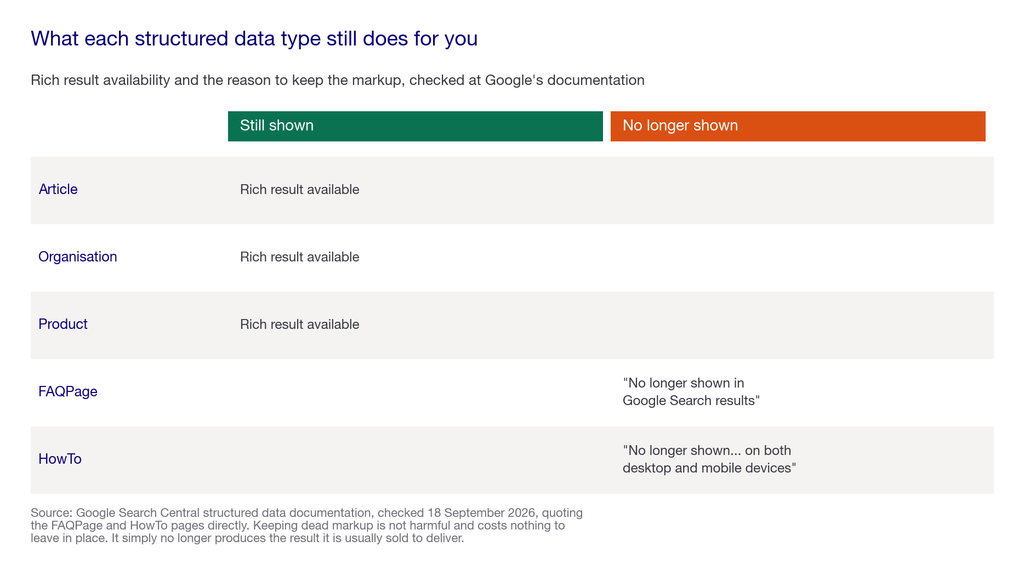
- FAQ rich results are gone. Google’s documentation states plainly: “The FAQ rich result feature is no longer shown in Google Search results.”
- HowTo rich results are gone too. Google states “this rich result is no longer shown in search results, on both desktop and mobile devices.”
- You cannot opt into a featured snippet. Asked whether you can mark a page as one, Google answers: “You can’t. Google systems determine whether a page would make a good featured snippet for a user’s search request, and if so, elevates it.”
None of that means AEO is fake. It means the work sits in the page itself: answer-first paragraphs, question-shaped headings, self-contained blocks, and evidence an engine can quote. That is what the rest of this page covers, in the order we would do it.
We run this work daily. Pepper is an agentic organic growth engine, not an SEO agency, and this page comes out of organic run for more than 250 enterprises across eight years and more than 10 million tracked prompts. Customers log in and run the platform themselves, with a Pepper growth team attached to the account. Book a growth audit and we will show you which of your pages engines can currently lift an answer from.
Key takeaways
Key takeaways from an afternoon inside Google’s own developer documentation.
- Two schema types commonly sold as AEO are dead. FAQPage and HowTo rich results are both no longer shown in Google Search, per Google’s own docs.
- FAQ markup was narrowed before it was removed. From September 2023 it showed only for “well-known, authoritative government and health websites,” then stopped entirely.
- Featured snippets cannot be requested. Google’s documented answer to whether you can mark a page as one is “You can’t.”
- Structure is the lever that remains. Answer-first paragraphs under question-shaped headings, kept self-contained, are what an engine can actually extract.
- AEO and GEO overlap almost completely. We traced both terms to source and AEO has no canonical origin. Treat the distinction as vocabulary, not strategy. The wider terminology map is in GEO vs SEO vs AEO.
- Schema still matters, just not for rich results. It helps machines parse entities and relationships. That is a different and smaller claim than the one usually sold.
What is answer engine optimization, and what does it actually involve?
Answer engine optimization is the practice of structuring content so a search or AI system can lift a direct answer from it and attribute that answer to you.
The term has a vocabulary problem worth naming early. We traced AEO and GEO to their origins and found GEO has a published academic paper behind it while AEO has no canonical source. In practice the two describe the same work, and most vendors now use one term or the other for positioning reasons rather than technical ones. The full trace is in AEO vs GEO: are they the same thing?.
So treat the techniques below as page-level craft, whatever the label on the invoice. If you want the definitional groundwork first, start with what is answer engine optimization.
Answer engine optimization techniques to stop paying for
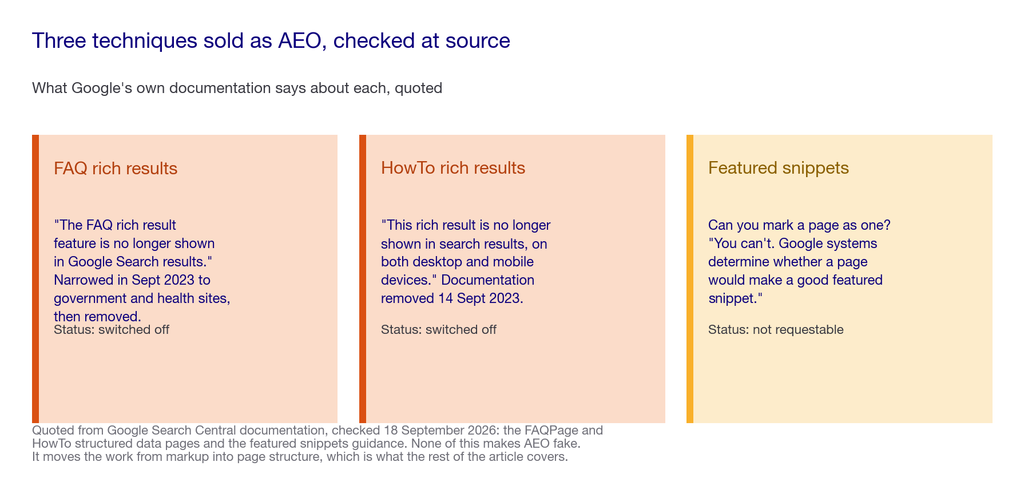
FAQ schema, as a visibility tactic. Google narrowed FAQ rich results in September 2023 so the feature showed only for “well-known, authoritative government and health websites.” It has since been removed outright. The documentation now states: “The FAQ rich result feature is no longer shown in Google Search results.” If a proposal lists FAQ markup as a deliverable that will win you visibility, that specific promise is no longer available.
HowTo schema. Same story, same announcement window. Google’s page now says “this rich result is no longer shown in search results, on both desktop and mobile devices.” The documentation itself was removed in September 2023.
Featured snippet optimisation, sold as a controllable output. Google’s own answer to whether you can mark a page as a featured snippet is direct: “You can’t. Google systems determine whether a page would make a good featured snippet for a user’s search request, and if so, elevates it.” You can write a page that is easy to elevate. You cannot request the elevation.
Where it falls short as advice. Saying “stop buying these three” is easier than replacing them, and the replacement is slower editorial work with no rich-result screenshot to show a stakeholder. That is the honest trade. What this does not mean: it does not mean drop structured data. Schema still tells machines what entities a page is about and how they relate, which matters more as engines parse pages rather than read them. It means the rich-result promise attached to two specific types is gone, and honest scoping should say so.
Step 1: Write the answer before the build-up
The single highest-leverage change is the order of your sentences.
Under every heading, the first two sentences should answer that heading completely. Not context, not a preamble about why the question matters. The answer.
- Why it works. An engine lifting a passage takes the passage. If your answer sits in sentence five, the lift either misses it or drags in four sentences of throat-clearing that read badly in an answer box.
- What it looks like. Heading: “How long does GEO take to show results?” First sentence: “Expect the first movement in eight to twelve weeks.” Then the nuance.
- The test. Delete everything under a heading except the first two sentences. If what remains still answers the heading, the structure is right.
Step 2: Shape headings as the questions people actually ask
A heading that matches a real query is free retrievability, and most content teams still write headings as topic labels.
- Replace labels with questions. “Pricing models” becomes “What does it cost?” The second one matches something a person types.
- Pull the phrasing from real prompts, not keyword tools. Run the questions through the engines you care about and read how they are phrased back to you. The tooling that does this at scale is compared in best AEO tools.
- Keep one question per heading. A heading asking two things produces a passage answering neither cleanly.
- Use the reader’s words, not your product’s. People search for what they want, not for what you named it.
Step 3: Make every block self-contained
Engines extract fragments. A fragment that depends on the paragraph above it breaks when lifted.
- Resolve pronouns and references inside the block. “This approach” means nothing in isolation. Name the approach again.
- Keep self-contained blocks under roughly 150 words. Longer blocks get summarised, which puts the engine’s words in front of your reader instead of yours.
- Repeat the subject where it reads naturally. Mild repetition is a small price for a passage that survives extraction.
- Front-load the specifics. Numbers, names and dates near the start of the block, not buried at the end.
Step 4: Put quotable evidence in every section
Independent research on what engines absorb points consistently at specific, sourced, dated material. Vague claims do not get cited because there is nothing to cite.
- One sourced number per major section. With the source named and the date attached, in the sentence itself.
- Name your sources inline. “According to Google’s documentation” is more liftable than a footnote marker.
- Date everything that can go stale. Pricing, vendor specs and engine behaviour all move fast enough to need a date on them.
- Say what you could not verify. An explicit “we looked and found nothing” is more credible than silence, and it is a thing engines quote.
We set out the evidence behind this in the generative engine optimization best practices playbook, which covers the off-page half this page deliberately leaves out.
Step 5: Fix access before you fix anything else
A page an engine cannot fetch scores zero on every technique above. This is a ten-minute check and it is skipped constantly.
- Check robots.txt against the right tokens. The crawler that fetches pages for ChatGPT answers is not the same token as the one used for training, and blocking the wrong one costs you visibility you meant to keep.
- Confirm the answer exists in the raw HTML. If your answer paragraph only appears after JavaScript runs, assume some engines will not see it.
- Check the page returns a real status code. Soft 404s, where a missing page returns HTTP 200 with an error message in the body, will quietly poison a site’s crawl.
- Do this first. Every other step on this page depends on it. If you are deciding who runs it, our view on that split is in the AI search team ownership model.
Step 6: Use schema for what it still does
Structured data remains worth implementing. Just buy it for the right reason.
- It describes entities, not appearance. Organisation, Person, Product and Article markup tell a machine what things are and how they connect.
- Article and Organisation are the durable ones. They are not tied to a rich result that can be switched off.
- Author and reviewer markup supports credibility signals. Pair it with visible author names and review dates on the page itself.
- Do not buy FAQPage or HowTo as a visibility deliverable. Both rich results are gone. If you already have the markup, it is not harmful, it is just not doing the job it was sold for.
How to sequence these answer engine optimization techniques
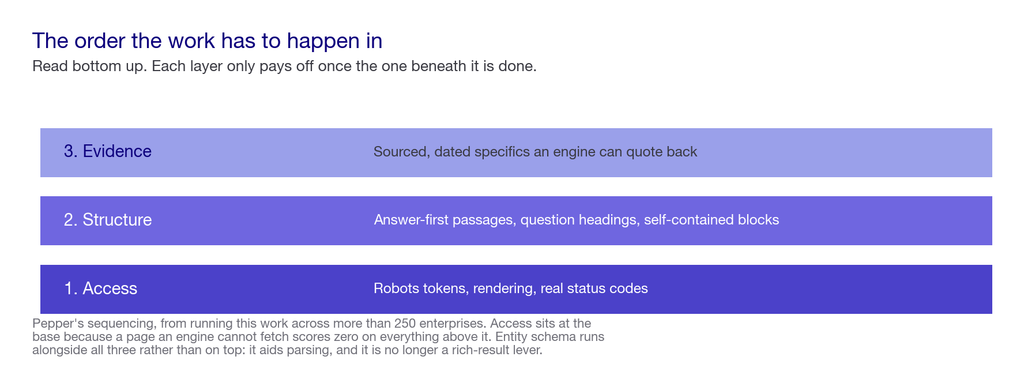
Do not run these steps in parallel across a library. They have dependencies, and working out of order wastes the effort.
- Week one, access. Robots tokens, rendering, status codes. Nothing else counts until an engine can fetch the page.
- Weeks two to four, structure on your top pages. Answer-first paragraphs and question headings on the twenty pages that already get traffic. This is the fastest visible change.
- Ongoing, evidence. Every new page carries sourced, dated specifics. Retrofit the old ones as they come up for review.
- Quarterly, schema hygiene. Confirm entity markup is intact and stop maintaining anything tied to a dead rich result.
What this work costs
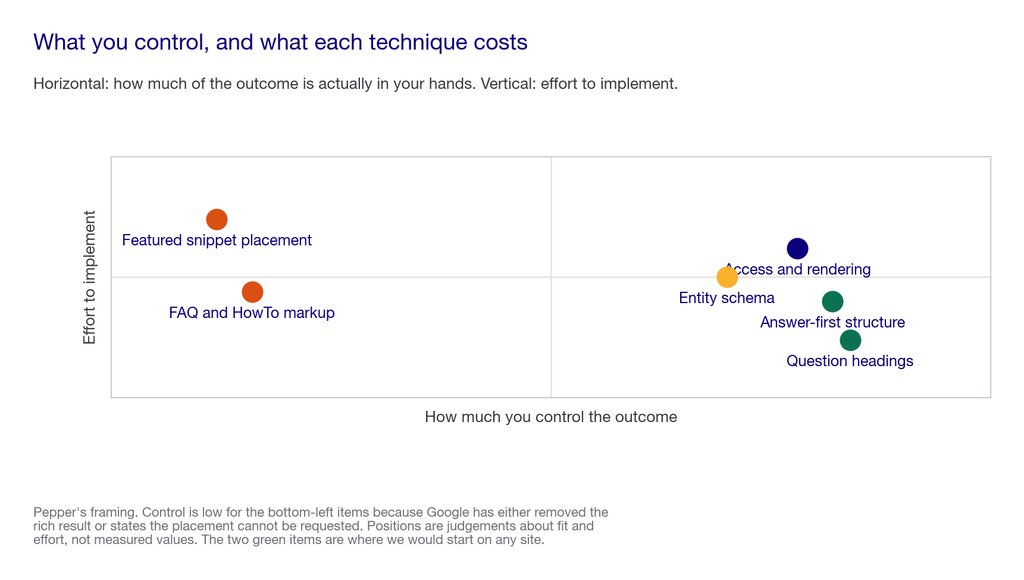
Access work is nearly free: a robots.txt edit and the time to check it. Rendering fixes cost engineering time and usually sit longest in a backlog.
Structural rewriting is editorial time, cheap per page and slow across a library. Budget by page count, not by month, and start with the twenty pages that already earn traffic.
Measurement is where the money goes. Entry tiers for AI visibility tools start around $29 a month, several vendors run free tiers, and agency retainers in this space start in the low thousands. We set the whole picture out in SEO, AEO and GEO pricing benchmarks.
One warning on scoping. If a proposal prices FAQ schema implementation as an AEO deliverable, the line item is buying something Google has switched off. That is worth catching before you sign, and it is one of the questions in our guide to answer engine optimization services.
What nobody should promise you
- A featured snippet. Google’s own documentation says you cannot request one. Anybody guaranteeing a snippet is guaranteeing something outside their control.
- FAQ or HowTo rich results. Both features are no longer shown in Google Search. There is nothing left to deliver.
- A guaranteed citation in an AI answer. Nobody controls what a model outputs. We will not promise it either.
- A single AEO score. One number collapsing several engines and dozens of prompts hides exactly the variance you are paying to see.
- That schema alone will move visibility. It helps machines parse your pages. It is not a ranking lever and has not been sold honestly as one for some time.
Frequently asked questions
What is answer engine optimization?
It is the practice of structuring content so a search or AI system can lift a direct answer from it and attribute that answer to you. In practice it covers answer-first writing, question-shaped headings, self-contained passages and quotable evidence.
Does FAQ schema still help with AEO?
Not for visibility. Google’s documentation states the FAQ rich result feature is no longer shown in Google Search results, after being narrowed in 2023 to well-known government and health sites. Existing markup is harmless but it is not earning placement.
What Google still supports
Can you optimize for featured snippets?
Not directly. Google’s answer to whether you can mark a page as a featured snippet is “You can’t,” because its systems decide which pages to elevate. You can write pages that are easy to elevate, which is a different thing.
Is HowTo schema still worth implementing?
Not for rich results. Google states the HowTo rich result is no longer shown on desktop or mobile, and it removed the documentation in September 2023. Spend the engineering time on entity markup like Organisation and Article instead.
Does structured data still matter at all?
Yes, for a narrower reason. It tells machines what entities a page describes and how they relate, which helps parsing. That is a smaller and more durable claim than the rich-result promise attached to the deprecated types.
Technique and sequencing
What is the single most effective AEO technique?
Putting the answer in the first two sentences under every heading. An engine lifting a passage takes the passage, so an answer buried in sentence five either gets missed or arrives wrapped in preamble.
How long should an extractable passage be?
Keep self-contained blocks under roughly 150 words. Longer blocks tend to get summarised, which puts the engine’s paraphrase in front of your reader rather than your own wording.
Is AEO different from GEO?
Barely. We traced both terms and GEO has a published academic origin while AEO has none. The underlying work is the same, so treat the choice of term as vocabulary rather than strategy.
Sources
Google’s documentation was read directly on 18 September 2026. Where a feature has been deprecated, we quote the current wording rather than describing it.
Google documentation
- Google Search Central, FAQ (FAQPage) structured data, checked 18 September 2026. Records that from September 2023 the feature was “only shown for well-known, authoritative government and health websites,” and that “The FAQ rich result feature is no longer shown in Google Search results.”
- Google Search Central, HowTo structured data, checked 18 September 2026. States “this rich result is no longer shown in search results, on both desktop and mobile devices.” Documentation removed 14 September 2023, following the announcement of 23 August 2023.
- Google Search Central, Featured snippets and your website, checked 18 September 2026. On whether a page can be marked as a featured snippet: “You can’t. Google systems determine whether a page would make a good featured snippet for a user’s search request, and if so, elevates it.”
- Google Search Central, AI features and your website, 15 May 2026. Places AEO and GEO inside SEO, and advises against providers guaranteeing rankings.
On what we did not do
We did not test these techniques in a controlled experiment, and we are not claiming a measured uplift for any of them. The deprecations above are documented facts from Google. The sequencing advice is our own judgement from running this work, and you should treat it as judgement.
Latest Blogs
Every agency lists the same dozen services. Almost none of them tells you how much of each you get, which makes the list unusable for comparison. One agency does publish full quantities per tier, so we divided its prices by its deliverables. The result inverts the ladder: the cheapest plan is the best value per page, and the first upgrade costs 3.4 times the entry rate for each additional page it buys.
The short answer The three terms name three surfaces, and that part is real. What is not real is the implication that they need three playbooks, three teams and three budgets each. Google states that its generative features run on core Search ranking systems. In July it also named four AI-specific tactics it does not […]
Most resource libraries are link dumps that rot quietly. We built this one the way we build everything else: 85 candidates checked at source on one day, 30 kept, 5 dropped because they no longer resolve, and two of our own entries flagged as partly superseded by newer guidance from Google. Every item says what it is for and what it cannot do. It is organised by the job you are trying to finish, not by content type.
Get your hands on the latest news!