What is AI search? The complete 2026 explainer
The short answer
AI search is any system that answers a question directly, with citations, instead of returning a list of links for you to sort through.
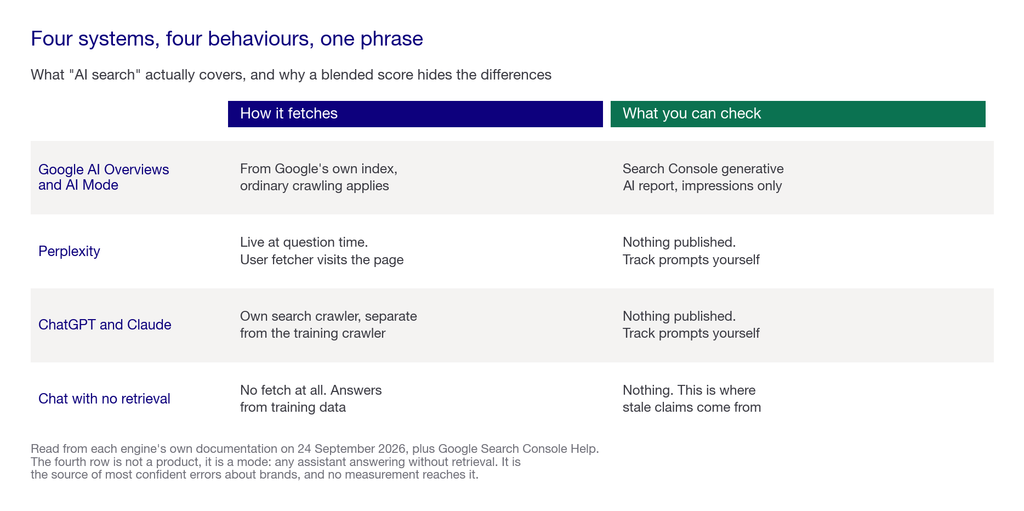
In practice you are dealing with four distinct kinds of system, and the differences are practical rather than cosmetic.
- Google’s AI surfaces. AI Overviews and AI Mode, sitting inside Google Search. Google places its guidance for these inside SEO rather than beside it.
- Standalone assistants that fetch live. Perplexity documents a user-triggered fetcher that “might visit a web page to help provide an accurate answer” when someone asks a question. A page can be read the moment it is published.
- Assistants with a search layer. ChatGPT and Claude retrieve pages through their own search crawlers, which are separate from the crawlers used for model training.
- Chat with no retrieval at all. A model answering from training data alone, with no live fetch and no citation. Still common, and the source of most confident errors about brands.
The practical result is that “are we visible in AI search” is not one question. It is four, with four different answers, and the tooling that reports a single blended figure is hiding that from you.
We run this work daily. Pepper is an agentic organic growth engine, not an SEO agency. This page comes out of what we run: organic for more than 250 enterprises across eight years, more than 10 million tracked prompts, and the questions buyers put to us in client reviews. Customers log in and run the platform themselves, with a Pepper growth team attached. Book a growth audit and we will show you what five engines currently say about you.
Key takeaways
Key takeaways from engine and search documentation, read at source.
- AI search is four systems, not one. Google’s surfaces, live-fetching assistants, retrieval-backed assistants, and pure chat with no retrieval.
- Google says this is SEO, not a new discipline. Its May 2026 guidance places AEO and GEO inside SEO.
- Some engines read your page at question time. Perplexity’s user fetcher visits pages live, and its documentation notes it “generally ignores robots.txt rules.”
- Search crawlers and training crawlers are different. Blocking the wrong token removes you from answers you meant to appear in.
- Google now reports its AI surfaces, through a generative AI performance report covering AI Overviews and AI Mode. It shows impressions only.
- Third-party sources carry most citations. Academic work across 11,000 queries found Wikipedia and longer third-party sources cited far more often than their share of the web would suggest.
What is AI search, and how is it different from a search engine?
AI search answers. A search engine lists.
That sounds like a small difference and it changes the entire economics of the page. In classic search your page competes for a click. In AI search your page competes to be the source the answer is built from, and the reader may never click anything.
Three things follow from that.
- The unit of competition changes. You are no longer competing for position one. You are competing to be one of a handful of sources an engine reaches for, which is a different and often less crowded contest.
- Most of the value is invisible to analytics. If the answer satisfies the reader, no click is recorded. Being described accurately in an answer nobody clicks is a real outcome with no measurement attached.
- Being named and being cited come apart. An engine can describe your product correctly while linking a competitor’s comparison page. That gap is the central diagnostic of the whole field.
If you want the terminology sorted before going further, AEO, GEO, AIO and LLMO explained traces each term to its origin, and GEO vs SEO vs AEO sets out what actually changes between them.
How an AI answer actually gets built
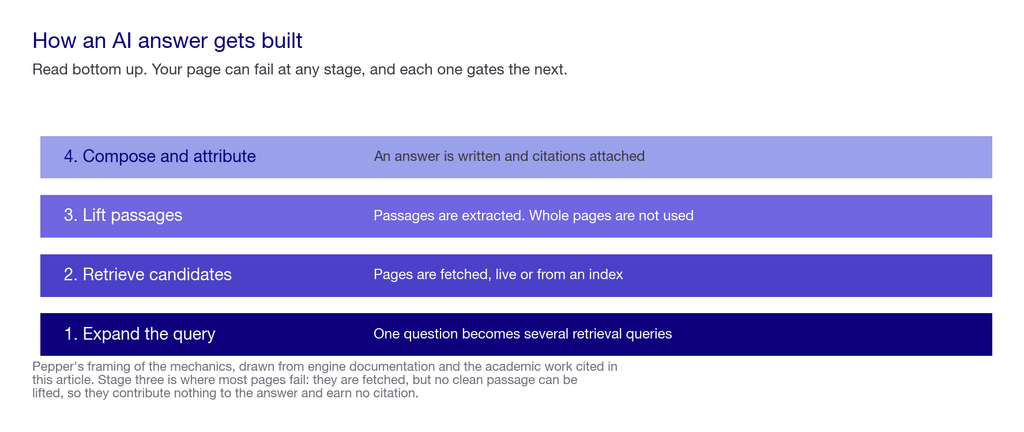
Four stages, and your page can fail at any one of them. Understanding where you fail is most of the work.
Stage one: the query is interpreted and often expanded
The system rewrites what the person typed into one or several retrieval queries. A single question can become five searches behind the scenes, which is why the phrasing a buyer uses and the phrasing that retrieves your page are frequently different.
What this means for you. The keyword you target and the query the engine actually runs are not the same string. This is why prompt sets, not keyword lists, are the right unit for measuring AI search.
Stage two: candidate pages are retrieved
The system fetches pages. How it does this varies more than most people realise.
- Live fetch at question time. Perplexity’s documentation describes a user fetcher that visits a page when a user asks a question, and notes it “generally ignores robots.txt rules” because a user request initiated it.
- From a prior crawl. Other systems retrieve from an index built earlier by their own search crawler, which is a different agent from the one used for training data.
- From Google’s index. AI Overviews and AI Mode sit on top of Google Search, so ordinary crawling and indexing apply.
What this means for you. If a crawler cannot reach your page, nothing above this stage can happen. This is the cheapest fix in the whole field and the most commonly skipped.
Stage three: passages are selected from those pages
The system does not use whole pages. It lifts passages. Academic work analysing 21,143 citations found that pages absorbed into answers are longer, more structured and richer in extractable evidence than pages that are merely retrieved.
What this means for you. A page can be fetched and still contribute nothing, because no clean passage could be lifted from it. Answer-first paragraphs under question-shaped headings are the fix, and the full practice set is in our GEO best practices playbook.
Stage four: the answer is composed and sources are attached
The system writes an answer and attaches citations. Which sources get the citation is not simply the best page: it reflects what the system retrieved, what it could lift, and how it weighs source authority.
What this means for you. You can be described in an answer without being cited in it. Both matter, and they are separate measurements.
Which systems disagree, and why that matters
Engines do not agree with each other, and the disagreements are documented rather than anecdotal.
On language and region. An independent practitioner test across five AI engines, using pages carrying correct hreflang, found Copilot consistently returned the correct localized URL and Gemini did when asked for sources, while ChatGPT, Perplexity and Claude returned the US English version instead.
On what they will fetch. Search crawlers and training crawlers are separate agents with separate rules. Perplexity’s own documentation separates PerplexityBot, “designed to surface and link websites in search results on Perplexity,” from the user-triggered fetcher described above.
On what they show you about it. Google now publishes a generative AI performance report in Search Console covering AI Overviews and AI Mode. It reports impressions only, defined as “how many times links to your site were shown to a user in a generative AI feature,” with no click metric and no query-level filtering. No match report exists for the assistants.
The practical instruction. Measure per engine, never blended. A single figure across five engines hides the one you are losing, which is the one you can act on. We go through the engine-by-engine differences in how to optimize for ChatGPT and Perplexity.
Where AI search gets its information about you
This is the part that reorders most people’s priorities.
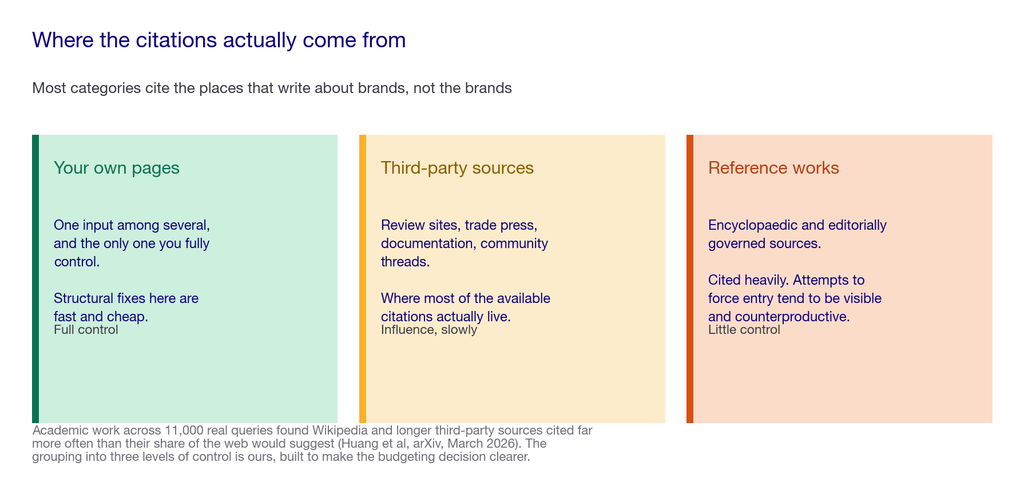
In most categories the engine is not quoting brands. It is quoting the places that write about brands. Academic work across 11,000 real queries found Wikipedia and longer third-party sources cited far more often than their share of the web would suggest.
- Your own pages are one input, and the one you fully control. Structural work here is fast and cheap.
- Third-party sources are review sites, trade publications, product documentation and community threads. Slower, and where most of the available citations live.
- Reference works sit largely outside your influence, and attempts to force entry tend to be visible and harmful.
So a programme confined to your own site addresses the smaller share. That is the single most expensive mistake in this field, and it is why earned authority is the largest recurring line item in any serious AI search budget.
Is AI search replacing traditional search?
Not in the way the framing implies, and Google’s own position is worth quoting on this.
Google’s May 2026 guidance places AEO and GEO inside SEO rather than beside them. Its guidance also advises against providers who guarantee rankings, stating plainly that “No one can guarantee a #1 ranking on Google.”
That has two implications.
- The fundamentals carry over. Crawlability, structure, authority and clarity matter in AI answers for the same reasons they mattered before. There is no separate discipline your team is locked out of.
- The measurement layer is genuinely new. What is different is that you now need to know which prompts you appear in, on which engines, and whether the citation was yours. That part did not exist before and it does need new tooling.
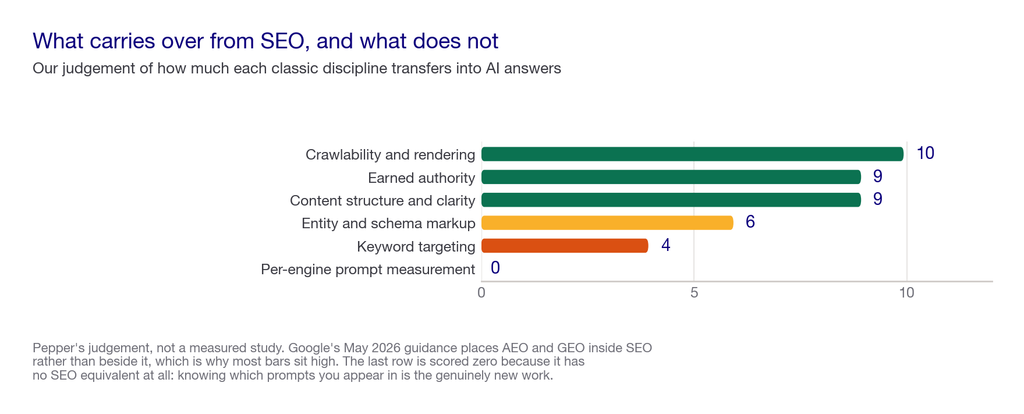
Where it falls short. We cannot tell you how much of your traffic will shift, and neither can anyone else with a figure we would trust. What we can tell you is that the answer is measurable per engine, and how to measure it is in AI search visibility metrics and KPIs.
How to tell whether AI search is working for you
Four numbers, reported separately. This is the shortest honest version.
- Brand Visibility. How often engines name you at all across a tracked prompt set.
- Domain Prompt Presence. How often an engine cites a page from your own domain.
- Share of Voice. Your slice of all brand mentions in the category.
- The gap between the first two. High mentions with low citations means engines are describing you using somebody else’s pages, which is a citability problem with a specific fix.
That gap is the diagnosis, and our framework for acting on it is Visibility, Citability and Retrievability. The tooling options, free and paid, are compared in top AI visibility platforms.
What nobody should promise you
- A guaranteed citation in an AI answer. Nobody controls what a model outputs. We will not promise it either.
- A guaranteed ranking. Google’s own words: “No one can guarantee a #1 ranking on Google.”
- A single AI search score that means something. One number across four kinds of system hides the differences that decide what you do next.
- That AI search is a separate discipline from SEO. Google places it inside SEO, and a proposal that doubles your cost by separating them should explain why.
- Complete credit. The largest share of AI search value arrives without a click, and no tool sees it.
Frequently asked questions
What is AI search?
Any system that answers a question directly with citations rather than returning a list of links. In practice it covers four different kinds of system: Google’s AI surfaces, live-fetching assistants, retrieval-backed assistants, and chat with no retrieval at all.
How is AI search different from Google?
Google is one of the systems, through AI Overviews and AI Mode. The difference is not the company but the mechanism: an answer is composed from a few retrieved sources rather than a list being returned, so you compete to be a source rather than to be clicked.
How it works
How does an AI engine decide which sources to cite?
It expands the query, retrieves candidate pages, lifts passages from them, then composes an answer with citations attached. Your page can fail at any stage, and a page that is fetched but has no liftable passage contributes nothing.
Do AI engines read my site in real time?
Some do. Perplexity documents a user-triggered fetcher that visits pages when someone asks a question, and its documentation notes that fetcher “generally ignores robots.txt rules.” Others retrieve from an index built earlier.
Is the crawler for AI answers the same as the training crawler?
No, and this matters. Search and training crawlers are separate agents with separate tokens. Blocking the training crawler is a reasonable choice; blocking the search crawler removes you from answers you wanted to appear in.
Measuring and competing
Can I see AI search traffic in Google Search Console?
Partly. Google’s generative AI performance report covers AI Overviews and AI Mode, but reports impressions only, with no clicks, no position and no query filtering. Nothing match exists for third-party assistants.
Does traditional SEO still work for AI search?
Yes, and Google’s May 2026 guidance places this work inside SEO rather than beside it. The fundamentals carry over. What is genuinely new is measurement: knowing which prompts you appear in, on which engines, and whether you were cited.
Why does my competitor appear in ChatGPT and I do not?
Usually because a third-party source that describes them is being retrieved and one describing you is not. Most citations in most categories go to review sites, trade publications and product documentation rather than to brand sites.
Sources
Engine and search documentation was read directly on 24 September 2026. Academic sources are independent and named below.
Engine and search documentation
- Google Search Central, AI features and your website, 15 May 2026. Places AEO and GEO inside SEO, and advises against providers guaranteeing rankings.
- Google Search Central, Do you need an SEO?, checked 24 September 2026. States “No one can guarantee a #1 ranking on Google.”
- Google Search Console Help, Generative AI performance report (Search), checked 24 September 2026. Covers AI Overviews and AI Mode, reporting impressions defined as “how many times links to your site were shown to a user in a generative AI feature,” with dimensions for pages, countries, dates and devices and no click metric.
- Perplexity, Crawler documentation, checked 24 September 2026. Distinguishes PerplexityBot, “designed to surface and link websites in search results on Perplexity,” from Perplexity-User, which “might visit a web page to help provide an accurate answer” and “generally ignores robots.txt rules.”
Independent research
- Huang, Goyal, Saha and Chandrasekharan, Answer Bubbles: Information Exposure in AI-Mediated Search, arXiv, 17 March 2026. 11,000 real search queries across five systems. Finds Wikipedia and longer third-party sources cited far more often than their share of the web would suggest.
- Zhang Kai, He Xinyue and Yao Jingang, From Citation Selection to Citation Absorption, arXiv, 28 April 2026. 602 set prompts, 21,143 search-layer citations, 18,151 fetched pages across ChatGPT, Google AI Overview and Perplexity. Finds absorbed pages are longer, more structured and richer in extractable evidence.
- Glenn Gabe, GSQI, AI Search, hreflang, and translated content, 1 December 2025. Independent consultant, not a vendor in this category. Tested French, Italian and Spanish queries against five AI engines. A recorded test rather than a large survey.
On what we did not do
We have not measured how much traffic is shifting from links to answers, and we are not aware of a figure we would trust. The four-system framing above is ours, built to make the mechanics teachable, and engines change their behaviour without notice. Check the documentation yourself before relying on any specific behaviour described here.
Latest Blogs
Yes, and it will not show up in your pipeline report. Those two statements are not in tension, they are the same fact stated twice. A survey of more than 1,000 B2B software buyers found 82% had sourced software recommendations from an AI chatbot in the last two years, and about half said AI mattered most when they were narrowing and comparing options. That is precisely the stage that produces no click. Meanwhile the conversion multiples circulating for AI traffic run from 22% better than organic to five times better, and the only peer-reviewed study says worse. Here is how to tell which is true for you.
Agent Atlas is the chat-first layer of Pepper’s platform: you ask in plain language, it reasons across your connected sources, and it runs the work. Here is exactly what it does, and what V1 does not.
The short answer The fork is who the buyer is, and it changes everything about what you should be buying. Both are legitimate, and the wording problem underneath them is one we traced in AEO, GEO, AIO and LLMO explained. They are not swaps, and a list that ranks them together is comparing an Indian […]
Get your hands on the latest news!