How to appear in Google AI Mode: what Google documents, and what the category invented
Key takeaways
- Google documents exactly one eligibility rule for AI Mode: a page must be indexed and eligible to appear in Google Search with a snippet.
- Google states in writing that no special files, markup or schema.org structured data are needed to appear in its AI features.
- In May 2026 Google published its first substantial AI Mode usage data, and growth is concentrated in planning, brainstorming and comparison queries.
- Query fan-out is real and documented, but Google publishes no numbers about it, so every precise fan-out statistic in circulation is unsourced.
- Because AI Mode holds a conversation rather than answering once, a page that only answers the opening question drops out at turn two.
A note on where this comes from. We run organic programmes for 250+ enterprises, and we track more than 10 million prompts across AI engines. The judgements below come from that work and from client reviews where this question keeps coming up. The facts come from Google and from named third-party research, and we have separated the two throughout.
The short answer
Google publishes exactly one eligibility rule for AI Mode, and it is not about AI.
Here is the sentence, from Google Search Central: “To be eligible to be shown as a supporting link in AI Overviews or AI Mode, a page must be indexed and eligible to be shown in Google Search with a snippet.”
That is the gate. Indexed, and snippet-eligible. There is no second gate that Google documents.
So the honest version of this playbook has two halves. The first half is technical hygiene, and it is boring. The second half is a judgement about what people now ask AI Mode, because in May 2026 Google published that for the first time. That data is the genuinely new thing, and almost nobody is writing about it.
If you would rather have someone run this with you than run it yourself, you can book a growth audit and we will look at your cluster coverage directly.
What is Google AI Mode, and how is it different from AI Overviews?
An AI Overview answers one query and sits above the conventional results. AI Mode holds a thread. The user asks, reads, narrows, then asks again, and the surface keeps the context.
Google’s own framing is useful here. It says AI Mode “is particularly helpful for queries where further exploration, reasoning, or complex comparisons are needed.” That is a description of deliberation, not of lookup.
In January 2026 Google connected the two surfaces directly. Follow-up questions inside an AI Overview now hand the user into an AI Mode conversation.
So the unit of competition changes. In classic search the unit is the query. In AI Mode the unit is the thread, a sequence of follow-ups you did not choose and cannot see.
That has one clear writing consequence. A page that answers only the opening question drops out of the conversation at turn two. The pages that survive also answer the obvious next question, in the same place, without requiring the reader to have read the section above.
We have written separately on how Google AI Mode works and on what Google AI Mode is, so we will not repeat the mechanism here.
What Google actually published about AI Mode users
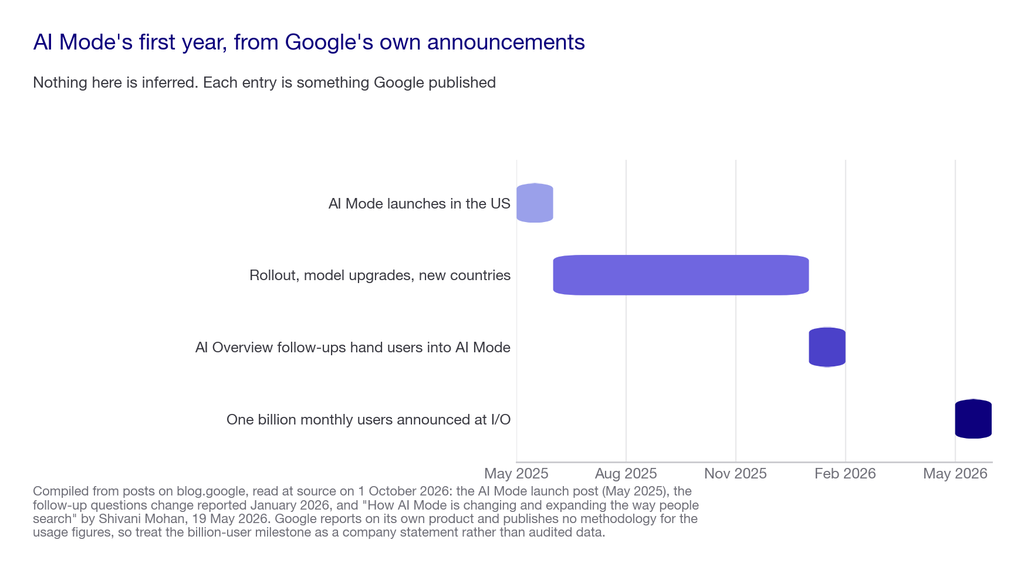
On 19 May 2026, Shivani Mohan, Google’s VP of Data Science and UXR, published a post on the company blog about how people use AI Mode after its first year. It is the first substantial usage data Google has released on this surface.
The headline numbers: AI Mode has passed a billion monthly active users, and queries have more than doubled every quarter since launch.
But the useful numbers are the behavioural ones.
“The average AI Mode search is triple the length of a traditional Search query.” People write sentences, not keywords.
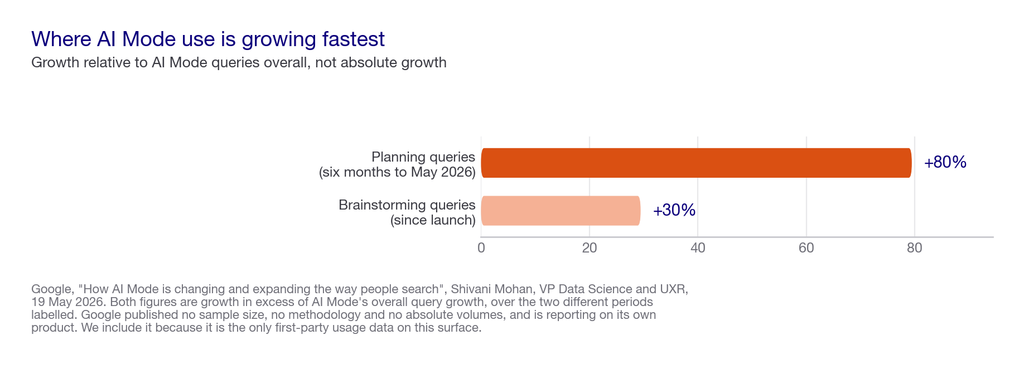
Planning queries have grown 80% faster than AI Mode queries overall in the six months to May 2026. Brainstorming queries have grown 30% faster since launch. Meanwhile more than one in six US searches now use voice or images.
Read those growth figures next to Google’s own description of the surface. The usage data agrees with the documentation. Growth is concentrated at the deliberative end of search.
This is the part with real strategic consequence. If your organic programme is built around short head terms, you are optimising for the query shape that AI Mode users are moving away from. That is a content planning problem, not a technical one.
The numbers the category made up
Query fan-out is real. Google names it and defines it: both surfaces “may use a ‘query fan-out’ technique, issuing multiple related searches across subtopics and data sources, to develop a response.”
That is the entire published description. Nowhere does it say how many sub-searches Google runs. It does not say how a query is decomposed. It does not say how results are chosen.
Yet the category quotes fan-out arithmetic to one decimal place. Five to sixteen sub-searches. Fifty-nine per cent of prompts triggering five to eleven. A named competitor running 2.3 to 2.8 per prompt. None of those figures appears in any Google documentation we can find, and the old version of this page repeated all three.
One number in that set does have a real origin. The “86% same conclusions, 13.7% citation overlap” claim comes from a study of 730,000 response pairs published in December 2025 by a well-known SEO tools company. Our page used it without credit. We are not republishing it here, because our own rule is that statistics must trace to a source published in 2026, and this one rests on September 2025 data. But the authors deserved the citation.
Where cited pages actually rank
For AI Mode itself, Google publishes no citation-distribution data at all. The closest available evidence covers AI Overviews, and it is worth looking at because it sets expectations correctly.
In March 2026, a study of 863,000 keyword SERPs and four million AI Overview URLs found that 37.1% of cited pages ranked in the organic top ten, 26.2% ranked between 11 and 100, and 36.7% did not rank in the top 100 at all.
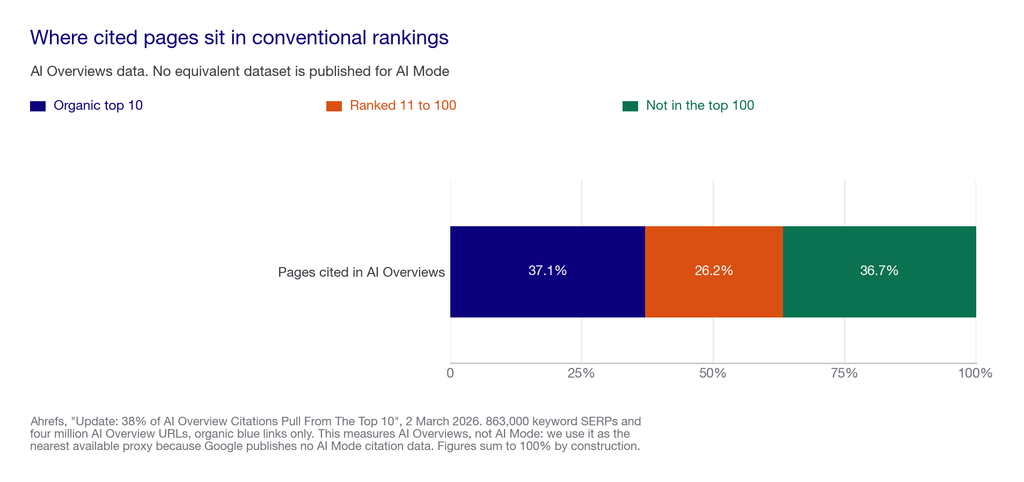
Two readings, and both matter.
Ranking still helps, and it is the single largest bucket. But a third of citations come from pages that rank nowhere. So being cited is not the same as ranking, and a programme that only tracks positions will miss most of what is happening.
The honest caveat: this is AI Overviews data, not AI Mode data. We use it as the nearest available proxy, and we are telling you so rather than letting it read as AI Mode research. Anyone quoting a precise AI Mode citation-overlap figure should be asked where it came from.
How to appear in Google AI Mode: the playbook, in Google’s order
This is ordered by what Google documents first, then by what published evidence supports, then by judgement. We have marked which is which.
1. Confirm you are not accidentally opted out. (Documented.) Google’s controls for limiting what appears are nosnippet, data-nosnippet, max-snippet and noindex, plus robots.txt. A max-snippet value set years ago for a different reason still applies today. Check it before anything else.
2. Get indexed and stay snippet-eligible. (Documented.) This is the only stated eligibility rule. It is unglamorous, and it is the whole gate.
3. Skip the special files. (Documented.) Google is explicit: “You don’t need to create new machine readable files, AI text files, or markup to appear in these features. There’s also no special schema.org structured data that you need to add.” Keep your schema for rich results, which is a real and separate benefit. Do not buy a schema project sold as an AI Mode lever.
4. Write for the thread, not the query. (Judgement, supported by Google’s usage data.) Cover the obvious follow-up in the same page. Make each section answer its own question without depending on the one before it.
5. Move budget toward comparison and planning content. (Judgement, supported by Google’s usage data.) Planning queries grew 80% faster than AI Mode queries overall. Comparison pages, decision frameworks and “how do I choose” content sit exactly where the growth is.
6. Keep doing conventional SEO. (Evidence.) Top-ten ranking remains the largest single source of citations in the nearest comparable dataset. It is necessary, and it is not sufficient.
7. Measure mentions alongside positions. (Judgement.) If a third of citations come from pages that do not rank, rank tracking cannot tell you whether you are winning. You need prompt-level tracking alongside it.
Our methodology: how we ordered the playbook
We ordered those seven steps deliberately rather than by difficulty. Each step was scored on three inputs, and the weights below decide the sequence.
| Input | Weight | What it means |
|---|---|---|
| Documented by Google | 50% | Google states it in published guidance, in its own words |
| Supported by named research | 30% | A dated 2026 study with stated sample size backs it |
| Pepper judgement | 20% | Our reading, from programmes we run. Marked as judgement in the text |
Steps one to three score entirely on the first input, which is why they come first. Steps four and five rest on Google’s usage data plus our own reading, so they sit lower despite being the more interesting work. Nothing in the list scores on judgement alone.
AI Mode at a glance
| Google AI Mode | AI Overviews | Classic organic | |
|---|---|---|---|
| What it is | A multi-turn conversational surface | A generated answer above the results | Ten blue links |
| Unit of competition | The thread | The query | The query |
| Documented eligibility | Indexed and snippet-eligible | Indexed and snippet-eligible | Indexed |
| Special markup needed | None, per Google | None, per Google | None |
| Citation data published | None by Google | Third-party only | Extensive |
| Cost to act on | Editorial rework, ongoing | Editorial rework, ongoing | Established retainer or in-house |
Where it falls short as a comparison: the cost row is the weakest. Nobody publishes a defensible benchmark for what AI search work costs, because the work is not standardised. Treat that row as a shape, not a quote.
What this costs
Steps one through three are hours of technical checking, not a project. Most teams complete them in a day.
Steps four and five are the expensive ones, because they change what you commission. Rewriting a cluster so each section stands alone is real editorial work. Shifting budget toward comparison content means producing fewer, longer, better-researched pages.
Step seven costs whatever prompt tracking costs you. That is a tooling decision rather than a content one.
Where Pepper fits
We are not a neutral recommender here, and you should read this section knowing that.
Pepper works as an organic growth partner rather than a tool vendor. Three parts do the work. Agent Atlas is our agentic engine for research, briefing and production at cluster scale, which is what step four actually demands. Pepper’s GEO platform handles measurement, tracking prompts and mentions rather than positions alone. Customers log in and run it themselves, and a growth team sits alongside for the judgement work: deciding which clusters matter, and in what order.
The framework we run this on is visibility, citability and retrievability. Retrievability is the technical gate. Citability is whether a passage survives extraction. Visibility is whether you show up at all.
For a worked example in B2B SaaS, our Acceldata case study shows the cluster approach applied end to end.
Where it falls short. We cannot tell you your AI Mode citation share with precision, because Google publishes no such data and neither does anyone else. We can track mentions across engines and show you the direction. Anyone promising a number here is selling a modelled estimate with a confident label on it.
How to choose what to do first
I will write this section in the first person, because an ordering nobody will defend is not worth printing.
Start with eligibility, not with content. Google documents one gate, and it is technical: a page must be indexed and eligible to appear in Search with a snippet. I have watched teams debate conversational tone while a stale max-snippet directive quietly removed them from every AI surface at once. That is redecorating a room you have locked yourself out of.
So my order is: clear the gate, then check whether your existing clusters survive a second question, then decide whether your demand is deliberative enough to justify the rework. Here is the scorecard I would apply to any proposed AI Mode programme, on a 100 point scale.
| Area | Weight | What a programme worth funding demonstrates |
|---|---|---|
| Technical eligibility is verified | 30 | Someone has actually read robots.txt and the snippet directives this quarter, not last year. |
| Sections stand alone | 25 | Each H2 answers its own question without depending on the paragraph above it to make sense. |
| The demand is deliberative | 20 | Buyers compare, plan and shortlist rather than converting on a single short-tail query. |
| Measurement exists before content | 15 | Prompt-level mention tracking is running, so the programme can be judged on evidence rather than faith. |
| Nothing rests on invented numbers | 10 | Every claim in the plan traces to published guidance or a dated study with a stated sample. |
Five questions I would ask before funding any of this, in this order.
- “When did someone last read our robots.txt and snippet directives?” A stronger answer names a date this quarter. A weaker one is “the agency handles that”, which in my experience means nobody has looked since the site migrated.
- “Can you show me a section that makes sense on its own?” Open a priority page at random and read one H2 aloud without its neighbours. If it dangles, you have editorial rework rather than a technical problem.
- “What does our buyer actually type?” If the honest answer is a two-word product category, AI Mode matters less to you than the noise suggests.
- “What instrument tells us this worked?” Rank tracking alone cannot answer it, because a third of citations in the nearest comparable dataset come from pages that do not rank at all.
- “Which numbers in this plan have a source?” Ask for the study. A stronger answer produces a link and a sample size within a minute.
Red flags, each one something a supplier actually says. A precise query fan-out count, when Google publishes none. A schema package sold as an AI Mode lever, which Google’s own documentation contradicts in writing. A guaranteed citation, when Google documents eligibility rather than selection. A composite AI visibility score presented as an industry standard. And our own previous version of this page, which did three of those four.
Before commissioning anything, measure what you own today. Write 25 real commercial questions your buyers would actually type into AI Mode, in full sentences rather than keywords, because that is how people use the surface. Run each of those 25 prompts three times, since engines are probabilistic and a single run is an anecdote. Then give any fix 90 days before you judge it. Four worked examples for a mid-market B2B software company:
- “how do I choose a data observability platform for a Snowflake stack”
- “what should I compare when shortlisting data quality vendors”
- “help me plan a data observability rollout across three teams”
- “who are the main alternatives to Monte Carlo and how do they differ”
Note the shape of the answer as well as whether you appear. Every one of those is a planning or comparison prompt, which is precisely where Google says AI Mode usage is growing fastest. If you appear in none of them, that tells you more than any score.
And the answer that loses Pepper the sale: if your demand is short-tail and transactional, you do not need an AI Mode programme, and you do not need us to run one. Stay where you are, keep your rankings healthy, and revisit in two quarters when the behaviour data updates.
It comes down to one principle: clear the documented gate, write sections that survive being read alone, and refuse every precise number nobody will source, ours included. We published ten of those numbers ourselves, twice, which is the strongest argument we can make for the principle.
The claims we removed
Every statistic on the previous version of this page, and what happened to it.
| Claim on the old page | Source named | What we found | Action |
|---|---|---|---|
| Session duration 3x traditional Search | None | Google published 3x about query length, not session duration | Removed, and corrected above |
| 93% zero-click rate in AI Mode | None | No published source located | Removed |
| Fan-out of 5 to 16 sub-searches | None | Google publishes no count | Removed |
| 59% of prompts trigger 5 to 11 sub-queries | None | No published source located | Removed |
| Complex B2B queries average 9 to 11 | None | No published source located | Removed |
| A named competitor runs 2.3 to 2.8 sub-queries | None | No published source located | Removed |
| 86% same conclusions, 13.7% citation overlap | None | Real: a 730,000-response study, December 2025. Used uncredited | Removed; source named above |
| 40% higher coverage “in simulations” | None | No methodology, no simulation described | Removed |
| Ontological structure answers 3x more variations | None | No published source located | Removed |
| Full schema stack cited 3 to 5 times more | None | Contradicts Google’s published statement | Removed and corrected |
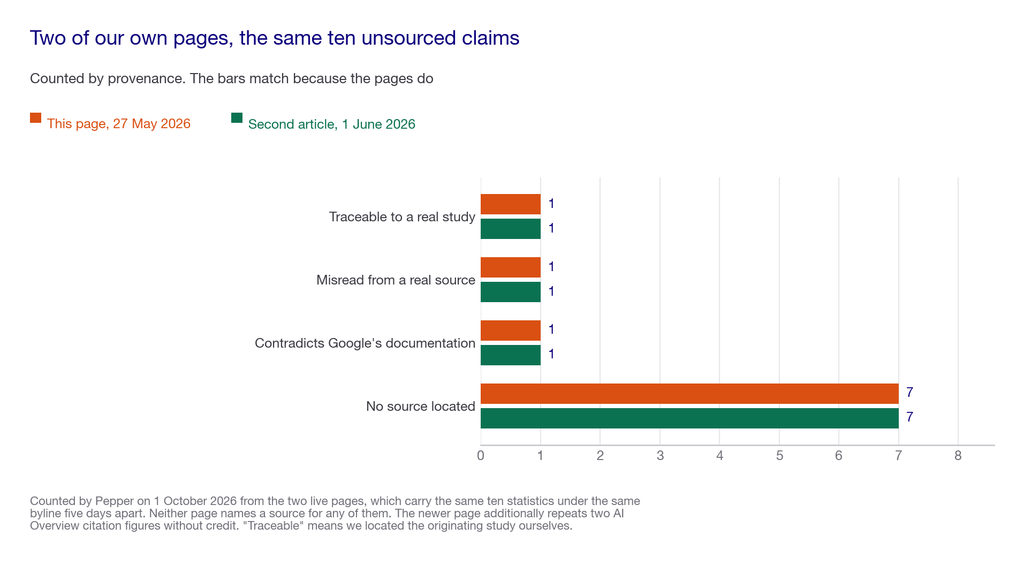
We also have a duplication problem, and we would rather say it than let a reader find it. Five days after this page went live, we published a second article under the same byline covering the same ground, with the same ten numbers. Two pages competing for the same queries split their own authority. We have flagged both for consolidation. The mechanism explainer should own how AI Mode works, and this page should own what to do about it.
What nobody should promise you
Be sceptical of any of these.
- A guaranteed AI Mode citation. Google documents eligibility, not selection.
- A single composite AI visibility score. It hides more than it reveals, and no two vendors compute it the same way.
- A universal benchmark. Citation behaviour varies enormously by vertical and query type.
- A precise fan-out count. Google publishes none.
- A schema package sold as an AI Mode lever. Google says in writing that you do not need it.
Frequently asked questions
What makes a page eligible to appear in Google AI Mode?
Google states one rule: the page must be indexed and eligible to be shown in Google Search with a snippet. There is no separate AI index, and no additional documented requirement exists beyond normal Search eligibility.
Do I need special schema or an AI text file to appear in AI Mode?
No. Google’s documentation says you do not need new machine-readable files, AI text files, or any special schema.org structured data. Schema remains genuinely useful for rich results, which is a separate and real benefit worth keeping.
How many sub-queries does query fan-out generate?
Google does not publish a number. It describes fan-out as issuing multiple related searches across subtopics and data sources, and it stops there. Treat any precise figure as unsourced until someone shows you the underlying study.
Is appearing in AI Mode the same as ranking in Google?
No, although ranking clearly helps. In the nearest comparable dataset, covering AI Overviews rather than AI Mode, 37.1% of cited pages ranked in the organic top ten and 36.7% did not rank in the top 100 at all.
How is AI Mode different from AI Overviews?
An AI Overview answers a single query above the results. AI Mode instead holds a multi-turn conversation, and since January 2026 follow-up questions inside AI Overviews hand users directly into an AI Mode thread.
What kind of content is growing fastest in AI Mode?
Google reported in May 2026 that planning queries grew 80% faster than AI Mode queries overall during the previous six months, and that brainstorming queries have grown 30% faster than queries overall since launch.
Can I opt out of AI Mode without leaving Google Search?
Only partly. Google points to nosnippet, data-nosnippet, max-snippet and noindex. These reduce what can be shown, but they also affect your normal Search snippets, so the trade-off is a real one.
How should I measure whether this is working?
Track mentions and citations at the prompt level alongside conventional rankings. Rank tracking alone will miss the large share of citations that come from pages sitting outside the top 100 entirely.
Where to go next
- What Google AI Mode is, if you want the plain explanation first
- How Google AI Mode works, for the mechanism in depth
- Ranking in Google AI Overviews, the sibling surface
- How AI search differs from traditional search
- How we rank and score GEO providers
Sources and further reading
- Google Search Central, “AI features and your website”, last updated 10 December 2025. Source of the eligibility rule, the fan-out definition, the schema statement and the opt-out controls.
- Shivani Mohan, Google, “How AI Mode is changing and expanding the way people search”, 19 May 2026. Source of the usage and growth figures. Google publishes no methodology for these numbers, and it is reporting on its own product.
- Ahrefs, “Update: 38% of AI Overview Citations Pull From The Top 10”, 2 March 2026. 863,000 keyword SERPs and four million AI Overview URLs. AI Overviews only.
- Ahrefs, “Are AI Mode and AI Overviews Just Different Versions of the Same Answer?”, 15 December 2025, 730,000 response pairs on September 2025 data. Named here as the origin of a figure our previous version used without credit. Not republished, because it falls outside our 2026 sourcing rule.
- Google, “Expanding AI Overviews and introducing AI Mode”, the launch announcement used for the timeline in Figure 1.
- Removed for age: a September 2025 seoClarity analysis of 1,000 transactional queries and 12,011 AI Mode citations, and a July 2025 Semrush study of 5,000 keywords. Both are AI Mode citation-overlap research, and both fall outside our 2026 cutoff.
Latest Blogs
Most advice on this is inference dressed as fact. OpenAI documents exactly one thing clearly, which is access. Here is what is documented, what is inferred, and how to verify the rest for yourself.
Being named in an AI answer and having your page used as its source are different outcomes with different causes and different fixes. The gap between them is the most useful diagnostic in AI search, and most reporting collapses it into one number.
Every platform reports share of voice and almost none of them define it the same way. Here is the definition worth using, the three choices that change the number, and how to measure it yourself without buying anything.
Get your hands on the latest news!

Similar Posts
GEO / AI Search
10 mins read
How to get cited by ChatGPT
GEO / AI Search
10 mins read
Mentioned vs cited: the difference that decides AI visibility
GEO / AI Search
13 mins read