Best LLM Monitoring Tools for Brand Visibility in 2026
Your brand ranks on Page 1 for every core keyword. Your SEO metrics look strong. But when prospects ask ChatGPT for product recommendations in your category, competitors get cited, but you don’t.
This visibility gap is becoming the norm. Only 16% of Fortune 500 brands systematically track their presence in AI search.
Meanwhile, AI-sourced traffic surged 527% year-over-year between January and May 2025, and LLM visitors convert at 4.4x the rate of traditional organic traffic.
LLM monitoring tools bridge this gap by tracking where your brand appears and where it doesn’t—across ChatGPT, Perplexity, Google AI Overviews, and Gemini.
| The 30-Second Download – High search rankings no longer guarantee visibility, as AI platforms increasingly dominate the discovery phase for buyers. – Visibility in AI answers fluctuates rapidly, with 40-60% of cited domains changing monthly, necessitating continuous monitoring. – Users leveraging AI search are high-intent buyers, with AI-sourced traffic converting at over 4x the rate of traditional organic search. – Tools like Pepper’s Atlas are essential for benchmarking share of voice and identifying specific content gaps to regain lost citations. |
What Are LLM Monitoring Tools for Brand Visibility?
LLM monitoring tools for brand visibility track how often your brand, products, or content appear in AI-generated responses. They automate the process of querying AI platforms, analyzing responses for brand mentions, and compiling data into actionable dashboards.
Technical tools track API latency, token usage, and error rates. Brand visibility tools track citation frequency, competitive share of voice, and sentiment—metrics that matter to marketing teams.
| Feature | Technical LLM Observability | Brand Visibility Monitoring |
|---|---|---|
| Primary Users | Developers, ML Engineers | Marketing Teams, SEOs |
| Core Focus | API performance, costs, latency | Brand mentions, citations, sentiment |
| Key Metrics | Token usage, error rates, hallucination detection | Share of voice, citation rate, competitor benchmarking |
| Example Tools | Datadog LLM Observability, LangSmith | Pepper Atlas, Semrush AI Visibility, Peec AI |
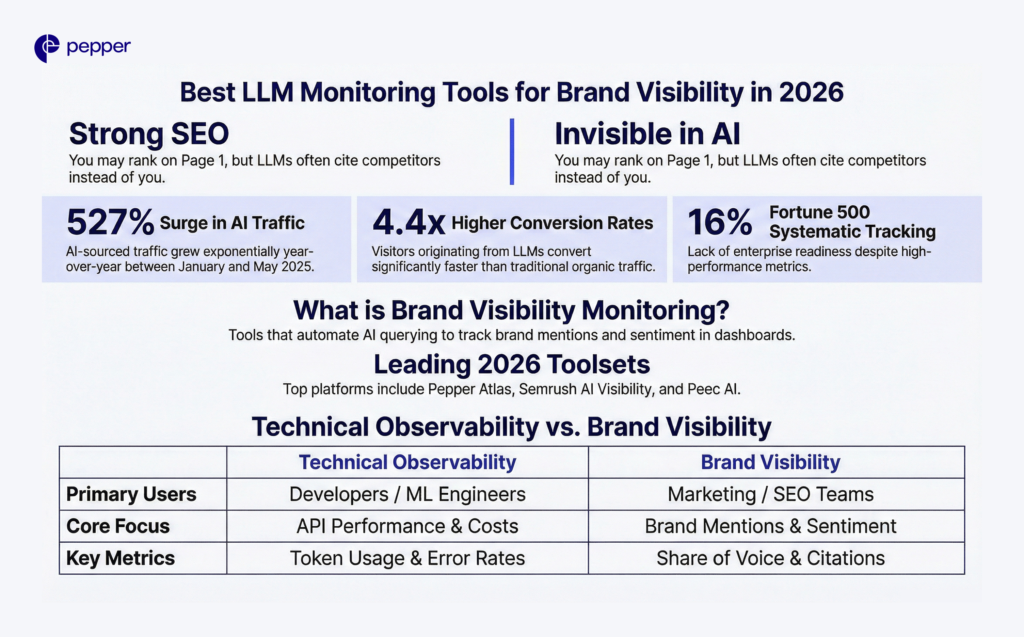
Brand visibility tools answer a simple question: When prospects ask AI platforms about your category, does your brand appear? Technical observability tools serve a completely different purpose—optimizing LLM application performance for engineering teams.
Why Do You Need LLM Monitoring Tools in 2026?
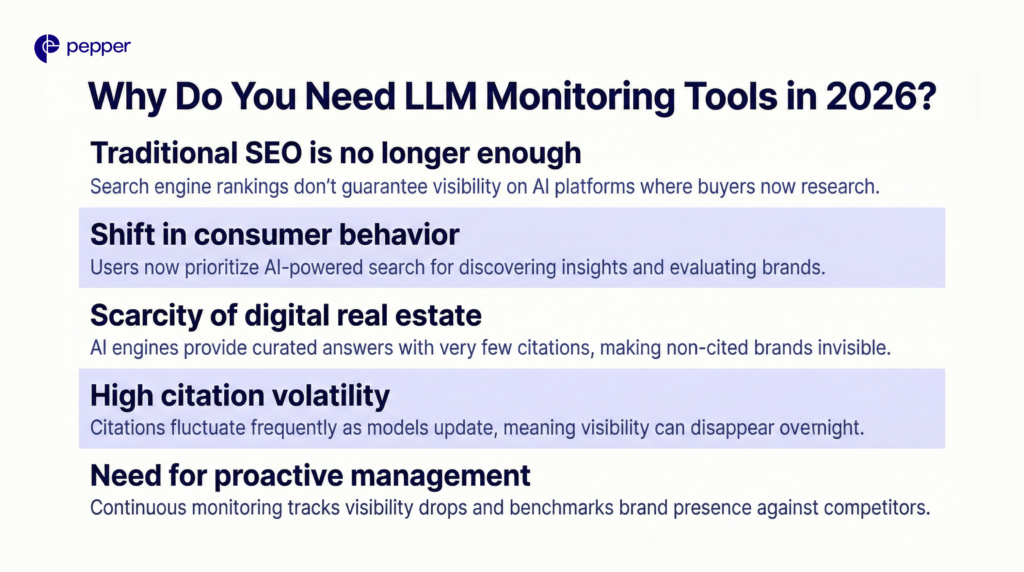
- Traditional SEO is no longer enough: High rankings on standard search engines do not guarantee visibility on AI platforms where modern buyers increasingly conduct their research.
- Shift in consumer behavior: A significant number of users now prioritize AI-powered search over traditional methods for discovering insights, researching purchases, and evaluating brands.
- Scarcity of digital real estate: Unlike search engines that display pages of results, AI engines provide curated answers with very few citations. If your brand is not cited in this small selection, you are effectively invisible to the prospect.
- High citation volatility: Visibility in AI responses is unstable. Citations fluctuate frequently as models update their retrieval patterns, meaning a brand featured today can easily disappear tomorrow.
- Need for proactive management: Continuous monitoring is required to catch sudden drops in visibility, benchmark your presence against competitors, and link your optimization efforts to actual outcomes.
| Remember: LLM monitoring tools provide the visibility you need to catch citation drops early, benchmark against competitors, and tie optimization efforts to measurable outcomes. |
What Features Should You Look for in LLM Tools?
Not all LLM monitoring tools offer the same capabilities. Focus on features that translate to actionable insights for your team.
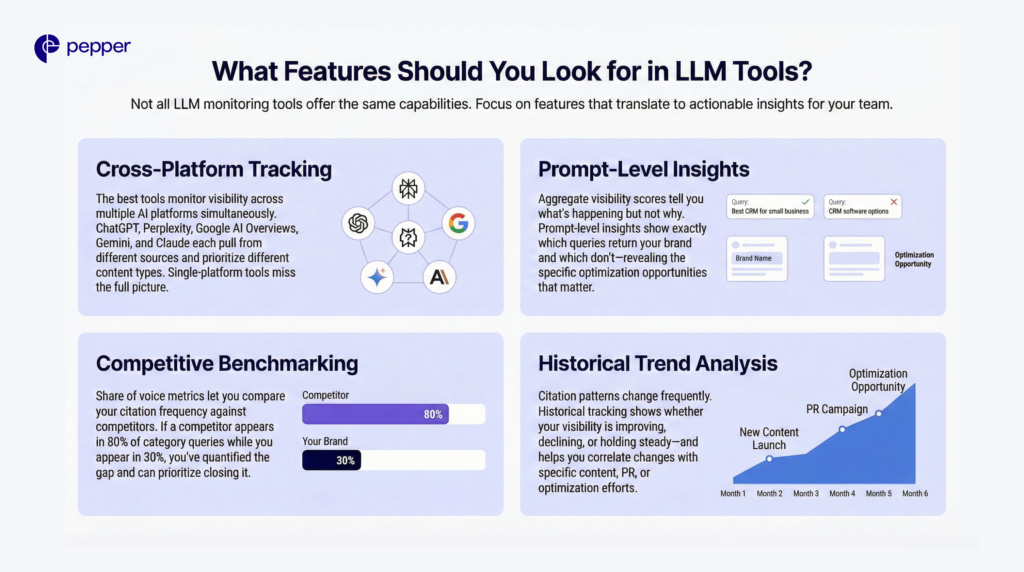
Cross-Platform Tracking
The best tools monitor visibility across multiple AI platforms simultaneously. ChatGPT, Perplexity, Google AI Overviews, Gemini, and Claude each pull from different sources and prioritize different content types. Single-platform tools miss the full picture.
Prompt-Level Insights
Aggregate visibility scores tell you what’s happening but not why. Prompt-level insights show exactly which queries return your brand and which don’t—revealing the specific optimization opportunities that matter.
Competitive Benchmarking
Share of voice metrics let you compare your citation frequency against competitors. If a competitor appears in 80% of category queries while you appear in 30%, you’ve quantified the gap and can prioritize closing it.
Historical Trend Analysis
Citation patterns change frequently. Historical tracking shows whether your visibility is improving, declining, or holding steady—and helps you correlate changes with specific content, PR, or optimization efforts.
| ✓ LLM Tool Evaluation Checklist – Tracks brand mentions across 4+ AI platforms (ChatGPT, Perplexity, Gemini, Claude) – Provides prompt-level visibility data, not just aggregate scores – Includes competitive share of voice benchmarking – Shows historical trends and citation changes over time – Offers optimization recommendations based on visibility gaps |
Best LLM Monitoring Tools for Brand Visibility
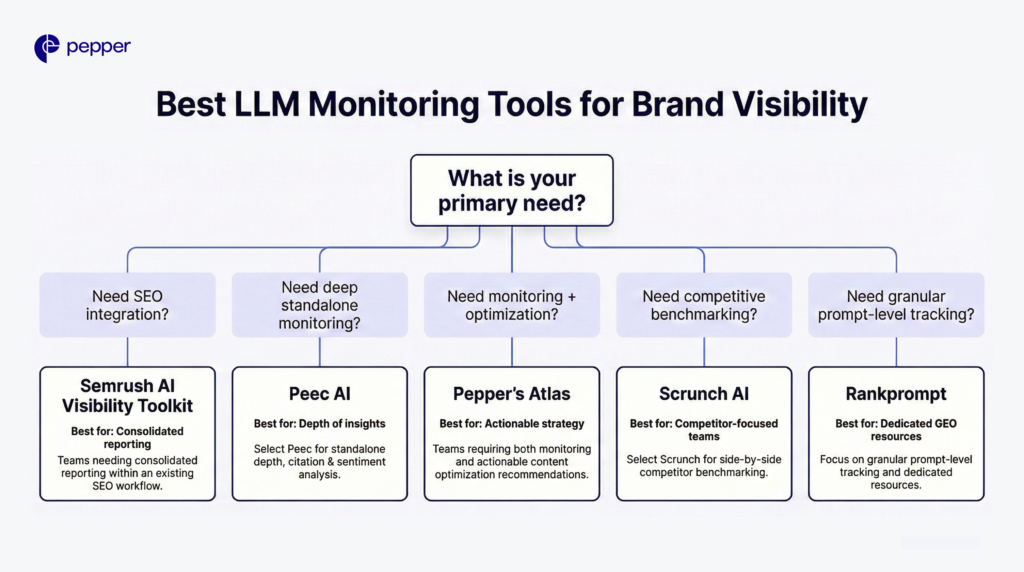
Here’s how the leading tools compare across key capabilities, pricing models, and ideal use cases.
| Tool | Cross-Platform | Competitive Benchmarking | Optimization Recommendations | Best For |
|---|---|---|---|---|
| Semrush AI Visibility | ✓ | ✓ | Basic | Teams using Semrush |
| Peec AI | ✓ | ✓ | Limited | Deep AI visibility focus |
| Pepper’s Atlas | ✓ | ✓ | Comprehensive | Monitoring + content strategy |
| Scrunch AI | ✓ | ✓ | Limited | Competitive intelligence |
| Rankprompt | ✓ | ✓ | Basic | Granular prompt analysis |
1. Semrush AI Visibility Toolkit
Semrush expanded its SEO platform to include AI visibility tracking. The toolkit monitors brand presence across ChatGPT, Perplexity, and Google AI Overviews, integrating data alongside traditional SEO metrics in a unified dashboard.
- Best for: Teams already using Semrush for SEO who want consolidated reporting.
- Key features: Cross-platform monitoring, competitor benchmarking, integration with existing Semrush workflows, and daily tracking updates.
- Considerations: Requires an existing Semrush subscription; AI visibility features are add-on modules.
2. Peec AI
Peec AI specializes exclusively in LLM brand monitoring. The platform tracks mentions across major AI platforms and provides detailed citation analysis, including sentiment and positioning within AI responses.
- Best for: Marketing teams prioritizing depth of AI visibility insights over broader SEO tooling.
- Key features: Real-time citation alerts, sentiment analysis, prompt-level visibility data, and white-label reporting options.
- Considerations: Standalone tool, doesn’t replace traditional SEO platforms.
3. Pepper’s Atlas
Atlas—Pepper’s intelligence layer—approaches AI visibility as part of a broader content optimization strategy. Beyond tracking brand mentions across ChatGPT, Gemini, Perplexity, and AI Overviews, Atlas identifies why certain content gets cited and provides optimization recommendations based on LLM retrieval patterns.
- Best for: Teams that need both monitoring and actionable guidance on improving visibility through content strategy.
- Key features: Multi-platform tracking, competitive share-of-voice analysis, content gap identification, optimization recommendations tied to citation improvement, and integration with Pepper’s content creation workflow.
- Considerations: Most valuable when combined with Pepper’s content optimization services.
4. Scrunch AI
Scrunch AI focuses on competitive intelligence within AI search. The platform emphasizes side-by-side competitor comparisons, showing exactly which brands appear for specific prompts and how positioning shifts over time.
- Best for: Competitive-focused teams that need granular benchmarking data.
- Key features: Head-to-head competitor tracking, share of voice trends, prompt library for category monitoring, export-ready reports.
- Considerations: Less emphasis on optimization recommendations compared to some alternatives.
5. Rankprompt
Rankprompt offers prompt-level tracking with a focus on understanding which specific queries drive brand visibility. The platform helps identify high-value prompts where optimization could improve citation frequency.
- Best for: Teams with dedicated GEO resources who want granular prompt data for optimization.
- Key features: Custom prompt tracking, citation rate analysis, historical comparisons, API access for custom integrations.
- Considerations: Requires more hands-on analysis; less automated guidance than some tools.
How Can LLM Tools Improve Your AI SEO Optimization Strategy?
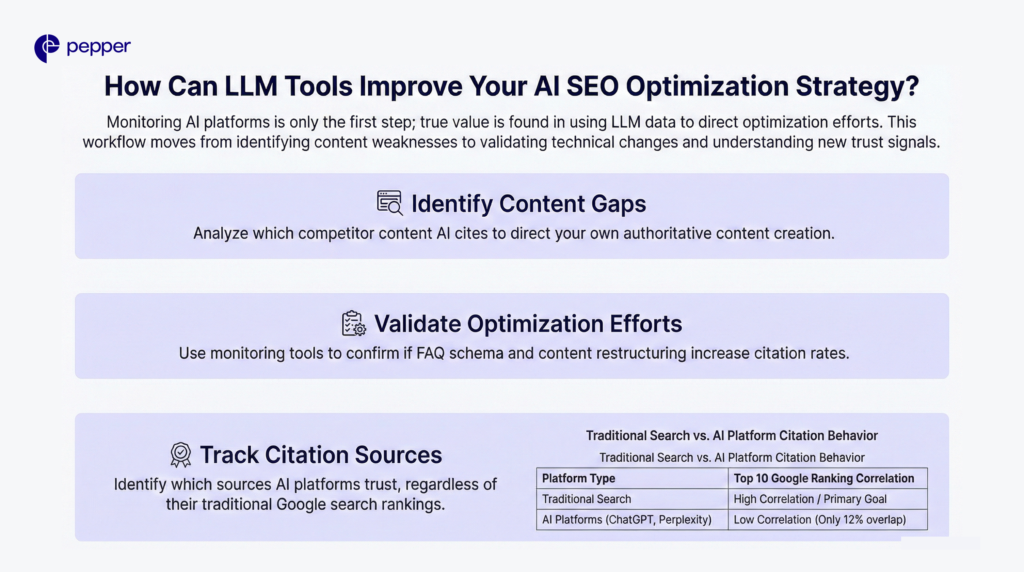
Monitoring alone doesn’t improve visibility. The value of LLM tools comes from translating data into optimization priorities.
Identify Content Gaps
LLM monitoring reveals which competitor content gets cited while yours doesn’t. This gap analysis directs content creation efforts toward topics where AI platforms seek authoritative sources but don’t find yours.
Validate Optimization Efforts
When you restructure content for LLM retrieval—adding FAQ schema, breaking articles into atomic Q&A blocks, front-loading context words—monitoring tools show whether changes actually improve citation rates. Without measurement, GEO efforts remain guesswork.
Track Citation Sources
Ahrefs research found that only 12% of URLs cited by ChatGPT, Perplexity, and Copilot rank in Google’s top 10 search results. LLM tools reveal which content sources AI platforms actually trust, even when those sources don’t match traditional SEO assumptions.
| Remember: LLM monitoring tools turn AI visibility from an abstract concern into a measurable channel with clear optimization levers. The data guides where to invest content resources for maximum impact on brand presence in AI-generated answers.[;p”;’///. |
Turn AI Visibility into Your Competitive Edge
The era of relying solely on traditional SEO is over. Today, AI-powered search is where buyers discover products, vet brands, and make decisions.
While others fly blind, brands that actively manage their presence on platforms like ChatGPT, Perplexity, and AI Overviews are seizing a first-mover advantage that traditional metrics simply can’t capture.
Stop guessing where you stand and start optimizing with precision. Pepper’s Atlas doesn’t just watch the changes; it gives you the intelligence to lead them. By automating cross-platform monitoring and pinpointing your competitive Share of Voice, Pepper uncovers the specific content gaps standing between you and your customers.
Don’t just adapt to the AI shift—master it, and turn visibility into a measurable engine for growth. Start monitoring with Atlas, book a demo today!
Frequently Asked Questions
Why do I need LLM monitoring tools to track brand mentions in 2025?
Traditional SEO tools track rankings, not AI visibility. LLM monitoring tools reveal whether your brand appears when prospects ask ChatGPT or Perplexity for recommendations in your category—a discovery channel that now influences 44% of AI search users’ purchase research.
What are the top LLM tools for analyzing brand mentions in AI models?
Leading options include Semrush AI Visibility Toolkit, Peec AI, Pepper’s Atlas, Scrunch AI, and Rankprompt. Each offers different strengths—from SEO platform integration to deep competitive benchmarking to optimization recommendations.
How can LLM monitoring tools improve my AI SEO optimization strategy?
These tools identify which competitor content gets cited while yours doesn’t, validate whether optimization efforts actually improve citation rates, and reveal which content sources AI platforms trust—directing content investments toward measurable visibility improvements.
Do LLM tools help with AI for SEO by identifying content gaps?
Yes. LLM monitoring tools show exactly which category queries cite competitors but not your brand. This gap analysis prioritizes content creation efforts where AI platforms seek authoritative sources, helping you build presence in high-value queries.
How accurately can you track brand mentions using these LLM monitoring tools?
Most leading tools provide 85-95% accuracy for direct brand mentions when running sufficient query volume. Accuracy depends on platform coverage, query sample size, and whether tools track direct citations versus indirect references.
What’s the difference between LLM observability and brand monitoring tools?
LLM observability tools help developers monitor AI model performance—tracking API latency, token usage, and error rates. Brand monitoring tools track marketing visibility—citation frequency, share of voice, and sentiment in AI-generated answers.
How often should I monitor brand visibility in AI search?
Given that 40-60% of cited domains change monthly, weekly monitoring provides enough frequency to catch trends and respond to visibility drops. Daily tracking becomes valuable when running active optimization campaigns.
Latest Blogs
This blog focuses on 12 of India’s top content writing services.
According to the Content Marketing Institute, one of the most effective ways to promote a business is via good content. At least half of all marketers either are or are planning to use content to reach their customers.
Get your hands on the latest news!

Similar Posts
Generative AI
8 mins read
How to Optimize for AI Search Results in 2026: The Complete Guide to AI Search Optimisation
Generative AI
8 mins read
Top 5 Rules to Rule AI Marketing Tools Like a Pro
Generative AI
8 mins read