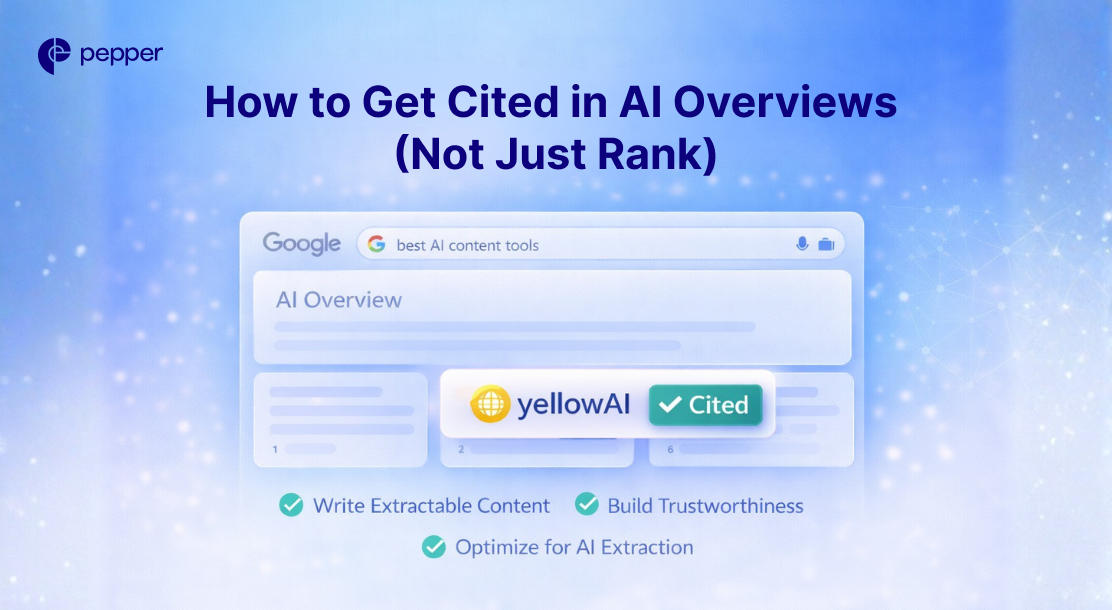
Google’s AI Overviews have quietly changed what “visibility” means.
For years, SEO was a game of earning a blue link and winning the click. Now, Google can answer the question before the user scrolls—by generating a summary and citing a handful of sources.
So the real question becomes: How do you become one of the sources Google chooses to cite?
This guide breaks it down—clearly, practically, and without the usual noise.
What are AI Overviews (and why they matter)?
AI Overviews are AI-generated summaries that appear at the top of Google Search for certain queries, with links to supporting pages across the web. They’re designed to help users get to “key information” faster—especially for more complex, multi-part questions.
That means two things for marketers:
- Your content can now be discovered without being clicked first.
- Being ranked isn’t enough—you need to be citable.
Google’s own guidance for success in AI search experiences boils down to a familiar theme: create unique, genuinely helpful content that satisfies the user—especially as queries get longer and more specific.
How Google chooses what shows up in AI Overviews
Google doesn’t publish a neat list of “AI Overview ranking factors.” But they do explain how AI features work from a site owner’s perspective, and the direction is consistent:
- AI Overviews draw from the web and link out to sources.
- Quality, trust, and helpfulness still matter (think Search Essentials, spam policies, and avoiding scaled low-value content—even if AI-generated).
- The system is built to answer nuanced questions, so content that handles nuance cleanly tends to map better.
So your job is to make it easy for Google to:
- understand your page,
- trust it, and
- extract a clean, accurate answer.

7 pro tips to rank in Google’s AI Overviews
1) Write the answer first (then earn the right to elaborate)
AI Overviews don’t reward suspense.
If your page takes 600 words to “get to the point,” you’re making extraction harder. Instead:
- Put a 2–4 line direct answer right under the intro
- Follow with context, examples, and edge cases
- Keep definitions crisp (no fluff adjectives, no circular phrasing)
A simple pattern that works:
- Direct answer
- When it applies
- When it doesn’t
- Steps/framework
- Example
This is the same reason featured snippet formatting used to work—AI Overviews just raise the stakes.
2) Build around entities, not just keywords
Keywords tell Google what the page is about. Entities help Google understand what the page is connected to.
When you write, make sure you naturally include:
- primary topic entity (the “thing”)
- related concepts (supporting entities)
- people/tools/standards/frameworks that are genuinely part of the topic
- consistent naming (don’t keep swapping terms)
Example: If you’re writing about “AI Overviews optimization,” you should probably also cover things like Search Essentials, spam policies, structured data, E-E-A-T, query intent, and content usefulness—where relevant.
This improves interpretability and reduces ambiguity (which AI systems hate).
3) Win the credibility layer (especially for YMYL topics)
Some categories are simply held to a higher bar—health, finance, legal, and safety. And AI-generated answers in sensitive areas have faced scrutiny when they’re wrong.
So if your content sits anywhere near “high-stakes”:
- Add clear author attribution (name, role, expertise)
- Include editorial review notes (when appropriate)
- Cite primary sources (standards bodies, regulators, original research)
- Keep claims precise and verifiable
This isn’t “because Google said E-E-A-T.” It’s because AI Overviews are designed to summarize—and summaries amplify errors.
4) Make your page easy to lift from
Think like a system trying to extract reliable passages.
Use formatting that turns your page into clean building blocks:
- Short paragraphs (2–4 lines)
- Descriptive subheads (not clever ones)
- Bullets for lists, steps, comparisons
- Tables only if they truly clarify (otherwise they’re noise)
- A dedicated FAQ section for follow-up queries
| Remember: Users ask longer questions now—and they almost always follow up. Structure your content with that in mind. |
If doing this across a handful of pages feels manageable—but doing it across an entire site doesn’t—you’re not alone. This is where Pepper works with content and SEO teams to systematize AI-ready structuring, refresh high-value pages, and make citation-friendly formatting scalable without rewriting everything from scratch.

5) Use structured data where it genuinely fits
Structured data won’t magically “force” an AI Overview citation.
But when used correctly, it helps Google understand the page type and key elements—especially for:
- FAQs
- How-tos
- Articles
- Products
- Organizations/authors
Also, don’t spam schema. Use only what matches the content on the page. Google’s AI features documentation lives under the same ecosystem as Search appearance guidance—so clarity and consistency still win.
6) Update content like a product, not a campaign
AI Overviews are often triggered by queries where freshness and specificity matter.
A practical cadence:
- Refresh top pages quarterly (even small upgrades help)
- Add a “Last updated” date (where truthful)
- Expand sections that keep showing up in related queries (GSC + SERP observation)
- Replace vague claims with tighter explanations + examples
If your content is “fine,” it’s replaceable. If it’s maintained, it’s a stronger candidate source.
7) Don’t mass-produce AI pages—Google is explicit about this
If you’re using AI to generate lots of pages without adding real value, you’re walking straight into the “scaled content abuse” zone.
Google’s guidance is clear: AI can help in creation, but content still needs to meet Search Essentials and spam policies; producing many low-value pages can violate those policies.
A good internal rule:
- AI can draft
- Humans must validate, enrich, differentiate, and own the POV
AI Overviews reward pages that feel specific, grounded, and real.
| A quick checklist you can run today. Use this on any page you want to “make cite-worthy”: ✓ Does the page answer the query in the first 10 seconds? ✓ Are headings written like questions users actually ask? ✓ Is the content uniquely useful (not a remix)? ✓ Are claims supported (examples, sources, data, experience)? ✓ Is the formatting extractable (bullets, steps, short blocks)? ✓ Is authorship and credibility obvious? ✓ Is the page updated and accurate? |

What to track (since AI Overviews don’t behave like classic SEO)
You’ll still track rankings and clicks—but add these:
- Query mix shift: more long-tail, more question-based
- Impressions up, clicks flat: classic “answer-first” behavior
- Brand mentions: are you being referenced more across the web?
- On-page conversions: because traffic quality matters more than volume now

The shift that matters most
Ranking in AI Overviews is less about “cracking a new algorithm” and more about mastering an older truth: The web rewards pages that are easy to trust and easy to use. AI just makes that selection visible.
At Pepper, we see this shift play out every day. The brands earning visibility inside AI Overviews aren’t chasing new hacks—they’re treating content like a product: structured for extraction, grounded in expertise, and continuously updated. That’s exactly where our content, SEO, and GEO teams focus their effort today.
Latest Blogs
This blog focuses on 12 of India’s top content writing services.
According to the Content Marketing Institute, one of the most effective ways to promote a business is via good content. At least half of all marketers either are or are planning to use content to reach their customers.
Get your hands on the latest news!

Similar Posts
Digital Marketing
3 mins read
When, Where, And How To Use Primary Keywords And Secondary Keywords
Artificial Intelligence
3 mins read
What Is Anchor Text?
Organic Marketing
2 mins read