When, Where, And How To Use Primary Keywords And Secondary Keywords
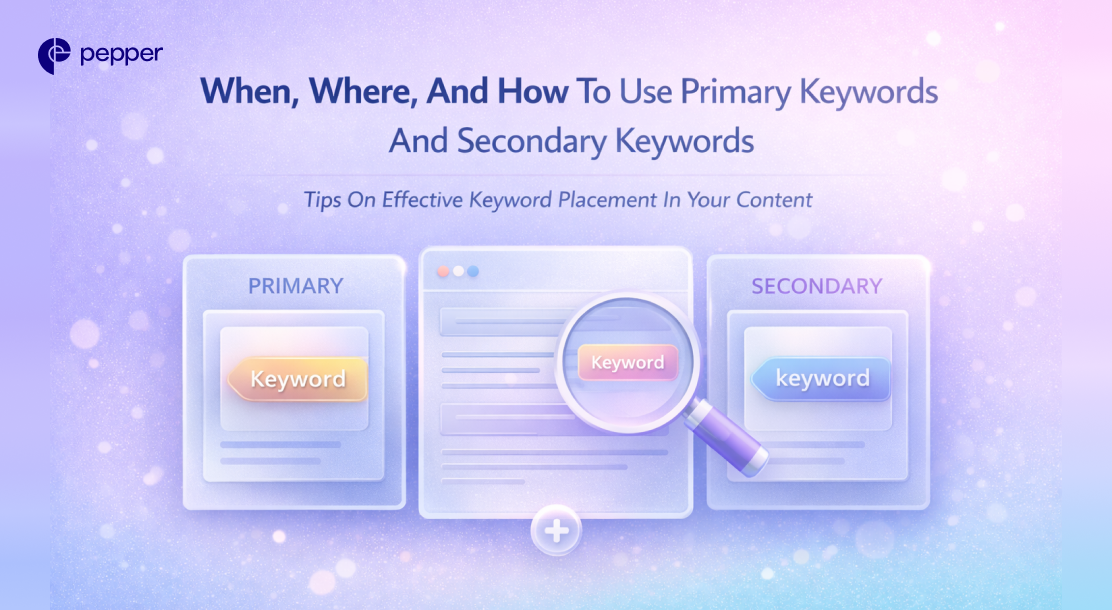
Table of Contents
- The Importance of Keywords in the AI Era
- Primary Keyword Examples
- Secondary Keyword Examples
- Understanding Long-tail Keywords
- Proper Keyword & Entity Research
- Keyword & GEO Research Tools
As a digital marketer, you want your content to be noticed by the right people. In 2026, it needs to be understood by AI as well. The bridge between your brand and the consumer remains Keywords, but the way we use them has evolved.
Keywords serve two vital functions. First, they help LLMs (Large Language Models) and search engine crawlers understand your website’s “Entity” (what you are and what you do). Second, they match the Search Intent of consumers.
When you balance primary and secondary keywords, your site doesn’t just appear in “blue links”—it becomes a cited source in AI-generated answers.
Understanding and Using Primary Keywords
Primary keywords (or “Seed Keywords”) are high-volume phrases that define your core topic. In the modern landscape, these are the foundation of your GEO visibility.
For effective optimization, you should include your primary keyword in:
- The H1 Title and Meta Description.
- The first 100 words to establish immediate context.
- The URL slug for clear site architecture.
Primary keyword examples: If you are targeting coffee lovers, your primary keywords might be “sustainable coffee beans,” “best espresso machines,” or “specialty coffee roasters.” These broad terms pull in a wide audience, acting as a magnet for your brand.
Understanding and Using Secondary Keywords
Secondary keywords (or LSI keywords) add depth. They provide “semantic signals” that prove to search engines you are an authority on a topic.
Secondary keyword examples: Continuing with the coffee theme, if your primary keyword is “best espresso machine,” your secondary keywords might include:
- Milk frothing capability
- Pressure bars for espresso
- Bean-to-cup vs. pod machines
- Easy cleaning coffee makers
By including these, you aren’t just repeating a phrase; you are covering the “sub-topics” that AI models look for when determining if your content is helpful and comprehensive.
Understanding Long-tail Keywords
Long-tail keywords are where the actual conversions happen. These are specific, multi-word phrases that signal a consumer is ready to take action.
Why they matter for GEO: AI search engines (like Google SGE) love long-tail keywords because they mirror how people speak into voice assistants.
- “What is the best energy-efficient laptop for video editing under $1500?”
- “Low-cost gaming laptops with 10-hour battery life”
These phrases have lower competition but much higher conversion intent.
Proper Keyword & Entity Research
Researching keywords in 2026 starts with understanding User Intent. What is the user’s “Jobs to be Done”?
- Informational: “How to clean a coffee maker?”
- Commercial: “Top 10 espresso machines 2026”
- Transactional: “Buy Breville Bambino Plus online”
How to Research:
- Analyze Search Generative Experiences: Look at what AI is already saying about your topic. Which keywords is it highlighting?
- Identify Semantic Gaps: Use tools to see what related topics your competitors are missing.
Essential Keyword & GEO Research Tools
- Google Keyword Planner: Still the gold standard for volume and trend data.
- Pepper Atlas: The modern essential. It tracks your AI Visibility and tells you which keywords are helping you get cited in AI-generated responses.
- AnswerThePublic: Perfect for finding the “Who, What, Why” questions that fuel your Hygiene content.
- Semrush / Ahrefs: Crucial for competitive analysis and tracking your “Share of Voice” in search rankings.
Key Takeaways
- Keywords = Context: They help search engines and AI models categorize your brand.
- Balance is Key: Use Primary keywords for reach and Secondary keywords for authority.
- Target the Long-tail: This is where the highest-intent traffic lives.
- Think Beyond Search: Use tools like Pepper Atlas to ensure your keywords are optimized for both traditional SEO and the new era of GEO.
FAQs
1. How many keywords should I use?
Focus on one primary keyword per page and 3-5 high-value secondary keywords. Quality and relevance always beat quantity.
2. What is GEO vs. SEO?
SEO (Search Engine Optimization) focuses on ranking in traditional search results. GEO (Generative Experience Optimization) focuses on making your content the preferred source for AI-generated answers.
3. Does keyword stuffing still work?
No. In fact, it will hurt you. Modern AI is smart enough to detect unnatural patterns. Always write for the human first, then optimize for the machine.
Latest Blogs
A curated, category-wise list of the best marketing newsletters in 2026—covering AI, SEO, B2B, creator economy, design, and more. Personal picks from Dhriti Goyal at Pepper.inc
Get your hands on the latest news!

Similar Posts

Artificial Intelligence
6 mins read
The Role of AI in Digital Marketing: AI Article Generators Transforming Content Creation

Artificial Intelligence
4 mins read
How AI Content Creator Is Shaping the Future of Digital Content

Digital Marketing
3 mins read