RAG: How AI Learns to Look Things Up (Just Like You!)
You know how when you forget something, you check your notes or ask Google? That’s basically what RAG does for AI. Instead of relying only on old memories, the AI gets to peek at fresh information before answering your question.
In This Article
- What RAG Is (The Library Card Explanation)
- How the Two-Step Process Works
- Why RAG Matters for Your Content
- RAG at a Glance
- Real-World Examples
What is RAG? (The Simple Version)
Think of a regular AI chatbot like a really smart kid who memorized a big textbook last year. They know a lot, but their information gets stale. RAG is like giving that kid permission to run to the library and grab the newest books before answering your question.
RAG stands for Retrieval-Augmented Generation. Big words, simple idea: the AI retrieves (fetches) relevant information from somewhere useful, then generates (writes) an answer using that fresh content. It’s a two-step dance. First, the AI finds the right stuff. Second, it uses that stuff to give you a better answer.
How Does RAG Work?
Imagine you ask your AI, “What’s the weather today?” A regular AI only knows weather patterns from when it was trained. But an AI using RAG does this:
Step 1 (Retrieval): The AI searches external sources—maybe a weather database or a news site—for current weather data.
Step 2 (Generation): The AI takes that fresh weather information and writes a helpful answer in plain English.
It’s like asking a friend for restaurant recommendations. They don’t just tell you what they remember from two years ago. They check their phone for the newest reviews, then suggest the best spot based on what they just found.
Why Does RAG Matter?
Without RAG, AI answers can be outdated or just plain wrong. A chatbot trained in 2022 won’t know about events from 2024. RAG fixes this by connecting the AI to live, updated sources.
Also, well-organized fresh content can actually beat older content that was around during the AI’s training. If your website has clear, structured information, an AI using RAG might grab your content over something that’s been sitting on the internet forever. That makes RAG super important for anyone creating online content.
RAG at a Glance
| Feature | Details |
| What it does | Connects AI to external knowledge sources for better answers |
| Two main phases | Retrieval (finding info) + Generation (writing the answer) |
| Main benefit | Provides current, accurate information beyond old training data |
| Data sources | Databases, documents, websites, company files, knowledge bases |
| Best for | Questions needing up-to-date facts, specialized knowledge, or real-time data |
Real-World Examples
Customer support chatbots: A company uses RAG, so their AI support bot can pull answers from the latest product manuals and troubleshooting guides—not just what it learned months ago.
Medical research assistants: A doctor asks an AI about recent studies on a specific treatment. The AI uses RAG to search medical databases and journals published last week, then summarizes findings in seconds.
Legal document analysis: A lawyer needs contract clauses from similar cases. An AI with RAG searches the firm’s entire case database, finds relevant examples, and drafts language based on current standards.
FAQs
Q1: Is RAG the same thing as a regular chatbot?
Nope. A regular chatbot works from memory alone. RAG gives the chatbot a library card so it can go fetch new books whenever it needs them.
Q2: Does RAG make AI perfectly accurate?
Not perfectly, but way better. RAG reduces errors by grounding answers in real documents and data. The AI is less likely to make stuff up when it’s reading from actual sources.
Q3: Can RAG access the entire internet?
That depends on how it’s set up. Some RAG systems search specific databases or company files. Others can search broader sources. The key is it accesses information outside the AI’s original training.
Q4: Why would my content get picked by RAG over older content?
If your content is clearly written, well-structured, and answers questions directly, RAG systems are more likely to retrieve it. Fresh, organized content often wins over older, messier sources—even if those older pages were around during the AI’s training.
Wrapping Up
RAG turns AI from a closed book into a research assistant. It fetches, it reads, and then it answers. That’s how modern AI stays smart and current.
Latest Blogs
Most advice on this is inference dressed as fact. OpenAI documents exactly one thing clearly, which is access. Here is what is documented, what is inferred, and how to verify the rest for yourself.
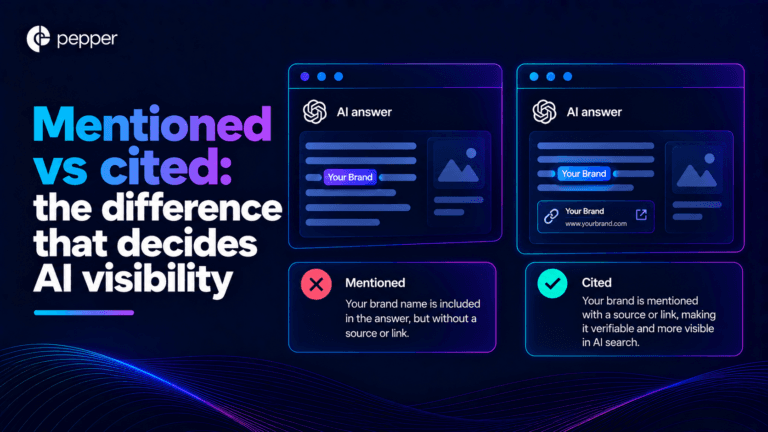
Being named in an AI answer and having your page used as its source are different outcomes with different causes and different fixes. The gap between them is the most useful diagnostic in AI search, and most reporting collapses it into one number.
Every platform reports share of voice and almost none of them define it the same way. Here is the definition worth using, the three choices that change the number, and how to measure it yourself without buying anything.
Get your hands on the latest news!

Similar Posts
GEO / AI Search
10 mins read
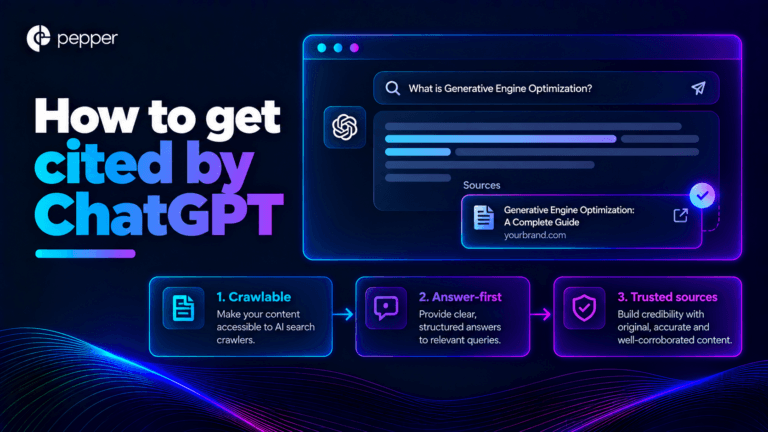
How to get cited by ChatGPT
GEO / AI Search
10 mins read
Mentioned vs cited: the difference that decides AI visibility
GEO / AI Search
13 mins read