The Content Format Playbook: Written, Audio, Video, Interactive (Explained)
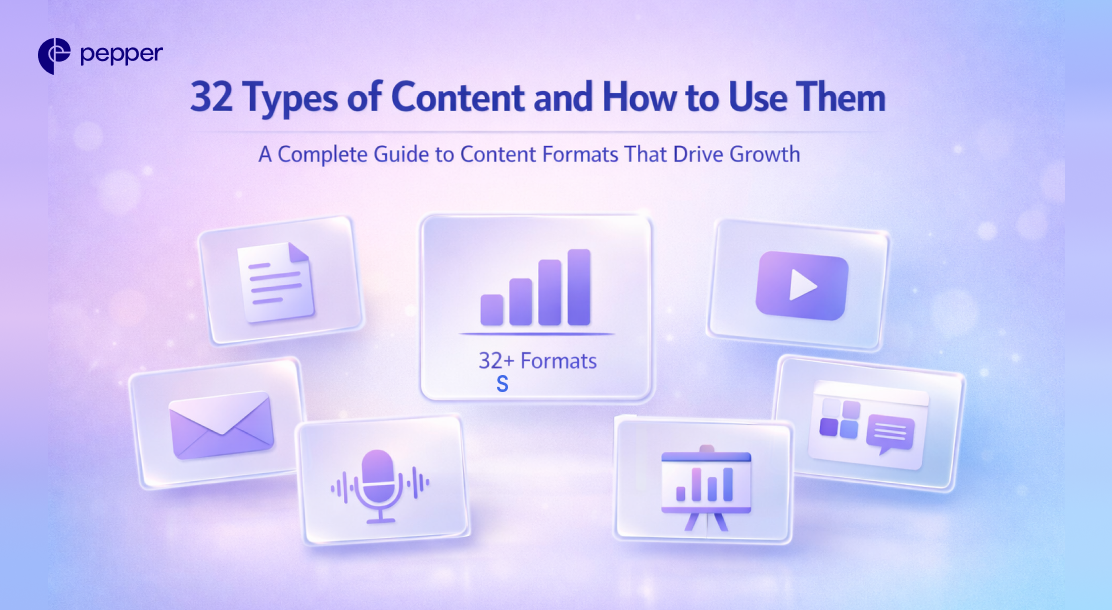
| TL;DR Content formats fall into four buckets: written, audio, visual, and interactive. In 2026, video (especially short-form) continues to dominate attention and investment, but the “best” format is the one that matches your audience intent (learn vs compare vs decide), your distribution (search, social, email, communities), and your proof level (examples, data, demos, customer stories). |
Content has always been how humans trade ideas—cave walls, pamphlets, radio, blogs, reels, and now AI answers.
For businesses, content isn’t just “marketing output” anymore. It’s how people discover you, trust you, and increasingly, how AI systems decide whether to surface you.
A few current signals worth noting:
- Video remains a core investment area.
- Short-form video is consistently ranked as a top-performing format in recent HubSpot reporting.
- Consumers strongly prefer learning via short video in multiple marketing benchmark summaries (often citing third-party surveys).
Instead of chasing every format, use this guide as a menu: what it is, where it works, and when it’s worth doing.
1) Written (Print + Web) formats
a) Books & eBooks
Best for: deep education, credibility, long shelf life
Examples: brand books, “how we do X” playbooks, research compilations
b) Articles (news-style / editorial)
Best for: commentary, thought leadership, quick takes
Examples: opinion columns, industry explainers, announcements
c) Blogs
Best for: discoverability, education, inbound demand, AI retrieval-friendly content
Examples: how-to posts, comparisons, templates, “explained” guides
Fun reality check: WordPress.com users publish 70M+ posts per month (so yes, competition is… a lot).
d) Brochures & one-pagers
Best for: offline distribution, events, sales enablement
Examples: product one-pagers, solution briefs, capability decks
e) Whitepapers/research reports
Best for: high-intent buyers, technical audiences, “prove it” moments
Examples: benchmark reports, “state of the industry” research, POV + methodology
f) Magazines
Best for: curated storytelling, niche communities, lifestyle categories
Examples: brand magazines, partner publications
g) Case studies
Best for: bottom-funnel trust, procurement-proof proof
Examples: “problem → approach → results” stories, implementation journeys
(If you sell B2B, case studies are rarely optional—they’re your receipts.)
h) Interviews (Q&A)
Best for: credibility via association, expert-led content
Examples: founder interviews, customer interviews, operator roundtables
i) Product guides/documentation
Best for: adoption, onboarding, reducing support load
Examples: setup guides, FAQs, troubleshooting, “getting started” docs
j) Newsletters
Best for: owned audience, retention, repeat attention
Benchmarks vary a lot, but many recent datasets put average opens around the 30–40%+ range depending on list health and industry.
k) FAQs
Best for: quick answers, objection handling, SEO snippets, AI answer compatibility
Examples: pricing FAQs, integration FAQs, policy FAQs, onboarding FAQs
2) Audio formats
a) Music & audio branding
Best for: emotional recall, brand identity
Examples: sonic logos, jingles, event bumpers
b) Audiobooks
Best for: long-form learning for busy audiences
Examples: converting books/guides into listening formats
c) Podcasts
Best for: trust-building, nuance, community-led discovery
Examples: founder/operator shows, customer story episodes, expert series
3) Visual formats
a) Images & carousels
Best for: social distribution, fast learning
Examples: “how it works” visuals, frameworks, before/after
b) Videos (short-form + long-form)
Best for: attention, product education, retention, conversion
Widely-cited benchmarks show video is heavily used and strongly preferred for product learning.
c) Infographics
Best for: simplifying data, making complex topics scannable
Examples: benchmarks, processes, “X vs Y” visuals
d) Memes & GIFs
Best for: reach + relatability (when it fits your brand)
Examples: culture posts, community engagement, internal comms
e) Vlogs
Best for: creator-led brands, behind-the-scenes trust
Examples: “day in the life,” event diaries, travel/field content
f) How-to videos
Best for: intent-driven learning
Examples: tutorials, quick demos, “3 steps to do X”
g) Educational videos
Best for: structured learning, skill-building
Examples: mini-courses, lecture-style explainers, workshops
h) Presentations
Best for: clarity + structure
Examples: webinar decks, sales decks, internal training
i) Product reviews/walkthroughs
Best for: evaluation-stage buyers
Examples: feature walkthroughs, “vs” comparisons, implementation tours
4) Interactive formats
a) Video games (rare for most brands, huge for some)
Best for: immersive brand storytelling
Examples: gamified learning, brand activations
b) Live streams
Best for: real-time trust, launches, community
Examples: product launches, AMAs, live demos
c) Polls & quizzes
Best for: engagement + insights
Examples: “what’s your role?”, maturity scoring, assessments
d) Webinars
Best for: high-intent education + lead capture
Examples: expert sessions, workshops, partner webinars
e) Q&A / AMA
Best for: credibility, objection handling, “human proof”
Examples: Reddit-style AMAs, community Q&As, founder office hours
f) Discussion forums/communities
Best for: retention, advocacy, peer learning
Examples: Slack/Discord communities, customer forums, niche groups
Key Takeaways
- Content formats cluster into written, audio, visual, and interactive—each maps to a different intent.
- Video + short-form continues to lead attention and investment trends.
- Written content still matters because it’s searchable, referenceable, and quotable—and often easier for AI systems to cite reliably.
- If you’re choosing formats for business growth, prioritize what supports the buyer journey:
- Learn: blogs, explainers, short videos
- Compare: product walkthroughs, “vs” pages, webinars
- Decide: case studies, reviews, FAQs, implementation docs
FAQs
1) What are the main types of content?
The four main categories are written, audio, visual, and interactive content.
2) What content type works best for businesses in 2026?
It depends on your audience and channel, but short-form video is consistently a top performer for reach and engagement, while blogs, FAQs, and case studies remain essential for search + trust.
3) How do I choose the right content format?
Match format to intent:
- Awareness: short videos, carousels, light blogs
- Consideration: webinars, comparisons, guides
- Decision: case studies, reviews, FAQs, product documentation
4) What are examples of “high-converting” content?
Common high-converting formats include case studies, product demos/walkthroughs, comparison pages, webinars, and implementation guides.
5) How often should I update content?
Update whenever facts, positioning, or user intent changes—but as a general rule, refresh key pages every 6–12 months, and refresh fast-changing topics (tools, stats, trends) more frequently.
Latest Blogs
According to the Content Marketing Institute, one of the most effective ways to promote a business is via good content. At least half of all marketers either are or are planning to use content to reach their customers.
Want to improve your SEO? This is how leveraging hidden content can have an impact on the same.
Get your hands on the latest news!

Similar Posts
Content
4 mins read
Hidden Content in SEO: What’s Allowed, What’s Spam, and How to Audit It
Blogging
6 mins read
How to Guest Post (Without Being Spammy): Strategy, Pitch Templates, and Writing Tips
Content
4 mins read