Hidden content SEO in 2026: what Google permits, and what an engine can actually retrieve
The short answer
Hidden content SEO splits into two questions that get treated as one, and separating them resolves most of the confusion.
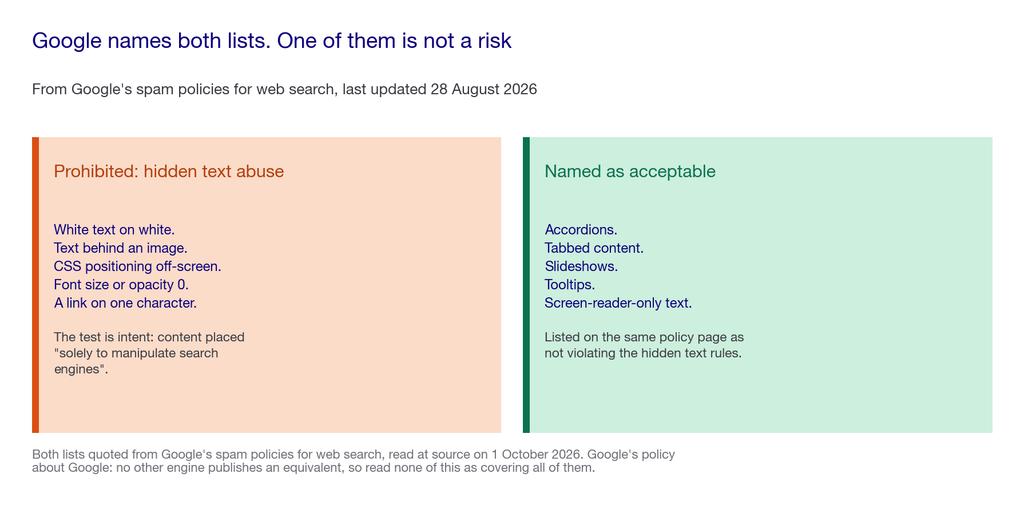
The permission question is settled, in writing. Google’s spam policies define hidden text and link abuse this way: “the practice of placing content on a page in a way solely to manipulate search engines and not to be easily viewable by human visitors”. The word doing the work is solely. The same policy page states explicitly that accordions, tabbed content, slideshows, tooltips and screen-reader text are not violations.
The retrieval question is not settled, and nobody documents it. Whether an engine will quote a passage is a different matter from whether Google penalises you for collapsing it. On that question, the risky pattern is not the accordion at all.
The pattern that actually costs you is content that never reaches the served HTML. A passage that exists only after JavaScript runs, or only after a click, may be indexed late, partially, or not at all. Google’s own documentation says rendering is queued and deferred, and it does not address content that appears only after user interaction.
Key takeaways
- Accordions and tabs are explicitly permitted. Google’s spam policy names them as acceptable. Stop treating them as a risk.
- Intent is the test for spam, not visibility. The definition turns on placing content “solely to manipulate search engines”. A collapsed FAQ that helps a reader is not that.
- Three tiers, not two. Visible text, collapsed text that is present in the HTML, and text that is not in the served HTML at all. Only the third is a retrieval problem.
- Rendering is deferred. Google queues pages for rendering and a page “may remain queued for several seconds or longer”. That is a delay in your favour if the content is in the HTML, and a gap if it is not.
- The audit takes ten minutes. Compare view-source against the rendered DOM. Anything in the second and not the first is the content to worry about, and Pepper’s agentic organic growth engine treats that gap as a retrievability problem rather than a spam one.
A note on where this comes from. We run organic for more than 250 enterprises and track more than 10 million prompts across every major engine. The Google quotations are Google’s, dated and linked. The three-tier model and the audit are ours, shaped by the technical reviews we run on client sites most weeks.
Book a growth audit if you want to know which of your answers are in the served HTML and which are not.
What is hidden content, and when is it a problem?
Hidden content is any text or link a human visitor does not see on first load. That covers two very different situations, and one genuinely ambiguous one.
Google’s definition of the prohibited version, quoted verbatim: hidden text and link abuse is “the practice of placing content on a page in a way solely to manipulate search engines and not to be easily viewable by human visitors”.
The examples Google gives are unambiguous and they are all deceptive by design.
- Using white text on a white background
- Hiding text behind an image
- Using CSS to position text off-screen
- Setting the font size or opacity to 0
- Hiding a link by only linking one small character
Cloaking is treated separately and more severely. Google defines it as “the practice of presenting different content to users and search engines with the intent to manipulate search rankings and mislead users”. A notable exception: paywalls and content gating are not cloaking, provided Google can access the full content and the relevant guidelines are followed.
The test in both definitions is intent, not visibility. “Solely to manipulate” and “with the intent to manipulate” are the operative phrases. A section collapsed to help a reader fails that test. The next section is why that matters.
What Google explicitly permits
This is the part worth knowing precisely, because the myth is durable and the documentation is unambiguous.
These do not violate the hidden text and link rules. Google’s spam policy page says so directly:
- Accordions
- Tabbed content
- Slideshows
- Tooltips
- “Text that’s only accessible to screen readers and is intended to improve the experience”
Pause on that last one. It is the clearest statement of the principle: content invisible to sighted users, deliberately and for a good reason, is fine. Visibility was never the test.
Where this falls short: this is Google’s policy about Google, last updated 28 August 2026. ChatGPT, Claude and Perplexity publish no equivalent, and none documents how it treats collapsed content. We read Google’s position as the best available proxy and say so rather than implying it covers every engine.
The three tiers of hidden content SEO risk
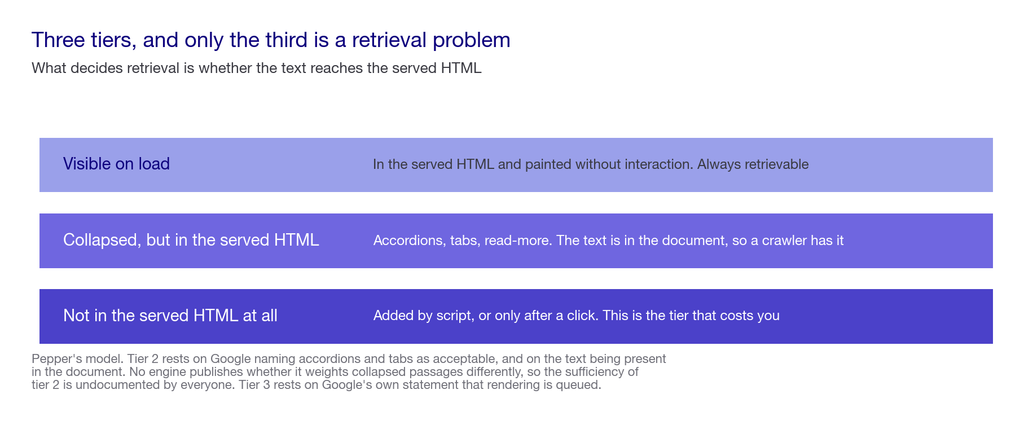
Most writing on this subject offers two categories: spam and user experience. That split answers the permission question. It answers the retrieval question badly.
For retrieval, what matters is whether the text is in the HTML a crawler receives. That is the distinction Pepper audits for.
Tier 1: Visible on load
Present in the served HTML, painted on screen without interaction. Always retrievable, and the baseline everything else is compared against.
Tier 2: Collapsed, but present in the served HTML
An accordion, a tab or a read-more block. The text sits in the DOM from the start, revealed by CSS or a small script.
This is the tier people worry about, and it is largely fine. The text is in the document, and Google names the pattern as acceptable. An engine parsing the page has the passage available whether or not a human clicked.
The honest caveat: no engine publishes guidance on whether it weights collapsed passages differently from visible ones. We have no reliable way to test that from outside. What we can say is that the text is present, which is the necessary condition. Whether it is sufficient is undocumented, by everyone.
Tier 3: Not in the served HTML at all
Content that appears only after JavaScript executes, or after a user clicks, scrolls or hovers. This tier costs you, and a visual audit will never find it.
Google’s own documentation is precise about the mechanism. Processing runs in three phases. Crawling, then rendering, then indexing. “Googlebot queues all pages with a 200 HTTP status code for rendering, unless a robots meta tag or header tells Google not to index the page”, and a page may remain queued “for several seconds or longer” before a headless Chromium executes the JavaScript.
Google acknowledges the pattern directly. Its words: “some JavaScript sites may use the app shell model where the initial HTML does not contain the actual content and Google needs to execute JavaScript before being able to see the actual page content”.
And here is the gap. Google’s JavaScript documentation does not address content that becomes available only after user interaction. It describes rendering, not clicking. No engine we have found, Google included, says whether a crawler triggers an interaction to reveal text.
So the practical rule Pepper uses: if a passage requires an event to exist in the DOM, treat it as unretrievable until proven otherwise.
How to audit it in ten minutes
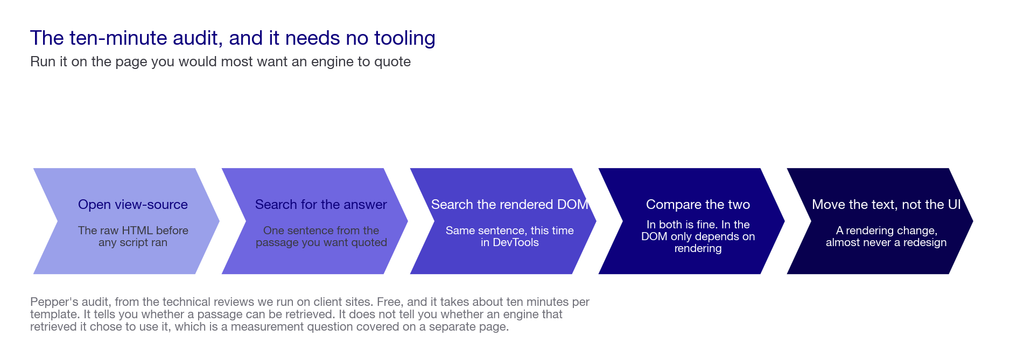
This is the audit Pepper runs first on any technical review.
- Open view-source on the page. This is the raw HTML the server sent, before any script ran. Search it for a sentence from the answer you most want quoted.
- Open DevTools and search the rendered DOM for the same sentence. This is the page after JavaScript.
- Compare. In both is tier 1 or 2, and you are fine. In the DOM only is tier 3, and it depends on rendering. In neither until you click is the case to fix.
- Check the deceptive patterns while you are there. Zero opacity, off-screen positioning, white on white, font-size zero. These are a different problem with a different remedy, and they are rare on sites that were not built to game something.
- Fix by moving the text, not by removing the interaction. You almost never need to un-collapse an accordion. You need the text in the served HTML, which is usually a server-side rendering or static generation decision rather than a design one.
What this audit does not tell you. Whether an engine that did retrieve the passage chose to use it. That is a separate question, and our measurement stack covers how to tell the difference between never retrieved and retrieved but not quoted.
Our methodology: how we prioritise a hidden content fix
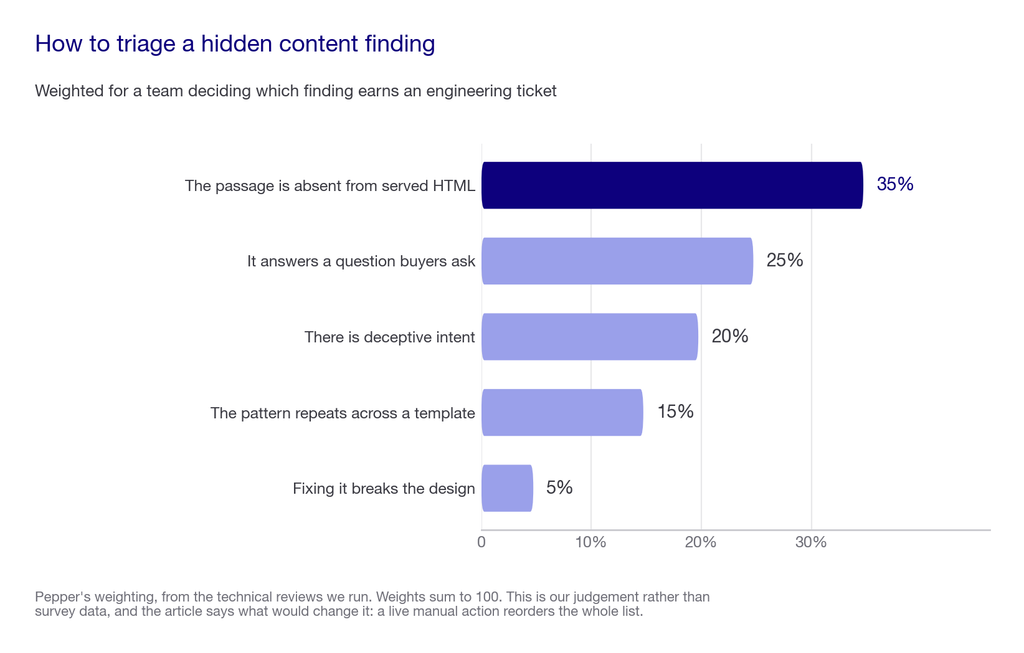
| Criterion | Weight | Why it carries that weight |
|---|---|---|
| Is the text in the served HTML | 35 | The necessary condition for retrieval. Everything else is a refinement on top of a passage a crawler can actually read. |
| Does it carry an answer somebody asks for | 25 | A hidden block nobody searches for is a low priority however it is implemented. Fix the passages that answer real questions first. |
| Is there deceptive intent | 20 | Rare, and serious when present. This is the only tier that risks a manual action. The others simply underperform. |
| How many pages share the pattern | 15 | A template problem affects everything built from it, which changes a page fix into a platform fix. |
| Does fixing it break the design | 5 | Usually it does not, because the remedy is rendering rather than layout. When it does, that is a real trade to weigh. |
Weights sum to 100. Presence in the served HTML and answer value carry 60 between them. That is Pepper’s judgement rather than a fact, and it is the judgement this page rests on. We publish our weightings the same way we publish [how we rank GEO agencies](https://www.pepper.inc/blog/geo-agency-ranking-methodology/), so you can argue with them precisely.
What would change these weights. If a manual action is already in Search Console, deceptive intent outranks everything until it is resolved. On a site with one template and a thousand pages, pattern reach rises sharply, because one fix moves the whole library.
Hidden content patterns at a glance
| Pattern | In the served HTML | Google’s published position | Retrieval risk | Cost of getting it wrong |
|---|---|---|---|---|
| Accordion or tab, text in the DOM | Yes | Explicitly acceptable | Low | Low. Teams un-collapse them for no reason |
| Read-more block, text in the DOM | Yes | Acceptable, same category | Low | Low |
| Slideshow or tooltip | Yes | Explicitly acceptable | Low | Low |
| Screen-reader-only text | Yes | Explicitly acceptable when it improves the experience | Low | Low, and removing it harms accessibility |
| Client-side rendered content | No, added by script | Handled, but rendering is queued and deferred | Medium | Medium. Late or partial indexing |
| Content loaded on click or scroll | No, until the event | Not addressed anywhere | High | High. Your best answer may not exist to a crawler |
| White on white, opacity zero, off-screen | Yes, but deceptive | Prohibited | Not the issue | Highest. Ranking demotion or removal |
| Cloaking | Different per user agent | Prohibited, treated separately | Not the issue | Highest. Manual action territory |
What this costs to fix
- The audit: free and about ten minutes a template. View-source against rendered DOM, on your most important answer pages.
- Moving text into the served HTML: an engineering ticket, not a content project. Server-side rendering or static generation for the affected components.
- Removing deceptive patterns: trivial technically, and occasionally political, because somebody put them there deliberately.
- What it does not cost: a replatform. If a supplier quotes a rebuild to fix hidden content, ask which of the tiers above they are moving and why the fix is not a rendering change.
Where Pepper fits
We are an agentic organic growth engine, and this page sits in the part of our work that is closest to engineering.
- An organic growth partner. A growth team is attached to your account, a senior strategist plus always-on agents, accountable for the number rather than for a findings document.
- Pepper’s GEO platform. Genuinely self-serve and included rather than billed as a separate licence. You log in and set up a workspace. Define your brand profile, competitors and personas, then connect GA4 and Search Console. From there you manage your own themes, prompts and analytics across six engines, including ChatGPT, Perplexity, Gemini, Claude and Google AI Overviews.
- The Agent Atlas. Your team builds, versions and runs its own agents, and keeps them.
The reason this matters here: retrievability is one of the three failure modes we measure. A tier 3 pattern produces a very specific signature. Brand Visibility holds up while Domain Prompt Presence stays flat, because engines know you and cannot read the page that would prove it. For what the combination produces, the Acceldata case study records 6X organic traffic and top-three keywords rising from 85 to more than 300, mostly through B2B SaaS programmes.
Where it falls short: we are a content, authority and AI search business, not a rendering-architecture practice. We will find a tier 3 problem. We will not rebuild your front end. On large JavaScript applications you want a technical SEO or a front-end team alongside us, and we say so at the qualification stage rather than after the contract.
How to choose what to fix first
I will write this in the first person, because a recommendation nobody will defend is worth nothing.
Start by separating the two questions. In Pepper’s technical reviews, teams routinely spend a sprint on the wrong one. Somebody reads that hidden content is risky, so the team un-collapses a set of FAQs that Google explicitly permits. Meanwhile the genuinely unreadable content sits untouched in a JavaScript component nobody audited. I have watched that exact sequence more than once.
So my order is: check the served HTML first, triage by whether the passage answers something, and only then worry about intent. Here is the scorecard I would use on any finding, on a 100 point scale.
| Area | Weight | What a finding worth fixing demonstrates |
|---|---|---|
| The passage is absent from served HTML | 35 | A crawler cannot read it without rendering, and may not read it at all if it needs a click. This is the finding that matters. |
| It answers a question buyers ask | 25 | Taken from your prompt set or sales calls. A hidden block nobody asks about is a low priority whatever its tier. |
| The pattern repeats across a template | 20 | One fix moves many pages. A single-page oddity is rarely worth an engineering ticket on its own. |
| There is deceptive intent | 15 | Rare and serious. Escalate immediately, because this is the only tier that risks a manual action. |
| The fix is a rendering change | 5 | Most are. If the proposed remedy is a redesign, somebody has misdiagnosed it. |
Five questions I would ask about any hidden content finding, in this order.
- “Is this sentence in view-source?” A stronger answer is a yes or no from somebody who just looked. A weaker one is a theory about the framework.
- “Does a user have to click before the text exists?” Exists, not appears. The distinction is the whole article.
- “Which question does this passage answer?” If nobody asks it, deprioritise regardless of tier.
- “Is this one page or the template?” Changes the size of the ticket by an order of magnitude.
- “Did somebody hide this on purpose?” Rare. If yes, stop the triage and escalate.
Red flags, each one something a supplier actually says. “Accordions hurt your SEO”, which Google’s own policy contradicts in writing. “You need to un-collapse your FAQs”, same. “We will fix your hidden content with a replatform”, when the remedy is server-side rendering. A hidden content audit that never opens view-source. And any claim to know how ChatGPT or Perplexity weight collapsed text, because none of them publishes it.
Before you commission anything, check your own most important page. Write 25 real commercial questions your buyers would type. Run each of those 25 prompts three times across every engine you care about, because engines are probabilistic and one run is an anecdote. Then give any fix 90 days before you judge it. Four worked examples for a mid-market B2B software company:
- “best data observability platform for enterprise”
- “how do I monitor data quality across Snowflake and Databricks”
- “what should I look for in a data observability vendor”
- “who competes with Monte Carlo in data observability”
Find the page you would want cited for each, then search its view-source for the answer sentence. That single check tells you more than a full technical audit, and it takes about a minute per page.
And the answer that loses Pepper the sale. If your answers are all in the served HTML, you do not need a hidden content project, and you do not need us for this. Collapsed FAQs are fine, Google says so in writing, and the money is better spent on the earned media that actually produces citations.
It comes down to one principle: the question is not whether a human sees it, but whether a crawler receives it. Every hidden content audit that looked for the wrong thing confused those two, ours included, when we wrote about visibility instead of delivery.
What nobody should promise you
- That accordions or tabs harm your rankings. Google’s spam policy names them as acceptable in writing.
- That any engine documents how it weights collapsed content. None does, including Google. We say so rather than inferring.
- That a crawler will click to reveal text. Google’s JavaScript documentation does not address interaction-gated content at all.
- A guaranteed timeline for rendering. Google says a page may remain queued “for several seconds or longer”, which is not a service level.
- That fixing this produces citations. It removes a reason you cannot be quoted. It does not create a reason you should be.
Frequently asked questions
Is hidden content bad for SEO?
Only when it is deceptive. Google defines the violation as placing content “solely to manipulate search engines and not to be easily viewable by human visitors”. Accordions, tabs, slideshows, tooltips and screen-reader text are named in the same policy as acceptable.
Do accordions and tabs hurt rankings?
No. Google’s spam policy page explicitly lists accordions and tabbed content among the patterns that do not violate its hidden text rules. The text is in the document, so a crawler receives it whether or not a human expands the section.
What is the difference between hidden content and cloaking?
Hidden text abuse places content so humans cannot easily see it. Cloaking presents different content to users and to search engines. Google treats cloaking separately and more severely, though paywalls are not cloaking if Google can access the full content.
Can search engines read content behind a click?
Google’s documentation describes crawling, rendering and indexing, and does not address content that becomes available only after user interaction. We treat a passage that requires an event to exist in the DOM as unretrievable until proven otherwise.
Does JavaScript content get indexed?
Yes, but later. Google queues pages with a 200 status for rendering, and a page may remain queued for several seconds or longer before JavaScript executes. Content already in the served HTML skips that wait entirely.
How do I check for hidden content on my site?
Open view-source and search for a sentence from the answer you most want quoted. Then search the rendered DOM in DevTools for the same sentence. In both is safe, in the DOM only depends on rendering, in neither until you click is the problem.
Should I remove screen-reader-only text?
No. Google’s spam policy explicitly permits “text that’s only accessible to screen readers and is intended to improve the experience”. Removing it harms accessibility and gains nothing, which is the clearest sign that visibility was never the test.
Will fixing hidden content get my brand cited in AI answers?
It removes a reason you cannot be cited, which is not the same as creating a reason you should be. Retrievability is a precondition. Engines still cite third-party sources far more often than brand-owned pages, so the citation work sits elsewhere.
Where to go next
If the passages are readable and still not quoted, the writing is the next constraint. The passage craft guide covers whether each answer survives being lifted, and the page structure and FAQ playbook covers the container around it.
To tell retrieval failure apart from a citation failure, the GEO measurement stack sets out which KPIs mean anything, and the three-stage diagnostic separates the failure modes.
Sources and further reading
- Google Search Central, “Spam policies for Google web search”, last updated 28 August 2026, read at source on 1 October 2026. All quotations on this page are verbatim. Hidden text and link abuse defined as “the practice of placing content on a page in a way solely to manipulate search engines and not to be easily viewable by human visitors”, with examples covering white-on-white text, text behind images, off-screen CSS positioning, zero font size or opacity, and single-character links. Accordions, tabbed content, slideshows, tooltips and “text that’s only accessible to screen readers and is intended to improve the experience” are named as acceptable. Cloaking defined separately as “presenting different content to users and search engines with the intent to manipulate search rankings and mislead users”, with paywalls excepted where Google can access the full content.
- Google Search Central, “Understand JavaScript SEO basics”, last updated 4 March 2026, read at source on 1 October 2026. Crawling, rendering and indexing as three phases. “Googlebot queues all pages with a
200HTTP status code for rendering, unless a robotsmetatag or header tells Google not to index the page”, and a page may remain queued “for several seconds or longer”. On the app shell model: “the initial HTML does not contain the actual content and Google needs to execute JavaScript before being able to see the actual page content”. The page does not address content that becomes available only after user interaction, which is the gap this article names rather than fills. - Google Search Central, “Optimizing your website for generative AI features on Google Search”, last updated 10 July 2026. The position that optimizing for generative AI search is still SEO, which is why Google’s crawling documentation is the best available proxy for engines that publish none.
A note on other engines. ChatGPT, Claude and Perplexity publish no spam policy and no rendering documentation comparable to Google’s. Every claim on this page about how an engine treats collapsed or script-injected content is either Google’s, quoted and dated, or ours and labelled as a working rule. We have not inferred behaviour for engines that document none.
Further reading on Pepper, each checked live on 1 October 2026:
- How to structure content for answer engines, whether a retrievable answer is also a quotable one.
- AEO page structure, H1s and FAQ strategy, the container.
- The GEO measurement stack, telling retrieval failure apart from citation failure.
- Schema markup, which is a separate question from whether the text is readable.
Latest Blogs
Bluefish, Peec AI, GrowthX: the three names appear on the same shortlists constantly. We read all three sites on the same morning, and they are not competing products in any useful sense. The short answer Bluefish orchestrates AI marketing for very large enterprises. Peec AI measures AI search visibility. GrowthX produces content through a closed […]
People call it answer share. Pepper calls it Share of Voice, and it is one of three brand metrics that have to be read together. Here is the exact derivation, the denominator that surprises people, and what the number cannot tell you.
Most GEO work is repetitive enough to automate and a few parts never will be. Here is the line we draw, the test we apply before building an agent, and the governance that stops automation quietly shipping rubbish at scale.
Get your hands on the latest news!

Similar Posts
Artificial Intelligence
11 mins read
What is anchor text, and does it still matter in 2026?
SEO
11 mins read
What is internal linking? Meaning, and what changed for AI search
SEO
15 mins read