AEO for Enterprise: How Large Marketing Teams Are Adapting in 2026
Disclosure: Pepper published this guide and appears in it. Every option carries a “where it falls short” line, including ours. Pepper does not publish pricing, so this piece describes how enterprise engagements are shaped rather than quoting a rate.
The short answer
Enterprise AEO is not a harder version of AEO. In addition, it is a governance problem wearing a marketing problem’s clothes. The tactics are largely the same; what changes is doing them repeatedly, safely, and across thousands of pages, several languages and multiple legal jurisdictions.
Key takeaways
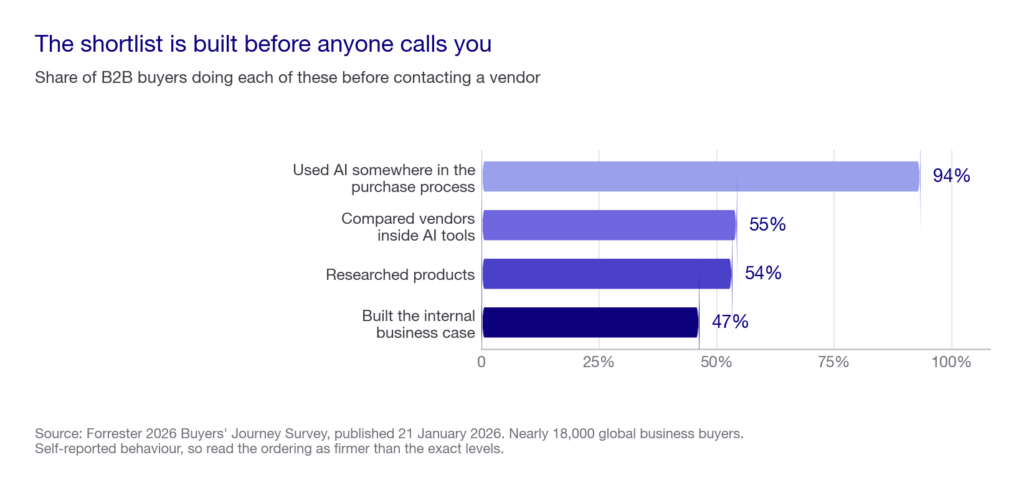
- 94 percent of B2B buyers used AI somewhere in their most recent purchase, and 55 percent compared vendors inside AI tools before contacting anyone (Forrester 2026 Buyers’ Journey Survey, nearly 18,000 buyers).
- 54 percent researched products and 47 percent built the internal business case inside AI tools, all before vendor contact. If the model does not surface you during that phase, you are often not on the shortlist.
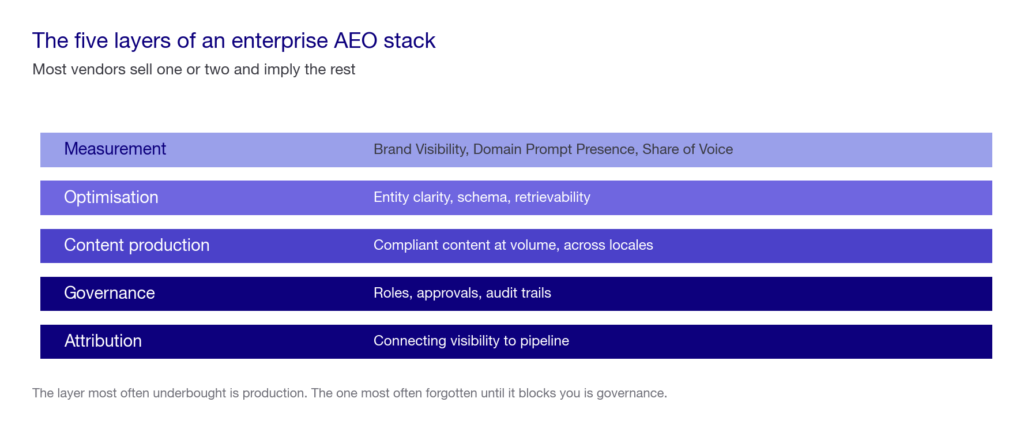
- The enterprise stack has five layers: measurement, optimisation, content production, governance and attribution. Most tools cover one or two.
- Procurement is the real timeline. SOC 2, ISO 27001 and a GDPR data processing agreement gate the start date more often than strategy does.
- Enterprise AEO fails on ownership, not tactics. Decide who owns it before you buy anything.
A note on where this comes from. And we run organic for more than 250 enterprises and track over 10 million prompts across every major engine. Also, the view below is shaped by that, by the client reviews we sit in every week. And by the conversations we have with buyers and operators at the events we run. As a result, this is our read on the category, not a neutral directory.
What is enterprise AEO?
Enterprise AEO is answer engine optimisation run at organisational scale: getting a brand surfaced and cited in AI answers across thousands of pages, several languages and multiple jurisdictions, with the governance, approvals and audit trails a large company requires. The tactics are largely shared with mid-market AEO. The constraints are not.
Why enterprise AEO is different
Five constraints separate enterprise AEO from the same work at a startup. What is more, each one is a reason a tool that demos well fails in month three.
Governance. Brand, legal, PR and regional teams all have a claim on what gets published. And a workflow with no approval layer does not survive contact with that structure.
Compliance. Security review, data residency and model-training transparency are procurement gates. They arrive before the work does.
Scale. Thousands of pages, multiple languages, several regulatory regimes. Tactics that work by hand on fifty pages need to be systematic across five thousand.
Execution capacity. Enterprise teams are usually not short of insight. They are short of hands. Equally, a dashboard that surfaces two hundred fixes nobody has time to make has added a backlog, not a capability.
Proof. Someone will ask what the programme returned, and “our visibility score improved” is not an answer that survives a budget review.
| Enterprise needs | Where most tools stop |
|---|---|
| Approval workflows and audit trails | Single-user dashboards |
| SOC 2, ISO 27001, GDPR DPA | Self-serve terms of service |
| Thousands of pages, many locales | Per-page manual optimisation |
| Execution capacity | A prioritised list of things to do |
| Pipeline attribution | Visibility scores and screenshots |
More on structuring the team in our AI search team ownership model and the enterprise playbook.
Why this matters now
The shift is in when the decision gets made, not whether buyers use AI.
Forrester’s 2026 Buyers’ Journey Survey, published in January 2026 and covering nearly 18,000 global business buyers, found 94 percent used AI somewhere in their most recent purchase. The more consequential finding is what they did with it: 55 percent compared vendors inside AI tools, 54 percent researched products and 47 percent built the internal business case, all before contacting a vendor (Forrester, January 2026).
Read those together. The buyer builds a shortlist during a research phase you cannot see, partly mediated by models. And arrives at your sales team having largely decided. Your sales motion is confirming a preference rather than creating one.
Worth holding a caveat, and Forrester supplies it themselves. In the same study 36 percent of buyers said generative AI left them more confident in their decision, while 20 percent said it left them less confident after hitting unreliable or inaccurate information. Buyers are using these tools and checking them. Consensus across sources is what decides the shortlist, not dominance of one.
That is the case for AEO at enterprise scale. At the same time, it is also the case for treating it as an authority programme rather than a content programme.
See where you show up. Pepper’s GEO platform tracks Brand Visibility, Domain Prompt Presence and Share of Voice across ChatGPT, Perplexity, Gemini, Claude and Google AI Overviews. And a growth team works the account with you. Book a growth audit or see where you show up.
The enterprise AEO stack
Five layers. In practice, most vendors sell one or two and imply the rest.
| Layer | What it does | Failure mode when missing |
|---|---|---|
| Measurement | Brand Visibility, Domain Prompt Presence and Share of Voice across a tracked prompt set, by engine and region | You cannot tell whether anything worked |
| Optimisation | Entity clarity, schema, retrievability, technical fixes | Good content nothing can retrieve |
| Content production | Compliant content at volume, across locales | A backlog of identified fixes |
| Governance | Roles, approvals, audit trails, brand and legal control | Legal shuts the programme down |
| Attribution | Connecting visibility to pipeline | The budget does not survive review |
The layer enterprises most often underbuy is production. The layer they most often forget until it blocks them is governance.

Our methodology: how we evaluated these options
Applied to publicly verifiable information: vendor product, pricing and security pages, documentation and public reviews. The full model is set out in our GEO agency ranking methodology.
| Factor | Weight | What we looked for |
|---|---|---|
| Governance and controls | 25% | Roles, approvals, audit trails, and a workflow that survives brand, legal and regional review |
| Measurement depth | 20% | Brand mentions, cited URLs, competitors and share of voice by engine and region |
| Execution capacity | 20% | Can do the work at enterprise scale rather than hand over a prioritised list |
| Security and procurement readiness | 15% | SOC 2 Type II in date, ISO 27001 with the right scope, GDPR DPA, model-training transparency |
| Multi-engine and multi-region | 10% | Coverage that matches where the buyers actually are |
| Business attribution | 10% | Reaches pipeline, and survives a CFO reading it |
What we could not verify. Pricing for several vendors, since enterprise tiers are quoted custom. Where a rate is published we give it with the date checked.
The honest landscape, at a glance
| Option | What it is | Where it falls short |
|---|---|---|
| AI search platforms (Profound, AirOps, Scrunch) | Measurement plus agent-based execution, broad engine coverage | Capable, but self-serve. They assume you have someone with the capacity to run them. |
| Measurement-first tools (Semrush AI Toolkit, Otterly) | Tracking, share of voice and sentiment | Cheaper and narrower. They tell you the gap and leave the closing to you. |
| Growth agencies (NoGood and similar) | Human execution against an agency retainer | You are buying labour, not a system. Knowledge leaves when the account lead does. |
| Enterprise SEO suites (Conductor and similar) | AI visibility inside an established SEO platform | Suits teams already running organic there; AI-specific depth trails the specialists. |
| Platform plus team (Pepper) | The same capability, operated by our growth team | Not built for cheap monitoring trials, and you give up direct control of the build |
Fuller comparisons: tool vs agency vs platform, best AEO platforms and Profound alternatives.
The compliance checklist
This is what actually gates the start date. Get it in front of procurement before you get attached to a vendor.
SOC 2. The US enterprise baseline. Type I attests that controls are designed properly at a point in time; Type II attests they operated effectively over a period, usually three to twelve months. So ask which one, and ask for the report date. Beyond that, a Type I from two years ago is not a current control environment.
ISO 27001. The international signal, built on an information security management system audited against Annex A controls. Certificates run on a three-year cycle with surveillance audits in between. That means ask for the certificate and its scope: a certificate covering a subsidiary is not the same as one covering the product you are buying.
GDPR. Not a badge, the law. So you need a data processing agreement, a lawful basis for transfer, and clarity on where data resides. Breach notification runs to 72 hours, and penalties reach the higher of 20 million euros or 4 percent of global annual turnover.
The AI-specific gap. Standard security questionnaires predate generative AI and miss the questions that now matter most:
- Is our content or data used to train your models, or anyone else’s?
- Which sub-processors and model providers touch our data, and where are they?
- What is retained, for how long, and can we delete it?
- Can we restrict which models are used for our account?
Checklist
- [ ] SOC 2 Type II report, current, with scope confirmed
- [ ] ISO 27001 certificate, in date, scope covers the product
- [ ] GDPR data processing agreement signed
- [ ] Data residency confirmed for your regions
- [ ] Role-based access control and SSO available
- [ ] Model-training transparency in writing
- [ ] Breach notification commitment in contract
What an enterprise rollout looks like
Sequenced so nothing waits on something it did not need to.
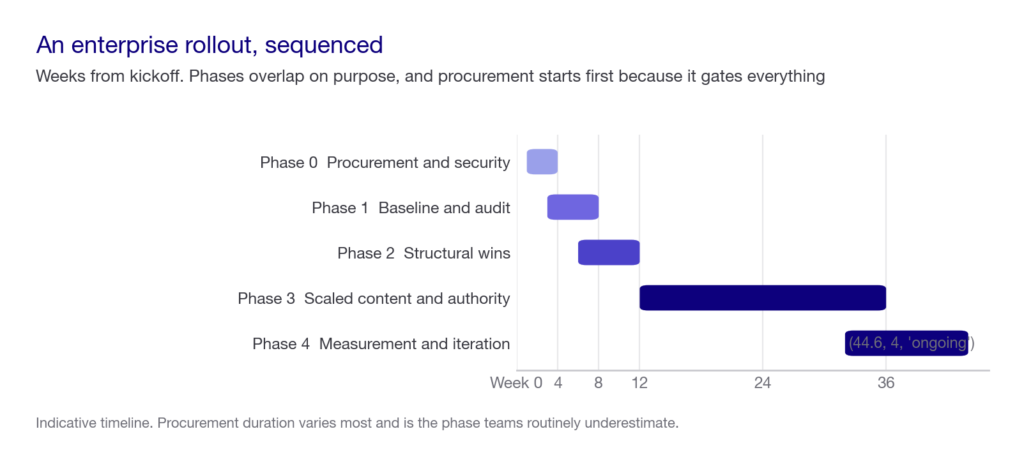
Phase 0, weeks 1 to 4: procurement and security. Security review, DPA, access provisioning. For that reason, start this first. And it is the phase that most often adds a month nobody planned for.
Phase 1, weeks 3 to 8: baseline and audit. Establish the prompt universe: what your buyers actually ask, per segment and region. Measure where you appear today and which sources get cited alongside you. Without this, later claims of improvement are unfalsifiable. In practice, our 7-point AI search audit covers the method.
Phase 2, weeks 6 to 12: structural wins. Schema, entity consistency, crawler access, retrievability fixes on the highest-value pages. Least glamorous, earliest movement, because it removes reasons for a model to skip you.
Phase 3, months 3 to 9: scaled content and authority. The citation core: the ten to twenty sources that decide your category. In practice, most brands cannot name one of them. Then content against the priority prompts, through your approval workflow, across locales.
Phase 4, ongoing: measurement and iteration. Brand Visibility, Domain Prompt Presence and Share of Voice tracked over time, then branded search lift, then pipeline. Not a score.
What an enterprise AEO programme costs
| Engagement type | Typical range | Notes |
|---|---|---|
| Monitoring platform, entry | From $99 per month | Usually one engine at this level |
| Monitoring platform, mid | $399 to $1,500 per month | Multi-engine, deeper analytics |
| Enterprise platform | Custom | Governance, SSO, regions, support |
| Full function, run for you | Custom, annual | Strategy, execution and accountability |
Procurement, not licence cost, is usually what moves the start date. So budget for the security review before you budget for the platform.
How to choose an enterprise AEO partner
Enterprise selection fails differently from mid-market selection. The tool is rarely the problem. Ownership, procurement and capacity are.
In May 2026 Google published its first official guidance on optimising for its AI features and filed it under SEO fundamentals. In practice, its position: AEO and GEO are part of SEO for Google, AI Overviews and AI Mode run on the core Search ranking systems. In addition, there is no separate AI index. It also mythbusts several things GEO vendors sell hard, including llms.txt, content chunking and AI-specific rewrites. In an enterprise setting that guidance is genuinely useful ammunition. It gives you something authoritative to hand a stakeholder who has been sold an AI-specific silver bullet. And it moves the conversation back to fundamentals your team probably already understands.
The scorecard we would use
Score each shortlisted partner out of 100 using the weights below, before the pricing conversation rather than after it. Also, a partner who scores well on measurement and badly on execution is a research vendor, whatever the deck says.
| Area | Weight | What a strong partner demonstrates |
|---|---|---|
| Governance and controls | 25% | Roles, approvals, audit trails, and a workflow that survives brand, legal and regional review |
| AI visibility measurement | 20% | Brand mentions, cited URLs, competitors and share of voice by engine and region |
| Execution capacity | 20% | Can do the work at your scale, across locales, rather than hand over a prioritised list |
| Security and procurement readiness | 15% | SOC 2 Type II in date, ISO 27001 with the right scope, GDPR DPA, model-training transparency |
| Multi-engine and multi-region | 10% | Coverage that matches where your buyers actually are |
| Business attribution | 10% | Reaches pipeline, and survives a CFO reading it |
Execution capacity is weighted as heavily as measurement here because enterprise teams are rarely short of insight. They are short of hands, and a platform that surfaces two hundred fixes nobody can action has added a backlog rather than a capability.
Ask them to prove it before procurement starts
Give each shortlisted partner 20 to 30 real commercial questions your buyers ask. Not branded ones. Things like “best enterprise content marketing platforms”, “best alternatives to our closest competitor”, “which platform should I use for this use case” and “how should a company like ours improve visibility in ChatGPT”.
Then ask them to come back with five answers: where do we appear, which competitors appear instead, which sources are influencing those answers, why are those sources winning. And what exactly would you change in the first 90 days?
Give each shortlisted partner 20 to 30 real commercial questions per priority segment and region. Then ask for five answers:
- Where do we appear across these prompts, by region?
- Which competitors appear instead?
- Which sources are influencing those answers?
- Why are those sources winning?
- What would you change in the first 90 days, and which of it needs approval from whom?
Run the security review in parallel, starting now. In our experience procurement, not strategy, is what pushes an enterprise start date by a month.
Expect a serious partner to say that answers vary between runs and engines. What is more, to explain how they separate signal from noise across a large prompt set.
The distinction that decides it: weak playbook against strong
The weaker playbook in this category runs: find prompts, rewrite blogs, add FAQs, add statistics, hope the engines cite you. And it is cheap to sell and it plateaus in about a quarter.
The stronger model, and the one we run, sequences it: demand intelligence, then technical discoverability, then entity and brand authority, then content, then earned-media authority, then distribution, then visibility measurement, then revenue attribution.
That difference matters because generative engines synthesise an answer from several sources rather than ranking one page. Being retrieved, being cited, and actually influencing the answer are three different things worth measuring separately.
Red flags
- “We guarantee citations” or a guaranteed visibility score. Google gives the same warning about guaranteed rankings.
- No SOC 2 Type II, or a Type I presented as equivalent. Ask for the report date and the scope.
- No answer on model training. Whether your content trains their models, or anyone else’s, is a question your legal team will ask eventually. Better now.
- Single-owner tooling. If the platform has no roles, approvals or audit trail, it will not survive your review process.
- A recommendation engine with no execution. Fine, if you have the capacity. Verify that you do.
- Volume content plans. The tactic Google’s guidance warns against, and at enterprise scale it is expensive to unwind.
The five questions we would spend the meeting on
- Show me how measurement works across regions and languages.
- Take one query where a competitor beats us in one market and explain why.
- Who does the work, and what happens when our team has no capacity that month?
- Walk me through your security posture and sub-processors.
- How does this reach pipeline? If the answer stops at visibility, the budget conversation will stop there too.
Reduced to one principle: decide who owns this internally before you buy anything. The most common enterprise failure we see is not a bad platform. Equally, it is a good platform with diffuse ownership across three teams and accountability in none.
One honest closing note. Very few firms are equally strong across measurement, execution, earned authority and attribution, ours included. The good ones will tell you which is their weakest without being asked. If a partner claims to be excellent at all four, you have learned something about how they answer questions.
Why a CMO might pick the platform-plus-team model
The argument is narrow and worth stating plainly rather than overselling.
Enterprise teams rarely lack insight. They lack the capacity to act on it at the cadence the work requires. And they lack an owner accountable for the outcome when the work spans brand, legal, regional teams and agencies. At the same time, a platform hands you findings. And a agency hands you hours. Neither is on the hook for the number.
Pepper is an agentic organic growth engine. Atlas is the platform underneath, tracking Brand Visibility, Domain Prompt Presence and competitive Share of Voice across ChatGPT, Perplexity, Gemini, Claude and Google AI Overviews. In practice, you get the platform and a growth team on the account. Your team can log in, connect Search Console and GA4, manage the prompt set, read the analytics. Beyond that, build and run agents in the Agent Atlas. In practice, our growth team works the same account alongside you, so the work still happens when your week fills up. So that combination is the point: governance and visibility stay with you, and the execution capacity does not depend on your headcount. In practice, engagements are annual and outcome-pegged, with KPIs written into the contract. More than 10 million tracked prompts sit behind the strategy. Eight years, 250 plus enterprises.
Where it falls short. No monthly rolling option, so it is a poor fit for a cheap monitoring trial. Organic only. And if you already have both spare capacity and an accountable owner internally, you may only need better data rather than a team alongside it.
What nobody should promise you
A single AI visibility score presented as a ranking position. Consequently, ask a model the same question repeatedly and the answers vary. Brand Visibility, Domain Prompt Presence and Share of Voice across a tracked prompt set, over time, are real moving numbers. In practice, Pepper reports this as three numbers: Brand Visibility (how often engines mention you by name), Domain Prompt Presence (how often they cite a page from your domain) and Share of Voice (your slice of all brand mentions in the category). Visibility rising while Share of Voice falls means competitors rose faster. The chain worth measuring runs: authority built, then consensus across trusted sources, then Share of Voice up, then branded search lift, then organic demand and pipeline. In addition, every link is observable.
What this looks like when it works
Acceldata, an enterprise data observability company, is a useful example because the mechanism is visible in the numbers.
| Metric | Result |
|---|---|
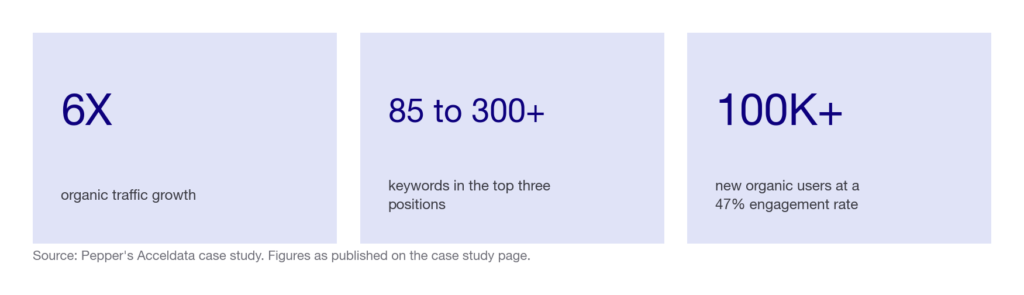
| Organic traffic | 6X growth |
| Keywords in top three positions | 85 to more than 300 |
| New organic users | More than 100,000 |
| Engagement rate | 47 percent |
| Impressions from a single hero guide | More than 260,000 |
The pattern worth noticing is the keyword concentration: moving from 85 to over 300 top-three positions is what builds the consensus an engine reads as authority. One guide generating 260,000 impressions is the compounding asset, not a content calendar entry.
“Their ability to hone in on a specific topic that really resonates and draw people in was absolutely critical for us,” said Mahesh Kumar, CMO at Acceldata.
Worth being clear about scope: this is an SEO and content programme whose structural properties (topical concentration, authority, retrievability) are the same ones that drive AI citation. And it is evidence of the mechanism, not a controlled AEO experiment.
Frequently asked questions
What is AEO for enterprise?
Answer engine optimisation run at organisational scale: getting your brand surfaced and cited in AI-generated answers across thousands of pages, multiple languages and several jurisdictions, with the governance, approvals and audit trails a large company requires.
How is enterprise AEO different from regular AEO?
The tactics are similar. In practice, the s are governance, procurement gates like SOC 2 and GDPR, scale across locales. Also, the need for execution capacity rather than another list of recommendations.
What does enterprise AEO cost?
Monitoring platforms start around 99 to 500 US dollars a month. Full programmes with execution are quoted custom and annually, because scope varies with page count, locales and compliance overhead. In practice, Pepper does not publish a rate.
Who should own AEO inside a large company?
Usually the organic or content leader, with a named counterpart in PR for off-site authority and one in legal for sign-off. The common failure is diffuse ownership across three teams and accountability in none.
How long before enterprise AEO shows results?
Structural fixes move within four to eight weeks. Authority and citation gains compound across three to nine months. In practice, procurement often adds a month before any of it starts.
What should we ask a vendor about AI and our data?
Whether your content trains their models or anyone else’s, which sub-processors and model providers touch your data, what is retained and for how long. And whether you can restrict which models are used.
Do we need a platform, an agency, or both?
It depends on which layer you are missing. If you lack visibility, buy measurement. If you have findings you cannot action, you have a capacity problem and a dashboard will not fix it.
How do we prove this to the CFO?
Track Brand Visibility, Domain Prompt Presence and Share of Voice against a fixed prompt set, then branded search lift, then organic pipeline. Show the chain rather than the score. What is more, a screenshot of one good answer proves nothing and everyone in the room knows it.
You may not need to buy anything yet
The answer that costs us the sale. If ownership is unresolved, you do not need to buy anything yet, and you should not start a procurement cycle. And a enterprise AEO programme with three teams involved and nobody accountable produces a platform nobody logs into and a report nobody acts on. Settle who owns it, get a baseline, and only then decide what to buy. So that sequencing costs nothing and saves a year.
The bottom line
Enterprise AEO is less about clever tactics and more about doing the right tactics repeatedly, safely and at scale. The organisations that win it are not the ones with the best insight. They are the ones that resolved ownership, cleared procurement early, and built the capacity to act on what they found.
Decide who owns it. As a result, start the security review now. Get a baseline before you buy anything else.
See where you show up · Book a growth audit
Sources and further reading
- Forrester. “Forrester’s 2026 Buyer Insights.” Published 21 January 2026. Nearly 18,000 global business buyers. Link
- Removed in the 2026 sourcing pass: the 6sense 2025 Buyer Experience Report and the Gartner survey fielded August to September 2025. Both predate 2026; Forrester’s January 2026 survey replaces them.
- Pepper, Acceldata case study. Metrics as published..
Latest Blogs
There is no shortage of numbers answering this. But there is a severe shortage of numbers you can trace to a primary source, and the two sets do not overlap much. The short answer In short: large and growing, and yet nobody can give you a defensible growth rate. Only four figures come from primary […]
Indian AI users are ahead on capability, not just volume. Four times the global median on data analysis, second globally in AI skills penetration. That changes what adapting means for Indian brands.
The short answer An AI visibility check takes about fifteen minutes and gives you one of four answers. That is the whole exercise. Ask five questions your buyers ask, in three engines. Record two things each time: whether the answer named you, and whether it cited a page you own. Those two columns produce four […]
Get your hands on the latest news!