AI Hallucination: When Your Smart Assistant Starts Fibbing
You know when your friend confidently tells you that sharks can sneeze? They sound super sure, but they just made that up. AI does the same thing.
What is AI Hallucination? (The Simple Version)
Think of a chatbot like a really enthusiastic kid who always raises their hand in class. Sometimes they know the answer. Sometimes they just string together words that sound good. AI hallucination happens when a language model generates information that sounds totally believable but is completely wrong.
Here’s the wild part: the AI has no idea it’s wrong. It’s like a cookie recipe machine that makes up ingredients because it ran out of real ones. The cookies still look perfect, but they might taste like cardboard. The AI writes sentences that look perfect but might be total nonsense.
How Does AI Hallucination Work?
Your AI assistant doesn’t actually know stuff the way you know your own birthday. Instead, it plays a really advanced guessing game. It learned patterns from millions of texts, kind of like how you learn that “peanut butter” usually goes with “jelly.”
When you ask a question, the AI thinks: “Based on everything I’ve seen, what words usually come next?” Sometimes this works great. Sometimes it fills in blanks with confident gibberish. A chatbot might write about a book that never existed, complete with a fake author name and publication date. All the parts sound right because the AI knows how book citations look. But the book itself? Total fiction.
Why Does AI Hallucination Matter?
Imagine asking your GPS for directions and it confidently sends you to a lake instead of a library. That’s annoying. Now imagine a doctor using AI that invents medical facts, or a student turning in a paper citing research that doesn’t exist.
When AI hallucinates, it doesn’t say “I’m not sure” or “This might be wrong.” It sounds just as confident as when it’s correct. That’s scary. You can’t tell the difference between good answers and made-up nonsense just by reading them. The fake stuff sounds smart and professional and totally real.
AI Hallucination at a Glance
| Feature | Details |
| What it is | When AI generates confident but factually incorrect information |
| Why it happens | AI predicts patterns, doesn’t truly understand facts |
| How it appears | Plausible, well-formatted, and convincing |
| Common causes | Insufficient training data, biased datasets, wrong assumptions |
| Who’s affected | Anyone using large language models for facts or research |
| Risk level | High – hallucinations look identical to accurate outputs |
Real-World Examples
A lawyer once submitted a court filing with case citations generated by ChatGPT. The cases sounded legit. They had proper formatting, case numbers, everything. Except none of them existed. The AI hallucinated an entire legal precedent.
Students have gotten caught with bibliography entries for academic papers that don’t exist. The AI knew what a proper citation looks like, so it created perfect-looking references to imaginary research.
Companies have asked AI about their own brand history and gotten confident answers about events that never happened, products they never made, or awards they never won.
FAQs
Q1: What exactly is hallucination in AI terms?
AI hallucination is when language models generate incorrect or misleading information. This happens because of insufficient training data, incorrect assumptions the model makes, or biases baked into the training process.
Q2: Why can’t AI just admit when it doesn’t know something?
AI doesn’t actually “know” anything. It’s a prediction machine that guesses the most likely next words based on patterns. It has no awareness of whether its output is true or false, so it can’t recognize its own mistakes.
Q3: What makes AI hallucinations so dangerous?
The fake output looks and sounds just like accurate information. There’s no warning label. The AI writes with the same confidence whether it’s right or completely making things up, so readers can’t easily tell the difference.
Q4: Which types of AI have this problem?
Large language models like ChatGPT, Claude, and similar chatbots are particularly prone to hallucinations. Any AI that generates natural language text can confidently produce incorrect information.
Wrapping Up
AI hallucination isn’t a bug you can just fix. It’s built into how language models work. They’re pattern machines, not truth machines. Next time a chatbot gives you an answer, remember: it might sound smart, but it could also be making cookies with imaginary ingredients.
Latest Blogs
Most advice on this is inference dressed as fact. OpenAI documents exactly one thing clearly, which is access. Here is what is documented, what is inferred, and how to verify the rest for yourself.
Being named in an AI answer and having your page used as its source are different outcomes with different causes and different fixes. The gap between them is the most useful diagnostic in AI search, and most reporting collapses it into one number.
Every platform reports share of voice and almost none of them define it the same way. Here is the definition worth using, the three choices that change the number, and how to measure it yourself without buying anything.
Get your hands on the latest news!

Similar Posts
GEO / AI Search
10 mins read
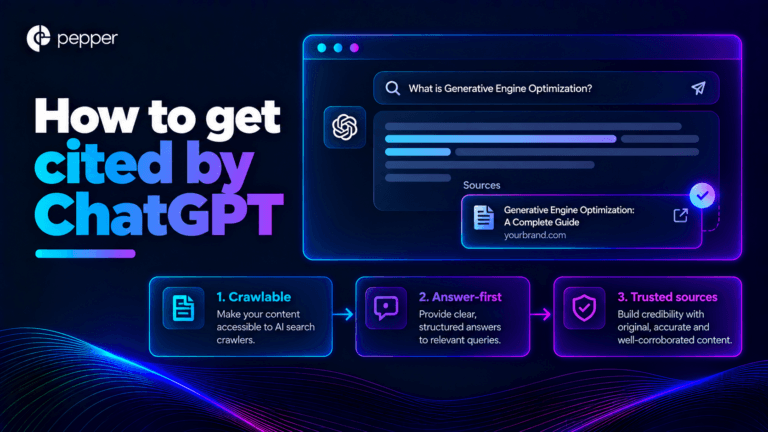
How to get cited by ChatGPT
GEO / AI Search
10 mins read
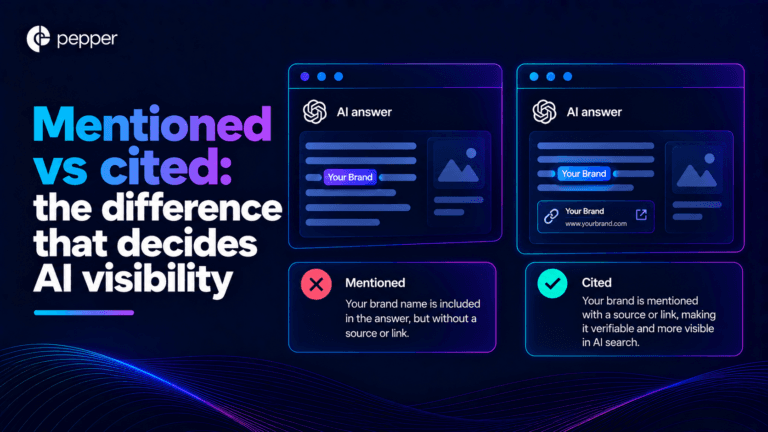
Mentioned vs cited: the difference that decides AI visibility

GEO / AI Search
13 mins read