Remember when you asked Google a question and got a big list of blue links? Those days are fading fast. Now, AI tools like ChatGPT and Perplexity just give you the answer directly. AI Search Optimization is how you get your content to be the answer they pick.
What is AI Search Optimization? (The Simple Version)
Think of AI Search Optimization as the new way to help AI-powered search tools find and use your content. It’s like the grown-up version of regular SEO (which helped you show up on Google), but designed for the world where AI answers questions instead of just listing websites.
Here’s a fun way to think about it: Traditional SEO was like making sure your lemonade stand had a big colorful sign so people walking by would notice it. AI Search Optimization is like teaching a helpful robot exactly what’s in your lemonade, how much it costs, and what makes it special so when someone asks that robot “where can I get good lemonade?”, it can tell them about your stand right away.
This umbrella term covers several specific practices, including AEO (Answer Engine Optimization), GEO (Generative Engine Optimization), and LLMO (Large Language Model Optimization).
How Does AI Search Optimization Work?
When you write content the AI Search Optimization way, you organize it so AI tools can easily grab exactly what they need. Instead of writing one long blog post, you break things into clear question-and-answer pairs, create FAQ sections, and structure information like little building blocks.
Here’s an example: Say you run a bakery. The old way, you’d write “Our bakery has been serving the community since 1995 with fresh bread and pastries.” The AI-optimized way, you’d write:
Q: What does Main Street Bakery sell?
A: Fresh bread and pastries baked daily.
Q: How long has Main Street Bakery been open?
A: Since 1995.
See the difference? AI tools love clear, direct answers they can quote. This approach started gaining traction around 2017 when voice assistants and featured snippets became popular.
Why Does AI Search Optimization Matter?
Because people are changing how they search. Instead of typing “best pizza near me” into Google, they’re asking ChatGPT or Perplexity “what’s a good pizza place I should try?” And the AI picks ONE answer to recommend, not ten blue links.
If your content isn’t optimized for these AI tools, you become invisible. You could have the best pizza in town, but if the AI can’t easily pull your information to cite in its answer, someone else gets the recommendation instead.
Success here looks different too. You’re not chasing a #1 ranking anymore you’re counting how many times AI tools cite your content as a trusted source.
AI Search Optimization at a Glance
| Feature | Details |
| What it covers | AEO, GEO, LLMO, and other AI-focused optimization methods |
| When it started | Around 2017 with voice search and featured snippets |
| Best content format | Question-answer pairs, FAQs, clear atomic answers |
| Success metrics | Citation rates and visibility in AI answers (not rankings) |
| Main difference from SEO | Optimizes for AI synthesis, not search result pages |
Real-World Examples
A recipe site using AI Search Optimization would format ingredient lists with clear headers (“Ingredients for Chocolate Chip Cookies”) and step-by-step instructions numbered 1-2-3. When someone asks an AI “how do I make chocolate chip cookies?”, the AI can easily extract and cite those clear steps.
A software company might create a dedicated FAQ page answering “What does this tool do?”, “How much does it cost?”, and “Who is it for?” in short, quotable paragraphs. AI tools love this format because they can pull exact answers.
A local dentist could structure their About page with clear sections: “Services We Offer”, “Insurance We Accept”, “Office Hours” — each with concise, factual answers that AI can reference when someone asks about dentists in their area.
FAQs
What’s the difference between SEO and AI Search Optimization?
SEO gets you ranked on search engine results pages with links. AI Search Optimization gets your content cited when AI tools generate direct answers. Traditional SEO is about visibility; AI Search Optimization is about being the quoted source.
Which should I focus on – AEO, GEO, or LLMO?
They’re all parts of the same puzzle. Think of AI Search Optimization as the umbrella that covers all of them. Start with the basics (clear Q&A formatting, good FAQs), and the specifics will follow naturally.
Do I still need regular SEO if I’m doing AI Search Optimization?
Yes, for now. Google still exists, and people still click links. Think of them as two different skills that work together – like knowing how to ride a bike AND a skateboard.
How do I measure if my AI Search Optimization is working?
Track how often AI tools cite your content as a source. Some tools can monitor “AI visibility” and citation rates, similar to how you used to track rankings.
Wrapping Up
AI Search Optimization is your ticket to staying visible as search evolves. Format your content clearly, answer questions directly, and make it easy for AI to quote you. Your future customers are already asking AI for recommendations – make sure it knows your name.
Latest Blogs
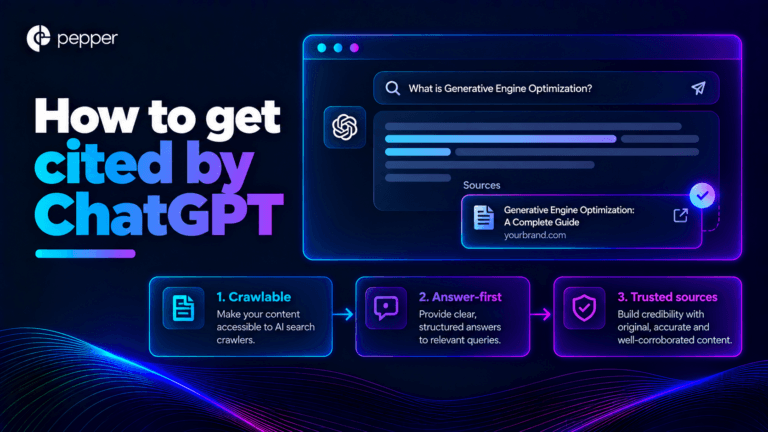
Most advice on this is inference dressed as fact. OpenAI documents exactly one thing clearly, which is access. Here is what is documented, what is inferred, and how to verify the rest for yourself.
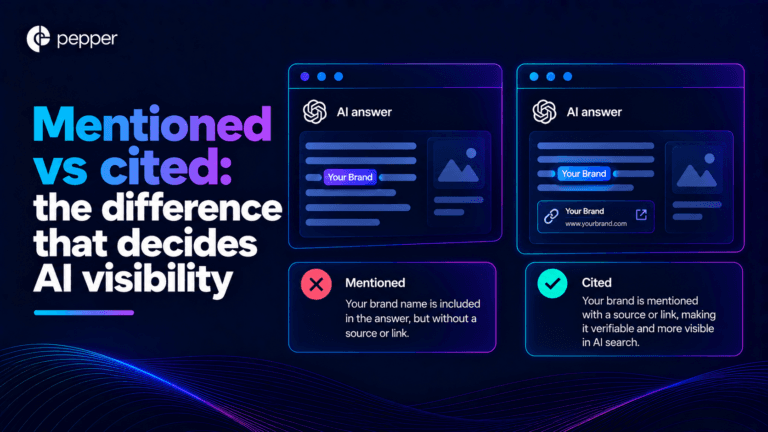
Being named in an AI answer and having your page used as its source are different outcomes with different causes and different fixes. The gap between them is the most useful diagnostic in AI search, and most reporting collapses it into one number.
Every platform reports share of voice and almost none of them define it the same way. Here is the definition worth using, the three choices that change the number, and how to measure it yourself without buying anything.
Get your hands on the latest news!

Similar Posts
GEO / AI Search
10 mins read
How to get cited by ChatGPT
GEO / AI Search
10 mins read
Mentioned vs cited: the difference that decides AI visibility
GEO / AI Search
13 mins read