Article Schema: The Secret Decoder Ring for Your Content
Remember when you had to label your lunchbox with your name so everyone knew it was yours? Article schema does the same thing for content on the internet. It’s a special code that tells Google and other search engines, “Hey, this is an article, Sarah wrote it, and The Daily News published it on Tuesday.”
What is Article Schema? (The Simple Version)
Article schema is code you add to your website that works like labels on a toy box. When you write a blog post or news article, the words show up on the screen. But computers need extra help understanding what those words mean. That’s where article schema comes in. It’s a behind-the-scenes note that says “this is an article,” “this person wrote it,” and “this company published it.” Search engines read these notes and understand your content better, just like how a label on a cookie jar tells you what’s inside without opening it first.
How Does Article Schema Work?
When you publish an article, you add special code to your website’s HTML. This code follows rules from a dictionary called Schema.org that all search engines understand. The code includes information like the article’s title, the author’s name, when you published it, and which organization created it. When Google crawls your page, it reads this code and thinks, “Got it! This is a blog post by Dr. Smith from Tech University, published last Monday about robots.” Now Google can show your article in search results with a nice picture, the publish date, and the author’s name. It’s like how a nutrition label on a cereal box tells you what’s inside before you buy it.
Why Does Article Schema Matter?
Article schema matters because it helps Google and AI systems trust your content. When you mark up who wrote something and which organization published it, you’re building credibility. If Dr. Smith has a Person schema showing she’s a robotics professor, and your article schema points to her as the author, AI systems like ChatGPT and Google’s AI think, “This article about robots is probably reliable because a real expert wrote it.” Without article schema, your content is like an unsigned birthday card. It might say nice things, but nobody knows who wrote it.
Article Schema at a Glance
| Property | What It Does | Example |
| headline | The article’s title | “How Solar Panels Work” |
| author | Who wrote it (links to Person schema) | Jane Smith, Energy Expert |
| datePublished | When it went live | 2024-01-15 |
| publisher | The organization behind it | Green Energy Blog |
| image | Main article image URL | featured-solar-image.jpg |
Real-World Examples
When The New York Times publishes a news article, they use NewsArticle schema with the journalist’s name and The New York Times as the publisher. When a cooking blogger shares a recipe post, they use BlogPosting schema with their name as the author. When a company publishes a thought leadership piece on LinkedIn, they use Article schema linking to the executive’s Person schema to show their credentials. Each of these examples helps search engines understand not just what the content says, but who said it and why they’re qualified to say it.
FAQs
Q1: What’s the difference between Article, NewsArticle, and BlogPosting schema?
Article is the general type for any written content. NewsArticle is specifically for journalism and news reporting. BlogPosting is for blog posts and informal articles. They all work similarly but tell search engines what kind of content to expect.
Q2: How does article schema help with AI and LLMs?
When AI systems like ChatGPT look for information to cite, article schema helps them identify authoritative sources. If your schema shows a credentialed author and reputable publisher, AI is more likely to trust and reference your content.
Q3: Do I need Person schema for the author too?
Yes, pairing Article schema with Person schema for your authors creates stronger trust signals. Person schema shows the author’s credentials, job title, and expertise, which reinforces the authority of the article.
Q4: Will article schema make my content rank higher?
Article schema doesn’t directly boost rankings, but it helps your content appear with rich snippets in search results (like showing the author name and publish date), which can increase clicks. It also helps AI systems understand and potentially cite your content.
Wrapping Up
Article schema is your content’s nametag. It tells search engines and AI who wrote something, who published it, and when. Add it to your articles to build trust and authority.
Latest Blogs
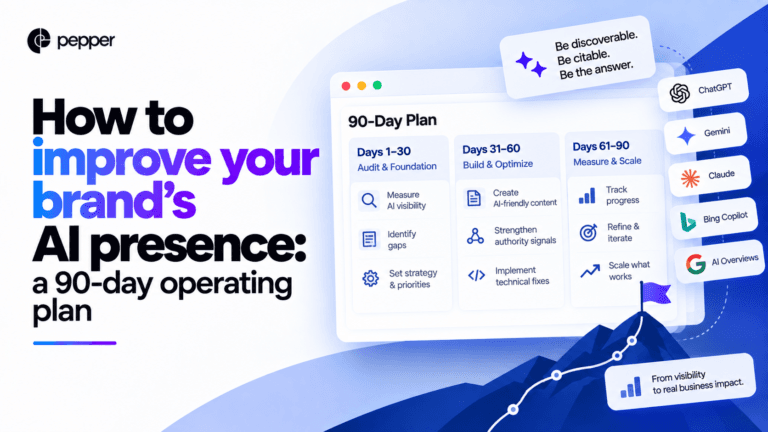
Most 90-day AI plans are sequenced by how hard the work feels rather than by how long it takes to land. So they spend week one on an llms.txt file that Google states it does not use, and they schedule earned media for phase three, which guarantees no result inside the quarter. This plan inverts that. It orders the work by lead time, starts the slowest thing on day one, and cuts four tactics Google explicitly says are unnecessary.
We priced this category nine days ago. Today we went back to the same four pricing pages to check the numbers before publishing. Three of the four had changed, and two had stopped publishing prices altogether. That is the real answer to what AEO costs in 2026: not a number, but a meter that moves, measured in prompts and responses and engines that are billed separately. Here is how each pricing model works, what unit it charges you for, and which incentive that unit creates.
Ask what AI search traffic is worth and you will be handed a multiplier. The ones in circulation right now run from 13% worse than organic search to 23 times better, a spread of roughly twenty-six fold on the single input your whole business case depends on. They disagree because they are measuring the same behaviour under different attribution models. So this is not a guide to finding the right multiplier. It is a guide to building a model whose assumptions are visible, and to being honest about the half you cannot prove.
Get your hands on the latest news!

Similar Posts
Artificial Intelligence
16 mins read
How to improve your brand’s AI presence: a 90-day operating plan

Artificial Intelligence
16 mins read
What does AEO cost in 2026? Pricing models explained

Artificial Intelligence
17 mins read