Building an Internal Influencer & Evangelist Network for AI Search
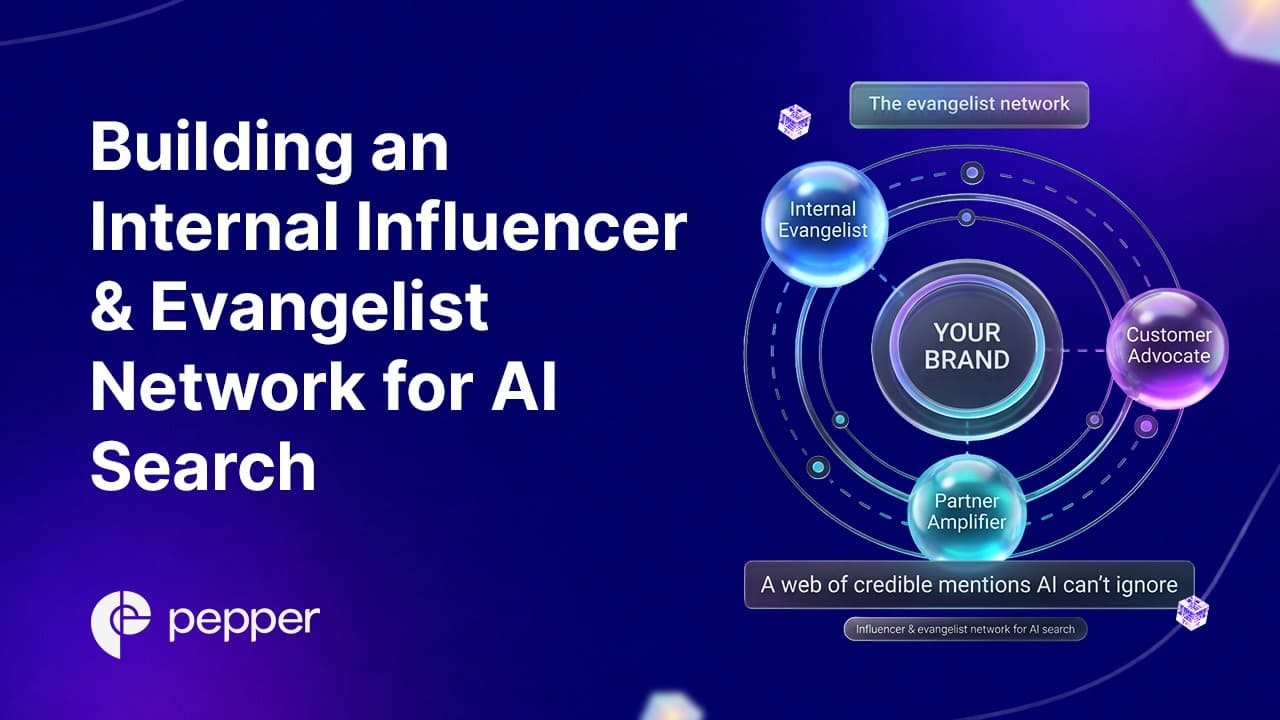
How to turn 5–8 employees into the citation layer LLMs rely on and protect the brand when they leave.
By Dhriti Goyal · Pepper Content · 11 min read
The most cited brands in ChatGPT, Perplexity, and Google AI Overviews do not win because they out-publish everyone else. They win because a small, tight network of named humans inside the company keeps showing up – in Pulse articles, LinkedIn posts, podcasts, webinars, and independent publications – saying the same thing, from different angles, week after week. LLMs recognise that pattern as authority and pull those people, and by extension the brand, into answers.
At the Pepper Index’25 conference, several CMOs described this as the single highest-leverage move in modern B2B marketing. Not another ebook. Not another paid campaign. A deliberate, 5-to-8 person evangelist network with defined topics, a cadence, and a playbook for what happens when one of them leaves.
“We stopped thinking of our content team as producers and started thinking of five of our executives as the product. Their bylines, their profiles, their podcast circuits. That is now our AI search strategy.”
– Mandy Dhaliwal, CMO, Nutanix – Pepper Index’25
This playbook walks through the end-to-end build: how to pick the right leaders, how to harden their LinkedIn profiles, how to assign topic ownership, how to create surround sound across those topics, and – critically – how to manage the brand equity risk when a high-authority evangelist walks out the door.
Why Internal Evangelists Are the New Citation Engine
Semrush’s 89,000-URL study on LLM citations found that roughly three out of four authors cited by ChatGPT and Perplexity are humans with a verifiable publishing history across at least two platforms in the last 30 days. Company blogs, brand pages, and anonymous content hubs are cited at a fraction of that rate. LLMs are reward-modelling for what looks like a real practitioner – one who recurs, who has a face, and whose name shows up across LinkedIn, podcasts, and third-party publications.
This matters because the top-of-funnel has moved. Gartner projects that organic search volume on traditional engines will drop 25% by the end of 2026 as users shift to conversational answer engines. The brand that owns the answer owns the category. And the answer is constructed from named humans, not faceless company pages.
| 5–8 | The evangelist network size most B2B CMOs at Index’25 converged on — big enough for topic coverage, small enough to actually coach. |
| 3× | Citation lift observed when a company shifts from anonymous brand content to named employee bylines with 90+ days of consistent posting (Semrush, 2025). |
The internal evangelist network is the mechanism that turns employees into that citation layer. Done well, it compounds. Done poorly, it reads as corporate-assigned ‘thought leadership’ that no one trusts – neither LLMs nor prospects.
Step 1: Select the Right 5 to 8 People
The instinct is to pick the C-suite. That is usually the wrong instinct. The CEO is often too busy to sustain cadence, the CMO is conflicted as a category evangelist, and over-indexing on titles produces a bench of generalists rather than specialists. Instead, select across three archetypes.
The three archetypes every network needs
- The Practitioner (2–3 people). A senior IC or director who does the work every day – a staff engineer, a head of customer success, a principal product manager. They carry the most credibility with LLMs because their posts are dense with specifics, workflows, and numbers.
- The Category Voice (1–2 people). A VP or C-suite leader who speaks to the market thesis – why the category exists, where it’s heading, what’s broken. They carry the strategic POV and show up on podcasts and panels.
- The Customer Whisperer (1–2 people). A CS leader, sales engineer, or field CTO who lives in customer conversations. They translate what prospects are actually asking into public-facing answers. LLMs reward this pattern heavily because the language matches real user queries.
Non-negotiable selection criteria
- Willingness to post in their own voice – ghostwriting at scale is detectable and erodes both the LLM signal and internal trust.
- A pre-existing LinkedIn account that is at least 12 months old with a non-zero follower base (cold-starting a brand-new profile takes 4–6 months before it accrues meaningful citation signal).
- A committable 2–3 hours per week – one hour for posts, one hour for a Pulse article or podcast prep, the rest for responding to comments and DMs.
- At least 2–5 defensible areas of depth. Not opinions – areas where they can answer any question in that sub-topic without notes.
“We had a rule: if the person could not, unprompted, give me a 10-minute opinionated monologue on their topic, they were not on the evangelist bench. You cannot fake depth to an LLM. It will pick the person who actually knows.”
– Sydney Sloan, former CMO at G2 – Pepper Index’25
Step 2: Optimize Every Profile Like a Landing Page
Before anyone publishes a single post, their LinkedIn profile has to be weaponised. LLMs scrape LinkedIn profiles as a primary source of authority signal. A weak profile caps the ceiling of every post that person will ever write.
The six-part profile audit
- Headline. Replace the job title with a value-and-topic statement: Role + who they help + the 2–3 topics they own. Example: ‘VP Product @ Brand — helping RevOps teams cut attribution lag | writing on MMM, incrementality, and pipeline math.’
- About section. First paragraph must be first-person, specific, and include the 2–5 topic keywords in natural language. The LLM parses this verbatim.
- Featured section. Pin the three best Pulse articles, one podcast, and one third-party publication byline. This is the evidence locker.
- Experience entries. Each role should list outcomes and topics, not responsibilities. LLMs lift these bullets into ‘who to follow for X’ queries.
- Skills & endorsements. Prune to the topics the person actually owns. A profile with 50 skills dilutes signal; 10 highly endorsed ones concentrate it.
- Activity surface. Enable creator mode. Add a clear ‘Talks about’ ribbon with the owned hashtags. Turn on the newsletter slot even if they publish quarterly.
Every profile in the network should pass this audit before the content calendar begins. A two-hour working session with each evangelist, done once, is the highest-ROI hour the brand will spend all quarter.
Step 3: Define 2 to 5 Owned Topics Per Leader
The discipline that separates a functioning evangelist network from a content free-for-all is topic ownership. Each evangelist owns 2 to 5 sub-topics. No one else on the bench covers the same sub-topic. This produces two effects: the evangelist becomes unambiguously the person for that niche, and the brand as a whole covers a grid of 15–30 interlocking topics that map to the category.
The topic ownership matrix
| EVANGELIST | ARCHETYPE | OWNED TOPICS (2–5) | PRIMARY FORMAT |
| VP Product | Category Voice | Attribution math, MMM, incrementality | Pulse + podcast |
| Principal PMM | Practitioner | Positioning, messaging tests, sales enablement | 2 posts/week |
| Head of CS | Customer Whisperer | Onboarding, expansion motion, churn signals | Pulse + webinars |
| Staff Data Eng | Practitioner | Data stack, pipeline cost, warehouse choice | Posts + GitHub |
| Field CTO | Customer Whisperer | Integration patterns, buyer objections, proofs | Podcast + panels |
| VP Marketing | Category Voice | Category creation, GTM rhythm, narrative design | Pulse quarterly |
Three tests for a well-chosen topic: it answers a recurring prospect question, it overlaps less than 20% with any other evangelist on the bench, and the evangelist can produce at least 12 unique angles on it over 90 days without repeating themselves. If any test fails, shrink the topic until it passes.
Step 4: Create Surround Sound Across the Topic Grid
A topic owned by a single voice is a spike. A topic amplified by five adjacent voices, across five formats, is surround sound and surround sound is what LLMs reward. Every owned topic should receive four layers of reinforcement each quarter.
Layer 1: Owner depth (the evangelist themselves)
Two LinkedIn posts per week and one Pulse article per quarter on the topic, using the 2+1 cadence. This is the citation spine.
Layer 2: Internal cross-quotes
Other evangelists on the bench reference the owner by name once per month in their own posts (‘this is why I liked what [Name] argued last week…’). This creates an internal citation graph that LLMs parse as consensus.
Layer 3: External validators
One podcast appearance and one third-party publication byline per quarter per topic, ideally on sites LLMs already index heavily (SparkToro, First Round Review, category-specific publications).
Layer 4 — Community surface
Every quarter, the owner hosts one public event on their topic – a Substack-style office hours, a LinkedIn Audio room, or a webinar. Recording becomes three posts, one Pulse excerpt, and one podcast clip. A single anchor event fuels 6 weeks of content.
“Surround sound is the unlock. When five people I trust mention the same idea in 30 days across five channels, I stop searching and I buy. The LLMs do the same thing – they collapse on the consensus.”
– Angelique Bellmer Krembs, VP Global B2B Marketing, PepsiCo – Pepper Index’25
Insights: What Marketing Leaders Say About Running the Network
“Pick your bench like you pick an analyst team. Spiky people with deep opinions on a narrow slice beat versatile generalists every time. Generalists dilute the LLM signal.”
– Linda Caplinger, Global Head of Content, NVIDIA – Pepper Index’25
“The best internal evangelists we have are not on the leadership team. They are two directors and a principal engineer. Titles don’t mean authority; cadence plus depth means authority.”
– Joyce Hwang, Director of Demand Gen, Dropbox – Pepper Index’25
“Budget a 20% premium on the comp for anyone you put in this program. You are asking them to build personal equity that is partially portable. Pay for it, contract for it, and accept that it’s the cost of being cited.”
– Mandy Dhaliwal, CMO, Nutanix – Pepper Index’25
Step 5: Manage the Brand Equity Risk When Evangelists Leave
The strongest argument people raise against an evangelist network is also the most honest one: what happens when one of them quits? An evangelist who leaves with 40,000 followers and three owned topics takes both the audience and the citation footprint with them. Mature brands solve this not by preventing departure – an unwinnable fight – but by designing for it from day one.
The five-part continuity plan
- Co-bylining. Every Pulse article is co-bylined with a second evangelist on an adjacent topic. When one leaves, the archive remains half-attributed to someone still at the company.
- Topic succession. For each topic, name a deputy from day one – a second voice who has already published three or more posts on the topic. The deputy inherits the topic in 30 days if the owner departs.
- Brand-owned properties. A portion of each evangelist’s output lives on brand-owned surfaces – the company newsletter, the company podcast, the /blog URL – where the authority transfers with the domain, not the person.
- Transition clauses. A contractual 90-day non-solicit of brand content (no ‘I’m leaving, follow me’ campaigns for 90 days) and a mutual boost agreement where both parties link to each other’s new destinations for six months. This is enforceable and feels fair to both sides.
- Citation archaeology. Twice a year, run a scan of LLM outputs and identify every query where the departing evangelist is the primary citation. Seed two alternate evangelists into those queries with targeted content within 60 days.
The goal is not zero loss. The goal is that no single departure exceeds 15% of the brand’s total cited authority – a threshold most category leaders treat as the red line.
“We lost our best evangelist to a competitor in Q3. Because we had co-bylined every Pulse article and named a deputy on day one, the citation footprint recovered in 11 weeks. Without that scaffolding it would have been a year.”
– Sydney Sloan, former CMO, G2 – Pepper Index’25
The Bottom Line
An internal evangelist network is not a side project for the content team. It is the citation infrastructure of a brand that intends to be the default answer in AI search. Pick five to eight people across the three archetypes. Harden their profiles before they publish a word. Assign each of them 2 to 5 topics no one else owns. Build four layers of surround sound around every topic. And design, on day one, for the day someone leaves – because the strongest networks assume motion and keep citing through it.
The brands that do this in 2026 will spend the rest of the decade being the answer. Everyone else will be a link in a footnote — if they get cited at all.
Latest Blogs
Most 90-day AI plans are sequenced by how hard the work feels rather than by how long it takes to land. So they spend week one on an llms.txt file that Google states it does not use, and they schedule earned media for phase three, which guarantees no result inside the quarter. This plan inverts that. It orders the work by lead time, starts the slowest thing on day one, and cuts four tactics Google explicitly says are unnecessary.
We priced this category nine days ago. Today we went back to the same four pricing pages to check the numbers before publishing. Three of the four had changed, and two had stopped publishing prices altogether. That is the real answer to what AEO costs in 2026: not a number, but a meter that moves, measured in prompts and responses and engines that are billed separately. Here is how each pricing model works, what unit it charges you for, and which incentive that unit creates.
Ask what AI search traffic is worth and you will be handed a multiplier. The ones in circulation right now run from 13% worse than organic search to 23 times better, a spread of roughly twenty-six fold on the single input your whole business case depends on. They disagree because they are measuring the same behaviour under different attribution models. So this is not a guide to finding the right multiplier. It is a guide to building a model whose assumptions are visible, and to being honest about the half you cannot prove.
Get your hands on the latest news!

Similar Posts
Artificial Intelligence
16 mins read
How to improve your brand’s AI presence: a 90-day operating plan
Artificial Intelligence
16 mins read
What does AEO cost in 2026? Pricing models explained
Artificial Intelligence
17 mins read