Is Your Brand Visible in AI Search Results? Here’s How to Find Out
You rank on Google. Your traffic graph looks healthy. Your SEO dashboard is glowing green.
But then someone asks ChatGPT, Perplexity, or Google’s AI Overview for recommendations in your category… and your competitor gets the mention.
Welcome to the new visibility gap.
In this guide, we’ll show you exactly how to check if your brand appears in AI-generated results, what signals influence AI mentions, and what to fix if you’re invisible where modern buyers are actually asking questions.
| ⚡ AI Visibility Highlights – Ranking on Google doesn’t guarantee being cited in AI answers. – AI visibility is measured by citation rate and share of voice, not traffic. – Entity recognition matters more than keyword optimization. – Clear, chunked content structure increases retrievability and citations. – Cross-platform brand mentions strengthen AI inclusion signals. – AI visibility compounds over time, making early adoption a competitive advantage. |
Why Traditional SEO Metrics Miss AI Search Visibility
AI search doesn’t just rank pages. It chooses sources. It summarizes. It cites. It decides which brands get surfaced in the answer itself — not just in the blue links below it.
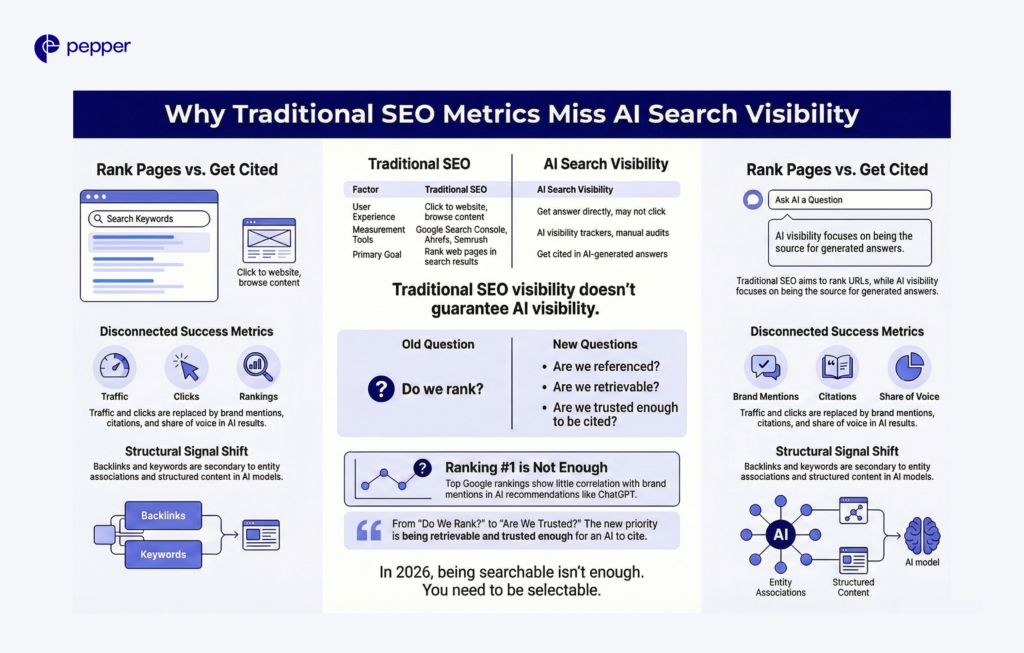
And here’s the uncomfortable truth: traditional SEO visibility doesn’t guarantee AI visibility. So the real question isn’t “Do we rank?”
It’s: Are we referenced? Are we retrievable? Are we trusted enough to be cited?
Because in 2026, being searchable isn’t enough. You need to be selectable.
| Factor | Traditional SEO | AI Search Visibility |
|---|---|---|
| Goal | Rank web pages in search results | Get cited in AI-generated answers |
| Success Metric | Rankings, clicks, organic traffic | Mentions, citations, share of voice |
| Key Signals | Backlinks, keywords, page authority | Entity associations, citation authority, content structure |
| User Experience | Click to website, browse content | Get answer directly, may not click |
| Measurement Tools | Google Search Console, Ahrefs, Semrush | AI visibility trackers, manual audits |
Research from Seer Interactive found that traditional SEO strengths—rankings, backlinks, and domain authority—showed little correlation with brand mentions in AI answers. A brand ranking #1 in Google can be completely absent from ChatGPT’s recommendations for the same query.
| Remember: Strong SEO performance doesn’t guarantee AI visibility. LLMs retrieve and cite content based on entity associations and content structure, not PageRank. You need a separate measurement for each channel. |
How to Audit Your Brand’s AI Search Visibility
Before investing in optimization, you need baseline data on where your brand currently appears. A manual audit takes 2-4 hours and reveals exactly how prospects experience your brand in AI search.
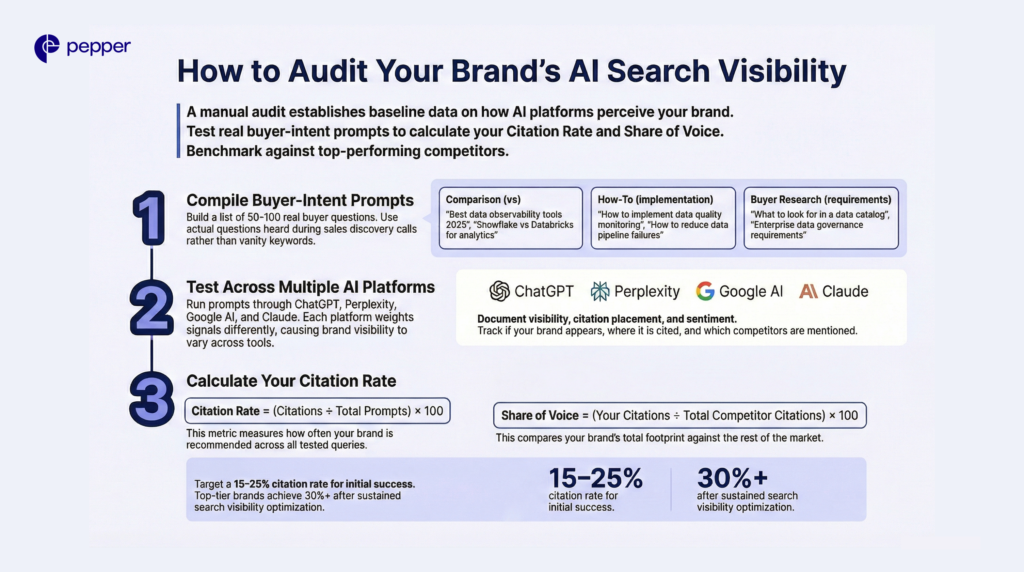
Step 1: Compile Buyer-Intent Prompts
Create a list of 50-100 questions prospects might ask AI tools about your category. Focus on three prompt types:
- Comparison prompts: “Best data observability tools 2025,” “Snowflake vs Databricks for analytics”
- How-to prompts: “How to implement data quality monitoring,” “How to reduce data pipeline failures”
- Buyer research prompts: “What should I look for in a data catalog,” “Enterprise data governance requirements”
Avoid vanity prompts that don’t reflect real buyer behavior. Focus on questions your sales team actually hears during discovery calls.
Step 2: Test Across Multiple AI Platforms
Run each prompt through ChatGPT, Perplexity, Google AI Overviews, and Claude. For each response, document:
- Whether your brand appears at all
- Citation placement (first mention vs buried in list)
- Context and sentiment of the mention
- Which competitors appear instead
This matters because AI platforms pull from different sources and weight signals differently. Your brand might appear in Perplexity but be invisible in ChatGPT for the same query.
Step 3: Calculate Your Citation Rate
After testing, calculate two baseline metrics:
- Citation Rate = (Prompts where you’re cited ÷ Total prompts tested) × 100
- Share of Voice = (Your citations ÷ Total competitor citations across all prompts) × 100
Aim for a 15-25% citation rate on core category queries as an initial target. Top brands in competitive categories often achieve 30%+ after sustained optimization.
| ✓ AI Visibility Audit Checklist – Compile 50-100 buyer-intent prompts across comparison, how-to, and research categories – Test all prompts across ChatGPT, Perplexity, Google AI Overviews, and Claude – Document brand mentions, placement, sentiment, and competitor presence for each – Calculate citation rate and share of voice baselines – Identify the top 10 high-intent queries where competitors appear, but you don’t |
Tools like Atlas automate tracking across LLM platforms, monitoring category prompts daily, and measuring share-of-voice against competitors. This transforms AI visibility froma periodic audit toa continuous measurement.
What Drives Brand Visibility in AI Answers?
Understanding why certain brands get cited helps you prioritize optimization efforts.
Entity Recognition Matters More Than Keywords
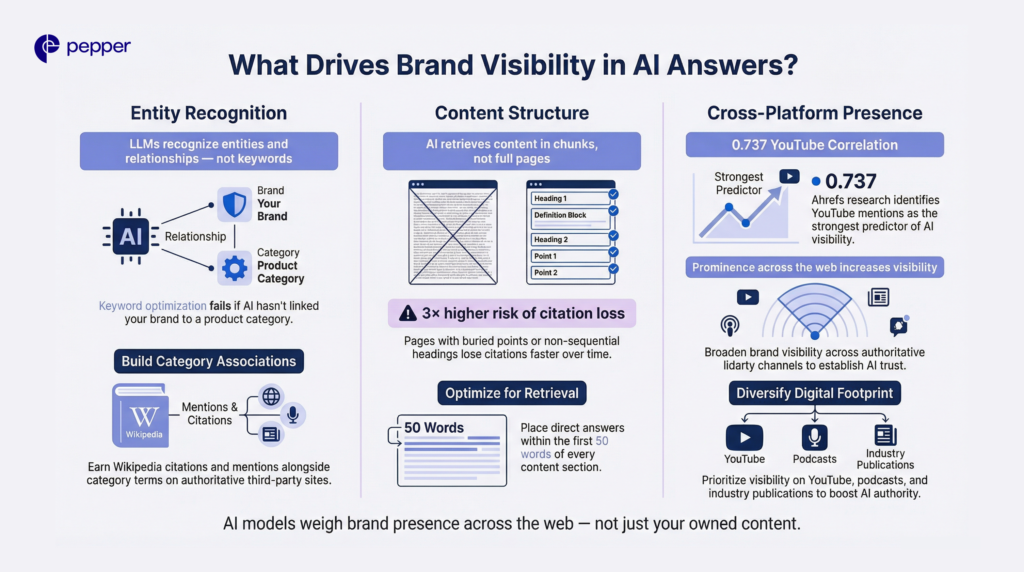
LLMs don’t match keywords—they recognize entities and their relationships. If AI models haven’t associated your brand with your product category, strong keyword optimization won’t help.
Build entity associations by:
- Getting mentioned alongside category terms on authoritative third-party sites
- Earning Wikipedia references or citations
- Creating content that explicitly connects your brand to category concepts
Content Structure Affects Retrieval
AI platforms retrieve content in chunks, not full pages. Content structured with clear headings, direct answers in the first 50 words of each section, and explicit definitions gets cited more often.
Pages without sequential headings or with buried key points are 3× more likely to lose citations over time, even when content remains accurate.
Brand Mentions Across Platforms Correlate With Visibility
Ahrefs’ research found YouTube mentions show the strongest correlation with AI visibility (~0.737), outperforming every other factor, including backlinks and domain authority.
Brands visible across YouTube, podcasts, and industry publications appear more frequently in AI answers. This suggests AI models weigh brand prominence across the web, not just your owned content.
| Remember: AI citation depends on entity recognition, content structure, and cross-platform brand presence. Traditional ranking factors like backlinks show weak correlation with AI visibility. |
Common AI Visibility Problems and How to Fix Them
Your audit will likely reveal one of four common patterns. Each requires a different fix.
Problem 1: Brand Not Mentioned at All
Symptom: AI tools recommend competitors but never mention your brand, even for queries where you have strong Google rankings.
Likely Cause: Weak entity associations. AI models haven’t connected your brand to your product category.
Fix: Earn mentions on authoritative third-party sites that already rank well for your category. Target industry publications, comparison sites, and analyst reports that AI models trust as sources.
Problem 2: Mentioned But With Wrong Context
Symptom: Your brand appears but is associated with outdated products, wrong use cases, or competitors’ categories.
Likely Cause: Stale or conflicting information across the web. AI models synthesize information from multiple sources, and outdated content confuses the picture.
Fix: Audit all brand mentions across the web. Update owned content, request corrections on third-party sites, and publish fresh content that reinforces accurate positioning.
Problem 3: Mentioned But Never Cited
Symptom: AI tools describe your brand but don’t link to your content as a source.
Likely Cause: Content structure issues. Your pages may contain relevant information, but lack the clear, retrievable structure LLMs need.
Fix: Restructure key pages with direct answers in opening paragraphs, clear H2/H3 hierarchy, and explicit definitions that can be extracted as standalone facts.
Problem 4: Inconsistent Visibility Across Platforms
Symptom: You appear in Perplexity but not ChatGPT, or in Google AI Overviews but not Claude.
Likely Cause: Different AI platforms weigh different signals. Perplexity emphasizes recent web content; ChatGPT relies more on training data; Google AI Overviews favor sites performing well in traditional search.
Fix: Diversify your optimization. Don’t over-index on one platform. Ensure your content is structured for retrieval across all major LLMs.
| Problem | Root Cause | Priority Fix |
|---|---|---|
| Not mentioned | Weak entity associations | Third-party mentions on authoritative sites |
| Wrong context | Outdated/conflicting info | Content audit and corrections |
| Mentioned but not cited | Poor content structure | Restructure for LLM retrieval |
| Inconsistent across platforms | Platform-specific signals | Diversified optimization approach |

Don’t Let AI Make You Invisible
The window to establish AI visibility is narrowing. Brands that appear in AI answers now are building “citation authority” that compounds with every model update. Those who wait will find competitors entrenched in the training data, making them significantly harder to displace.
Stop flying blind.
Pepper’s Atlas turns AI visibility from a guessing game into a measurable growth engine. By automating cross-platform monitoring and pinpointing exactly why competitors are winning citations, Atlas gives you the intelligence to take back your Share of Voice.
Ready to see where you stand? Book a demo now!
Frequently Asked Questions
What is AI search and why does it matter for my brand’s visibility?
AI search refers to platforms like ChatGPT, Perplexity, and Google AI Overviews that generate direct answers instead of link lists. It matters because buyers increasingly get recommendations from these tools without clicking to your website—if you’re not cited, you’re invisible during critical research moments.
How can AI SEO help improve my brand’s online visibility?
AI SEO (often called GEO or Generative Engine Optimization) focuses on optimizing content for LLM retrieval and citation rather than traditional rankings. This includes structuring content for chunk-based retrieval, building entity associations, and earning mentions on authoritative sources that AI models trust.
What are the best AI search engines for my brand to target?
Prioritize ChatGPT (largest user base), Google AI Overviews (integrated into traditional search), and Perplexity (growing B2B adoption). Claude is increasingly relevant for technical audiences. Test all four during your visibility audit to understand where your brand appears and where gaps exist.
How do AI answers impact my brand’s visibility in search results?
AI answers often appear above traditional search results, capturing user attention before organic listings. When AI Overviews appear, organic click-through rates drop significantly—studies show 34-61% CTR declines depending on query type. Brands not cited in AI answers lose visibility even with strong rankings.
How does AI content affect my brand’s ranking in AI search results?
Content structure matters more than length for AI citation. Pages with clear headings, direct answers in opening paragraphs, and explicit definitions get cited more frequently. Content not updated regularly loses citation authority over time, even when information remains technically accurate.
Latest Blogs
This blog focuses on 12 of India’s top content writing services.
According to the Content Marketing Institute, one of the most effective ways to promote a business is via good content. At least half of all marketers either are or are planning to use content to reach their customers.
Get your hands on the latest news!