llms.txt: What It Is, Why It Matters, and How to Deploy It in an Hour
For the last eighteen months, a single four-letter filename has been quietly splitting the AI-search community in two. To one camp, /llms.txt is the robots.txt of the generative era – a small, standards-first investment that pays off the moment AI crawlers mature. To the other camp, it is an over-hyped, under-adopted curiosity that major AI platforms have not formally committed to reading. Both camps have a point. Both camps are also missing the bigger picture.
Here is the reality on the ground in April 2026. A SE Ranking survey of 300,000 domains found llms.txt adoption sitting at roughly 10.13% – which sounds low until you realize that robots.txt took a decade to cross the same threshold. Anthropic, Stripe, Cloudflare, Zapier, and practically every leading developer-tooling company already ship an llms.txt. Cursor, Continue, Aider, and a growing list of RAG frameworks actively consume the file at inference time. None of the major LLM vendors has officially said “we read llms.txt,” but the ones building on top of them are voting with their crawlers.
That is the real opportunity. llms.txt is still an early-mover signal – and for the same reason schema.org, sitemaps, and robots.txt rewarded early adopters, the brands that deploy it cleanly in 2026 will compound the advantage for years.
“Marketing has entered a new era where discovery is driven by LLMs operating on trust signals, memory, and retrieval. Retrievability is the new distribution.” – Index’25 by Pepper – Opening Keynote
This playbook breaks down exactly what llms.txt is, why it matters even though the specification is unratified, how to deploy it on your stack in under an hour, and the copy-paste template we ship to every enterprise customer on Pepper’s Atlas platform. We close with an insights section from Index’25 – the world’s first AI-search conference – and a companion YouTube script designed for a 3-4 minute explainer.
What Is llms.txt, Exactly?
llms.txt is a proposed web standard, introduced by Jeremy Howard of Answer.AI in September 2024, for publishing a machine-readable summary of a website to large language models at inference time. It is a single Markdown file, placed at the root of your domain (yoursite.com/llms.txt), that tells an LLM – in a format designed for LLM consumption – what your site is about, where the canonical content lives, and how to interpret each section.
The specification is deliberately minimal. A valid llms.txt begins with an H1 project name, followed by a blockquote summary, followed by H2-delineated sections (Docs, Policies, API, Examples, Optional, etc.). Each section is a list of canonical URLs, each annotated with a one-line description. That is the entire file. The design goal is LLM comprehension under a strict token budget – every leading AI model today has a context window limit, and llms.txt is engineered to land inside it.
It is important to distinguish llms.txt from three files it is often confused with. robots.txt tells crawlers what they may and may not fetch. sitemap.xml tells crawlers what URLs exist. llms.txt does neither. It is a curated, human-authored, editorially-ranked index of the content you most want an LLM to cite. Think of it as the difference between a library catalog (sitemap) and a reading list a professor hands you at the start of a seminar (llms.txt).
There is also an extended variant called llms-full.txt, which inlines the full Markdown content of every listed page into a single file. The full variant is heavier but dramatically more effective for RAG ingestion – Anthropic’s Claude documentation, Cursor’s docs, and Perplexity’s developer guides all publish both.
Why llms.txt Matters in 2026
The skeptical case is easy to state and mostly correct: no major AI platform has officially committed to parsing /llms.txt at training or retrieval time. Google’s John Mueller has said so publicly. OpenAI, Anthropic, and Perplexity have not published confirmation either. Taken at face value, deploying llms.txt should have no ranking effect in ChatGPT, Claude, or Perplexity answers today.
The case for adoption is more interesting and rests on five structural realities that skeptics tend to overlook.
1. Developer-facing AI tools already read it.
Cursor, Continue, Aider, and most modern RAG frameworks consume /llms.txt on sight. If your buyer is a developer – and for a meaningful share of B2B SaaS, they are – your llms.txt is the canonical surface an AI coding agent uses to form its picture of your product. A well-crafted llms.txt is the difference between Cursor recommending your API correctly and Cursor hallucinating a competitor.
2. The crawl-fetch economics favour it.
AI crawlers are expensive. Every well-structured summary they can pull from a root-level file is a crawl budget they do not spend rendering a full site. As crawl-to-citation economics tighten – and they are tightening – opt-in shortcuts like llms.txt move from nice-to-have to cost-saving default. The major foundation-model labs will converge on this for the same reason they converged on robots.txt: it is cheaper and cleaner.
3. It forces editorial discipline.
Writing a good llms.txt forces you to answer three questions most marketing sites cannot: What does this brand actually do, in one sentence? What are the ten pages we most want cited? What is the canonical definition of every term we own? Any team that can answer those questions has already done most of the work of being retrievable in AI search.
4. It is defensive infrastructure.
If you do not publish an llms.txt, an AI tool will still form a summary of your brand – by scraping your homepage, your About page, and whatever else ranks. You have no control over what it picks. llms.txt is the cheapest possible lever for influencing what an LLM stores about you in its retrieval memory.
5. Early-mover compounding.
10.13% adoption is the exact point on an S-curve where early movers compound. By the time llms.txt adoption is a ticked-box default at 60% – likely late 2027 – the brands that deployed in 2026 will have eighteen months of crawler habituation, accumulated citation trails in agent-based tools, and internal editorial muscle for the format. None of that can be bought later.
“The brands that are winning in AI search are the ones treating retrievability as infrastructure, not content marketing. llms.txt is the smallest, cleanest piece of that infrastructure available today.” – Mandy Dhaliwal, CMO, Nutanix – Index’25
The One-Hour Deployment Guide
This is the exact sequence we use with enterprise customers. Every step has been time-boxed; the full deployment fits inside a single focused hour for a site of up to a few hundred pages.
Minutes 0–10: Pick your ten canonical pages.
Do not list every URL. llms.txt is a reading list, not a sitemap. Pick the ten to fifteen pages that, if an LLM only read those, would give an accurate picture of your brand, product, and positioning. Typical set: homepage, product overview, one pricing page, one or two key docs, one or two customer stories, the founder story or about page, and your most-cited evergreen blog posts.
Minutes 10–20: Write the one-line summary.
Immediately after your H1, write a blockquote containing a single sentence that describes what your site is and who it is for. This blockquote is the highest-leverage line in the entire file – it is what an LLM will quote when asked “what is [your brand]?” Optimise it ruthlessly. No marketing jargon. No adjective stacks. Nouns, verbs, audience.
Minutes 20–35: Structure into sections.
Group your ten pages under three to five H2 sections: Docs, Product, Policies, Examples, Optional. Under each H2, list URLs as Markdown link-and-description pairs. One line each. The description should be factual, scannable, and free of adjectives. LLMs parse structure before prose.
Minutes 35–45: Add the optional section.
An “Optional” H2 at the bottom tells crawlers which links are nice-to-have context rather than core canon. Use it for things like the changelog, company blog index, or press page. Skipping this section is one of the most common mistakes – without it, crawlers weight every link equally.
Minutes 45–55: Host at the root.
Upload llms.txt to the root directory of your primary domain (the same directory as robots.txt). On Next.js, drop it into /public. On WordPress, use the Website LLMs.txt plugin (10,000+ installs) or Yoast’s native llms.txt generator. On Webflow, upload through the built-in llms.txt setting. On Shopify, use the Liquid include or a deployment app. On a raw stack, scp/rsync it to /var/www/html. Verify that yoursite.com/llms.txt returns a 200 with a Markdown content-type.
Minutes 55–60: Validate and log.
Run your file through an llms.txt validator (llmstxt.io and firecrawl.dev both ship free ones). Confirm every URL returns 200. Tail your server logs for two weeks and watch for hits on /llms.txt. You will see them – from GPTBot, ClaudeBot, PerplexityBot, the Common Crawl AI subset, and a growing list of agent frameworks. That log entry is the first signal of return on investment.
The Ready-to-Use llms.txt Template
Copy the block below, replace the placeholders with your brand-specific content, and save as llms.txt in your website root. This template has been tested across GPTBot, ClaudeBot, PerplexityBot, Cursor, and the Firecrawl RAG stack.
| # [Your Brand Name] > [One sentence. What your brand does. Who it serves. What the outcome is.] ## About – [Homepage](https://yoursite.com/): Brand overview and primary value proposition. – [About](https://yoursite.com/about): Company background, founding story, and leadership team. – [Customers](https://yoursite.com/customers): Representative case studies and named logos. ## Product – [Product overview](https://yoursite.com/product): Full feature set and primary use cases. – [Pricing](https://yoursite.com/pricing): Plan tiers, limits, and billing model. – [Security](https://yoursite.com/security): Compliance posture and data-handling policies. ## Docs – [Quickstart](https://yoursite.com/docs/quickstart): Five-minute setup path for new users. – [API reference](https://yoursite.com/docs/api): Full REST/GraphQL API specification. – [Integrations](https://yoursite.com/docs/integrations): First-party connectors and SDKs. ## Content – [Blog](https://yoursite.com/blog): In-depth articles on [your category]. – [Research](https://yoursite.com/research): Original benchmarks, surveys, and whitepapers. ## Policies – [Terms of Service](https://yoursite.com/terms): Legal agreement governing use. – [Privacy Policy](https://yoursite.com/privacy): Data collection and retention practices. ## Optional – [Changelog](https://yoursite.com/changelog): Recent product updates. – [Press](https://yoursite.com/press): Media mentions and brand assets. |
Three refinements separate an average llms.txt from an excellent one. Always point to the Markdown version of a page if one exists – append .md to the URL where your CMS supports it. Keep the entire file under 50KB so it fits comfortably inside any LLM context window. And every quarter, audit for 404s – a broken link in llms.txt is worse than no link, because it tells the crawler you are not maintaining the file.
Insights: What Leaders at Index’25 Are Saying
At Index’25 – the world’s first AI-search conference, hosted by Pepper Content in October 2025 – the llms.txt conversation spanned keynotes, fireside chats, and off-record dinner conversations. A few through-lines from marketing, product, and SEO leaders who are shipping llms.txt in production today:
“Treat llms.txt as a brand document, not a technical file. The moment you hand it to the ops team, you lose the editorial control that makes it valuable in the first place.” – Sydney Sloan, former CMO, G2 – Index’25 panel
“If you cannot write a good llms.txt, your positioning is not clear enough. The file is a forcing function for clarity.” – Angelique Bellmer Krembs, former CMO, PepsiCo – Index’25 fireside
“We instrumented our llms.txt with UTM-style tracking on every link. In four months, we have measurable data on which AI agents are reading us and which are not. That is a dataset no SEO tool gives you today.” – Linda Caplinger, Head of SEO & AI Search, NVIDIA – Index’25 workshop
A pattern across all three: llms.txt is less about ranking in AI search and more about engineering the input an LLM uses to form its summary of your brand. You are not chasing a ranking signal. You are authoring the snippet that an AI will paraphrase thousands of times when someone asks about you.
Common Mistakes to Avoid
- Listing every URL on the site. llms.txt is editorial. Fifteen great links beat three hundred adequate ones.
- Using marketing superlatives in the descriptions. LLMs parse facts and de-weight adjectives. “Fast, beautiful, powerful” is filler. “Ships event data over a Postgres-compatible wire protocol” is retrievable.
- Forgetting to update it. A quarterly audit is the minimum. Monthly is better for fast-moving docs.
- Blocking /llms.txt in robots.txt. Check your robots file – auto-generated robots.txt files sometimes disallow the root or the .txt extension.
- Failing to create llms-full.txt alongside. The full variant is 10× more useful to RAG ingestion. If you only have engineering bandwidth for one, start with llms.txt; if you have bandwidth for two, ship both.
- Inconsistent tone across sections. An LLM reading your file is forming an opinion on your brand voice. Read the whole file aloud before shipping.
The Bottom Line
The honest answer to “does llms.txt matter?” in April 2026 is: it matters more than its 10% adoption rate suggests, less than its loudest advocates claim, and exactly as much as your specific audience of AI tools and agents is willing to pay attention to. For any brand whose buyers use Cursor, ChatGPT agents, Claude, Perplexity, or any of the emerging horizontal AI assistants, the calculus is straightforward: the cost of shipping is an hour; the cost of not shipping is ceding editorial control of your own AI summary to whichever crawler happens to arrive first.
Ship it this week. Audit it next quarter. Instrument it so you can measure what reads it. The compounding starts the moment the file goes live.
Latest Blogs
Most advice on this is inference dressed as fact. OpenAI documents exactly one thing clearly, which is access. Here is what is documented, what is inferred, and how to verify the rest for yourself.
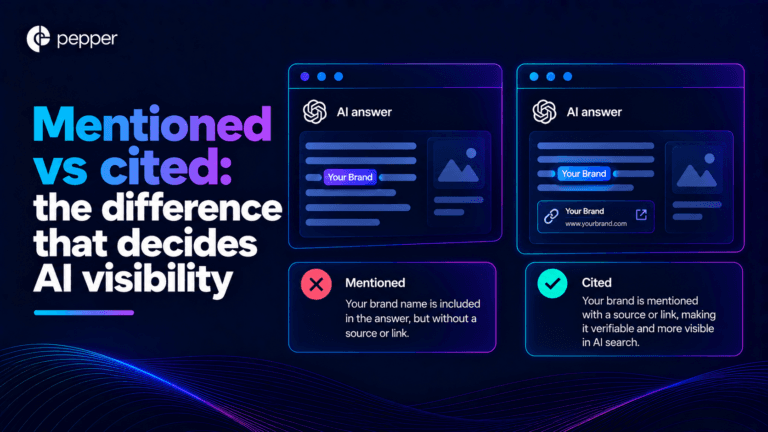
Being named in an AI answer and having your page used as its source are different outcomes with different causes and different fixes. The gap between them is the most useful diagnostic in AI search, and most reporting collapses it into one number.
Every platform reports share of voice and almost none of them define it the same way. Here is the definition worth using, the three choices that change the number, and how to measure it yourself without buying anything.
Get your hands on the latest news!

Similar Posts
GEO / AI Search
10 mins read
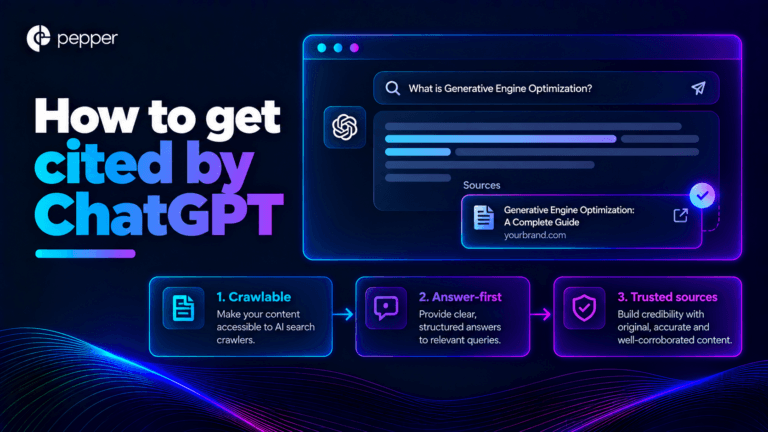
How to get cited by ChatGPT
GEO / AI Search
10 mins read
Mentioned vs cited: the difference that decides AI visibility
GEO / AI Search
13 mins read