How to Optimize for Topical Authority in AI Search
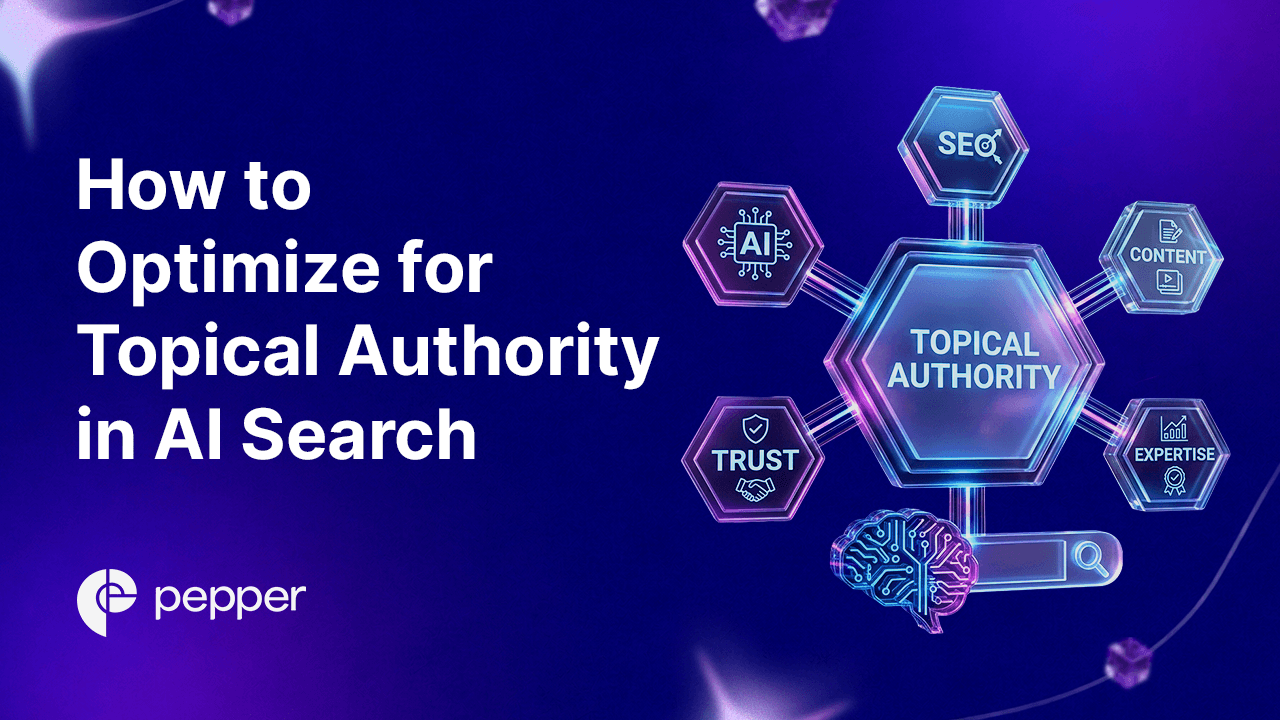
Topical authority used to be an SEO concept. In 2026, it has become the single most decisive variable in AI search – and the most under-instrumented one inside marketing organisations. LLMs do not rank pages the way Google’s classical algorithm did. They reason about domains. They assign expertise scores based on how thoroughly a site covers a topic, how interlinked its content is, how consistent its entity vocabulary is, and how many adjacent sub-queries it can answer well. A site with one strong page and nothing around it cites at the median; a site with a hub-and-spoke cluster on the same topic cites at 4–6× the rate.
The architecture that produces that lift is well-understood but rarely built systematically. Most marketing teams ship content as a stream of independent articles. The brands compounding in AI search are shipping content as themed clusters – ten themes per year, one pillar page per theme, six-to-twelve supporting spokes per pillar – and the cluster discipline is what the AI engines are weighting when they decide which domains to treat as authoritative.
This piece is the working playbook. How LLMs actually assign topical authority. The hub-and-spoke architecture that produces it. How to size and sequence the content programme across a year. The anatomy of a pillar page and a spoke article. And a content planning template you can lift directly into the next quarterly content calendar.
“Search is undergoing the most profound transformation of our time. Generative AI is redefining how people discover, trust, and engage with information – moving us from keywords and rankings to intelligence and context at scale.” – Anirudh Singla, Co-founder & CEO, Pepper Content (Index’25 keynote)
Topical authority is where that intelligence and context get rewarded. The brands building clusters are the brands AI engines treat as the experts.
How LLMs Actually Assign Topical Authority
Classical SEO measured topical authority loosely – through site-wide signals, internal-link patterns, and how often a domain appeared on Google for a given topic cluster. LLMs measure it sharply, and they measure it differently. Three mechanics matter most.
Cluster density. AI engines reason about how many distinct, well-structured pages on a domain cover a given topic. A site with a head-term page plus eight long-tail variants, all interlinked, is read by the model as authoritative on the topic. A site with one head-term page and nothing adjacent is read as a passing reference. Cluster density is the single biggest weight.
Fan-out coverage. Google AI Mode runs five-to-sixteen sub-queries per user prompt. ChatGPT runs two-to-three. Each engine retrieves and synthesises across the fan-out. A brand whose cluster covers 8–12 of the model’s likely sub-queries gets cited across multiple positions in the answer. A brand that covers two of them gets cited in one position, alongside competitors covering the other ten.
Entity-consistency density. AI engines weight whether a domain uses the same vocabulary across its cluster – same product names, same concept definitions, same author names linked consistently. Inconsistent vocabulary fragments the model’s understanding of the brand entity, and retrieval confidence drops. The canonical-glossary discipline matters as much for topical authority as it does for finserv compliance.
The implication is direct. Topical authority is not an attribute of a single page. It is an attribute of an interconnected cluster of pages, evaluated as a system. The unit of optimisation has moved from the URL to the cluster.
“Enterprise marketing is being re-architected around retrievability, not production volume. On topical authority specifically, that re-architecture is the move from a content calendar to a cluster plan.” – Mandy Dhaliwal, CMO, Nutanix (Index’25)
The Hub-and-Spoke Architecture
Hub-and-spoke is the content architecture that produces the cluster density LLMs reward. It has been the working model for SEO topical authority for half a decade. In AI search, the same architecture compounds at multiples of the rate. The shape is simple.
Hub (also called the pillar page). A long-form, comprehensive resource on a head-term topic. Typically 2,500–4,000 words. Self-contained, answer-shaped, schema-marked. Functions as the canonical source on the brand’s domain for that topic and as the anchor every spoke article links back to.
Spokes (also called supporting articles). Six-to-twelve focused articles, each addressing a specific sub-query under the head term. Typically 1,200–1,800 words each. Each spoke links upward to the pillar and laterally to two or three sibling spokes. The interlink structure is what tells AI engines the cluster is a single editorial system.
The discipline is in the connections. A pillar page with nine spokes that link only to the pillar is not a cluster – it is nine articles around a hub. A pillar with nine spokes that interlink with each other, repeatedly, using consistent anchor text and entity vocabulary, is the architecture LLMs read as authoritative. Cluster density is the metric. Interlink discipline is how it gets built.
Sizing the Architecture: Ten Themes Per Year
The working cadence that produces compounding topical authority across a full marketing function is ten themes per year, one pillar page per theme, six-to-twelve spokes per pillar. The math: 10 pillars × ~9 spokes = ~100 cluster articles per year, on top of the existing content surface. That is a content programme a marketing team of 3–10 people can ship without burning out, and it is the band where the citation lift compounds most sharply.
Theme selection matters more than total volume. Pick the ten that meet three tests. First, the theme is one your buyers prompt AI engines about – established by the audit prompt universe. Second, your brand has a credible position to take – original data, named-expert authorship, or product-led perspective the AI engines can attribute to you. Third, the theme has fan-out depth – at least 6–12 sub-queries to anchor as individual spokes. Themes that fail any of these three tests get cut from the year’s plan.
The ten themes do not all ship simultaneously. The shape that works is quarterly cohorts of 2–3 themes each. Each theme’s cluster ships across one quarter – pillar in weeks 1–3, spokes in weeks 3–12 – with the next cohort starting on the next quarterly boundary.
Pillar Page and Spoke Article Anatomy
Pillar pages and spoke articles do different jobs and need different structural treatment. Building them to the same template is the most common failure mode in cluster construction.
| Element | Pillar (hub) page | Spoke article |
| Target prompt | Head-term “what is [topic]” or “the complete guide to [topic].” | Specific sub-query (“how to do X”, “X vs Y”, “best X for [use case]”). |
| Word count | 2,500–4,000 words. | 1,200–1,800 words. |
| Schema | Article + FAQPage + Person + Organization + table of contents. | Article + FAQPage or HowTo + Person. |
| Opener | 50–70-word self-contained definition. | 50–70-word answer to the specific sub-query. |
| Internal links | Out to every spoke, with descriptive anchor text. | Up to the pillar; lateral to 2–3 sibling spokes. |
| Refresh cadence | Quarterly. | Twice a year, or on new data/regulatory change. |
| Companion media | Embedded YouTube explainer + downloadable template. | Optional companion video on technical or how-to spokes. |
The pillar is the canonical source. It is comprehensive, structured for table-of-contents navigation, and answer-ready at every section heading. The spokes are tactical – each one designed to win citation on a specific sub-query and to feed traffic back upward to the pillar through the interlink. Both ship with named expert authorship, full schema, and original data where the topic warrants.
“AI discovery rewards content that proves it has been lived. First-hand experience, original photography, real deployment data – and a verified human attached to all of it.” – Linda Caplinger, Head of SEO & AI Search, NVIDIA (Index’25)
The Content Planning Template
The template below is the working calendar shape we ship with every Pepper enterprise customer running the cluster programme. Ten themes, four quarterly cohorts, with the year sized for production realism rather than aspirational maximums.
| Quarter | Themes (2–3 per quarter) | Pillar shipped | Spokes shipped (6–12 per theme) |
| Q1 | Theme 1 + Theme 2 + Theme 3. | 3 pillars (one per theme, weeks 1–3). | ~24 spokes total across the three themes (weeks 3–12). |
| Q2 | Theme 4 + Theme 5 + Theme 6. | 3 pillars (weeks 14–16). | ~24 spokes (weeks 16–24). |
| Q3 | Theme 7 + Theme 8. | 2 pillars (weeks 27–29). | ~16 spokes (weeks 29-37). Lighter quarter – re-audit and refresh Q1–Q2 clusters. |
| Q4 | Theme 9 + Theme 10. | 2 pillars (weeks 40–42). | ~16 spokes (weeks 42-50). Year-end refresh of all 10 clusters in week 51. |
Two operational details make the calendar work. First, the pillar always ships first in the cohort – spokes that publish before their pillar have no anchor to interlink to. Second, every spoke published in weeks 3–12 of the cohort links upward to the pillar from launch, and the pillar gets a corresponding link out to each spoke as the spoke goes live. The interlink density compounds across the quarter, not in a single big-bang launch.
→ Atlas: Atlas auto-generates the cluster brief for each of the ten themes – pillar outline, spoke list, fan-out coverage map, prioritised by estimated citation lift per theme. The editorial team approves the briefs; production runs against a defensible cluster plan rather than a freewheeling content calendar.
Insights: What Marketing Leaders Are Saying About Topical Authority
The Index’25 panel on content architecture for AI search produced unusually direct lines from the field.
“We measured by hand for six months before we bought anything. The cluster discipline was what showed up in the data first – pages without adjacent supporting articles got cited at the median; clustered pages got cited at four times the rate.” – Sydney Sloan, former CMO, G2 (Index’25)
“In a world where AI summarizes everything, the brands that get summarized favourably are the ones with the clearest positioning and the most distinctive voice. A cluster is positioning made structural.” – Angelique Bellmer Krembs, former CMO, PepsiCo (Index’25)
“AI search collapses the distance between brand and demand. The cluster is how a brand stays present across the buyer’s entire research arc – not just the first prompt.” – Joyce Hwang, Head of Marketing, Dropbox (Index’25)
“Be the source worth citing. The cluster is what the AI engines read when they decide which domains are worth quoting on a topic, repeatedly.” – Neil Patel (Index’25 keynote)
“Once in a generation, technology doesn’t just improve – it changes the way we see the world. The unit of optimisation has moved from the URL to the cluster.” – Kishan Panpalia, Pepper Content (Index’25)
The Quiet Truth About Topical Authority in AI Search
AI engines do not cite pages. They cite domains they trust on a topic – and the trust is built cluster by cluster, not article by article. The brands compounding in AI search in 2026 are the ones who recognised this early and rebuilt their content programmes around themed clusters instead of standalone articles. Ten themes per year. One pillar per theme. Six-to-twelve spokes. Interlinked. Schema-marked. Named-expert-authored. Refreshed quarterly.
The architecture is not new. The discipline of running it across a full year, at the cadence above, against a measured citation baseline, is. Atlas exists to make the measurement layer cheap; the cluster discipline is what produces the lift the dashboard then surfaces.
→ Atlas: Run the cluster audit on your domain inside Atlas – theme prioritisation, cluster density scoring, pillar-and-spoke gap analysis, and the auto-generated brief for the next quarter’s themes. Start at atlas.peppercontent.io.
Frequently Asked Questions
Why ten themes per year specifically? Quarterly cadence with 2–3 themes per cohort is what a team of 3–10 can ship sustainably while still leaving room for refreshes, original-data programmes, and one-off opportunistic content. Below five themes a year, the cluster signal is too sparse; above twelve, production quality drops.
Can spokes share schema with the pillar? They should share Author/Person/Organization schema for entity consistency. The Article and FAQPage schema instances are unique per page, with the spoke’s schema referencing its own URL.
How long until cluster effects show up in citations? First citation lift on cluster pages appears 30–60 days after the spoke cohort ships. Full compounding lands 4–6 months into the programme as AI engines re-index and weight the cluster.
Should pillar pages be gated? No. Pillars are citation surfaces – they need to be fully crawlable, ungated, schema-marked. Gate the downloadable template companion if conversion is the goal.
What if a theme runs out of sub-queries after six spokes? Cap the cluster at six and reallocate the production budget to an eleventh theme or to refresh work on Q1 clusters. Forcing low-quality spokes onto a thin theme degrades the cluster signal.
Latest Blogs
Most advice on this is inference dressed as fact. OpenAI documents exactly one thing clearly, which is access. Here is what is documented, what is inferred, and how to verify the rest for yourself.
Being named in an AI answer and having your page used as its source are different outcomes with different causes and different fixes. The gap between them is the most useful diagnostic in AI search, and most reporting collapses it into one number.
Every platform reports share of voice and almost none of them define it the same way. Here is the definition worth using, the three choices that change the number, and how to measure it yourself without buying anything.
Get your hands on the latest news!

Similar Posts
GEO / AI Search
10 mins read
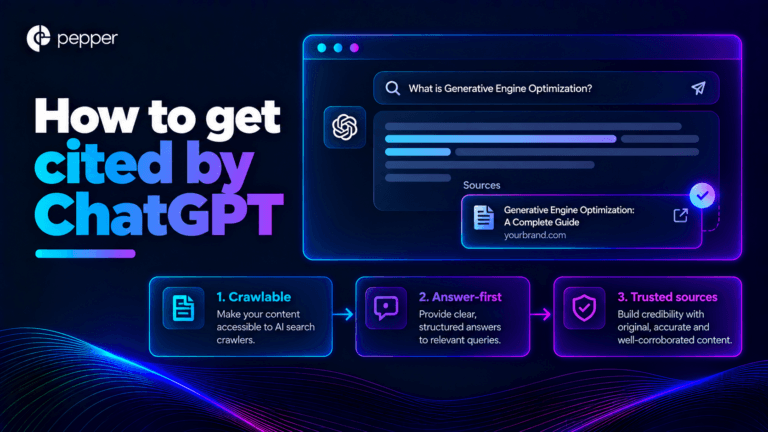
How to get cited by ChatGPT
GEO / AI Search
10 mins read
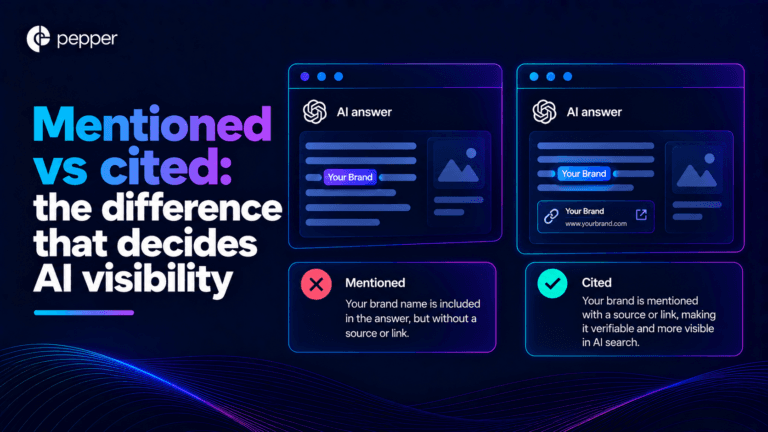
Mentioned vs cited: the difference that decides AI visibility
GEO / AI Search
13 mins read