What is Chunking? Breaking Big Documents into Little Pieces
Remember trying to eat a giant sandwich in one bite? Impossible, right? That’s exactly why AI systems use chunking. When you feed a huge document to an AI, it needs to break it into smaller, bite-sized pieces first.
What is Chunking? (The Simple Version)
Chunking is like cutting a really long rope into smaller pieces that are easier to hold and work with. When you have a 100-page document, your AI can’t swallow it whole. So chunking splits it into manageable sections-maybe a few paragraphs each.
Think of it like breaking a chocolate bar. The whole bar is too big to enjoy at once, so you snap it into squares. Each square (or chunk) is perfect on its own, but together they make up the complete chocolate bar. That’s chunking-taking something big and making it small enough to use.
How Does Chunking Work?
Here’s the simple version: Your AI reads through a document and decides where to make cuts. Maybe it stops every 500 words. Maybe it waits until a topic changes. Either way, it creates separate pieces.
After cutting the document, each chunk gets turned into numbers (called embeddings) that capture what the chunk means. When someone asks a question, the AI searches these numbered pieces to find the most relevant chunks-kind of like fishing out the exact LEGO brick you need from a big bin.
Smart chunking systems use a trick called overlap. They keep a few sentences from the end of one chunk at the start of the next. This prevents important ideas from getting split in half, like making sure you don’t slice through the peanut butter when cutting a sandwich.
Why Does Chunking Matter?
Without chunking, your AI would be like a kid trying to find one sentence in a 300-page book-overwhelming and slow. Chunking helps the AI zoom straight to the relevant section.
It’s faster, more accurate, and saves money. Processing a 10-paragraph chunk costs way less than processing a 100-page document every single time someone asks a question. Plus, you get better answers because the AI focuses on exactly what matters.
Chunking at a Glance
| Strategy | Best For | Complexity | Context Quality | Cost |
| Fixed-size (set word count) | Quick setup, consistent results | Low | Good | Low |
| Semantic (meaning-based splits) | Preserving topic flow | Medium | Excellent | Medium |
| LLM-based (AI decides splits) | Complex documents | High | Excellent | High |
| 10-20% overlap recommended | Preventing information loss | Any | Better continuity | Slightly higher storage |
| 500-token chunks (common size) | Balanced retrieval | Low | Good for most uses | Standard |
Real-World Examples
Customer support chatbots use chunking all the time. A company might have a 200-page product manual. Instead of feeding the whole manual to the AI each time someone asks “How do I reset my password?”, chunking lets it grab just the password-reset section.
Marketing teams use chunking when analyzing competitor websites. They chunk each webpage into sections (about us, pricing, testimonials) so the AI can pull specific insights rather than generic summaries.
E-learning platforms chunk course materials into topics. When a student asks about photosynthesis, the AI retrieves just the photosynthesis chunks from the biology textbook-not the entire chapter on plant biology.
FAQs
Q1: What happens if chunks are too small?
If chunks are tiny (like one sentence each), they lose context and meaning. It’s like reading random sentences from a story-confusing. Aim for chunks with enough information to stand alone.
Q2: Can I use different chunk sizes in the same project?
Yes! Some teams use smaller chunks for dense technical content and larger chunks for narrative sections. Match the chunk size to your content type.
Q3: Does chunking work for images and videos?
Chunking is mainly for text, but similar concepts apply. Videos get split into scenes or timestamps. Images can be split into regions or analyzed in sections.
Q4: How much overlap should I use between chunks?
Industry best practice recommends 10-20% overlap. For a 500-word chunk, that means about 50-100 words repeat in the next chunk. This prevents ideas from getting cut in half.
Wrapping Up
Chunking turns massive documents into snackable pieces your AI can actually use. Whether you’re building a chatbot, analyzing content, or creating a knowledge base, good chunking makes everything work better. Start with fixed-size chunks and 15% overlap-you can always adjust from there.
Latest Blogs
The short answer LLM seeding promises something the data does not support. LLM seeding suggests you can plant content in the places models read, then get picked up. One number settles that. Roughly 99 percent of Reddit citations point to individual threads with substantive discussion, rather than to subreddits, profiles or brand-authored posts. So the […]
Anchor text is the visible, clickable words in a link. It still matters, and we should be straight about the evidence: no published study has measured its effect on AI citation directly. What exists is adjacent, and it points one way.
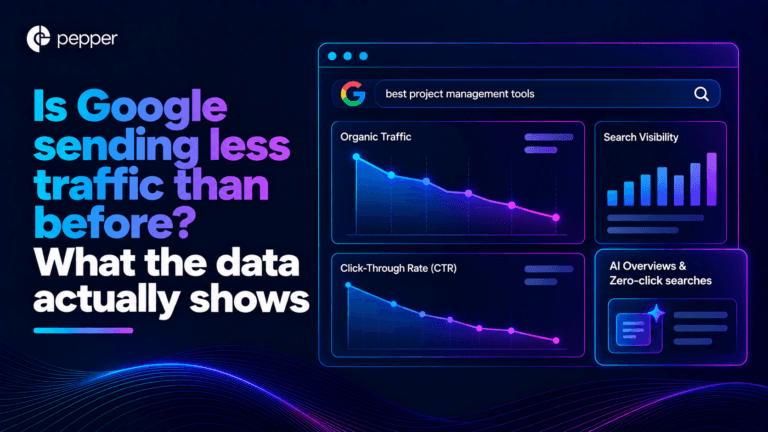
Is Google sending less traffic than before? On queries where AI features appear, yes, and a randomised experiment published in August 2026 puts the effect at 18.8 percentage points of click-through. Across a whole site the picture is much softer, because most queries do not trigger those features and impressions have grown. The traffic is also not migrating to AI engines, which still account for under 1% of referrals. This article ranks every 2026 study by how well it identifies the effect, rather than by how large its headline is.
Get your hands on the latest news!

Similar Posts
GEO / AI Search
10 mins read
LLM seeding: an AI search strategy to get mentioned and cited
Artificial Intelligence
11 mins read
What is anchor text, and does it still matter in 2026?
GEO / AI Search
15 mins read