E-E-A-T (Experience, Expertise, Authoritativeness, and Trustworthiness) is Google’s framework for evaluating content quality, used by human Search Quality Raters to assess web pages. While not a direct ranking factor, E-E-A-T signals help Google understand which content deserves visibility for queries where accuracy matters most.
Understanding E-E-A-T helps content marketing teams create material that both search engines and AI systems recognize as trustworthy and worth surfacing to users.
E-E-A-T Explained
E-E-A-T appears 186 times in Google’s 176-page Search Quality Rater Guidelines. Each letter represents a distinct quality signal:
- Experience evaluates whether content creators have first-hand involvement with the topic. Product reviews from someone who actually used the product carry more weight than theoretical assessments.
- Expertise measures the creator’s knowledge or skills. A certified financial planner writing about retirement strategies demonstrates expertise differently than a hobbyist blogger.
- Authoritativeness considers whether the creator and website are recognized sources for the topic. Industry recognition, citations from peers, and an established reputation all contribute.
- Trustworthiness is what Google calls “the most important member of the E-E-A-T family.” Google’s guidelines state that “untrustworthy pages have low E-E-A-T, no matter how Experienced, Expert, or Authoritative they may seem.”

Why E-E-A-T Matters
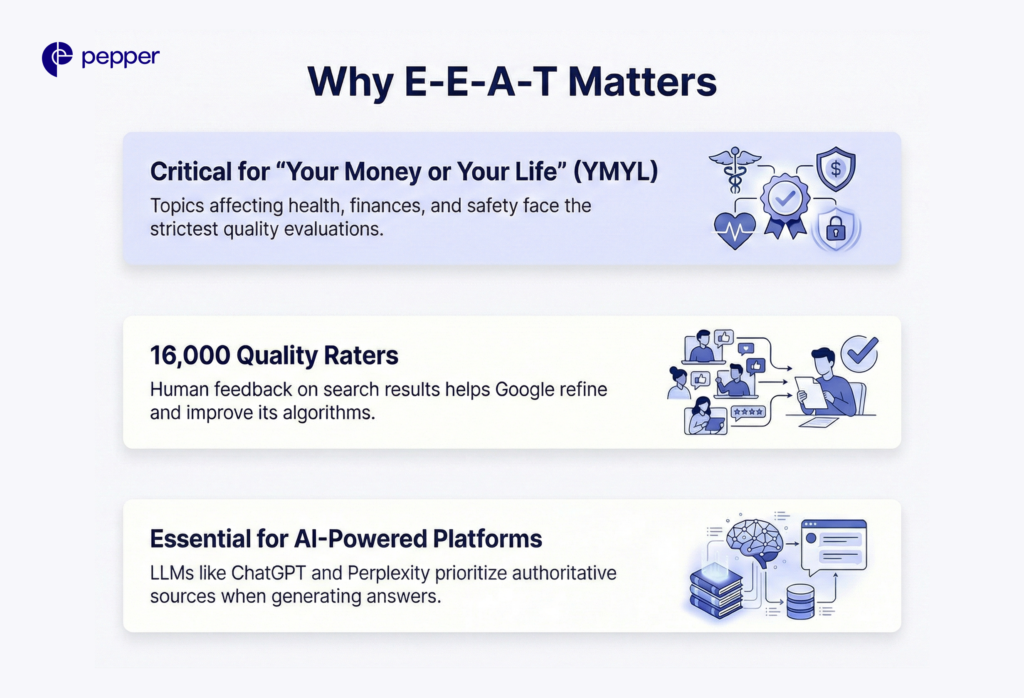
E-E-A-T carries extra weight for YMYL (Your Money or Your Life) topics—content affecting health, finances, safety, or well-being. Medical information, financial advice, and legal guidance face stricter quality evaluation.
Google’s 16,000 human Quality Raters use E-E-A-T criteria to provide feedback on search results. This feedback helps Google refine algorithms, similar to how restaurant feedback cards guide service improvements.
For marketing teams, strong E-E-A-T signals improve content performance in both traditional search and AI-powered platforms. LLMs like ChatGPT and Perplexity prioritize trustworthy, authoritative sources when generating answers.
E-E-A-T vs. E-A-T
| E-A-T (Pre-December 2022) | E-E-A-T (Current) |
|---|---|
| Expertise, Authoritativeness, Trustworthiness | Experience, Expertise, Authoritativeness, Trustworthiness |
| Focused on credentials and recognition | Added first-hand experience as a quality signal |
| Favored institutional authority | Recognizes the value of personal experience |
| Did You Know? Google added “Experience” in December 2022, acknowledging that first-hand knowledge adds credibility beyond formal expertise. |
A Reddit thread from someone who actually consolidated debt can rank alongside financial institution content because lived experience matters.

How to Demonstrate E-E-A-T
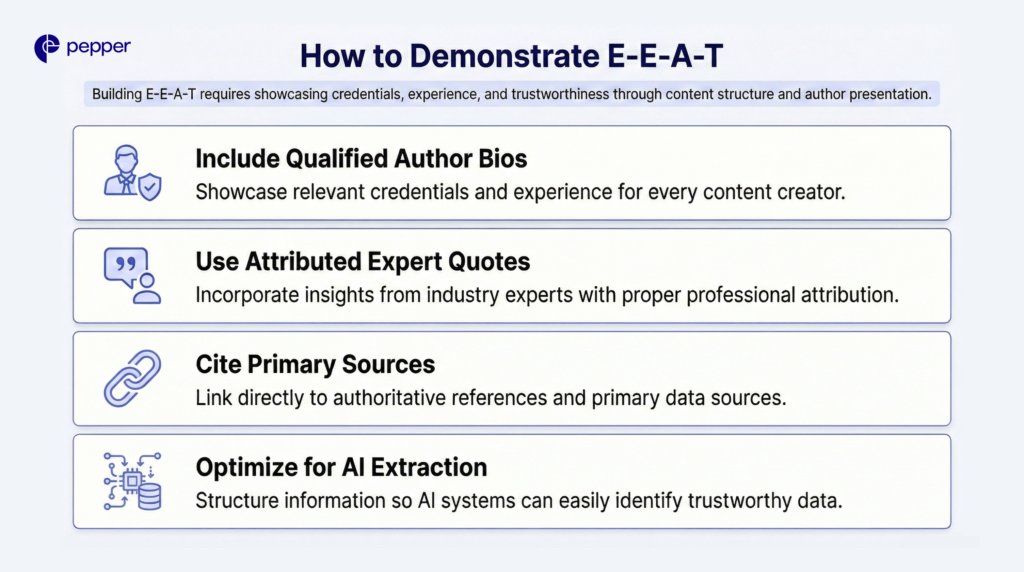
Building E-E-A-T requires showcasing credentials, experience, and trustworthiness through content structure and author presentation.
Include author bios with relevant qualifications. Add expert quotes with proper attribution. Cite primary sources and link to authoritative references. Structure content so AI systems can identify and extract trustworthy information.
| Quick Takeaway: E-E-A-T helps Google evaluate content quality through Experience, Expertise, Authoritativeness, and Trust—with Trust being foundational. Strong E-E-A-T signals improve visibility in both traditional search and AI-generated answers. |
Frequently Asked Questions
1. What does E-E-A-T stand for in SEO?
E-E-A-T stands for Experience, Expertise, Authoritativeness, and Trustworthiness. Google uses this framework to evaluate content quality through human Search Quality Raters who assess web pages.
2. Is E-E-A-T a direct Google ranking factor?
No. Google confirms E-E-A-T guidelines help Quality Raters evaluate search results, but rater data doesn’t directly influence ranking algorithms. Strong E-E-A-T signals correlate with content that performs well.
3. When did Google add Experience to E-A-T?
Google updated E-A-T to E-E-A-T in December 2022, adding “Experience” to recognize that first-hand knowledge adds credibility to content beyond formal expertise alone.
4. Why is Trustworthiness the most important E-E-A-T element?
Google’s guidelines explicitly state that untrustworthy pages have low E-E-A-T regardless of other signals. Accuracy, honesty, and reliability form the foundation for all other quality assessments.
5. Does E-E-A-T matter for AI search optimization?
Yes. LLMs prioritize trustworthy, authoritative sources when generating answers. Content demonstrating strong E-E-A-T signals is more likely to be retrieved and cited by ChatGPT, Perplexity, and AI Overviews.
Latest Blogs
This blog focuses on 12 of India’s top content writing services.
According to the Content Marketing Institute, one of the most effective ways to promote a business is via good content. At least half of all marketers either are or are planning to use content to reach their customers.
Get your hands on the latest news!

Similar Posts

Content Marketing
4 mins read
11 Best B2B Content Marketing Agencies for B2B Companies in 2024

Content Marketing
5 mins read
Top ecommerce Marketing Agencies with Proven Strategies for 2024

Content Marketing
5 mins read