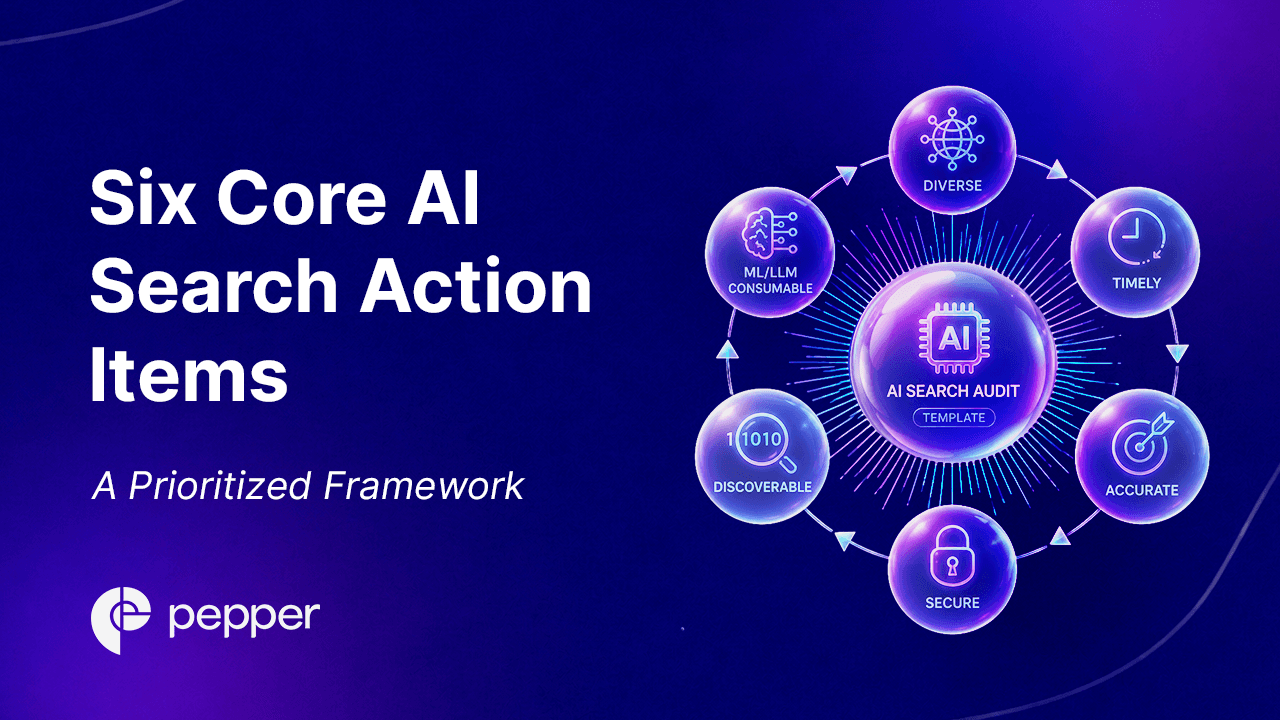
Six Core AI Search Action Items: A Prioritized Framework
By Dhriti Goyal
The question I get most often from CMOs starting an AI-search programme is the simplest one: where do I start? The audit is done. The Share of Answer baseline is set. The team is willing. Where exactly does the first sprint go – and what should it not include?
Six action items. Strictly ordered. Designed as a 90-day sprint for a marketing team of three to ten people, highest-leverage moves first. We have run this sequence with mid-market SaaS teams, Fortune 500 industrials, and category-defining FinTech challengers. The order is non-negotiable; each step compounds the next.
The promise is concrete. A team that runs the full plan in 90 days against a locked prompt universe will move Share of Answer by 4–9 percentage points in our reference dataset – the difference between sitting at the median of your vertical and entering the top quartile.
“Search is undergoing the most profound transformation of our time. Generative AI is redefining how people discover, trust, and engage with information – moving us from keywords and rankings to intelligence and context at scale.” – Anirudh Singla, Co-founder & CEO, Pepper Content (Index’25 keynote)
Six actions. Ninety days. The framework starts now.
Why Prioritization Beats Production Volume
Most AI-search programmes fail because the team tried to do everything at once. The audit produces 40 recommendations. The team runs eight in parallel. None get the resourcing they need. The dashboard moves negligibly. Confidence erodes.
Sequencing is the cheapest leverage available. Each action below builds the substrate the next one needs. Long-tail (Action 1) creates the surface area refreshes can compound. Technical hygiene (Action 3) makes everything crawlable. PR (Action 4) externalises trust. Social (Action 5) feeds the same loop. Multimodal (Action 6) is the multiplier that lands only after Actions 1–5 have produced cited assets.
“Enterprise marketing is being re-architected around retrievability, not production volume. Sequencing is half the architecture.” – Mandy Dhaliwal, CMO, Nutanix (Index’25)
Action 1 – Expand Long-Tail Content Coverage (Weeks 1-4)
The first move is breadth. AI engines reward content clusters that cover every adjacent sub-query a user might prompt. A single high-authority page on a head term gets cited less often than five interconnected pages covering the head term plus four long-tail variants – because AI engines rank topical authority by cluster density, not by any single URL’s strength.
Goal: ship 12 new long-tail articles per priority topic across weeks 1–4. Each answers one specific query from the locked prompt universe. 1,200–1,800 words each. 50–70-word definitional opener. FAQPage and HowTo schema where applicable. Named expert byline.
Without Action 1, Action 2 has nothing to compound and Action 6 has nothing to multiply.
Owner: editorial. Time: ~80 hours across 4 weeks. Expected outcome: 3–5 new cited URLs by week 8 (citation lag); 8–12 by end of quarter.
→ Atlas: Atlas surfaces the 25 highest-leverage long-tail prompts you do not currently cover, with estimated citation lift per article – so the editorial team is not guessing which 12 to ship.
Action 2 – Refresh Existing Content Until It Works (Weeks 3-8)
Most brands have far more cited-eligible content on the site than they realise. Refresh is consistently the highest-ROI activity in the framework – 3–4× the citation lift per hour invested versus net-new, because the URL already has indexation, internal links, and trust signals the new article has to earn from scratch.
Goal: refresh 25 priority pages in weeks 3–8. The pattern is fixed. Add a 50–70-word answer block at the top. Add or upgrade FAQPage, HowTo, Article, Person, and Organization schema in JSON-LD. Replace any quote or statistic more than 18 months old. Add a named expert byline. Add a companion YouTube embed where one exists. Internally link to the long-tail cluster from Action 1.
“AI discovery rewards content that proves it has been lived. First-hand experience, original photography, real deployment data – and a verified human attached to all of it. Refresh is where most of that proof gets added.” – Linda Caplinger, Head of SEO & AI Search, NVIDIA (Index’25)
Owner: editorial + SEO. Time: ~60 hours across 6 weeks. Expected outcome: refreshed pages see a 35–55% citation rate lift within 30 days of refresh.
Action 3 – Technical SEO Hygiene (Weeks 1-2, in parallel)
Technical hygiene runs in parallel with Action 1 because Actions 1 and 2 do not work without it. The check is narrow, fast, and decisive. Five items, every one of which makes or breaks AI-engine inclusion.
- Robots.txt explicitly allows GPTBot, ClaudeBot, PerplexityBot, GoogleOther, Google-Extended, and CCBot.
- CDN edge layer is not silently blocking AI crawlers. Cloudflare’s “Block AI Bots” default is the most common offender; check it first.
- Pages serve fully-rendered HTML on first request rather than relying on client-side JavaScript. Perplexity and ChatGPT browsing layers do not execute complex JS reliably.
- Schema validation passes for FAQPage, HowTo, Article, Person, Organization across the priority URL set.
- An /llms.txt file is published at the root with curated, ranked URLs and one-line descriptions.
Owner: SEO + engineering. Time: ~12 hours total. Expected outcome: any AI engine you were silently excluding becomes available; baseline citations begin appearing within two weeks of remediation. If you find no issues – uncommon – re-run the audit in 90 days. CDN rules drift.
Action 4 – Digital PR on DA 50+ Domains (Weeks 4-10)
Earned-media coverage on high-authority domains is the strongest external trust signal AI engines weight, and the leading indicator of citation lift four-to-six weeks ahead of when the citations themselves show up in measurement. The bar is specific: Domain Authority 50 or above, editorial coverage with named author attribution, content corroborates a brand claim that exists on the brand’s own pages.
Goal: secure 6–10 earned-media placements on DA 50+ domains across weeks 4–10. Pitches are anchored on the proprietary data and named-expert content shipped in Action 1. Avoid press-release-as-pitch; lead with the data the journalist would not have otherwise. Tier-one publication mentions, named-analyst inclusions in Forrester or IDC research, and category-defining press citations all qualify.
The PR-as-GEO panel at Index’25 captured the operating reality:
“Press mentions in trusted editorial sources are increasingly influencing AI search outcomes. PR is no longer adjacent to SEO; it is a primary input.” – Index’25 panel insight (Pepper Content)
Owner: PR + comms. Time: ~40 hours across 7 weeks. Expected outcome: 6–10 placements; secondary AI-citation lift visible 4–6 weeks after each placement lands.
Action 5 – Social Signaling on Reddit / Quora / LinkedIn (Weeks 6-12)
Three platforms function as load-bearing AI-citation surfaces in 2026, and each rewards a different kind of presence. The discipline is authentic engagement, not seeding. Detection mechanisms at both the platform level and the LLM-citation level have improved dramatically; spammy seeding now costs more than it earns.
Reddit. Perplexity’s preferred-domain hierarchy puts Reddit at the top for user-voice queries; ChatGPT browsing weights subreddit threads heavily for category-evaluation prompts. The play is to engage in the three to five subreddits adjacent to your category – answer real questions, link to product docs not marketing pages, correct misinformation publicly. A single high-signal Reddit thread can drive more AI citations than a quarter of blog content.
Quora. Underrated and cited heavily by Gemini and AI Mode on definitional and how-to prompts. Named expert answers, with credentials in the profile, outperform brand-led answers by a wide margin. Three to five high-quality answers per week from one or two named experts is the minimum viable cadence.
LinkedIn. The 2-Posts-Plus-1-Pulse rule. Two text-form posts per week from each named expert; one long-form Pulse article per quarter. Pulse articles are cited at high frequency by Perplexity and AI Mode; text-form posts train the algorithm and the LLM crawler simultaneously.
Owner: thought leadership + named experts. Time: ~6 hours per named expert per week. Expected outcome: named-author citations begin appearing inside AI answers within 4–8 weeks of consistent cadence; compounding becomes visible by month four.
→ Atlas: Atlas tracks named-author citations across LinkedIn, Reddit, Quora, and the open web, surfaces which voices are doing the citation work, and flags when a Pulse article begins compounding inside Perplexity and AI Mode.
Action 6 – Multimodal Content Scale-Up (Weeks 8-12)
The multiplier. Pages that combine text, original images, video, and proper schema achieve 317% higher selection rates in AI Overviews. Multimodal scale-up only lands after Actions 1–5 have produced cited assets to multiply against; running it first is wasted production cost.
Goal: produce a companion 6-to-10-minute single-expert explainer video for each of the top 10 cited URLs identified after Actions 1–4 have produced eight weeks of citation data. Each video has burned-in captions, an on-page transcript embed, chapter markers, and HowTo or TechArticle schema. Use the Search-mode video format guidance from earlier in this hub – solo expert, one concept per video, 6–10 minute length.
Beyond video, scale-up includes original photography for product and process pages, custom diagrams for technical content, and infographic versions of every proprietary data point you have published. The multimodal density signal is the single highest-leverage move on top of an already-cited page.
Owner: video + design + SEO. Time: ~50 hours across weeks 8–12. Expected outcome: 25–40% citation rate lift on multimodal-enriched pages vs text-only equivalents within 90 days.
The 90-Day Sprint Sequencing
The actions run in deliberate overlap. Action 3 ships in week one in parallel with Action 1. Action 2 starts in week three, riding the long-tail cluster Action 1 has begun seeding. Action 4 starts in week four because the proprietary content from Action 1 is now pitchable. Actions 5 and 6 layer on through the back half of the quarter. The full sequencing:
| Week | Action(s) running | Primary milestones | Expected signal |
| Weeks 1–2 | Actions 1 + 3 | Long-tail article queue defined; technical hygiene complete. | Robots / CDN / llms.txt verified; first 3 articles drafted. |
| Weeks 3–4 | Actions 1 + 2 | First 12 long-tail articles shipped; refresh queue defined. | Cluster density starts to build; first refreshes drafted. |
| Weeks 5–6 | Actions 2 + 4 | 10 refreshes shipped; 3 earned-media pitches landed. | First refreshes already showing citation lift in Atlas. |
| Weeks 7–8 | Actions 2 + 4 + 5 | 25-page refresh complete; social cadence at full velocity. | Named-author citations begin appearing. |
| Weeks 9–10 | Actions 4 + 5 + 6 | PR placements landing; companion videos in production. | Tier-one mentions correlate with citation lift on linked pages. |
| Weeks 11–12 | Actions 5 + 6 | Top 10 cited URLs paired with companion videos. | Multimodal density lift visible on Atlas dashboard. |
The Share of Answer dashboard inside Atlas typically shows the first inflection between weeks 6 and 8 – the refresh-driven citations from Action 2 land first. Long-tail-driven citations from Action 1 land a few weeks later. PR-correlated lift from Action 4 lands in weeks 9–12. Multimodal lift from Action 6 compounds through the next quarter.
→ Atlas: Atlas runs the 90-day sprint dashboard pre-configured for the six-action framework. Each action’s expected lift is benchmarked against your vertical; the dashboard reports actual vs expected weekly so the team knows which actions are over- and under-delivering.
Insights: What Marketing Leaders Are Saying About Sprint Sequencing
The Index’25 panel on AI-search programme design produced unusually direct lines from the field.
“We measured by hand for six months before we bought anything. The audit was the artefact. The sprint was the result.” – Sydney Sloan, former CMO, G2 (Index’25)
“In a world where AI summarizes everything, the brands that get summarized favourably are the ones with the clearest positioning. Sequencing reveals whether your positioning survives compounding.” – Angelique Bellmer Krembs, former CMO, PepsiCo (Index’25)
“AI search collapses the distance between brand and demand. The first sprint is where the dashboard catches up with the strategy.” – Joyce Hwang, Head of Marketing, Dropbox (Index’25)
“Be the source worth citing. Six actions, ninety days. The rest is execution.” – Neil Patel (Index’25 keynote)
The Quiet Truth About AI-Search Sprints
The framework above is not new in its components. Long-tail content, refreshes, technical hygiene, PR, social, multimodal – every one of those moves has been part of digital marketing for a decade. What is new is the order, the measurement, and the discipline of running them as a single, coherent 90-day programme instead of as six parallel initiatives with no priority order.
The brands compounding in AI search in 2026 are not the ones with the largest budgets. They are the ones that ran this sprint, or a close variant, in their first quarter – and then ran it again, refined, in their second. The compounding is real. The metric catches up faster than most teams expect.
→ Atlas: Run the six-action sprint inside Atlas – 90-day dashboard pre-configured, per-action lift benchmarks against your vertical, weekly actual-vs-expected reporting included. Start at atlas.peppercontent.io.
Frequently Asked Questions
Can the actions run in a different order? The order is designed so each step builds on the prior. Action 3 (technical hygiene) and Action 1 (long-tail) can run in parallel; everything else needs the substrate the prior step creates.
What if my team is smaller than 3 -10 people? Scale the long-tail target (Action 1) down – six articles instead of twelve – and extend the sprint to 120 days. Keep the order. Do not skip steps.
Is digital PR (Action 4) worth it for SMBs? Yes, but the DA 50+ bar matters. Three placements on Domain Authority 60+ outlets outperform fifteen placements on DA 20–30 outlets by a wide margin.
What is the realistic Share of Answer lift after 90 days? 4 – 9 percentage points in the Atlas reference dataset for teams running the full sprint against a locked prompt universe. Below 4 points typically indicates that one of the actions was skipped or under-resourced.
When should the sprint be re-run? Quarterly. Each subsequent sprint refines the prompt universe, deepens the cluster from the prior quarter, and adds the next 12 long-tail articles. The compounding lives in the repetition.
Latest Blogs
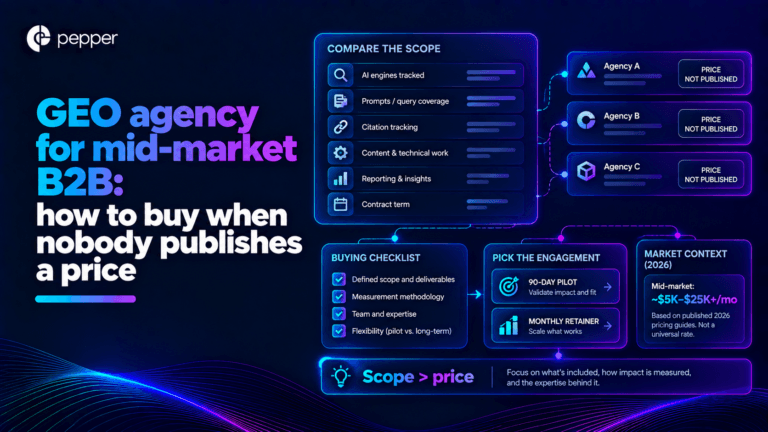
Choosing a GEO agency for mid-market B2B used to be a shortlisting problem. It is now a procurement problem, because the published prices have largely gone. Of four agencies publishing a GEO-specific figure in September 2026, two had withdrawn their pricing pages by early October and one had moved domains. Exactly one still publishes a number a mid-market buyer can act on. So the useful question is no longer which agency is best in the abstract, but how to compare three quotes when only one of them arrived with a method attached.
Third-party sources and AI citations are tightly linked, and the link stops short of where most plans assume. Off-page work decides whether an engine retrieves and cites you. It does not decide whether the answer names you, and 61.7% of brand appearances are citations with no name attached. The two largest 2026 datasets also disagree about how much of the citation surface is third-party at all, one saying 84% and the other putting the brand bucket above half. That disagreement is definitional rather than factual, and it decides where a budget goes.
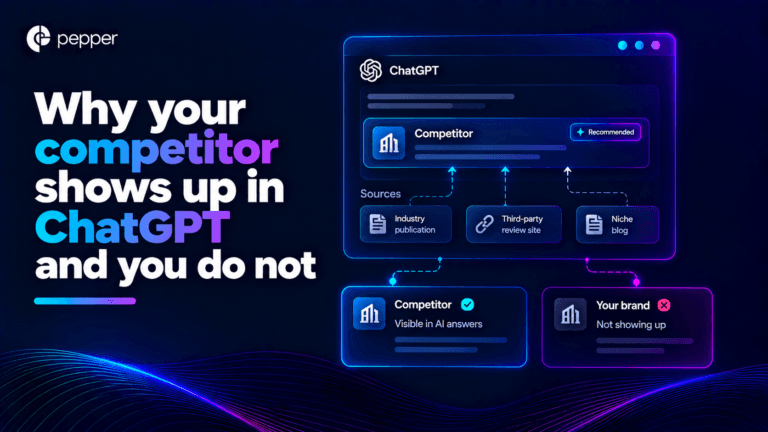
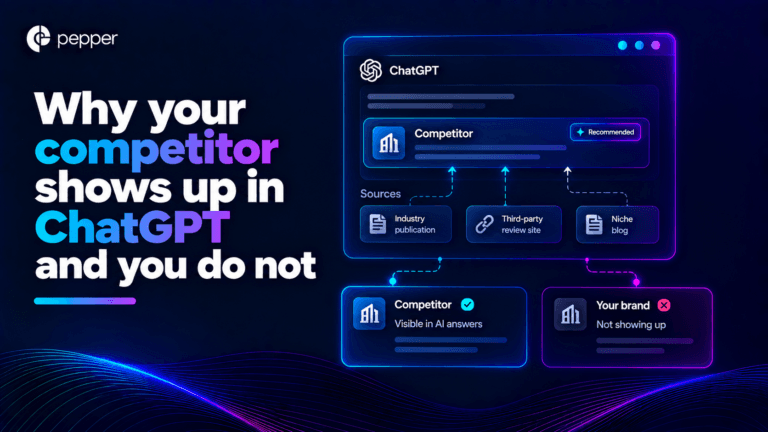
Why is my competitor showing up in ChatGPT and not me? Before accepting the premise, check it. Across 3,981 brand appearances studied in 2026, 61.7% were citations with no brand name in the answer and only 13.2% produced both. So there are three states that look identical from where you are sitting: genuinely absent, present as an unnamed source, and named less often than a rival. Each has a different cause and a different fix, and working on the wrong one is the most common way this gets expensive.
Get your hands on the latest news!

Similar Posts
GEO / AI Search
13 mins read
GEO agency for mid-market B2B: how to buy when nobody publishes a price
GEO / AI Search
14 mins read
Third-party sources and AI citations: what off-page decides, and what it does not
GEO / AI Search
14 mins read