AI Search for Pharma: Visibility with Compliance Constraints
| Pharma is the most constrained vertical in AI search – and also one of the highest-stakes. LLMs are now the first touchpoint for patients asking about conditions, treatments, and medications. But pharmaceutical brands cannot simply optimize their way to the top of AI health responses. FDA promotional regulations, MLR review requirements, and YMYL trust thresholds create a three-layer compliance gauntlet that governs every piece of citable content. The path to pharma AI visibility runs through unbranded disease awareness content, compliant educational frameworks, and entity optimization for pharma brand names – not through promotional optimization. |
Navigating the Most Constrained Vertical in AI Search
- Why Pharma Is Uniquely Difficult – The Three-Layer Compliance Stack
- The Core Distinction: Disease Awareness vs. Product Promotion
- Building AI Visibility Through Unbranded Content
- How LLMs Handle Pharmaceutical Queries – and What That Means for Your Strategy
- Entity Optimization for Pharma Brand Names Without Prescribing Implications
- Compliant Content Architecture for Pharma AI Search
- The MLR Review Workflow for GEO-Optimized Content
- Industry Updates: What Pharma Marketers and CMOs Are Saying
- YouTube Script
- FAQ
Patients no longer Google their symptoms. They ask ChatGPT. Is your brand in that answer?
By 2026, traditional search engine volume has dropped 25%, with organic search traffic falling even more sharply as generative AI becomes the default research interface for patients and healthcare professionals. When a patient asks ChatGPT ‘what are the treatment options for Type 2 diabetes,’ the model generates a confident, sourced answer – naming drug classes, mechanisms, and sometimes branded medications.
Whether your pharmaceutical brand appears in that answer depends on one thing: whether you’ve built AI visibility within the specific compliance framework that governs pharmaceutical marketing. Most pharma brands haven’t. And the consequences are real – competitor brands are being recommended in AI responses, while brands with equivalent or superior clinical profiles remain invisible.
This guide covers the complete compliance-aware GEO strategy for pharmaceutical brands – from the regulatory framework to the content architecture to the entity optimization tactics that build pharma AI visibility without triggering FDA or MLR violations.
| “Brand and trustworthiness are going to be more important to agentic search than almost anything else. That is a huge paradigm shift that people are underestimating.” – Linda Kaplinger, Integrated Search Marketing, NVIDIA, at Pepper’s Index ’26 |
Why Pharma Is Uniquely Difficult – The Three-Layer Compliance Stack
Every industry faces AI search challenges. Pharma faces three simultaneous constraints that no other vertical must navigate all at once:
| Layer | Constraint | Implication for AI Search |
| 1. FDA/EMA Promotional Regulations | All promotional claims must be FDA-approved, fairly balanced, and cannot exceed approved label claims | Promotional product content cannot be freely optimized for LLM citation – it requires review before publication |
| 2. MLR Review Process | Medical, Legal, and Regulatory teams must approve all content; cycles average 50–60 days per piece | Content optimized for AI search must still pass MLR – slowing the iteration cycle standard GEO requires |
| 3. YMYL Trust Threshold | LLMs apply maximum scrutiny to pharmaceutical content – anonymous claims, unsourced assertions, and promotional language trigger citation exclusion | Even compliant content fails AI citation if it lacks expert attribution, primary source links, and structured clinical specificity |
These three constraints are cumulative. A piece of pharma content must simultaneously avoid FDA promotional violations, pass MLR review, and meet LLM YMYL trust standards. Miss any one of the three, and the content either can’t be published or won’t be cited.
The good news: there is a path through all three. It runs through unbranded disease awareness content – the most powerful and flexible vehicle for compliant pharma AI visibility.
The Core Distinction: Disease Awareness vs. Product Promotion
| DEFINITION: Disease Awareness Content (Unbranded) |
| Disease awareness content – also called unbranded content – focuses on educating audiences about a medical condition, its symptoms, prevalence, risk factors, and treatment categories, without naming or promoting a specific branded drug. Disease awareness content does not require the same level of FDA fair-balance requirements as branded promotional materials, can be published and optimized more quickly through MLR review, and is the format LLMs overwhelmingly prefer to cite for health condition queries. It is the primary engine of compliant pharmaceutical AI search visibility. |
This distinction is not just a marketing technicality – it is the strategic core of pharma GEO. LLMs are trained to cite educational sources rather than promotional ones. Promotional language – benefit claims, brand comparisons, efficacy assertions – triggers the same YMYL filters that exclude low-authority health content.
The strategic result: pharma brands that invest in disease awareness content infrastructure earn LLM citations for the condition queries their patients are asking before they ever search for a specific drug. This is share-of-answer at the disease awareness level – and it’s where the highest-leverage pharma AI visibility is built.
What Separates Disease Awareness from Promotion – The Bright Lines
| Disease Awareness Content (Citable) | Promotional/Branded Content (Restricted) |
| Names the disease, condition, or indication | Names the specific branded drug |
| Describes symptom burden, diagnosis criteria, epidemiology | Makes efficacy, safety, or comparative claims about a product |
| Explains treatment categories (GLP-1 agonists, biologics, etc.) | Names the specific branded drug within its mechanism class |
| Links to clinical guidelines and peer-reviewed research | Cites clinical trial data with branded drug as study subject |
| Provides patient-journey information, HCP-patient dialogue guidance | Includes call to action to request or prescribe a specific product |
| Can be freely indexed and optimized for LLM citation | Must include full ISI (Important Safety Information) and fair balance |
| COMPLIANCE NOTE: The line between disease awareness and promotion is enforced by FDA’s Office of Prescription Drug Promotion (OPDP). Content that names a branded drug – even in an educational context – triggers the full promotional content review standard, including fair balance and ISI requirements. When optimizing pharma content for AI citation, keep disease awareness pages completely separate from brand pages. Do not link disease awareness pages to branded promotional pages. |
Building AI Visibility Through Unbranded Content
Unbranded disease awareness content is the highest-leverage content type in pharma AI search. It is compliant, it is citable, and it answers the exact questions patients and HCPs are asking AI systems before they engage with branded content.
According to industry research, unbranded content is the most robust and flexible vehicle for achieving regulatory compliance, building patient trust, and becoming the authoritative source that LLMs prefer to cite in pharmaceutical categories.
The Five Unbranded Content Categories That Earn LLM Citations
- ‘What is [condition]?’ is among the most common health queries on every LLM. A pharma brand that publishes the authoritative definition page – structured with DefinedTerm schema, backed by peer-reviewed sources, authored by a named KME (Key Medical Expert) – earns citations for every patient who asks this question.Condition/disease explainers –
- Content that maps the patient journey from symptom recognition to diagnosis to treatment category consideration. This content is highly citable because it answers ‘how do I know if I have [condition]?’ – a query with enormous volume.Symptom-to-diagnosis pathway content –
- Educational overviews of treatment categories available for a condition – without naming brands. ‘What are the treatment options for [condition]?’ guides that explain mechanism classes, administration routes, and patient profile considerations are consistently cited by LLMs.Treatment landscape guides –
- Content that helps patients prepare for conversations with their healthcare providers. LLMs frequently cite these when answering ‘what should I ask my doctor about [condition]?’ – a query that represents high-intent patients at a critical decision point.Patient-HCP dialogue resources –
- Prevalence statistics, diagnosis rates, comorbidity data, and healthcare utilization figures. LLMs cite this type of data extensively for condition awareness queries. Proprietary epidemiology data is especially valuable – it creates forced citations because no other source has it.Epidemiology and burden-of-disease data –
| The strategic hierarchy for pharma AI search: Build unbranded disease awareness content first. Build condition entity recognition second. Build pharma company entity recognition third. Only optimize branded content after all three layers are in place – and only with full MLR clearance. |
How LLMs Handle Pharmaceutical Queries – and What That Means for Your Strategy
LLMs apply differentiated handling to pharma content based on query type. Understanding these categories is essential for building a content strategy that targets the right queries with the right content type.
| Query Type | Example | LLM Handling | Pharma Opportunity |
| Condition/disease queries | ‘What is atrial fibrillation?’ | High citation; pulls from medical authority sources | Disease awareness content; DefinedTerm schema |
| Symptom queries | ‘Symptoms of Type 2 diabetes’ | High citation; structured lists preferred | Symptom guides with FAQPage schema |
| Treatment category queries | ‘How are GLP-1 agonists used?’ | Medium-high citation; mechanism education content | Unbranded mechanism explainers |
| Branded drug queries | ‘How does [drug name] work?’ | Cautious; requires fair balance, often defers to PI or FDA label | Hosted prescribing information, compliant mechanism pages |
| Safety/side effect queries | ‘Side effects of [drug class]’ | Very cautious; defers heavily to FDA label and clinical sources | FDA label hosted on brand domain; full ISI visible |
| Comparative queries | ‘[Drug A] vs [Drug B]’ | Highly restrictive; LLMs often decline or cite only independent clinical sources | Let independent clinical publications handle; no brand optimization |
| COMPLIANCE NOTE: Pharma brands should never attempt to optimize branded promotional pages for direct LLM citation. The fair balance and ISI requirements that make branded content compliant also make it structurally incompatible with LLM citation preferences. Branded pages should be optimized for human readers and compliance, not for AI retrieval. |
Entity Optimization for Pharma Brand Names Without Prescribing Implications
Pharma company entity optimization is one of the most underutilized AI visibility levers in the industry. The goal is to ensure LLMs recognize and can accurately describe the pharmaceutical company as a trusted entity – without the entity recognition creating prescribing implications or promotional associations.
There are 3 levels of pharma entity optimization, each operating independently:
Level 1: Company Entity (Non-Promotional)
The pharmaceutical company itself – its founding, research focus, pipeline, therapeutic areas, and scientific contributions – can be established as a recognized entity without promotional implications. Wikipedia and Wikidata entries for the company, press coverage in health and business media, and Organization schema on the company website create entity recognition that improves LLM understanding of who the company is, without triggering product promotion rules.
- Company name, founding year, headquarters, therapeutic focus areas, notable clinical contributions (from peer-reviewed publications, not promotional claims).Wikidata entry –
- Company type (pharmaceutical manufacturer), therapeutic areas, founding date, leadership. No brand-specific claims.Organization schema on corporate website –
- Coverage in industry publications (Fierce Pharma, Endpoints News, BioPharma Dive) about pipeline, research, scientific achievements, or corporate developments – distinct from product-specific press releases.Press coverage in non-promotional contexts –
Level 2: Disease Area Entity (Condition-Linked)
A pharmaceutical company can establish entity recognition in a specific disease area without naming products. When LLMs understand that a company is a recognized authority in, for example, oncology, cardiovascular disease, or rare metabolic conditions, they begin to associate the company with relevant disease queries – even before any branded product optimization.
This is built through: disease-area scientific publications with company-affiliated authors, sponsorship of medical education in the therapeutic area, and KME content that links company experts to disease area knowledge.
Level 3: Branded Product Entity (Requires Full MLR Clearance)
For approved branded products, entity optimization is possible and valuable – but every element must pass MLR review. The branded product entity includes: the drug name as a distinct entity (Wikidata entry linked to the company entity), the mechanism of action (stated precisely as in the approved label), the approved indication (stated exactly as approved – no paraphrase), and links to the official prescribing information and FDA label.
The goal of branded product entity optimization is accurate LLM recognition – not citation maximization. If LLMs accurately describe what a drug is, what it’s approved for, and where to find prescribing information, that is a compliant outcome.
Compliant Content Architecture for Pharma AI Search
A compliant pharma AI search content architecture separates content into three distinct zones, each with different optimization rules:
| Zone | Content Type | Optimization Goal | |
| Zone 1Disease Awareness | Condition explainers, symptom guides, treatment landscape, patient-HCP dialogue, epidemiology data | Maximum LLM citability – fully optimized for AI retrieval | Standard medical review; faster MLR cycle than promotional content |
| Zone 2Medical Education | HCP-directed clinical education, mechanism of action education (unbranded), clinical guideline summaries | LLM citability for HCP queries; medical journal co-citation | Full MLR review; medical affairs-led |
| Zone 3Branded Product | Prescribing information, mechanism of action (labelled), indication information, safety information | Accurate entity recognition; compliant LLM description | Full MLR + regulatory sign-off; every word is label-regulated |
The MLR Review Workflow for GEO-Optimized Content
The single biggest operational challenge for pharma AI search is MLR review velocity. Mid- and large-sized pharmaceutical companies report that MLR review cycles can often stretch 50–60 days per content piece. Standard GEO content iteration – publish, measure, update, republish – operates on a very different cadence.
There are 3 workflow adaptations that make pharma GEO viable within MLR constraints:
- Build a library of MLR-approved, pre-cleared content modules for disease awareness content. Each module is a self-contained fact block – a condition definition, a symptom description, an epidemiology statistic – that can be assembled into new pages without re-review. Once modules are cleared, new content is assembled from approved components, dramatically reducing MLR cycle time.Pre-approved modular content blocks –
- Structured data markup (Article schema, FAQPage schema, DefinedTerm schema) does not change the substance of the content – it only changes how AI systems parse it. Most MLR frameworks classify schema implementation as a technical change, not a content change, which means schema can often be implemented without full re-review. Confirm this with your MLR team; it is often the fastest GEO optimization available.Schema as a non-content layer –
- Structure the content production calendar to prioritize disease awareness content, which carries lower MLR burden than branded promotional content. 80% of pharma AI search visibility is built through Zone 1 unbranded content that can move through MLR faster. Invest in clearing the disease awareness content library first.Unbranded-first content pipeline –
| The modular content strategy applied to pharma GEO: Rather than reviewing each blog post individually, build a library of pre-approved clinical fact blocks. Each block is reviewed once and can be assembled into new page formats. This is the same logic that powers Veeva PromoMats modular content workflows – applied to AI search content optimization. |
Industry Updates: What Pharma Marketers and CMOs Are Saying
Patients and HCPs No Longer Google – They Ask ChatGPT
By 2026, traditional search engine volume has dropped 25%, with organic traffic falling even more as generative AI search becomes ubiquitous, according to Gartner. In pharma specifically, patients and HCPs are now using AI assistants as the default research interface. ‘Patients and HCPs no longer Google. They ask ChatGPT,’ according to a 2026 pharma marketing outlook by Spectrum Science. Pharmaceutical brands that aren’t visible in AI responses are missing the first touchpoint of patient and prescriber journeys.
FDA Warning Letters Are Expanding to AI-Assisted Content
In September 2025, the FDA sent thousands of warning letters to pharmaceutical companies for misleading ads and issued approximately 100 cease-and-desist letters in a concentrated enforcement wave. In April 2026, Morgan Lewis reported that the FDA issued a warning letter citing a drug manufacturer specifically for improper use of AI – signaling that AI-generated pharma content faces the same regulatory scrutiny as human-authored content. The lesson: AI is a tool, not a compliance defense. Every piece of content produced with AI assistance must still pass MLR review before publication.
50% of Life Sciences Leaders Have Already Deployed Gen AI – But Governance Lags
McKinsey’s 2026 healthcare survey found that 50% of healthcare and life sciences leaders have already implemented generative AI, with more than 80% having deployed first use cases to end users. But 43% still name risk and safety as the primary roadblock. This gap – rapid adoption without governance frameworks – is precisely where pharma AI search strategy lives. The brands building compliant content infrastructure now are creating a sustainable advantage, not a liability.
Unbranded Disease Awareness Is the Fastest-Growing Pharma Content Category
Pharma marketers increased unbranded campaign budgets by 22% in 2021 alone, and the trend has accelerated with the AI search shift. Unbranded disease awareness content is now recognized as the primary vehicle for compliant pharmaceutical AI visibility. It answers the questions patients ask before they ask about drugs, it passes MLR faster than branded content, and it earns the LLM citations that branded content cannot. Pharma brands that haven’t built a systematic unbranded content engine are being outpaced in AI search by competitors who have.
MLR Cycles Are the Operational Bottleneck – And AI Is Helping
MLR review cycles averaging 50–60 days are the primary operational constraint on pharma content velocity. AI-powered pre-check tools – including early implementations of platforms like Veeva PromoMats AI – are beginning to cut pre-review cycle times by automating claim identification and reference linking before content reaches the review team. These tools don’t replace MLR; they reduce the time content spends waiting for it. For pharma marketing teams building GEO content at scale, AI-assisted MLR pre-check is becoming a competitive necessity.
FAQ: AI Search for Pharmaceutical Brands
Can pharmaceutical brands optimize content for AI search (GEO) without violating FDA regulations?
Yes – through a structured separation of content types. Disease awareness content (unbranded educational content about conditions, symptoms, and treatment categories) can be fully optimized for LLM citation without triggering FDA promotional requirements. Branded promotional content must meet the same FDA fair balance, ISI, and claim substantiation requirements regardless of whether it targets traditional search or AI systems. The key is maintaining a strict separation between Zone 1 disease awareness content and Zone 3 branded product content, and ensuring all branded content has passed MLR review before publication.
What is the difference between branded and unbranded pharma content in AI search?
Unbranded content focuses on a disease, condition, or treatment category without naming a specific drug. It can be freely published and optimized for LLM citation with a standard medical review process. Branded content names or describes a specific approved drug, triggering the full FDA promotional standards including fair balance, important safety information, and claim substantiation requirements. LLMs are structurally more likely to cite unbranded disease awareness content for patient-facing health queries because it reads as educational rather than promotional – the distinction LLM training has made between trustworthy sources and marketing materials.
What does entity optimization mean for a pharmaceutical brand name?
Entity optimization for pharma brand names means ensuring LLMs can accurately identify and describe the drug as a distinct real-world entity – including its approved indication, mechanism class, and where to find prescribing information – without this recognition creating misleading promotional associations. It involves creating a Wikidata entry for the drug linked to its manufacturer entity, implementing branded product schema (with indication stated exactly as FDA-approved), and hosting the prescribing information on the brand domain for LLM cross-referencing. Every element of branded product entity optimization must pass MLR review.
How do MLR review requirements affect pharma GEO content velocity?
MLR review cycles averaging 50–60 days per content piece create a significant constraint on pharma GEO iteration. The most effective adaptations are: (1) building a library of pre-approved modular disease awareness content blocks that can be assembled into new pages without full re-review; (2) classifying schema markup implementation as a technical change rather than a content change, which often allows faster deployment; and (3) prioritizing the disease awareness content pipeline (Zone 1) which carries lower MLR burden and moves faster through review than branded promotional content.
What schema types should pharmaceutical brands implement?
The core schema stack for pharmaceutical AI search is: Organization schema on the corporate website (company type, therapeutic areas, non-promotional); Article schema on all disease awareness content (named medical author, reviewer, publish date, topic); FAQPage schema on all patient and HCP education guides; DefinedTerm schema on condition definition pages; and for branded product pages – MedicalTherapy or Drug schema (with indication stated exactly as FDA-approved, linked to official prescribing information). Schema markup for branded product pages must be reviewed by the regulatory team before deployment.
| Pharma is the hardest vertical to build AI search visibility in – and the one with the most to gain. Pepper works with regulated industry brands on compliant content architecture that earns LLM citations without compromising FDA or MLR compliance. To see where your pharmaceutical brand’s disease awareness content stands in AI search, start your audit at atlas.pepper.inc |
Latest Blogs
Most advice on this is inference dressed as fact. OpenAI documents exactly one thing clearly, which is access. Here is what is documented, what is inferred, and how to verify the rest for yourself.
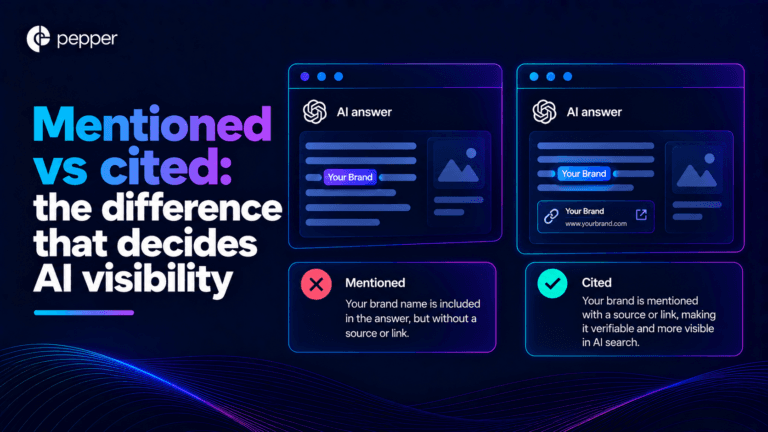
Being named in an AI answer and having your page used as its source are different outcomes with different causes and different fixes. The gap between them is the most useful diagnostic in AI search, and most reporting collapses it into one number.
Every platform reports share of voice and almost none of them define it the same way. Here is the definition worth using, the three choices that change the number, and how to measure it yourself without buying anything.
Get your hands on the latest news!

Similar Posts
GEO / AI Search
10 mins read
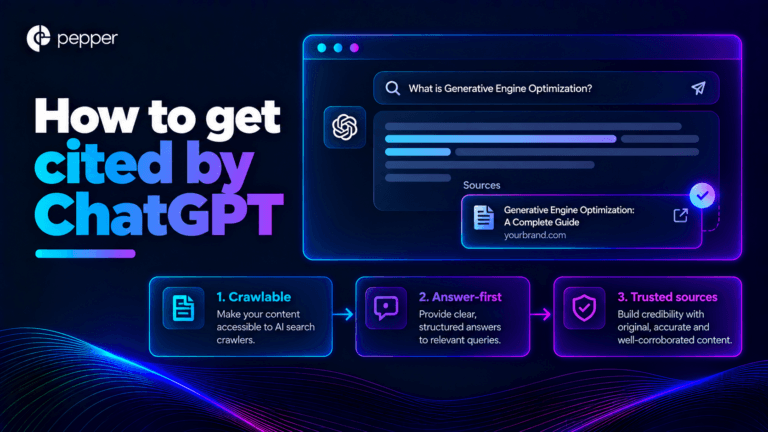
How to get cited by ChatGPT
GEO / AI Search
10 mins read
Mentioned vs cited: the difference that decides AI visibility
GEO / AI Search
13 mins read