AI Search for SaaS: How Software Brands Win
SaaS is where AI search is moving fastest, and where the gap between leaders and laggards is widening most aggressively. In the last six months, the way SaaS buyers find software has flipped. The first action used to be a Google search. It is now a prompt: “What is the best CRM for an outbound sales team of 12?”, “Notion alternatives that handle databases well,” “What does Asana cost for 50 seats?” The AI returns three to seven named tools, a one-line case for each, and a citation list that becomes the consideration set.
If you are inside that citation list, you are in the deal. If you are not, you are not. The buyer rarely runs the second prompt that would surface you. There is no organic-traffic recovery for being uncited in a SaaS category in 2026 – the AI’s first answer is now the consideration set.
This piece is the working playbook for the SaaS CMO operating inside that reality. It covers three layers that disproportionately drive SaaS AI-search outcomes: the tool-recommendation query economy inside ChatGPT, Perplexity, Gemini, and AI Overviews; the role review sites – G2, Capterra, TrustRadius, Software Advice – now play as the largest single source of SaaS LLM citations; and the under-recognised reality that product documentation is a separate AI-search asset class from marketing content, with its own rules, formats, and metrics. Refined across hundreds of SaaS engagements at Pepper, this is the operating system the SaaS brands compounding fastest in 2026 are running.
“Once in a generation, technology doesn’t just improve – it changes the way we see the world. GEO is not just a buzzword, but a new rule book for brand discovery, trust, and selection in an AI-first marketplace.” – Kishan Panpalia, Pepper Content (Index’25 keynote)
SaaS is where that rule book is being rewritten fastest. The brands reading it carefully are pulling ahead of the brands still running 2023 playbooks.
Why SaaS AI Search Is a Different Game
Three structural realities separate SaaS AI search from every other vertical.
First, the consideration set forms inside the answer. SaaS buyers do not browse ten options anymore – they read the three to seven the AI named. Atlas Q1’26 data puts the median SaaS Share of Answer at 4.1%, with leaders at 22% and top-quartile at 12.3%. The gap between median and leader is wider than for any other major vertical – and once a leader establishes that gap, the AI’s training and retrieval models reinforce it on every subsequent answer.
Second, the surface mix is asymmetric. SaaS citations skew heavily to three source types: review sites (G2, Capterra, TrustRadius), tier-one publications (TechCrunch, Forrester, IDC), and brand-owned product documentation. Marketing content matters less than most SaaS teams have been told. The single best lever a SaaS brand has on Share of Answer is not the next blog post – it is the next review and the next set of doc pages.
Third, the comparison economy. “X vs Y” is the dominant SaaS prompt shape. The AI compares you with three named alternatives every time. If your comparison content is weaker than the competitor’s, the AI cites the competitor’s comparison instead, and the answer leans against you on every variant of the query. SaaS is the only major vertical where competitor-controlled comparison pages routinely outrank brand-controlled ones in AI citations.
Layer 1 – The Tool-Recommendation Query Economy
ChatGPT, Perplexity, Gemini, and AI Overviews now answer SaaS tool-recommendation queries directly. The query patterns are narrow and consistent. Pepper Atlas’s prompt-mining work across forty SaaS sub-categories identifies five recurring shapes.
- Best-of: “best CRM for outbound sales teams.” The single highest-volume SaaS query shape. AI answers list three to seven named tools, weighted by review-site sentiment, recent press, and category-leader signals.
- For nonprofit organizations evaluating donor-management software, searches for Neon CRM alternatives follow the same comparison-driven pattern, helping buyers identify platforms that better fit their fundraising workflows, integrations, and budgets.
- X-vs-Y: “Notion vs Coda for technical documentation.” Decision-stage prompts. The AI typically picks a winner per use-case rather than overall – buyers reading these are pre-qualified.
- Pricing: “How much does HubSpot cost for 25 seats?” Often misanswered by AI with stale data. Brands with current, structured, ungated pricing copy can win these citations almost automatically.
- How-to integration: “How to connect Slack with Salesforce.” The AI cites the brand whose documentation answers the question fastest. Often, that is neither Slack nor Salesforce – it is the third-party integration tool whose docs are clearer.
A SaaS brand’s prompt universe needs explicit coverage of all five shapes, weighted to volume. The 250-prompt enterprise universe we build for SaaS customers typically allocates 25% to best-of, 20% to alternatives-to, 20% to X-vs-Y, 15% to pricing, and 20% to how-to and integration prompts. Anything that skews heavily definitional – “what is a CRM?” – is wasted measurement for category-established brands. The buyer already knows what the category is. They want the answer to which tool to pick.
→ Atlas: Atlas auto-generates a SaaS-tuned prompt universe across the five shapes above, weights citations by intent traffic per surface, and tracks Share of Answer per shape so the team can see whether a gain on alternatives-to is offsetting a loss on pricing.
Layer 2 – Review Sites as the Largest Single Source of SaaS LLM Citations
Across our 2026 SaaS dataset, G2, Capterra, TrustRadius, Software Advice, and the relevant category-specific subreddits collectively account for the largest single share of citations on tool-recommendation queries. Not the brand’s own website. Not tier-one press. The review-site network.
The implication is direct. Review collection is no longer a customer-marketing nice-to-have – it is one of the highest-leverage AI-search investments a SaaS brand can make. Pepper Atlas’s reference dataset puts the operating priority as follows.
| Review site | LLM citation weight | What makes a brand cited | Operating priority |
| G2 | Highest | Recent reviews (last 90 days), Grid/Leader badges, category-page presence, verified buyers. | Quarterly review drive; respond to every review within 48 hours; update category placement monthly. |
| Capterra / GetApp | High | Volume and recency; pricing transparency; verified categorisation across multiple use-cases. | Cross-publish on the Gartner Digital Markets network; keep pricing live. |
| TrustRadius | Moderate | Long-form, structured reviews with use-cases. Cited heavily by Gemini and AI Overviews on B2B prompts. | Invest in customer story-driven review collection; the format matches AI parsing best. |
| Software Advice | Moderate | Use-case alignment and category accuracy. Cited disproportionately by Perplexity for SMB queries. | Audit category placement; correct miscategorisation that fragments your citation share. |
| Reddit (subreddit reviews) | High & rising | Authentic user voice in category subreddits; verified-customer threads; engineer-led discussion. | Genuine engagement, not spammy seeding; correct misinformation publicly; cite your own docs. |
The Reddit row is the one most SaaS teams under-invest in. Perplexity’s own publisher guidelines confirm that user-voice forums sit at the top of its preferred-domain hierarchy. ChatGPT, when given browsing access, weights subreddit answers heavily for category-evaluation prompts. A single high-signal Reddit thread on r/sales or r/saas can drive more AI citations than a quarter of blog content. The discipline is to engage authentically – answer real questions, link to product docs not marketing pages, correct misinformation publicly. Spammy seeding is detected and downranked at both the platform level and the LLM level.
“AI search collapses the distance between brand and demand. On SaaS specifically, that collapse happens inside the review-site graph. A buyer reads a G2 review in turn one and the AI cites the same review in turn three.” – Joyce Hwang, Head of Marketing, Dropbox (Index’25)
→ Atlas: Atlas reconciles citations from G2, Capterra, TrustRadius, Software Advice, and category subreddits with brand-owned-domain citations, so a SaaS team can see exactly where its AI-search visibility is being earned – and which of those sources is most under-invested in.
Layer 3 – Product Documentation Is a Separate AI Asset Class
The strategic blind spot in most SaaS marketing functions is product documentation. Marketing owns the website. Engineering owns the docs. The AI engines, increasingly, cite the docs more often than the marketing pages – and reward docs that are written, structured, and maintained for citation.
Documentation is not marketing-content-by-other-means. It is a different asset class with different rules.
| Dimension | Marketing content | Product documentation |
| Audience | Early-funnel prospects. | Evaluators, integrators, AI agents. |
| Primary prompt shape | “What is X?”, “Best X for Y?” | “How do I do Z in [product]?”, “Does [product] support W?” |
| Format | Long-form articles, comparison pages, hero copy. | Structured procedures, code blocks, schemas, API references. |
| Schema priority | Article, FAQPage, Organization. | TechArticle, HowTo, SoftwareApplication, APIReference. |
| Cited where | Best-of, alternatives-to, vs queries. | Integration, how-to, capability prompts; agent retrieval. |
| Cadence | Weekly to bi-weekly. | Living document; updated on every release. |
| Owner | Content marketing. | Developer Relations / Technical Writing. |
The brands compounding in SaaS AI search are the ones who recognised this split and built documentation as a deliberate AI-search surface. Three operational moves do most of the work.
First, structured procedures. Every how-to in the documentation set is written as a 3-to-7-step procedure with HowTo schema in JSON-LD, code blocks where relevant, and a clear definitional opener. The AI parses this and cites it on integration and capability prompts at scale.
Second, the canonical glossary. Every product term, every feature name, every integration partner is defined once, canonically, and used verbatim across the docs. AI engines weigh entity consistency heavily; SaaS brands with consistent product vocabulary across their docs see citation rates 2-to-3× higher than brands whose docs use three different names for the same feature.
Third, the agent-readability tier. Modern coding agents – Cursor, Continue, Aider – read /llms.txt and structured developer docs to form their picture of a SaaS product. The brands appearing inside agent-driven workflows are the brands whose docs were structured for machine consumption alongside human consumption. The cost is small; the moat is large.
“AI discovery rewards content that proves it has been lived. First-hand experience, original photography, real deployment data – and a verified human attached to all of it. In SaaS, that includes documentation that proves the product exists and works.” – Linda Caplinger, Head of SEO & AI Search, NVIDIA (Index’25)
→ Atlas: Atlas monitors citation share across marketing pages, documentation pages, and review sites separately – and surfaces when documentation gaps are blocking AI citations on prompts the marketing site cannot answer.
Insights: What Marketing Leaders Are Saying About SaaS AI Search
The SaaS-specific conversation at Index’25 was unusually focused. A few lines have stayed with me.
“We measured by hand for six months before we bought anything. Half of what we discovered was that our review-site presence was driving more AI citations than our content team. We rebudgeted that quarter.” – Sydney Sloan, former CMO, G2 (Index’25)
“The moment we stopped measuring our docs as engineering deliverables and started measuring them as AI-search assets, the conversation between marketing and developer relations completely changed.” – Mandy Dhaliwal, CMO, Nutanix (Index’25)
“In a world where AI summarizes everything, the brands that get summarized favourably are the ones with the clearest positioning and the most distinctive voice. In SaaS, ‘distinctive’ means real customers saying real things in real reviews.” – Angelique Bellmer Krembs, former CMO, PepsiCo (Index’25)
“Be the source worth citing. Publish facts, stats, and expert insights that tools like ChatGPT and Perplexity can’t ignore. In SaaS, the documentation is half of that source.” – Neil Patel (Index’25 keynote)
“Search is undergoing the most profound transformation of our time. For SaaS specifically, the consideration set now forms inside the answer. The brands that show up there own the next quarter.” – Anirudh Singla, Co-founder & CEO, Pepper Content (Index’25 keynote)
The Quiet Truth About SaaS AI Search
The SaaS brands compounding in AI search in 2026 are not the ones with the largest content teams. They are the ones running three deliberate programs in parallel: prompt-universe coverage tuned to the five SaaS query shapes; a quarterly review-collection drive across G2, Capterra, TrustRadius, Software Advice, and the relevant subreddits; and a documentation function operating as a first-class AI-search surface, with structured procedures, canonical glossary, and agent-readable formats.
None of those programs is novel. The novelty is running them simultaneously, against a measured baseline, with a CMO who treats reviews and docs as AI-search assets rather than as customer-marketing or engineering deliverables. The discipline is unglamorous. The compounding is enormous. And the consideration set is forming inside the answer right now, every time a buyer types a prompt.
→ Atlas: Run the SaaS audit on your domain inside Atlas – SaaS-tuned prompt universe, review-site citation reconciliation, documentation-citation tracking, and three competitor benchmarks included. Start at atlas.peppercontent.io.
Frequently Asked Questions
What is a healthy SaaS Share of Answer? Median in the Atlas Q1’26 SaaS cohort is 4.1%; top quartile is 12.3%; leaders sit at 22%. Treat top quartile as the realistic 12-month target.
How important are G2 and Capterra relative to brand content? Across our 2026 dataset, the review-site network is the largest single source of SaaS LLM citations on tool-recommendation queries. Review investment routinely under-performs against its citation contribution.
Should product documentation report into marketing? No – but it should share a citation scorecard with marketing. Reporting structure matters less than aligned measurement.
How often should review-site content be refreshed? Recency carries citation weight. The operating cadence we recommend is quarterly review drives, plus a 48-hour response SLA on every public review.
Does Reddit really matter for SaaS AI search? Yes – Perplexity’s preferred-domain hierarchy puts Reddit at the top for user-voice queries, and ChatGPT browsing weights subreddit threads heavily. The discipline is authentic engagement, not seeding.
Latest Blogs
Most advice on this is inference dressed as fact. OpenAI documents exactly one thing clearly, which is access. Here is what is documented, what is inferred, and how to verify the rest for yourself.
Being named in an AI answer and having your page used as its source are different outcomes with different causes and different fixes. The gap between them is the most useful diagnostic in AI search, and most reporting collapses it into one number.
Every platform reports share of voice and almost none of them define it the same way. Here is the definition worth using, the three choices that change the number, and how to measure it yourself without buying anything.
Get your hands on the latest news!

Similar Posts
GEO / AI Search
10 mins read
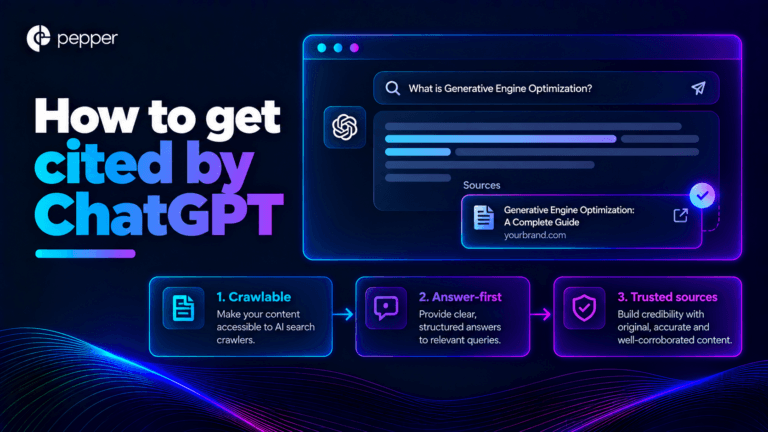
How to get cited by ChatGPT
GEO / AI Search
10 mins read
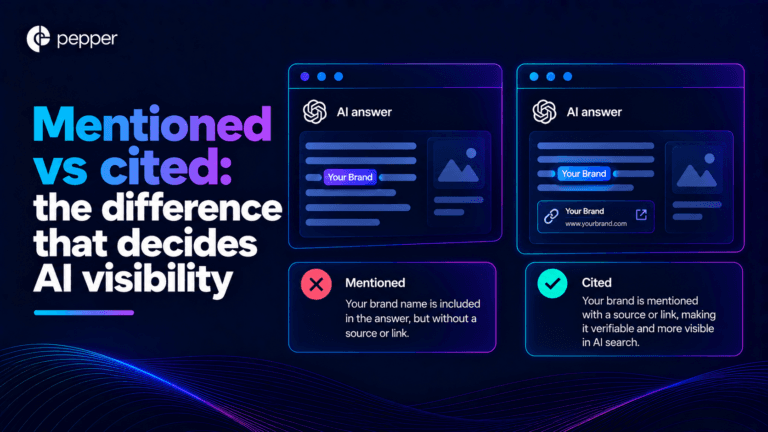
Mentioned vs cited: the difference that decides AI visibility
GEO / AI Search
13 mins read