Chain-of-Thought Prompting: Teaching AI to Show Its Work
Remember when your math teacher said “show your work”? Chain-of-Thought Prompting does exactly that for AI. Instead of spitting out an answer, the AI walks you through its thinking, step by step.
What is Chain-of-Thought Prompting? (The Simple Version)
Think of Chain-of-Thought Prompting like asking a friend to explain how they solved a puzzle instead of just telling you the answer. When you use this technique, you’re asking the AI to break down its thinking into smaller pieces before giving you a final answer.
Normally, you ask AI a question and it jumps straight to the answer. With chain-of-thought prompting, the AI says “First, I need to figure out this part… then this part… and now I can tell you the answer is…” It’s like watching someone think out loud.
This matters because some questions are tricky. When AI shows its reasoning steps, it gets better at handling complex problems that need multiple steps to solve.
How Does Chain-of-Thought Prompting Work?
Picture a decision tree. The AI starts at the trunk and explores different branches of reasoning before picking the best path to an answer.
Here’s how it works in practice: You ask the AI a question, but you also tell it to think step-by-step. For example, instead of asking “What’s 25% of 80?”, you might say “What’s 25% of 80? Think through each step.”
The AI then responds: “First, I need to convert 25% to 0.25. Then, I multiply 0.25 by 80. That equals 20.” See the difference? The AI showed its work.
You can do this two ways. Few-shot prompting means giving the AI examples of step-by-step reasoning first. Zero-shot prompting means just asking it to think step-by-step without examples. Both work, but examples often help.
Why Does Chain-of-Thought Prompting Matter?
For marketers working with AI tools, this technique is gold. When you need AI to analyze customer data, write complex email sequences, or solve marketing problems, you want answers you can trust.
Chain-of-thought prompting makes AI more accurate on tough tasks. You also see exactly how the AI reached its conclusion, which helps you catch mistakes. If the AI says “I think your email open rate is low because…” and then shows faulty reasoning, you can spot the error and try again.
Chain-of-Thought Prompting at a Glance
| Feature | Details |
| What it does | Makes AI show its reasoning process step-by-step |
| Best for | Complex problems requiring multi-step thinking |
| How to trigger | Add phrases like “think step-by-step” to your prompt |
| Accuracy boost | Higher accuracy on reasoning tasks compared to direct answers |
| Related technique | Prompt chaining (different: uses multiple separate prompts in sequence) |
Real-World Examples
A marketing manager asks AI: “Should we launch our product in Q3 or Q4? Think through the factors step-by-step.” The AI responds by analyzing seasonal trends, competition, budget cycles, and team readiness before recommending Q3 with clear reasoning.
A content strategist prompts: “Calculate the ROI of our blog strategy. Show your work.” The AI breaks down traffic numbers, conversion rates, customer value, and content costs step-by-step, making it easy to verify each calculation.
An email marketer asks: “Why did our last campaign underperform? Reason through possible causes.” The AI examines subject lines, send times, audience segments, and content quality one by one, identifying the likely culprit.
FAQs
Q1: What is the difference between Chain-of-Thought Prompting and prompt chaining?
They sound similar but work differently. Chain-of-thought prompting shows reasoning steps within a single AI response. Prompt chaining means using a series of separate prompts, where each answer feeds into the next prompt.
Q2: Do I always need to use Chain-of-Thought Prompting?
No. Use it for complex questions that need reasoning. For simple tasks like “Write a headline” or “Translate this text,” regular prompting works fine and is faster.
Q3: How do I trigger Chain-of-Thought Prompting?
Add instructions like “think step-by-step,” “explain your reasoning,” or “show your work” to your prompt. You can also provide examples of step-by-step reasoning before your actual question.
Q4: Does Chain-of-Thought Prompting work with all AI models?
It works best with larger, more advanced language models. Smaller or older models might not respond as well to this technique, but it’s worth trying.
Wrapping Up
Chain-of-thought prompting turns AI from a magic black box into a transparent thinking partner. Next time you need AI to solve something complex, just ask it to show its work. You’ll get better answers and actually understand how it got there.
Latest Blogs
Most advice on this is inference dressed as fact. OpenAI documents exactly one thing clearly, which is access. Here is what is documented, what is inferred, and how to verify the rest for yourself.
Being named in an AI answer and having your page used as its source are different outcomes with different causes and different fixes. The gap between them is the most useful diagnostic in AI search, and most reporting collapses it into one number.
Every platform reports share of voice and almost none of them define it the same way. Here is the definition worth using, the three choices that change the number, and how to measure it yourself without buying anything.
Get your hands on the latest news!

Similar Posts
GEO / AI Search
10 mins read
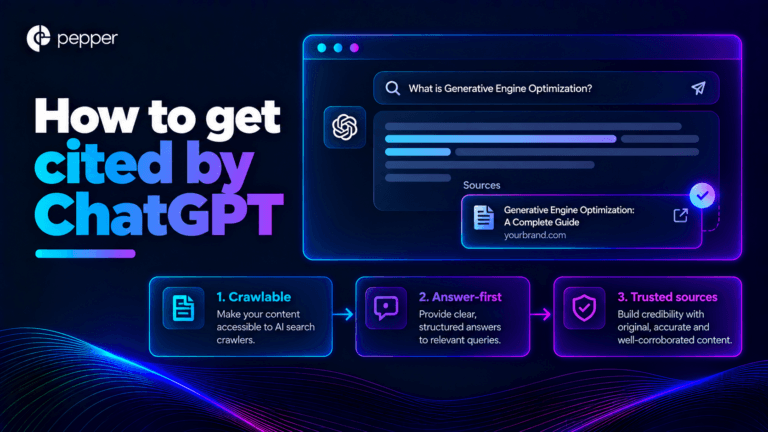
How to get cited by ChatGPT
GEO / AI Search
10 mins read
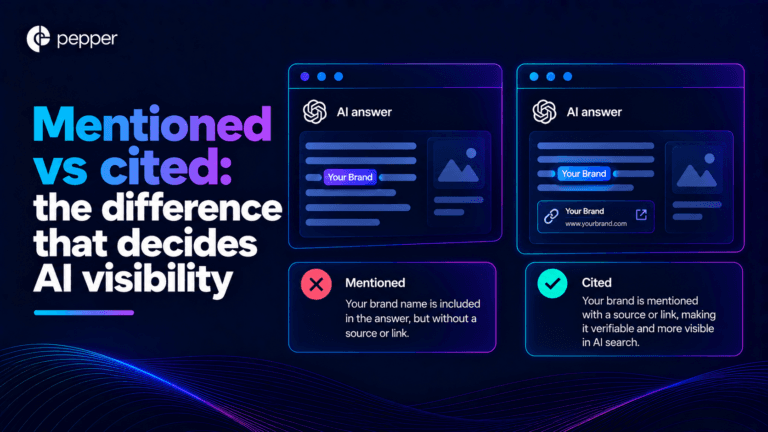
Mentioned vs cited: the difference that decides AI visibility

GEO / AI Search
13 mins read