GEO for Developer Tools: How to Get Your Product Cited in Technical AI Queries
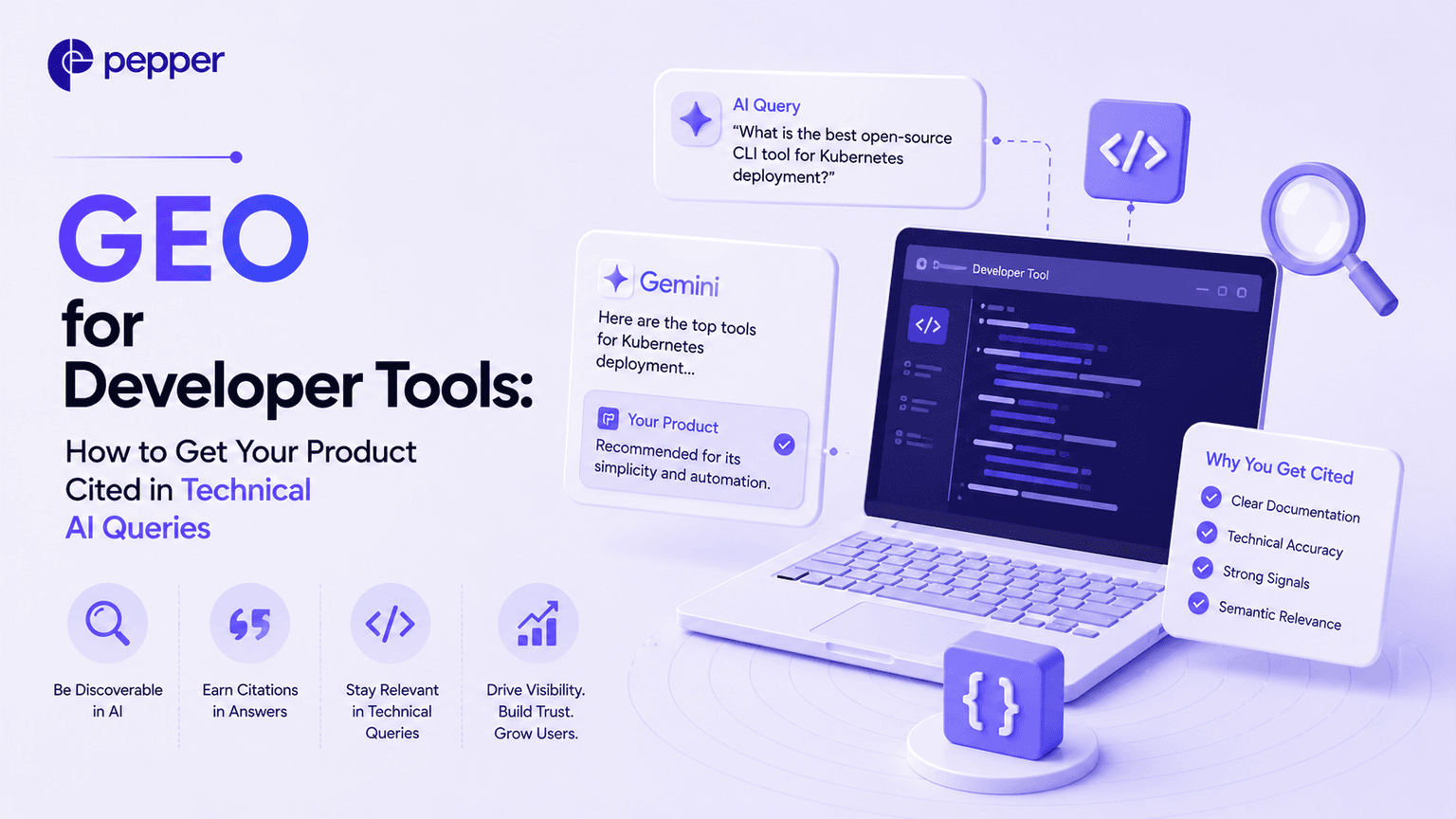
GEO for developer tools means optimizing your product so AI assistants and answer engines cite it when developers ask technical questions. Because developers now research through ChatGPT, Perplexity, and coding assistants, your documentation works as training data and a live retrieval source. This guide covers why dev-tool GEO is different, how these engines choose sources, and the exact steps to earn citations.
A developer opens their AI assistant and types, “What is the best vector database for a RAG app in production?” The answer names three tools, explains the tradeoffs, and links to two of them. No Google tab. No comparison blog. The shortlist is set before your marketing site ever loads. If your tool is named there, you are in the evaluation. If it is missing, you never entered it. We will come back to that developer at the end.
This shift is already large. ChatGPT alone drives roughly 92% of AI referral traffic across 6.77 million sessions, per Search Engine Land. In early 2026, 68.01% of US Google searches ended without a click, per SparkToro, so answers increasingly resolve inside AI. Developers are early adopters, so they lean on these tools harder than most buyers. They also distrust marketing language and trust peers, docs, and working code.
So the old playbook of ranking a landing page does not move the needle here. You have to earn a place inside the answer itself. That is a different discipline, and this guide walks through it step by step.
What This Guide Covers
- Why developer tools need a different GEO playbook
- How AI coding assistants choose which tools to cite
- How to get your developer tool cited in technical AI queries
- How Pepper earns citations for technical brands
- How to measure your developer tool’s AI visibility
- FAQ
- See how Pepper can help
Why Developer Tools Need a Different GEO Playbook
GEO for developer tools is the practice of earning citations in AI answers for technical queries, where documentation acts as both training data and a live retrieval source. In most categories, marketing content earns the citation. In dev tools, the code, the docs, and the community decide it.
Several factors set this vertical apart. Here is what changes the work.
- Docs are the product’s marketing. Coding assistants like Cursor, GitHub Copilot, and Claude Code read documentation to answer questions and generate code. So a gap in your docs becomes a gap in AI-assisted adoption. Clear, complete, versioned docs do more for citations than any campaign.
- Freshness matters more here. Deprecated code is worse than no code, because it breaks builds. Engines favor recent, working examples, so stale documentation quietly loses you citations.
- Community sources carry the weight. Reddit, GitHub, Stack Overflow, Hacker News, and Dev.to shape what AI says about your tool. Developers trust these, and so do the models trained on them.
- Developers detect and reject fluff. Thin, AI-generated marketing content performs poorly with this audience and earns far less traffic than human, technical writing. Precision wins.
- Queries split into two types. Technical “how do I” queries reward your own docs. Buyer-intent “best tool for X” queries reward third-party and community sources. You need both.
Because of these factors, the dev tools that win AI citations look less like brands and more like trusted references. They ship thorough docs, real code samples, honest comparisons, and content that survives peer scrutiny.
Takeaway: In developer tools, docs and community trust decide citations, not marketing polish. So the work is technical, current, and built to survive a skeptical audience.
How AI Coding Assistants Choose Which Tools to Cite
AI engines pick sources they can trust and lift cleanly. For technical queries, that means recent, specific, well-structured content backed by community signals. Three behaviors drive their choices.
First, they treat documentation as a retrieval source. Coding assistants fetch and quote docs directly. So the structure of your docs matters. Clear headings, one concept per page, runnable examples, and explicit version notes all help an engine find and quote the right passage.
Second, they weight community consensus. When developers praise or recommend a tool on Reddit, Stack Overflow, or GitHub, models absorb that signal. A tool discussed positively across community sources gets named more often, because the engine reads that as real-world validation.
Third, they reward freshness and specificity. Content with current version numbers, dates, and concrete benchmarks reads as reliable. The Princeton and Georgia Tech GEO study found that adding citations, statistics, and quotations can lift AI visibility by more than 40%. For technical content, specific and verifiable beats broad and vague every time.
One nuance on llms.txt is worth setting straight. Coding assistants that Stripe and Vercel influenced do fetch an llms.txt file, so it helps agentic tools navigate your docs. However, most AI search crawlers still skip it. So ship it as an aid for coding agents, but do not treat it as a citation-ranking factor.
Takeaway: Engines cite dev tools that pair clean, current docs with strong community signals. So optimize the docs an assistant retrieves and the third-party pages a search engine trusts.
How to Get Your Developer Tool Cited in Technical AI Queries
These steps run from foundation to advantage. Work through them in order, because the later ones build on the earlier ones.
- Make your docs answer-ready. Structure each page around one concept. Lead with a direct answer, then show a working code sample. Add clear headings that match how developers phrase questions, so an assistant can retrieve the exact passage.
- Keep everything current and versioned. Label version numbers, mark deprecations, and date your updates. Because engines favor fresh, working content, a documented update cadence protects your citations over time.
- Publish honest comparison content. Developers search “X vs Y” and “best tool for Z” constantly. So create fair, specific comparisons that name real tradeoffs. Accurate comparisons get cited even when your tool is not the only answer, and that builds trust.
- Build topic-cluster depth. One article rarely wins a technical category. Instead, cover a topic completely with linked guides, references, and tutorials, so an engine sees you as the authority on that subject.
- Earn community presence honestly. Answer questions on Stack Overflow, share real work on GitHub, and contribute to relevant Reddit and Dev.to threads. Because these sources feed the models, genuine participation compounds into citations.
- Add specific, verifiable facts. Include benchmarks, latency numbers, dates, and named sources. Concrete data reads as credible to both developers and engines, so it lifts your citation odds.
- Ship an llms.txt file. Add it to help coding agents navigate your docs. Treat it as a helpful extra for agentic tools, not a ranking lever for AI search.
- Strengthen author and project credibility. Real engineer bylines, active repos, and expert-reviewed content signal experience. Engines weight that trust, especially for technical claims that carry real consequences.
Takeaway: Get the docs retrievable, keep them fresh, publish honest comparisons, and earn community trust. That sequence is what turns a developer tool into a cited answer.
How Pepper Earns Citations for Technical Brands
The hardest part of dev-tool GEO is knowing which technical queries you lose, which third-party sources decide them, and what to publish next. That is where a platform built for the job helps, and it is how Pepper approaches technical brands.
Here is the workflow, mapped to the steps above.
- See where you stand. Pepper tracks your Brand Visibility and Share of Answer across ChatGPT, Perplexity, Gemini, Google AI Overviews, and Claude. So you know exactly which technical queries name you, and which name a competitor instead.
- Audit the web around you. Its Citation Analysis shows which third-party domains an engine cites in your category. That turns “earn more citations” into a concrete list of the exact community threads, comparison pages, and reference sites to target.
- Know the next move. Atlas Visibility Insights turn each gap into ranked, prompt-level actions, so your team knows what to create, refresh, or reinforce, and on which engine.
- Produce at technical depth. Its Agents and Sheets produce and optimize documentation-grade content at scale with human review, while Workflows keep the recurring refreshes running so nothing goes stale.
Pepper frames this through the Visibility, Citability, Retrievability framework, which maps cleanly onto how technical engines work. The approach is proven on high-consideration technical brands. Working with data observability platform Acceldata, Pepper drove a 6x increase in organic traffic, more than 300 top-three keywords, and rising AI Search citations, alongside an 18.4% gain in domain share in 30 days. With HR-tech platform Darwinbox, it delivered a predictable 10 to 20 quality pieces a month without losing technical accuracy. It has also done developer-facing search content with Algolia.
Takeaway: The dev-tool challenge is diagnosis plus depth. Pepper shows which technical queries and domains you lose, ranks the next move, and produces documentation-grade content that earns citations.
How to Measure Your Developer Tool’s AI Visibility
You cannot improve what you do not measure, and rank tracking misses AI citations completely. So set up citation-specific measurement early.
- Track your citation share by query. Measure how often AI names your tool for your priority technical queries, since that is the metric that now decides evaluations.
- Test queries manually to start. Ask ChatGPT, Perplexity, and Claude your top “how do I” and “best tool for” questions. Note whether you appear, how accurately, and which sources are cited alongside you.
- Watch the third-party and community sources. Track which Reddit threads, GitHub repos, and comparison pages an engine cites in your category, because closing that gap is the core of the work.
- Monitor accuracy, not just presence. For technical tools, a wrong version, a broken example, or a stale limit in an AI answer costs you trust. So flag inaccurate mentions and correct the source.
A practical first step costs nothing. Ask an assistant your top developer questions, record which sources it cites, and compare that to where your tool appears. For example, that gap is the clearest map of the work ahead.
Takeaway: Track your citation share and the community sources engines trust, not rankings. Start manually, then use a dedicated platform as you scale.
FAQ
How do I get my developer tool cited by ChatGPT?
Make your documentation answer-ready with clear headings and runnable code, keep it current and versioned, and publish honest comparison content. Then earn genuine presence on Reddit, Stack Overflow, and GitHub, because ChatGPT draws heavily on community sources for technical answers.
Is GEO for developer tools different from regular SEO?
Yes. Regular SEO ranks pages, while GEO earns citations inside AI answers. For dev tools, documentation acts as training data and a retrieval source, freshness matters more, and community sources like Reddit and Stack Overflow carry unusual weight. So the work is more technical and more current.
Does an llms.txt file help my tool get cited?
It helps coding assistants navigate your docs, since tools influenced by Stripe and Vercel fetch it. However, most AI search crawlers still skip it. So ship llms.txt as an aid for agentic tools, but do not rely on it as a citation-ranking factor.
Why does AI recommend my competitor instead of my tool?
Usually because the competitor has stronger community signals or appears on the third-party comparison pages an engine trusts, while you do not. Engines weight Reddit, GitHub, and review sources heavily for buyer-intent queries. So if those sources name a rival and omit you, you stay invisible.
How long does GEO for developer tools take to work?
Most technical brands see measurable citation changes within a few months of consistent, current, community-backed work. Documentation improvements can surface faster, while community authority compounds over a longer horizon. So treat it as an ongoing program, not a one-time fix.
See How Pepper Can Help
Return to that developer asking for the best vector database in production. The tools named in that answer earned their place through clear docs, current examples, honest comparisons, and community trust, the same signals this guide walked through. Pepper helps technical and B2B SaaS brands track citations and Share of Answer across every major engine, see which sources decide their category, and produce documentation-grade content with human review. Its work with technical brands like Acceldata, where it drove a 6x organic traffic lift and rising AI citations, shows the approach end to end. Explore Pepper’s case studies, then map your own path into the answers your developers already trust.
Latest Blogs
There is no shortage of numbers answering this. But there is a severe shortage of numbers you can trace to a primary source, and the two sets do not overlap much. The short answer In short: large and growing, and yet nobody can give you a defensible growth rate. Only four figures come from primary […]
Indian AI users are ahead on capability, not just volume. Four times the global median on data analysis, second globally in AI skills penetration. That changes what adapting means for Indian brands.
The short answer An AI visibility check takes about fifteen minutes and gives you one of four answers. That is the whole exercise. Ask five questions your buyers ask, in three engines. Record two things each time: whether the answer named you, and whether it cited a page you own. Those two columns produce four […]
Get your hands on the latest news!

Similar Posts
GEO / AI Search
9 mins read
AI search adoption: how fast is it actually growing?
GEO / AI Search
9 mins read
AI search in India: how Indian brands are adapting

Artificial Intelligence
11 mins read