Video Strategy for AI Search: Search vs. Discovery
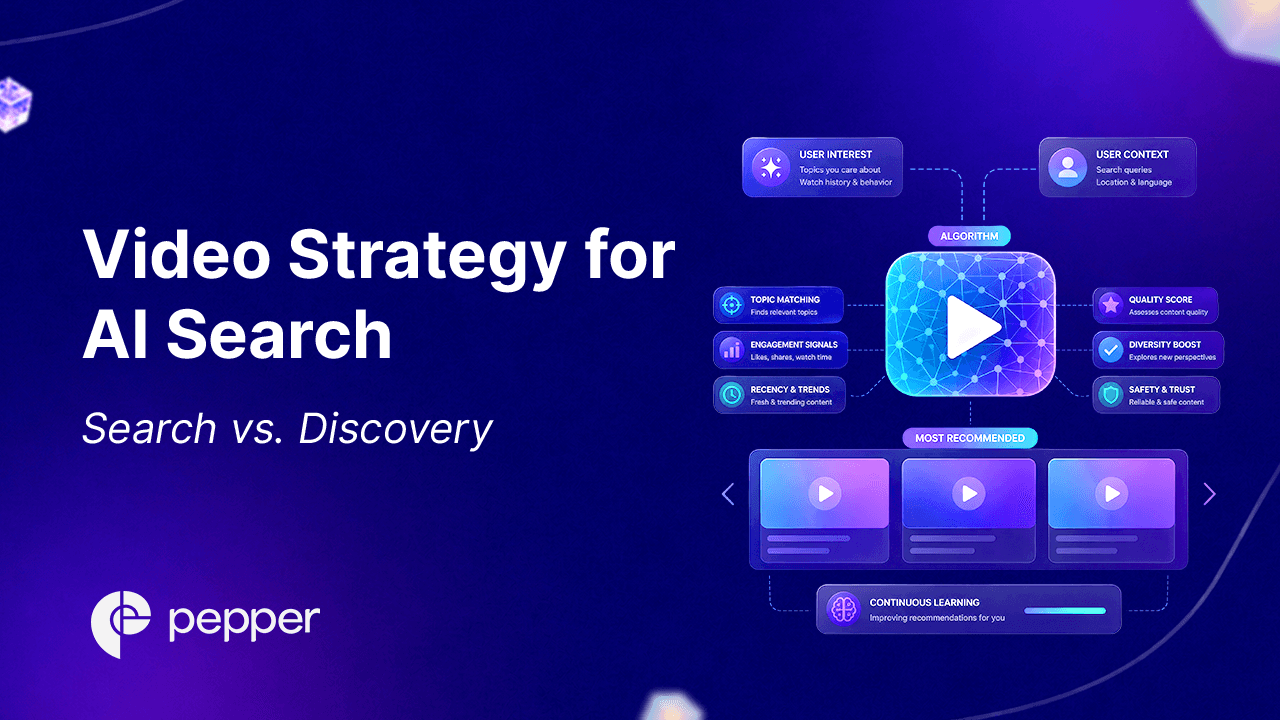
| YouTube is the most cited domain across all LLMs – ahead of LinkedIn, Reddit, and G2 combined. But most brands run a single video strategy when they actually need two distinct ones: a search/conceptual strategy (FAQ and how-to videos that answer specific AI search queries and earn LLM citations) and an engagement/discovery strategy (broad, personality-led content that reaches new audiences through the recommendation algorithm). These two modes have different success metrics, different formats, different titles, and different optimization rules. Conflating them destroys performance in both. This post explains how to separate them – and run both. |
Two Channels in One: Your Video Strategy Map
- Why YouTube Is the Most Important Citation Surface in AI Search
- The Two Modes: Search vs. Discovery
- Mode 1 – Search/Conceptual: Videos Built for LLM Citations
- Mode 2 – Engagement/Discovery: Videos Built for New Audiences
- Why Conflating the Two Destroys Both
- The Dual-Track Operating Model
- Industry Updates: What Marketing Leaders Are Saying
- YouTube Script
- FAQ
Your YouTube channel is probably optimized for neither humans nor machines
Here’s the most common video strategy failure in enterprise marketing: a brand launches a YouTube channel, publishes a mix of product demos, thought leadership clips, event recordings, and the occasional explainer – and gets neither subscribers nor LLM citations.
The diagnosis is almost always the same: the channel is running one undifferentiated strategy when YouTube in 2026 demands two.
YouTube is the most cited domain across all LLMs. Ahrefs’ study of over 1 billion prompts confirmed it: YouTube is the single most cited source across all queries on all LLM platforms. Pepper’s own Atlas data shows 95 YouTube pages indexed in LLM responses – more than LinkedIn, Reddit, and G2 combined.
But the videos that earn those citations are structurally different from the videos that grow audiences. They have different titles, different formats, different lengths, different metadata strategies, and different success metrics. A channel that doesn’t separate the two modes ends up with videos too dry to engage humans and too unfocused to be cited by machines.
| “All the companies in the room who have a bigger competitor in their category – you can beat them with this guerrilla strategy of creating a great amount of video. The larger the company, the harder it is for them to create video. They have to fight through red tape, compliance, and legal.” – Kishan Panpalia, Pepper founding team, at Index ’26 |
| DEFINITION: Search vs. Discovery Video Strategy |
| A dual-track YouTube approach where search/conceptual videos are built to answer specific queries (titled with exact-match question phrases, structured with chapters and transcripts for LLM extraction, optimized for citation) while engagement/discovery videos are built for the recommendation algorithm (titled for curiosity, formatted for watch time and retention, optimized for audience growth). The two tracks have separate success metrics: citations and query coverage for search content; watch time, subscriber growth, and impressions click-through for discovery content. |
Why YouTube Is the Most Important Citation Surface in AI Search
There are 4 structural reasons YouTube dominates LLM citations:
- LLMs don’t watch videos; they read transcripts. A 10-minute expert video produces a 1,500-word, naturally conversational transcript – exactly the structured, spoken-explanation format LLMs extract well.Transcripts are long-form, structured text –
- Timestamped chapters act like H2 headers in a blog post. LLMs extract chapters as structured content segments, making chaptered videos significantly more retrievable than unchaptered ones.Chapters function as content structure –
- Gemini has native access to YouTube’s index, and every major LLM crawls YouTube content through search results. Video content gets indexed faster than most new web domains.YouTube is fully indexed by Google –
- A named expert explaining a concept on camera is a stronger trust signal than anonymous text. The person, their face, their channel history, and their credentials compound into authority signals LLMs weight heavily.Expert-led video carries inherent E-E-A-T weight –
| The competitive asymmetry: large enterprises struggle to produce video at velocity because every video must clear brand, legal, and compliance review. Smaller, faster brands can out-publish enterprise competitors 10-to-1 on video – and capture the citation share that volume produces. Video is the most exploitable GEO gap in most categories right now. |
Mode 1 – Search/Conceptual: Videos Built for LLM Citations
Search videos answer one specific question, completely, in the shortest time the answer allows. They are the video equivalent of a well-structured FAQ page – and they are what LLMs cite.
The Search Video Format Rules
- ‘What is Generative Engine Optimization?’ not ‘The Future of Search Is Here.’ The title must match the question a person types into ChatGPT or Perplexity, in the first 5 words. This is the single highest-leverage decision in search video strategy.Title = the exact query –
- State the direct answer immediately, then expand. LLMs weight the opening of transcripts heavily, the same way they weight the first paragraph of articles. No long intros, no ‘before we start, smash that subscribe button.’Answer in the first 30 seconds –
- Every video over 5 minutes needs timestamped chapters labeled with full descriptive sentences, not keywords. ‘How LLMs read video transcripts’ beats ‘Transcripts.’Chapters with complete-sentence labels –
- Auto-captions are error-prone, and errors corrupt the text LLMs read. Upload a clean manual transcript for every search video. This is what gets extracted and cited.Manual transcript upload –
- The first 3 lines of the description should summarize the video’s answer using natural keywords. This is what YouTube and LLMs index first.Description = 3-sentence summary first –
| Search Video Type | Example Title | Target Outcome |
| Definitional | What is Share of Answer? Explained in 4 Minutes | Cited for ‘what is X’ queries |
| How-to | How to Add FAQ Schema for AI Search (Step-by-Step) | Cited for process queries |
| Comparison | GEO vs SEO: What Actually Changed | Cited for comparison queries |
| FAQ compilation | 10 Questions CMOs Ask About AI Search – Answered | Cited across multiple long-tail queries |
| Mechanism explainer | How LLMs Decide What to Cite – The Mechanics | Cited for ‘how does X work’ queries |
Search video success metrics: LLM citations (tracked via Atlas), impressions from YouTube search (not Browse), query coverage across your topic cluster, and traffic to linked blog content. Subscriber growth is irrelevant for this track – a search video that gets 400 views but earns a recurring ChatGPT citation is a success.
Mode 2 – Engagement/Discovery: Videos Built for New Audiences
Discovery videos are built for the recommendation algorithm – the Browse and Suggested feeds where new audiences find you. Their job is reach, retention, and brand affinity. They are not built to answer one query; they’re built to hold attention.
The Discovery Video Format Rules
- ‘We Audited 5 Famous Brands in ChatGPT – The Results Shocked Us’ beats ‘Brand Audit Tutorial.’ Discovery titles create open loops; search titles close them.Title and thumbnail built for curiosity, not queries –
- Discovery success is governed by retention curves. The first 8 seconds determine whether the algorithm continues recommending the video. Cold-open with the most surprising moment, claim, or result.Hook in the first 8 seconds –
- Discovery videos follow story arcs: setup, tension, payoff. A live brand audit, a results reveal, a debate between experts – these formats hold attention in ways structured explainers can’t.Narrative structure over information structure –
- Discovery content builds parasocial connection with the host. Founder-led discovery content compounds: the audience subscribes for the person, then trusts the brand.Personality is the product –
- 60-second clips from long-form content are the fastest subscriber growth mechanism on YouTube. Every long-form video should generate 3–5 Shorts with 3-second hooks.Shorts as the discovery accelerant –
Discovery video success metrics: impressions click-through rate, average view duration, subscriber conversion, and Browse/Suggested traffic share. LLM citations are irrelevant for this track – a discovery video that earns 50,000 views and 800 subscribers but zero citations is doing its job perfectly.
Why Conflating the Two Destroys Both
The failure mode is structural, not aesthetic. When teams run one strategy for both modes, every video makes compromises that break both systems:
| What Happens to Search Performance | What Happens to Discovery Performance |
| Curiosity-driven titles don’t match queries – LLMs can’t map the video to the questions it answers | Query-matching titles kill click-through – ‘What is FAQ schema’ gets skipped in Browse feeds |
| Narrative structure buries the answer at minute 7 – LLMs extract openings, so the answer is missed | Front-loaded answers kill retention – viewers leave once they have the answer, tanking the retention curve |
| Story-arc chapters don’t map to sub-queries – chapter extraction returns narrative beats, not answers | Complete-sentence query chapters read as dry and reduce session engagement |
| Personality-led tangents dilute transcript relevance – citation precision drops | Stripped-down delivery removes the parasocial hook – subscribers don’t convert |
| Result: the video is never cited | Result: the algorithm stops recommending the video |
The compromise video – informative enough to bore casual browsers, entertaining enough to confuse LLM extraction – is the default output of an undifferentiated video strategy. It is the worst of both worlds, and it describes the majority of enterprise YouTube channels today.
The Dual-Track Operating Model
Running both strategies on one channel is not only possible – it’s the recommended architecture. The separation happens at the planning level, not the channel level. There are 4 operating rules:
- For most B2B brands, search content should outnumber discovery content 2:1. Search videos are cheaper to produce (talking head + screen share), compound through citations, and build the query coverage that justifies the channel. Discovery content is the growth multiplier on top.Plan in a 2:1 search-to-discovery ratio –
- Organize search content into query-clustered playlists (‘GEO Explained’, ‘AI Search How-Tos’) and discovery content into format playlists (‘Live Audits’, ‘Brand Teardowns’). Playlists extend watch time and signal content type to both the algorithm and LLMs.Use playlists as mode separators –
- Every discovery video surfaces audience questions in the comments. Those questions are next month’s search video titles. The discovery track is a continuous query research engine for the search track.Let discovery feed search –
- End every discovery video with a pointer to the relevant search playlist (‘Full step-by-step in the GEO Explained playlist’). End every search video with a discovery hook (‘Watch us audit 5 real brands live’). Each track converts its audience into the other’s.Cross-link the tracks –
| The repurposing multiplier from Pepper’s strategy work: every long-form video – search or discovery – should generate a blog post (from the transcript), 3–5 LinkedIn clips, and 3–5 Shorts. One recording session feeds four channels. This is how a 2-person team sustains a dual-track video engine. |
Industry Updates: What Marketing Leaders Are Saying
Ahrefs Confirms: YouTube Is the #1 Cited Source Across 1 Billion Prompts
Ahrefs’ large-scale study of over 1 billion prompts confirmed what Pepper’s Atlas data has shown across enterprise audits: YouTube is the most cited source across all queries on all LLM platforms. LinkedIn leads for professional queries specifically, but on aggregate, YouTube dominates. For any brand prioritizing GEO investments in 2026, video is no longer a nice-to-have channel – it is the single highest-citation-weight surface available.
The Guerrilla Video Strategy – Small Brands Can Outrun Giants
Kishan Panpalia of Pepper’s founding team made the competitive case at Index ’26: large enterprises struggle to ship video because every piece must clear compliance, legal, and brand review. ‘I have not seen a successful video engine except for a handful of companies that are truly enterprise,’ he noted. For smaller, faster challengers, video volume is a structural advantage that the bigger incumbent literally cannot match – making video the most exploitable GEO gap in most competitive categories.
Instagram Reels Are Now Transcribed and Indexed
Since July 2025, public posts from Instagram professional accounts are automatically indexed by Google and other search engines – with Reels transcribed and indexed as cached HTML. The implication: short-form video strategy now extends beyond YouTube Shorts. The same dual-track logic applies – search-intent Reels (quick answer formats) and discovery Reels (hook-driven formats) – and brands that transcribe and structure their short-form content are building citation surface area on a second video platform.
Sentiment Matters as Much as Visibility
A point from Index ’26 that applies directly to discovery content: the sentiment in which a brand appears on LLMs matters as much as the frequency. One polluted mention or one viral negative Reddit thread can drag brand perception across AI answers. Discovery video – where brands control narrative, tone, and framing – is one of the few channels where a brand can proactively shape the sentiment of the content LLMs learn from. ‘If LLMs know something about your brand, it better come from you.’
Repurposing Is the Operational Unlock
At Index ’26, a GEO practitioner described her team’s workflow shift: ‘We’re working on new workflows to use the content we already have and distribute it into other channels. How do we take the content that we already have and use it to make scripts for YouTube videos?’ The pattern is now standard among high-performing teams: blog content becomes video scripts, video transcripts become blog posts, and both feed LinkedIn. The dual-track video engine doesn’t require doubling content production – it requires routing existing expertise through video formats.
FAQ: Video Strategy for AI Search
Why is YouTube the most cited domain by LLMs?
YouTube dominates LLM citations for four structural reasons: video transcripts are long-form structured text that LLMs can extract directly; timestamped chapters function like H2 headers, making content segments retrievable; YouTube is fully indexed by Google and natively accessible to Gemini; and expert-led video carries strong E-E-A-T signals – a named expert on camera is a higher-trust source than anonymous text. Ahrefs’ study of over 1 billion prompts confirmed YouTube as the most cited source across all LLM platforms.
What is the difference between search videos and discovery videos?
Search videos answer one specific query completely – titled with the exact question phrase, structured with chapters and manual transcripts, with the answer stated in the first 30 seconds. Their success metric is LLM citations and search impressions. Discovery videos are built for YouTube’s recommendation algorithm – titled for curiosity, hooked in the first 8 seconds, structured as narratives, and led by personality. Their success metrics are click-through rate, retention, and subscriber growth. The two formats are structurally incompatible within a single video, which is why they must be planned as separate tracks.
How do I optimize YouTube videos for LLM citations?
There are 5 non-negotiable optimizations: (1) Title the video with the exact target query in the first 5 words; (2) State the direct answer in the first 30 seconds of the video – LLMs weight transcript openings heavily; (3) Add timestamped chapters labeled with complete descriptive sentences; (4) Upload a clean manual transcript – auto-captions contain errors that corrupt what LLMs read; (5) Write the first 3 lines of the description as a keyword-rich summary of the video’s answer. Track citation performance through a platform like Pepper’s Atlas.
Should search and discovery videos be on separate YouTube channels?
No – one channel with separated planning is the recommended architecture. Use playlists to organize the two modes (query-clustered playlists for search content, format-based playlists for discovery content), maintain a 2:1 search-to-discovery production ratio for most B2B brands, and cross-link the tracks in end screens. A single channel accumulates authority signals – subscriber base, watch time history, topical focus – that benefit both tracks. Splitting channels divides those signals and slows both.
How many videos do I need before seeing LLM citations?
Citation velocity depends on query competitiveness, but the pattern from Pepper’s GEO programs is consistent: brands publishing 1–2 search-optimized videos per week typically see first LLM citations within 4–8 weeks for long-tail queries, with meaningful citation share on core topic queries by month 4–6. The compounding factor is topical clustering – 10 videos answering related queries in one cluster outperform 10 videos scattered across topics, because LLMs build topical authority associations at the channel level, not just the video level.
| Want to know which queries your videos could be cited for – and which competitors currently own them? Pepper’s Atlas platform tracks YouTube citation share across ChatGPT, Gemini, and Perplexity, and maps the query gaps your video strategy should target. Start your video citation audit at atlas.pepper.inc |
Latest Blogs
Most advice on this is inference dressed as fact. OpenAI documents exactly one thing clearly, which is access. Here is what is documented, what is inferred, and how to verify the rest for yourself.
Being named in an AI answer and having your page used as its source are different outcomes with different causes and different fixes. The gap between them is the most useful diagnostic in AI search, and most reporting collapses it into one number.
Every platform reports share of voice and almost none of them define it the same way. Here is the definition worth using, the three choices that change the number, and how to measure it yourself without buying anything.
Get your hands on the latest news!

Similar Posts
GEO / AI Search
10 mins read
How to get cited by ChatGPT
GEO / AI Search
10 mins read
Mentioned vs cited: the difference that decides AI visibility
GEO / AI Search
13 mins read