By Dhriti Goyal
Pepper Content · Create for AI Search · Video Deep-Dive
Two different videos. Same brand. Same channel. Same content team. One is a four-minute documentary-style explainer about how the company started – handheld camera, founder voice-over, swelling music, ten thousand views in the first week. The other is a 90-second screen-recording titled “How to set up SAML SSO in 5 steps” – flat lighting, no music, captions burned in, and a quiet 38,000 monthly views that compound for two years. Both videos work. They work because they are not the same kind of video. The brands losing in 2026 are the ones that still treat them as if they were.
YouTube is now the most-cited domain inside large language models. Across our 2026 dataset, YouTube URLs appear in AI answers more often than any other domain – across ChatGPT, Perplexity, Gemini, AI Overviews, and AI Mode. The platform that started as entertainment infrastructure is, quietly, the largest single source of AI citations in the open web. That fact has not yet reached most marketing dashboards.
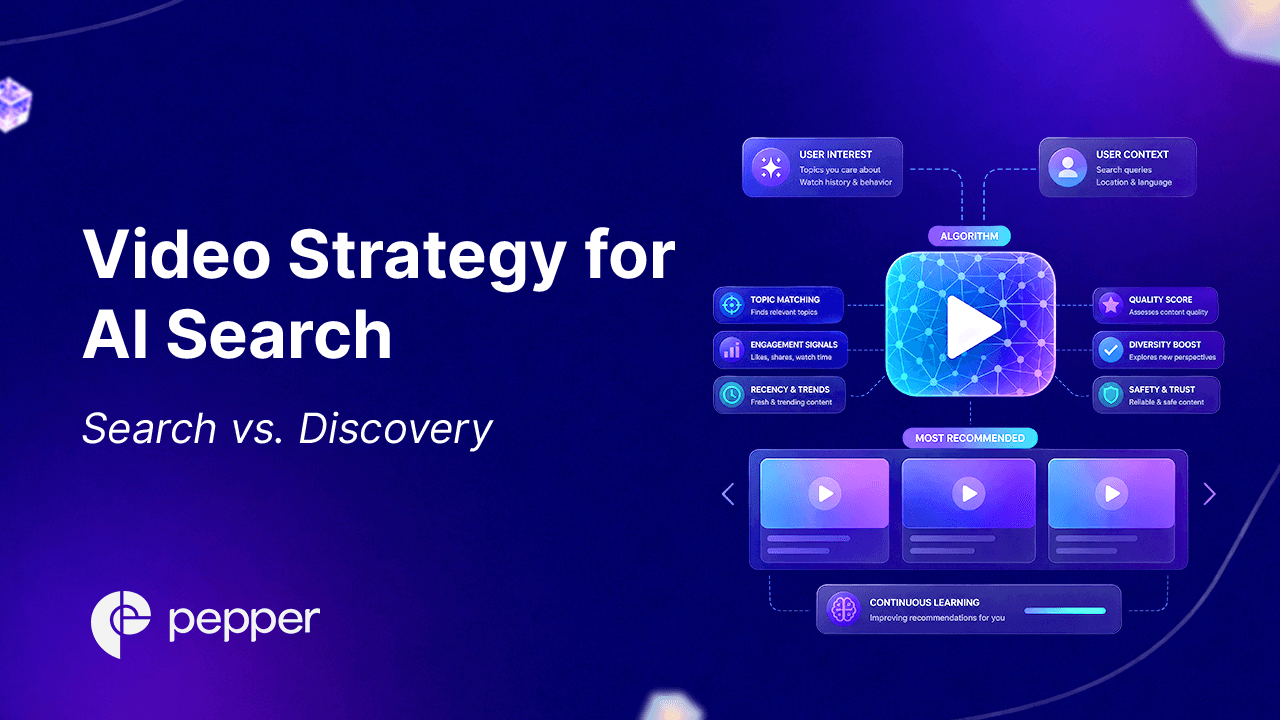
Inside that fact lives a strategic split most teams miss. There are two YouTube strategies, not one. Discovery video is built for the YouTube algorithm and human attention. Search video is built for the AI engines and conceptual queries. The metrics are different, the formats are different, the metadata is different, the success criteria are different – and conflating the two destroys performance in both modes. This piece is the working framework for splitting them, dialled in across hundreds of Pepper enterprise engagements.
“Search is undergoing the most profound transformation of our time. Generative AI is redefining how people discover, trust, and engage with information – moving us from keywords and rankings to intelligence and context at scale.” – Anirudh Singla, Co-founder & CEO, Pepper Content (Index’25 keynote)
YouTube is where that transformation has gone furthest. The brands that recognise the split are the ones citing the next decade of AI.
Why YouTube Is Now Load-Bearing Infrastructure for AI Search
Three forces converge in 2026 to make YouTube the single most important external surface for AI-search citations.
First, transcript indexing. Every public YouTube video has a machine-readable transcript that AI engines can quote, cite, and link directly to with timestamp anchors. That is a functionality no PDF, white paper, or webpage offers natively. When an AI engine cites a Perplexity-style answer that says “as explained at 2:14 in this video,” it is exploiting a citation primitive that only YouTube, at scale, provides.
Second, multimodal density. Pages that combine text, original images, video, and proper schema achieve 317% higher selection rates in AI Overviews. Video is the single highest-leverage way to reach that density on a single brand asset; a written article with an embedded YouTube video and a transcript-rendered FAQ outperforms either format alone by a wide margin.
Third, the trust premium. AI engines cite YouTube videos disproportionately because creators put their face on the camera and their reputation on the line. The implicit verification – a real human, a real channel history, a real subscriber base – functions as exactly the kind of E-E-A-T signal Google’s December 2025 Core Update extended across nearly every category.
The implication is direct. Every brand serious about AI search has a video pillar in 2026. The question is no longer whether to invest. It is which of the two video strategies to invest in, and how to keep them from cannibalising each other.
The Split: Discovery vs Search Video Defined
Discovery video is engagement-mode YouTube. It exists to be found by humans inside YouTube’s recommendation surface. The Home feed, the Suggested column, the Browse Features, the Subscriptions tab. The KPIs are CTR, average view duration, subscriber growth. The format is broad, narratively-shaped, retention-engineered.
Search video is conceptual-query mode. It exists to be cited by AI engines when a buyer types a specific question. The KPIs are AI citations, transcript pull-quotes, and on-site embeds. The format is narrow, structured, fully captioned, and answer-shaped.
The two are not adjacent variations of the same playbook. They diverge across at least eight dimensions, and a video that gets one of those dimensions wrong for its mode performs measurably worse than a video that picks a lane and commits.
| Dimension | Discovery video (engagement) | Search video (conceptual / AI citation) |
| Primary audience | New viewers via the YouTube home and Suggested feed. | Buyers prompting an AI engine with a specific question. |
| Title format | Pattern-broken hooks: “I tried 10 X tools – here’s what happened.” | Literal queries: “How to set up SAML SSO in [tool] (5 steps).” |
| Length | 8–14 minutes; the algorithm rewards watch time. | 2–6 minutes; the AI rewards a complete, citable answer. |
| Thumbnail | High-contrast face, expressive emotion, bold copy. | Clean text-led card; query-matching language. |
| Pacing | Fast cuts, B-roll, music, retention curves shaped to 80%+. | Linear, chaptered, captions burned in. Retention is not the metric. |
| Description | Conversational, links to related videos, optimised for human click-through. | Structured: numbered steps, timestamps, transcript link, FAQ block. |
| Success metric | Click-through rate, average view duration, subscriber lift. | Citations in AI answers, transcript references, on-site embeds. |
| Cadence | Weekly to bi-weekly; consistency trains the algorithm. | On-demand; published as a category prompt is identified as un-served. |
The most expensive mistake is treating a Search video like a Discovery video – adding music, fast cuts, and a clickbait title to a 90-second SAML walkthrough. The pattern-broken title kills AI matching; the music distracts from the captioned step list; the fast cuts erase the linear, chapterable structure the AI engine needs to anchor a timestamp citation. The video underperforms in both modes.
“AI discovery rewards content that proves it has been lived. First-hand experience, original photography, real deployment data – and a verified human attached to all of it.” – Linda Caplinger, Head of SEO & AI Search, NVIDIA (Index’25)
The Discovery-Mode Playbook
Discovery video is a category most marketing teams have run for a decade and most enterprise teams have run badly. The discipline is broadcast-thinking, not search-thinking.
Build for the home feed. The first three seconds are the entire battle for click-through. A presenter looking directly at the camera, a tight pattern-break in the opening line, and a thumbnail-title pair that promises a specific transformation. “I tried five workflow-automation tools so you don’t have to” is a Discovery title. “How to compare workflow automation tools” is not – it should be a Search video instead.
Length is a feature, not a problem. The YouTube algorithm rewards videos that hold attention, and 8 to 14 minutes is the sweet spot for B2B marketing channels in the 2026 dataset. Edit aggressively to maintain a 60%+ retention curve, but do not chase short-form length unless the entire channel is built around it.
Treat the first uploaded video on a topic as the Discovery anchor and the second as the Search asset. The Discovery anchor builds the channel’s subscriber base; the Search asset converts the audience into AI citations. Run both, separately, against the same topic. Sydney Sloan at Index’25 framed the operational version:
“The moment we stopped publishing one video per topic and started publishing two – one for our audience, one for the AI – our citation rate doubled inside a quarter and our subscriber growth held. The split was the unlock.” – Sydney Sloan, former CMO, G2 (Index’25)
The Search-Mode Playbook
Search video is the discipline most enterprise teams have not yet built – and the one with the highest AI-citation leverage in 2026.
Title for the literal query. Use the exact phrasing buyers type into ChatGPT, Perplexity, and Gemini. “How to set up SAML SSO in [tool]” is a Search title. “The complete SSO masterclass” is not. The literal-query format makes the video matchable; the masterclass framing makes it invisible to the AI.
Structure the script for citation. Open with a 50–70-word answer to the primary query in the first 30 seconds. Follow with a chaptered, numbered breakdown – three to seven steps, each with a clear visual anchor and a transcript-friendly verbal hand-off (“Step one: open the admin console”). The AI parses chapters and timestamps as citation anchors. Pages without that structure are systematically under-cited.
Caption everything, burn-in for accessibility and pull a clean SRT for the engines. Render the video transcript on the same page where the video is embedded. AI engines parse on-page transcripts at higher confidence than the YouTube transcript alone, especially for citations.
Forget retention. The success metric is citations, not view duration. A two-minute Search video cited in 18 AI answers per month is a higher-performing asset than a 12-minute Discovery video with double the watch time and zero citations. The dashboards should report the metric that matches the mode.
→ Atlas: Atlas tracks YouTube-citation patterns across all five major AI surfaces, surfaces which Search videos are doing the citation work, and flags Discovery videos that are unexpectedly being cited so the team can build a Search variant on the same topic.
The Portfolio: How to Split the Channel
Most enterprise YouTube channels under-invest in Search video and over-invest in Discovery. The split that works at scale, refined across hundreds of Pepper engagements, is roughly 70/20/10 – a deliberate inversion of where most teams are starting from.
| Asset type | Share of channel | Owner / cadence / metric |
| Search videos | 70% of output | Editorial · on-demand publishing · cited-AI-answer count, transcript pull-quote count, on-site embed count. |
| Discovery videos | 20% of output | Brand / Studio · weekly cadence · CTR, average view duration, subscriber lift. |
| Hybrid (anchor + variant) | 10% of output | Cross-functional · launched together for a single topic · combined dashboard with both metric sets. |
The 70/20/10 split flips the average enterprise channel’s composition. It also resolves the recurring tension between “our subscriber numbers are flat” and “we are not getting cited.” The two complaints come from the same misallocation. Once the channel is split, the Search videos do the citation work and the Discovery videos do the audience-building work, and neither is asked to do both.
Mandy Dhaliwal at Index’25 made the underlying point:
“Enterprise marketing is being re-architected around retrievability, not production volume. Video is the cleanest expression of the principle. Fewer Discovery videos. More Search videos. Both are better.” – Mandy Dhaliwal, CMO, Nutanix (Index’25)
Insights: What Marketing Leaders Are Saying About Video for AI Search
The Index’25 panel on video and AI search produced unusually direct lines from the field.
“YouTube is the most cited surface our buyers find us on, and we did not budget for it as a citation channel a year ago. The dashboard caught up before the strategy did.” – Joyce Hwang, Head of Marketing, Dropbox (Index’25)
“Once we stopped putting music on our how-to videos, our AI citation rate on the same topics doubled. The music was masking the captioned step structure the AI needed to parse.” – Linda Caplinger, Head of SEO & AI Search, NVIDIA (Index’25)
“In a world where AI summarizes everything, the brands that get summarized favourably are the ones with the clearest positioning. On video, ‘clearest positioning’ means an answer that sits inside the first thirty seconds.” – Angelique Bellmer Krembs, former CMO, PepsiCo (Index’25)
“Be the source worth citing. YouTube has become the source AI cites first for procedural and conceptual queries. The brands that ship Search-mode video systematically are the ones building a moat.” – Neil Patel (Index’25 keynote)
“GEO is not just a buzzword, but a new rule book for brand discovery, trust, and selection in an AI-first marketplace. Video is the rule book’s most under-priced chapter.” – Kishan Panpalia, Pepper Content (Index’25)
The Quiet Truth About Video for AI Search
The brands compounding in AI search through video in 2026 are not the ones producing more content. They are the ones who recognised that Discovery and Search are different products, built around different audiences, measured by different KPIs, and shipped on different cadences. The split is operational, not creative – and it is the split most marketing organisations have not yet made.
Pick a topic. Ship the Discovery video for the YouTube algorithm. Ship the Search video for the AI engines. Run both. Measure both. The difference between brands that get cited inside AI answers and brands that do not is whether they have done that twice – once, and then twice – for every category prompt that matters.
→ Atlas: Atlas tracks YouTube-citation patterns across all five major AI surfaces, segments them by Discovery vs Search structure, and surfaces the next ten Search videos a brand should ship to close its highest-leverage citation gaps. Start at atlas.peppercontent.io.
Frequently Asked Questions
Is YouTube really the most-cited domain across AI engines? In our 2026 dataset, YouTube URLs appear in AI answers at the highest frequency of any single domain. The transcript layer, multimodal density, and creator E-E-A-T together produce the citation premium.
Can one video serve both modes? Almost never at the level of execution either mode requires. Hybrid assets exist (10% of the portfolio) but should be planned as such, not as cost-saving compromises.
How long should a Search video be? 2–6 minutes is the working range. Long enough to deliver a complete, chaptered answer; short enough that AI engines parse the full transcript and timestamp anchors reliably.
Do Shorts and TikTok-style videos work for AI citations? They drive Discovery, not Search citations. AI engines cite full-length, transcript-rich videos disproportionately. Use Shorts for distribution; do not rely on them as a citation surface.
What metric should the CMO see on the dashboard? Two: AI citations from Search videos (the leading indicator) and subscriber growth from Discovery videos (the audience asset). Reporting them on the same tile invites confusion.
Latest Blogs
AI search optimization has four cost layers and only one of them has a price you can look up. Software is published, comparable and the cheapest. Agency retainers are published by exactly two firms. Earned media, which drives most AI citations, is priced by almost nobody. And the fourth layer, doing it with your own people, turns out to have no market rate at all. A study of 3,900 SEO job listings found that just 6.3% of senior roles mention AI search, and published salary figures for the same job title differ by 76% between sources.
We re-read every published GEO agency price on 25 September 2026, fifteen days after our own benchmark first recorded them. All four held, which is worth knowing on its own because the software side of this market has been withdrawing prices all quarter. The more useful finding came from the one agency that publishes volumes alongside price. Ten blog articles at $3,000 a month and forty at $8,000 works out at $300 and $200 an article. That is a content production contract with a GEO label, and the citation evidence says content you own accounts for a small minority of AI citations.
Our own benchmark of 30 published prices already answers what GEO costs. This answers the different question, which is what you should budget and where it should go. Two numbers decide it. A study of more than 25 million cited links found earned media drives 84% of AI citations while paid and advertorial content drives 0.3%. And the Gartner CMO survey of 401 CMOs puts marketing at 7.8% of revenue with SEO the largest single line inside owned and earned digital. Put those together and the answer is that GEO is not a new budget line at all. It is a reallocation, and most teams are making it in the wrong direction.
Get your hands on the latest news!

Similar Posts
AI search tracking: how to monitor brand mentions across AI engines in 2026
18 generative engine optimization best practices that actually move citations
Artificial Intelligence
14 mins read