Alternate topic option – Content Chunking for SEO or GEO: How to Write “Retrieval-Friendly” Pages Without Killing Readability
If you’ve ever opened a page and instantly bounced because it looked like one giant paragraph… You already understand chunking.
Content chunking is simply breaking a page into smaller, focused sections—each section covering one idea, one question, or one step—so it becomes easier to scan, understand, and retrieve (by search engines and AI systems).
But here’s the important part: Chunking isn’t “make everything tiny.” Chunking makes everything clear.
| The one-paragraph summary Content chunking is the practice of structuring a page into self-contained sections (chunks), where each chunk answers a specific question or delivers one complete idea, supported by context or evidence, using clear headings and formatting. If an LLM can lift a chunk and it still makes sense on its own, you’re doing it right. |
Why chunking matters more in 2026 than it did before
Because modern search experiences increasingly behave like this:
- A user asks one question
- The system silently expands it into multiple sub-questions
- It retrieves the best passages (chunks) from different pages
- Then it stitches an answer together
Search Engine Land describes AI Mode answers as being built from “multiple fragments or chunks of content.”
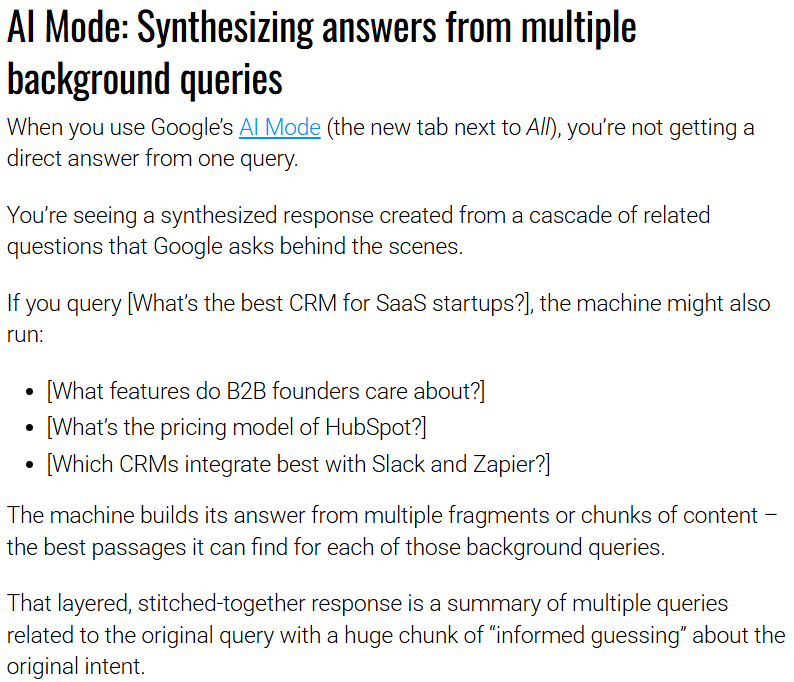
So your page isn’t just competing page vs. page anymore. It’s often chunk vs. chunk.
A reality check: Google’s warning against over-chunking
This is where a lot of advice online goes off the rails.
Danny Sullivan has explicitly warned against reformatting content into “bite-sized chunks” because you think LLMs like it.
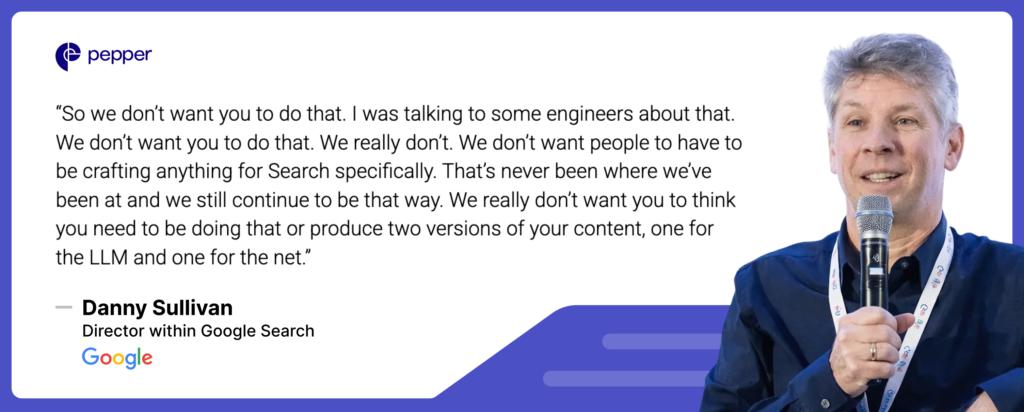
So yes—structure matters. But structure as clarity, not as cosplay.
What a “chunk” actually looks like
A good chunk usually has:
- A descriptive subheading (the question or concept)
- A direct first sentence (the answer, not the warm-up)
- 2–6 lines of explanation (context, nuance, edge cases)
- Optional bullets (steps, criteria, examples, comparisons)
- Optional proof (sources, data, definition, screenshot, quote)
| Mini example (chunk template) H3: What is content chunking? Content chunking is structuring a page into smaller sections where each section answers one question or completes one idea—so both humans and AI systems can scan and retrieve it quickly.Keep one chunk = one intentUse headings that match how people searchPut the “answer sentence” first |
Chunking for SEO vs chunking for AI retrieval
They overlap, but they aren’t identical.
Chunking for SEO (classic)
- Helps readers scan
- Improves time-on-page and comprehension
- Makes topical coverage easier to navigate
Chunking for AI retrieval (2026 reality)
- Helps systems extract the right passage
- Reduces ambiguity inside the chunk
- Makes the chunk usable out of context (citations + summaries)
What SEO folks are saying (real quotes + links)
1) Lily Ray: chunking “works”… but we’re also reading too much into it
Lily shared a post reacting to Danny Sullivan’s comments and pointed out that “chunking content” has become one of the most popular tactics people believe improves AI search discoverability—and that the industry has produced a lot of interpretations of what chunking even means.
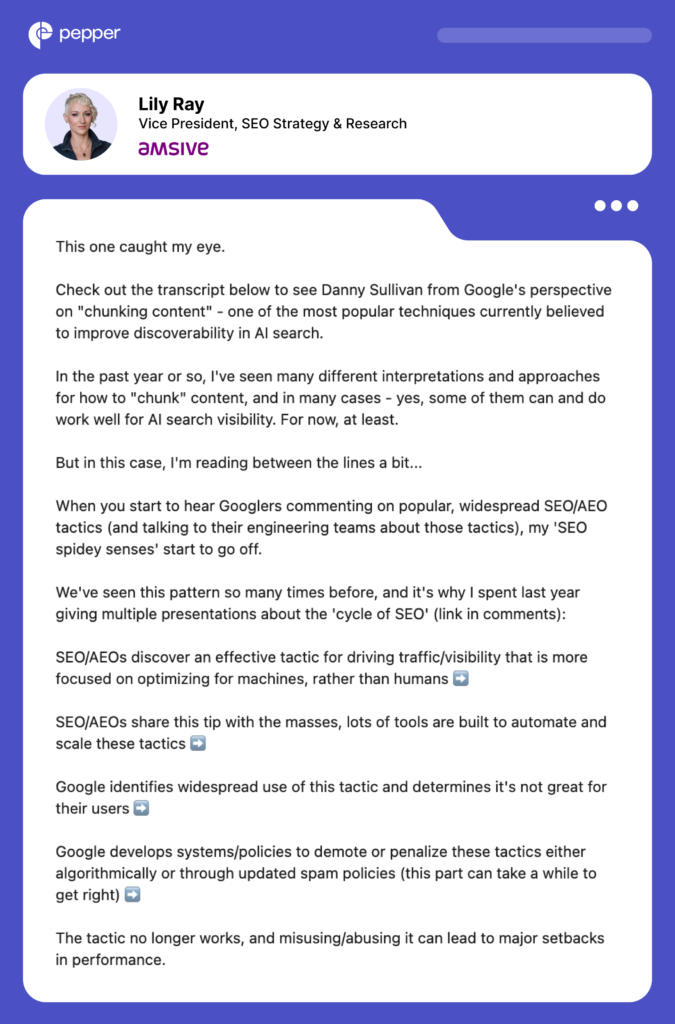
Pepper lens: Treat this as permission to chunk for clarity, not as a new “rule set.” If your chunking reads like a formatting hack, you’re probably optimizing for the wrong judge.
2) Aleyda Solís: chunking is now operational (people are building tools for it)
Aleyda highlighted “Chunk Norris”, a chunking tool built around zChunk, and shared the tool + system prompt details, which is a good signal that chunking is moving from concept → workflow.

Pepper lens: When tools emerge, the practice spreads fast. But tools don’t decide what you should say—only how you package it. The substance still matters more than the split points.
3) Rand Fishkin: “LLM rankings” aren’t stable, so obsessing over position is a trap
Rand’s recent framing is basically: if you’re treating AI visibility like classic rank positions, you’ll misread reality—because these systems are inconsistent and context-sensitive.
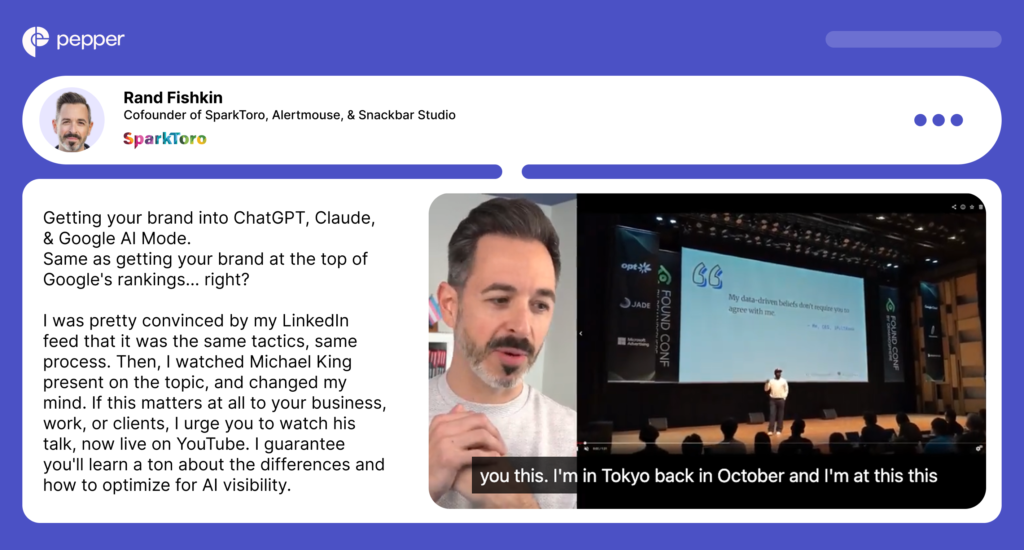
Pepper lens: Chunking isn’t a tactic to “rank #1 in ChatGPT.” It’s a tactic to increase the odds that your best passage is eligible to be pulled into answers across different contexts.
4) Mike King (iPullRank): AI Mode is passage-level selection + relevance engineering
Mike’s write-ups go straight to the mechanics: generative surfaces aren’t just “SEO with summaries.” They’re pipelines that retrieve and select passages, which means you need to think in terms of passage performance and retrieval compatibility.
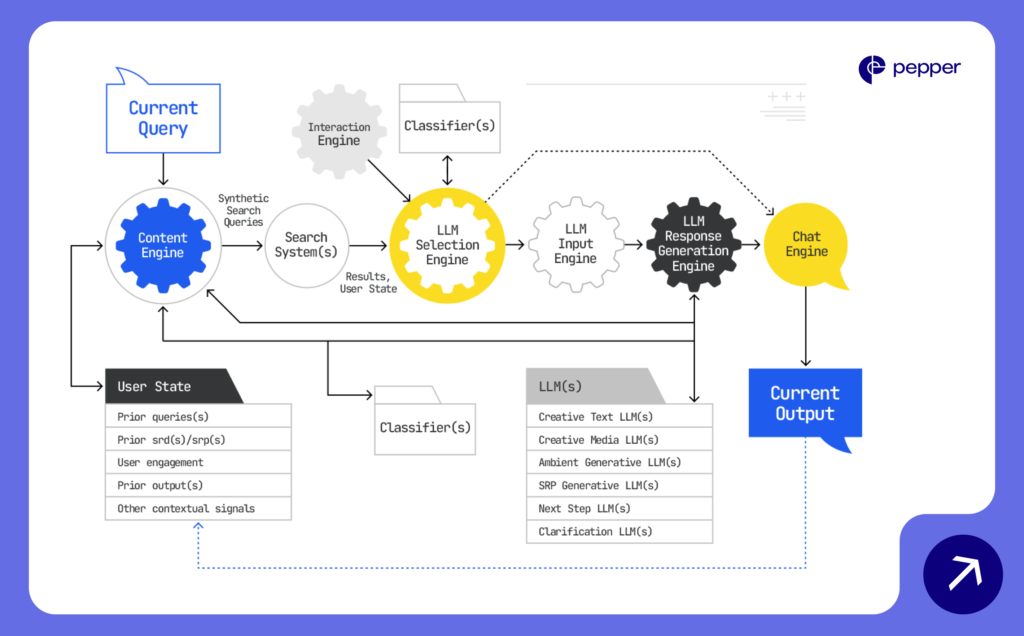
Pepper lens: This is the strongest “why” behind chunking: it’s not a formatting trick—it’s aligning your page structure with how retrieval systems actually consume information.
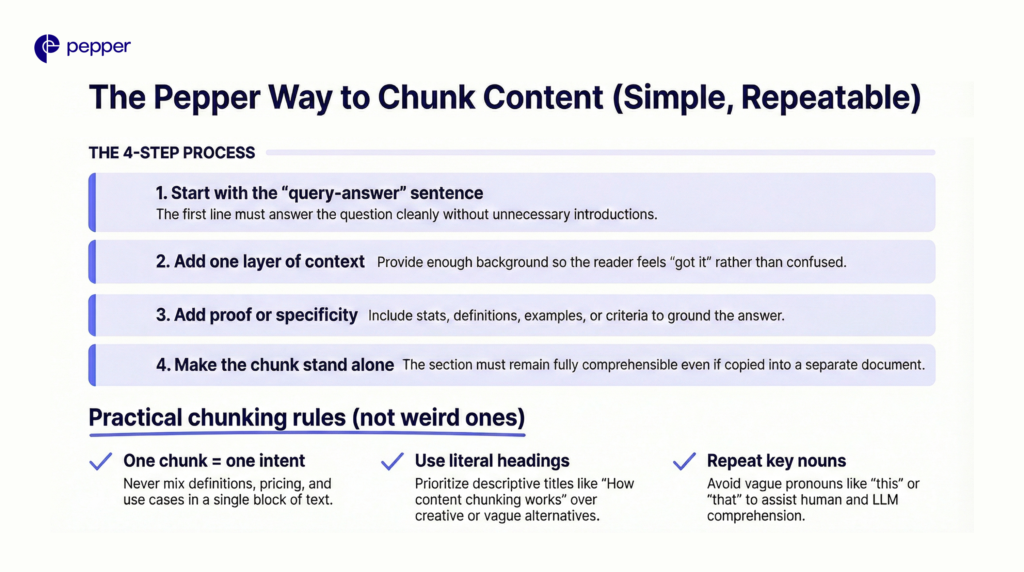
The Pepper way to chunk content (simple, repeatable)
Here’s the pattern we keep coming back to:
1) Start with the “query-answer” sentence
First line answers the question cleanly. No throat-clearing.
2) Add one layer of context
A human should feel “got it,” not “wait, what?”
3) Add proof or specificity
Stats, definitions, examples, criteria, caveats.
4) Make the chunk stand alone
If someone copied only that section into a doc, it should still make sense.
Practical chunking rules (not weird ones)
Use these as defaults (break them when you need to):
- One chunk = one intent (don’t mix definitions + pricing + use cases in one blob)
- Headings should be literal (prefer “How content chunking works” over “The magic behind structure”)
- Short paragraphs are fine, but don’t force micro-paragraphs
- Bullets for lists, paragraphs for reasoning
- Repeat key nouns (LLMs don’t love vague pronouns like “this” and “that”)
- Add “edge-case” sentences where confusion is likely (“In B2B SaaS, this usually means…”)
Common mistakes (that look like chunking but aren’t)
- Over-chunking: everything is 1–2 lines, nothing has substance
- Heading spam: 20 subheads that restate the same point
- Keyword-stuffed micro answers: reads like a robot trying to get cited
- No evidence layer: definitions without examples, claims without support
- Mixed intent sections: “What it is” + “tools” + “pricing” in one chunk
Quick checklist: Will an LLM cite this section?
A chunk is citation-ready if:
- The heading matches a real question people ask
- The first sentence answers it directly
- The chunk includes 1–2 specifics (example, criteria, number, definition)
- The chunk is unambiguous (clear subject, clear terms)
- It reads naturally (not a formatted trick)
FAQs
Is content chunking a new SEO tactic?
No. It’s mostly a new name for clear structure—headings, short sections, and scannable formatting.
Does chunking guarantee AI Overview or LLM visibility?
No. It can help with retrieval, but cannot guarantee AI Overview or LLM visibility.
Should I rewrite every page into tiny chunks?
Google has cautioned against creating “bite-sized chunks” just to appeal to LLMs. Keep structure human-first.
Pepper Takeaway
Chunking works best when you treat it as information design: Answer first. Clarify second. Prove third. And make every section useful enough that it could stand on its own.
Latest Blogs
This blog focuses on 12 of India’s top content writing services.
According to the Content Marketing Institute, one of the most effective ways to promote a business is via good content. At least half of all marketers either are or are planning to use content to reach their customers.
Get your hands on the latest news!

Similar Posts
Content
4 mins read
Best Content Writing Companies in India: 12 Options + Selection Checklist

Blogging
3 mins read
Guest Blogging in 2026: How to Get Published + 60+ Guest Posting Sites
Content
4 mins read