Evergreen content is content that remains relevant, accurate, and useful long after its publication date. Unlike trending content that peaks and fades, evergreen content delivers consistent organic traffic and compounding SEO value over months and years.
Just as pine trees stay green through winter while other trees shed their leaves, evergreen content maintains its value regardless of season or news cycle.
| Quick Tip: For B2B marketers, evergreen content is one of the most cost-effective investments in the content strategy. |
Evergreen Content Explained
Think about the difference between “2026 marketing trends” and “how to write a compelling headline.” The first becomes outdated by January. The second remains valuable indefinitely because the core principles don’t change.
Key characteristics of evergreen content include:
- Consistent relevance—information remains useful regardless of when someone reads it
- Minimal time references—avoids specific years, fads, or rapidly evolving technology
- Adaptability—can be refreshed with updated examples without losing core value
Common evergreen formats include how-to guides, tutorials, glossaries, FAQs, pillar pages, and foundational explainers. Research analyzing billions of articles found that list posts and how-to posts are the most “evergreen” content formats.

| Remember: True evergreen content meets two criteria: it covers a topic with consistent search interest, and the information stays useful over time. |
Why Evergreen Content Matters for SEO
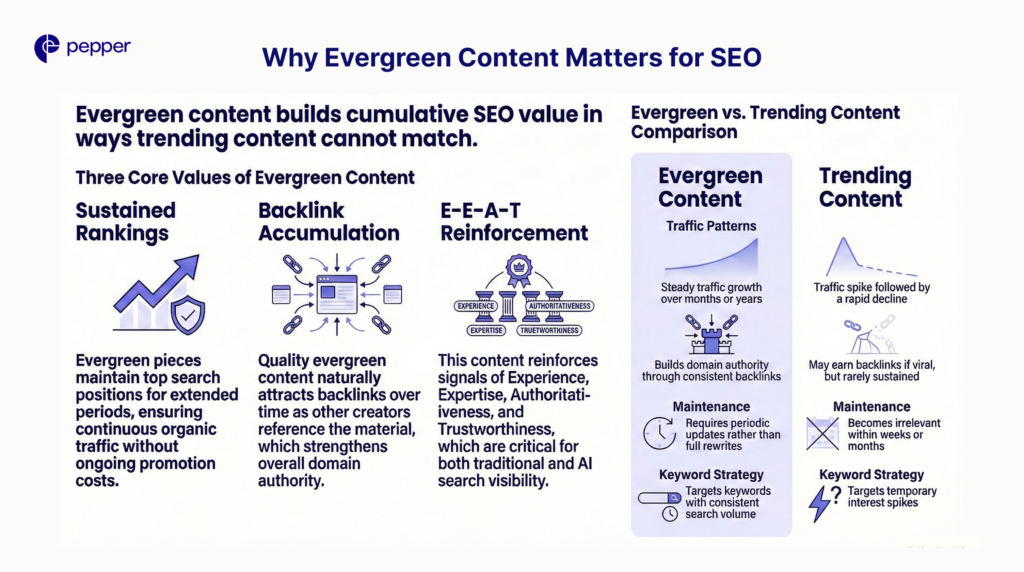
Evergreen content builds cumulative SEO value in ways trending content cannot match.
- Sustained rankings: Evergreen pieces tend to maintain top search positions for extended periods, ensuring continuous organic traffic without ongoing promotion costs.
- Backlink accumulation: Quality evergreen content attracts backlinks over time as other creators reference your material. This steady accumulation strengthens domain authority.
- E-E-A-T reinforcement: Over time, evergreen content reinforces your Experience, Expertise, Authoritativeness, and Trustworthiness signals—critical factors for both traditional search rankings and AI search visibility.
| Evergreen Content | Trending Content |
|---|---|
| Steady traffic growth over months/years | Traffic spike followed by a rapid decline |
| Builds domain authority through backlinks | May earn backlinks if viral, rarely sustained |
| Requires periodic updates, not rewrites | Becomes irrelevant within weeks or months |
| Targets consistent search volume keywords | Targets temporary interest spikes |
How to Create Effective Evergreen Content
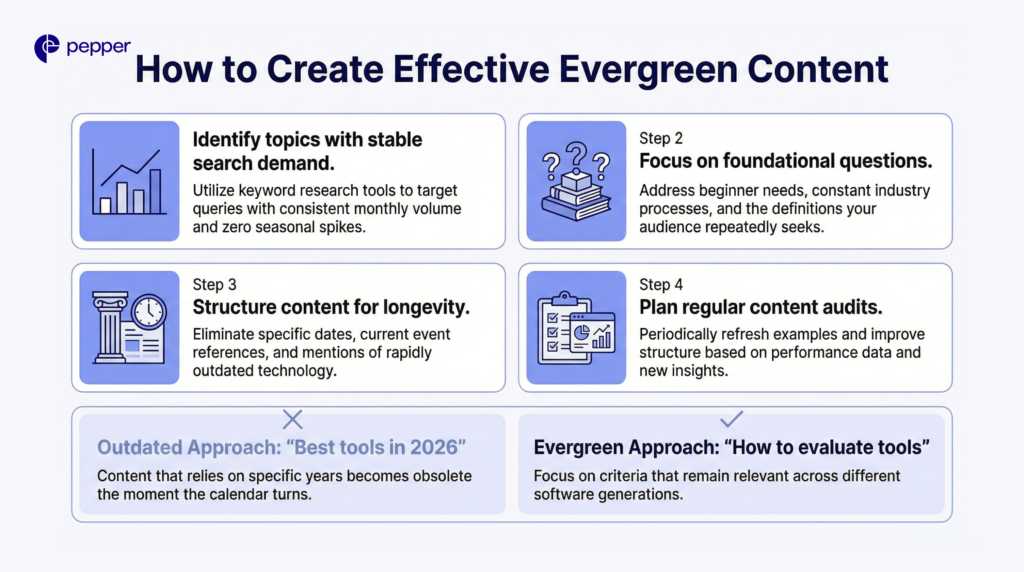
- Start by identifying topics with stable search demand.
- Use keyword research tools to find queries with consistent monthly volume rather than seasonal spikes.
- Focus on foundational questions in your industry.
- What do beginners always need to learn?
- What processes remain constant despite technological changes?
- What definitions or explanations does your audience repeatedly seek?
- Structure content for longevity by avoiding specific dates, current events references, or technology that will become outdated. Instead of “best tools in 2026,” write “how to evaluate tools” with criteria that remain relevant.
- Plan regular content audits. Even evergreen content benefits from periodic updates—refreshing examples, adding new insights, or improving structure based on performance data.
| Quick Takeaway: Evergreen content delivers compounding SEO returns by targeting topics with lasting relevance, building authority through sustained rankings and backlink accumulation. |
Frequently Asked Questions
1. What is evergreen content and why is it important for SEO?
Evergreen content remains relevant long after publication, driving consistent organic traffic without ongoing promotion. It builds domain authority through accumulated backlinks and sustained search rankings.
2. What are examples of the best evergreen content formats?
How-to guides, tutorials, glossaries, FAQs, pillar pages, and beginner’s guides consistently perform well. These formats address foundational questions that audiences always need answered.
3. How often should evergreen content be updated?
Review evergreen content quarterly or semi-annually. Update statistics, refresh examples, and improve structure based on search performance data while keeping core information intact.
4. How does evergreen content differ from trending content?
Evergreen content targets consistent search demand and builds value over time. Trending content captures temporary interest spikes but becomes irrelevant quickly, requiring constant creation to maintain traffic.
5. What topics work best for an evergreen content strategy?
Foundational concepts, how-to processes, definitions, best practices, and comparison guides work well. Choose topics where core principles remain stable despite industry changes.
Latest Blogs
AI search optimization has four cost layers and only one of them has a price you can look up. Software is published, comparable and the cheapest. Agency retainers are published by exactly two firms. Earned media, which drives most AI citations, is priced by almost nobody. And the fourth layer, doing it with your own people, turns out to have no market rate at all. A study of 3,900 SEO job listings found that just 6.3% of senior roles mention AI search, and published salary figures for the same job title differ by 76% between sources.
We re-read every published GEO agency price on 25 September 2026, fifteen days after our own benchmark first recorded them. All four held, which is worth knowing on its own because the software side of this market has been withdrawing prices all quarter. The more useful finding came from the one agency that publishes volumes alongside price. Ten blog articles at $3,000 a month and forty at $8,000 works out at $300 and $200 an article. That is a content production contract with a GEO label, and the citation evidence says content you own accounts for a small minority of AI citations.
Our own benchmark of 30 published prices already answers what GEO costs. This answers the different question, which is what you should budget and where it should go. Two numbers decide it. A study of more than 25 million cited links found earned media drives 84% of AI citations while paid and advertorial content drives 0.3%. And the Gartner CMO survey of 401 CMOs puts marketing at 7.8% of revenue with SEO the largest single line inside owned and earned digital. Put those together and the answer is that GEO is not a new budget line at all. It is a reallocation, and most teams are making it in the wrong direction.
Get your hands on the latest news!

Similar Posts
Content
17 mins read
How to structure content for answer engines, when the structure is not the hard part

Content
12 mins read
How to write content that AI engines actually cite

Blogging
14 mins read