Summary
LLMs.txt is a proposed markdown standard designed to help AI models efficiently parse website content by providing a clean, structured summary distinct from HTML clutter. While it offers specific benefits for developer documentation and token efficiency, major AI search providers like Google do not currently support the file for ranking purposes.
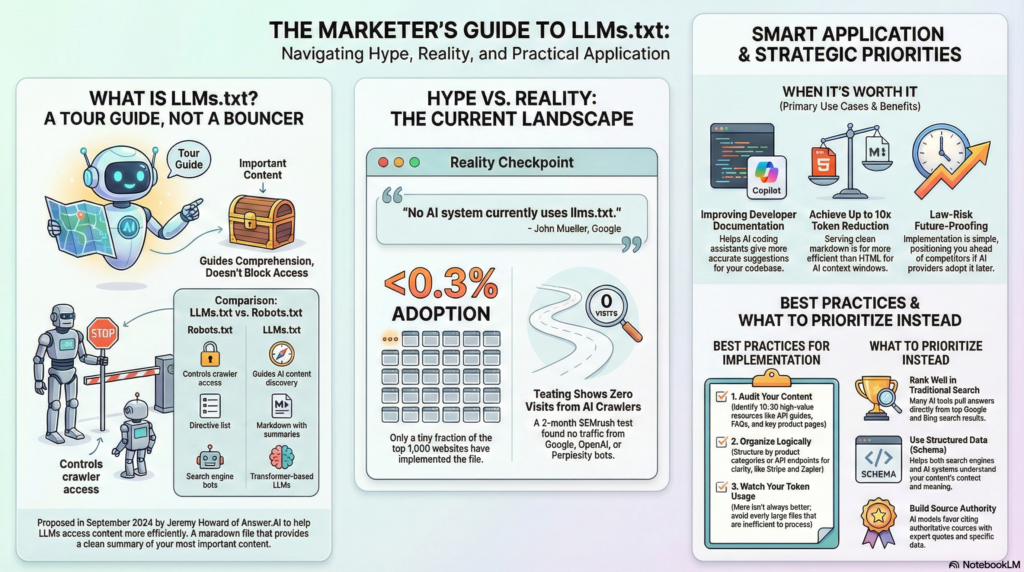
Your competitors started adding LLMs.txt files to their websites. Your SEO team wants to know if you should do the same. The problem? No major AI provider has confirmed they actually use these files.
LLMs.txt emerged in September 2024 as a proposed standard for helping large language models access website content. With nearly 60% of Google searches now ending without clicks and AI referral traffic growing 527% in just five months, the pressure to optimize for AI search is real.
But does LLMs.txt actually help with AI ranking and content optimization?
This guide breaks down what LLMs.txt is, how it compares to robots.txt SEO, whether it improves visibility in AI search, and what SEO sites should prioritize instead.
What Is LLMs.txt and How Does It Work?
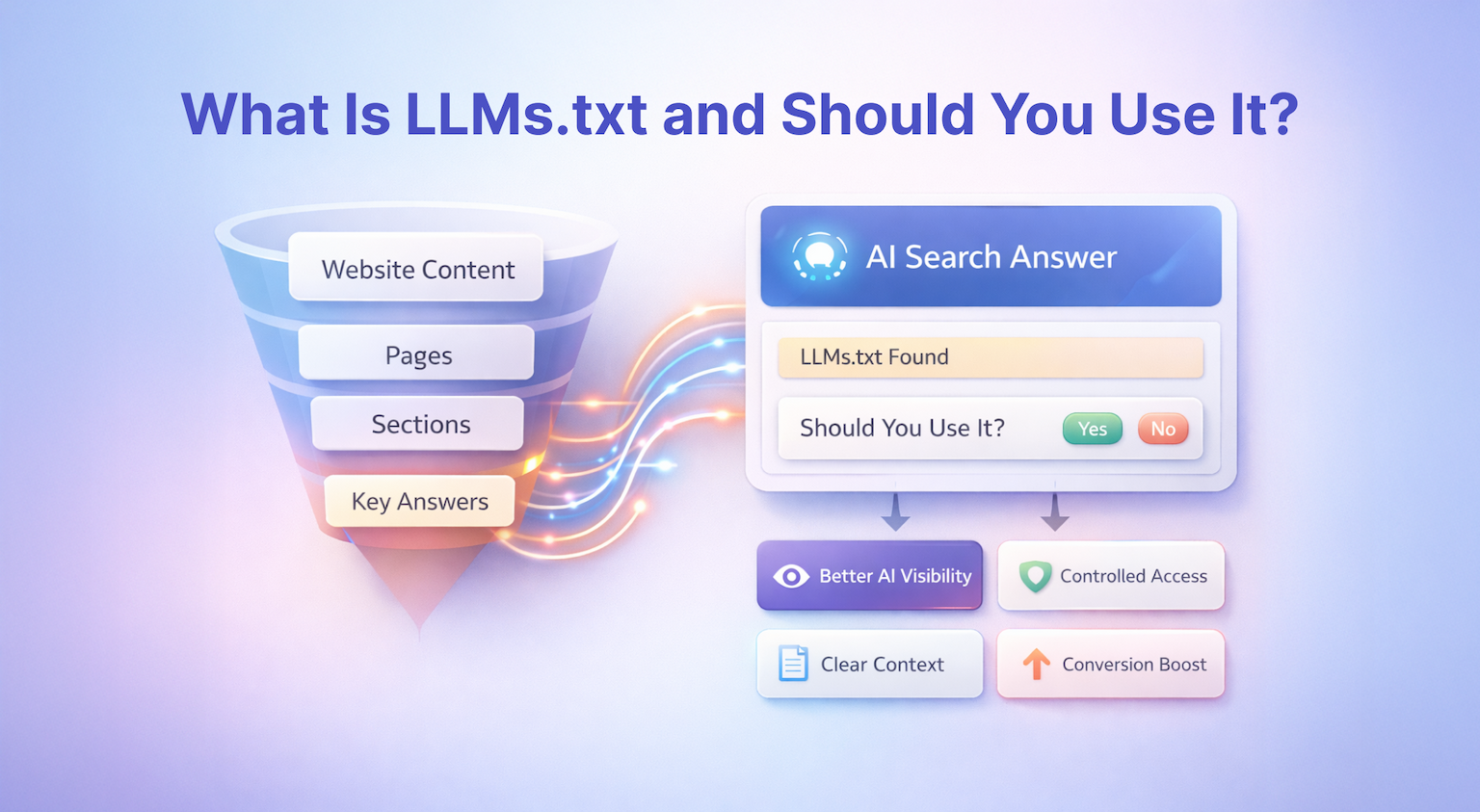
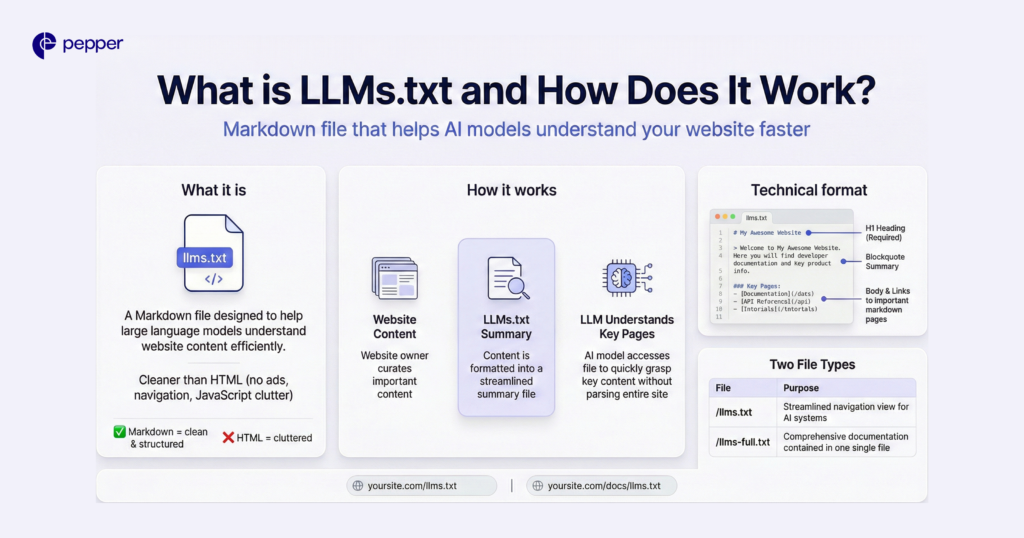
LLMs.txt is a markdown file designed to help large language models understand your website content more efficiently. Unlike traditional HTML pages filled with navigation, JavaScript, and ads, LLMs.txt provides a clean, structured summary of your most important content.
The standard was proposed by Jeremy Howard, Co-founder of Answer.AI, on September 3, 2024. You can read the full specification at llmstxt.org.
The Technical Format
The file uses markdown formatting rather than XML or JSON. This design choice was intentional. LLMs process markdown more efficiently than complex structured formats.
A compliant LLMs.txt file requires:
- H1 heading: Your project or site name (the only mandatory element)
- Blockquote: A summary with key information
- Body sections: Detailed information about your site and content
- Links: URLs to your most important markdown files
The specification defines two file types:
| File | Purpose |
| /llms.txt | Streamlined navigation view for AI systems |
| /llms-full.txt | Comprehensive documentation in one file |
Where It Lives
Place the file at your website’s root path: yoursite.com/llms.txt. You can also use subpaths /docs/llms.txt for documentation-specific implementations.
How Is LLMs.txt Different from Robots.txt SEO?
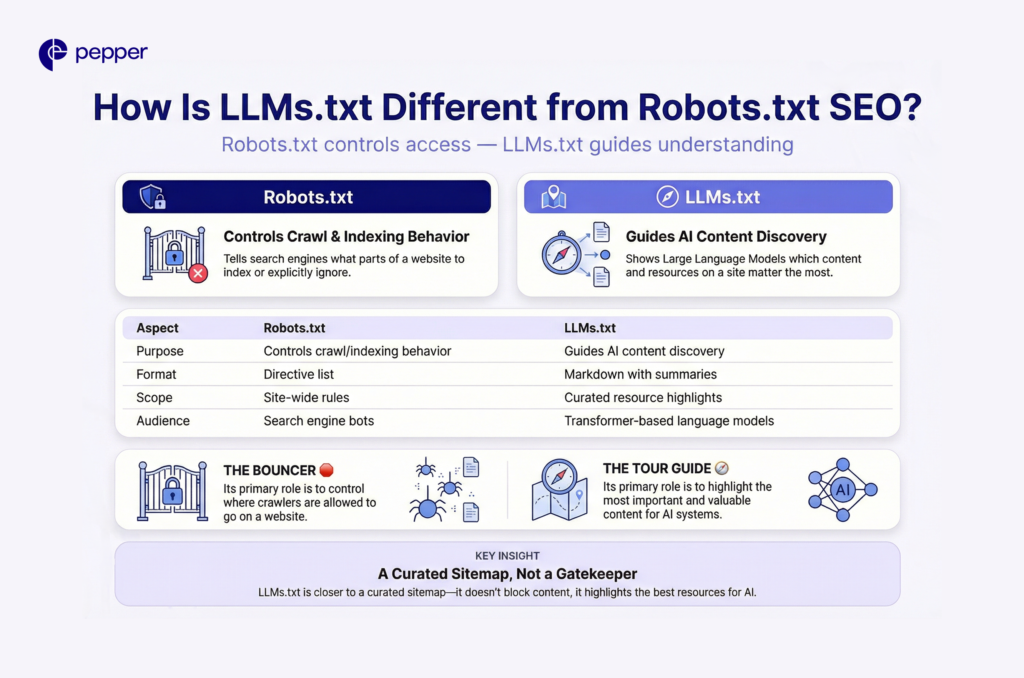
Many marketers assume LLMs.txt functions like robots.txt SEO. This comparison misses the fundamental purpose difference.
- Robots.txt controls crawler access. It tells search engines what to index or ignore. It uses directive-based syntax and applies site-wide rules.
- LLMs.txt guides AI comprehension. It instructs language models on where to locate valuable content. It uses markdown formatting and highlights specific resources.
Think of it this way: robots.txt is a bouncer telling crawlers where they can go. LLMs.txt is a tour guide showing AI systems what matters most.
| Aspect | Robots.txt SEO | LLMs.txt |
|---|---|---|
| Purpose | Controls crawl/indexing behavior | Guides AI content discovery |
| Format | Directive list | Markdown with summaries |
| Scope | Site-wide rules | Curated resource highlights |
| Audience | Search engine bots | Transformer-based language models |
Does LLMs.txt Actually Improve AI Ranking?
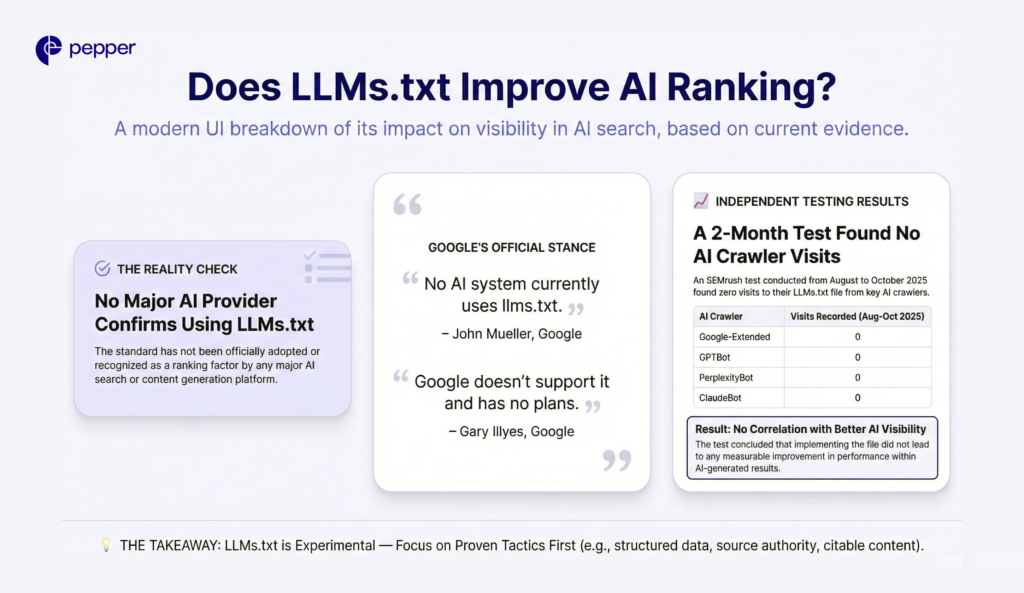
Here’s the honest answer: no major AI provider has confirmed they use LLMs.txt files.
Google’s John Mueller stated clearly on Bluesky: “FWIW, no AI system currently uses llms.txt.” At Search Central Live in July 2025, Gary Illyes confirmed Google doesn’t support the standard and has no plans to do so.
What the Testing Shows
SEMrush ran a two-month test from mid-August to late October 2025. Their LLMs.txt page received zero visits from:
- Google-Extended bot (Google’s AI crawler)
- GPTbot (OpenAI’s crawler)
- PerplexityBot
- ClaudeBot
Their conclusion? “We didn’t find a correlation between implementing llms.txt and improved performance in AI results.”
The Adoption Reality
Current adoption numbers tell a clear story:
- Only 0.3% of the top 1,000 websites have implemented LLMs.txt
- Just 951 domains had published files as of July 2025
- Growth is happening from a near-zero base (15 sites in February 2025 to 105 by May)
That said, companies like Anthropic, Cloudflare, Coinbase, and Stripe have implemented LLMs.txt. Anthropic publishing one on their own site suggests openness to the concept, even without official crawler support.
Why Should SEO Sites Consider LLMs.txt?
Despite limited AI crawler support, LLMs.txt offers specific benefits for certain SEO sites.
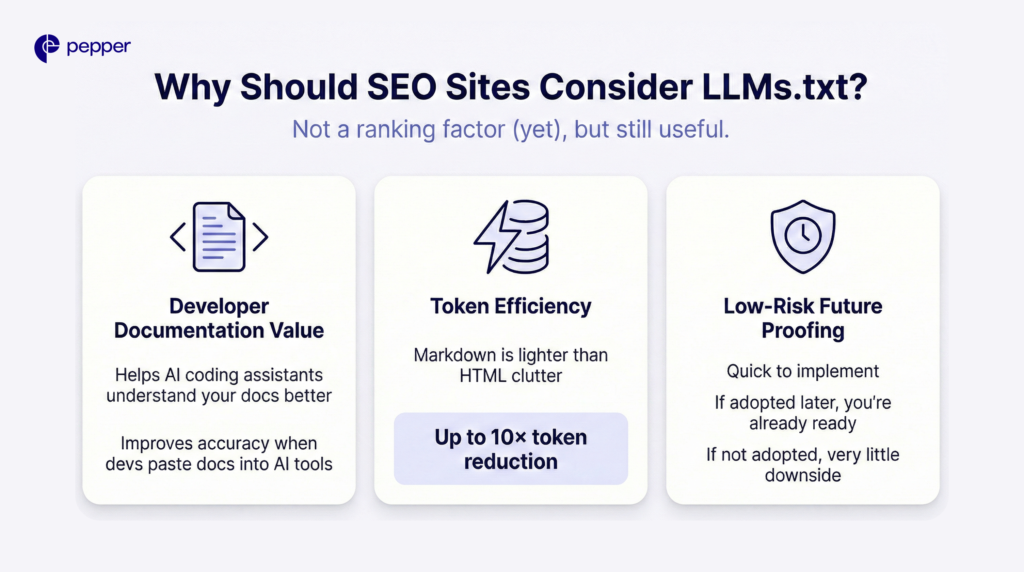
1. Developer Documentation Value
The strongest use case isn’t AI ranking in search results. It’s improving how AI coding assistants understand your documentation.
When developers paste your docs into ChatGPT, Claude, or Copilot, well-structured LLMs.txt files help these tools provide more accurate suggestions.
2. Token Efficiency
LLMs have limited context windows. They can only process so much text at once. Converting HTML pages with navigation, ads, and JavaScript into usable content wastes tokens.
Mintlify found that companies report up to 10x token reductions when serving Markdown instead of HTML. This efficiency matters when users manually share your content with AI assistants.
3. Low-Risk Future Proofing
Implementation takes minimal effort. You’re creating a markdown file with your best content links. If AI providers adopt the standard later, you’re ready. If they don’t, you’ve lost little.
Standards evolve. Robots.txt, schema markup, and sitemaps all took years to reach widespread adoption. Early implementation positions you ahead of competitors when adoption accelerates.
How Can an AI SEO Tool Help with LLMs.txt Creation?
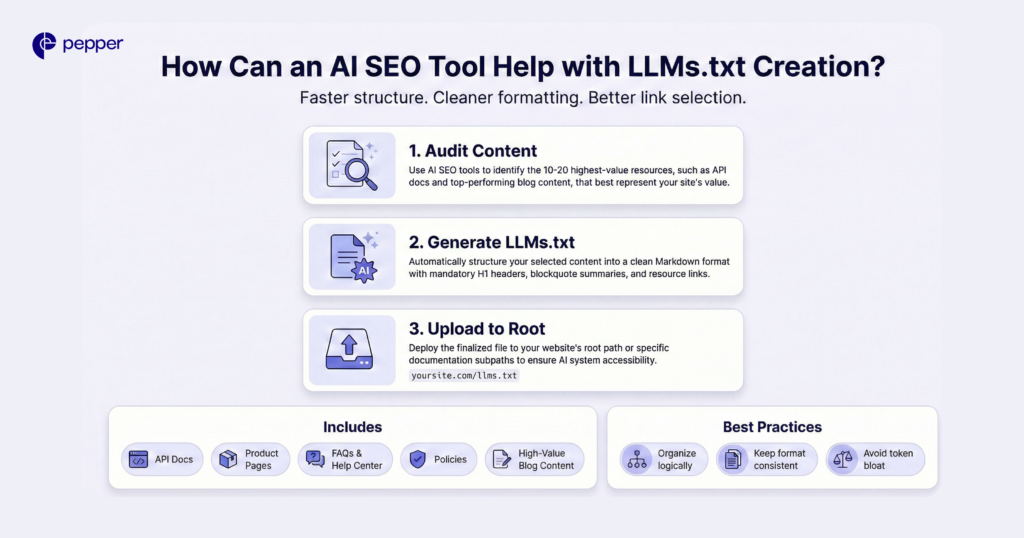
Creating a compliant LLMs.txt file requires identifying your most valuable content, structuring it in markdown, and maintaining consistency. An AI SEO tool can streamline this process.
What to Include
Before creating your file, determine which content deserves highlighting:
- API documentation and developer guides
- Product pages and feature explanations
- Help center articles and FAQs
- Policy pages (returns, privacy, terms)
- High-value blog content and research
Creation Steps
Building your file takes three steps:
- Audit content: Identify 10-20 resources that best represent your site’s value
- Create the file: Use a text editor to write markdown following the spec
- Upload to root: Place at
yoursite.com/llms.txt
What Should You Prioritize Over LLMs.txt?
If you’re focused on visibility in AI-generated answers, LLMs.txt shouldn’t top your priority list. Proven tactics deliver more reliable results.
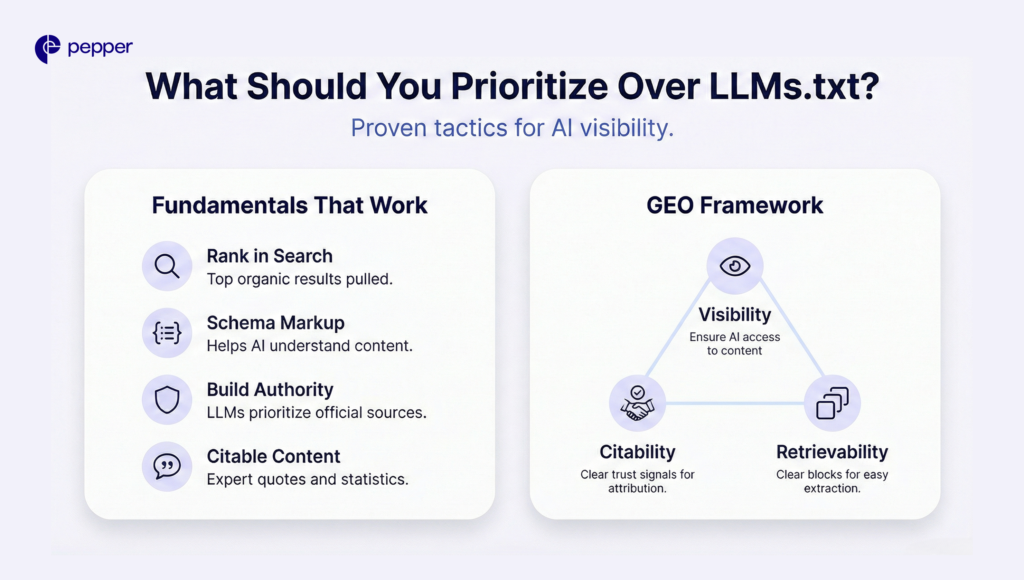
Fundamentals That Work
Focus on strategies with confirmed impact:
- Rank well in traditional search: Many AI tools pull directly from Google and Bing results. Strong organic rankings improve AI visibility.
- Use structured data: Schema markup helps both search engines and AI systems understand your content. This applies to FAQs, how-to content, product information, and organization details.
- Build source authority: LLMs weigh sources differently. Wikipedia, high-authority publishers, and official documentation get cited more frequently.
- Create citable content: Include expert quotes, specific statistics, and clear factual statements. LLMs prefer content they can attribute confidently.
The GEO Framework Approach
Pepper’s approach to Generative Engine Optimization focuses on three pillars:
- Visibility: Can LLMs access and index your content?
- Citability: Do your pages include trust signals LLMs rely on?
- Retrievability: Is the content structured in blocks that LLMs can extract?
Pepper applied this framework for Acceldata and grew organic traffic 6X, from 5.5K to 33.4K monthly visitors. They ranked #1 for “data observability” by creating structured, expert-backed content that both search engines and AI systems could process efficiently.
Track What Matters
AI referral traffic converts at 14.2% compared to Google’s 2.8%. This traffic is valuable when you capture it. But you need visibility into where your brand appears in AI answers.
Pepper’s Atlas platform tracks brand presence across ChatGPT, Gemini, and Perplexity. You can see exactly where you appear in AI-generated responses, measure share-of-voice against competitors, and identify content gaps to address.
The Bottom Line on LLMs.txt
LLMs.txt represents an interesting experiment in AI content optimization, not a proven ranking factor.
The standard has legitimate value for developer documentation sites where users manually share content with AI coding assistants. The token efficiency and structured format help AI tools deliver better responses.
For general AI ranking in ChatGPT, Perplexity, or Google AI Overviews? The evidence doesn’t support prioritizing LLMs.txt over proven GEO fundamentals.
Your next step: Audit your current AI visibility before investing in experimental standards. Test 20-30 prompts your buyers might ask across ChatGPT and Perplexity. See where your brand appears. That baseline tells you whether you need better content structure, more authoritative sources, or more targeted pages addressing buyer questions.
| Key Takeaways 1. Distinct Purpose: LLMs.txt guides AI models to valuable content using markdown, whereas robots.txt controls crawler access and indexing behavior. 2. Lack of Support: Major providers like Google have confirmed they do not currently use LLMs.txt, and independent tests show zero visits from AI crawlers. 3. Documentation Value: The standard is most effective for developer documentation, helping AI coding assistants provide accurate suggestions with high token efficiency. 4. Token Reduction: Serving markdown through LLMs.txt can reduce token usage by up to 10x compared to processing standard HTML pages with navigation and ads. 5. Strategic Focus: Marketers should prioritize proven tactics like structured data and source authority over this experimental standard to improve AI visibility. |
Frequently Asked Questions:
1. What is LLMs.txt, and how is it different from robots.txt SEO?
LLMs.txt is a markdown file that guides AI systems to your best content. Unlike robots.txt SEO, which controls crawler access and indexing behavior, LLMs.txt highlights valuable resources without restricting anything. Think of robots.txt as access control and LLMs.txt as a curated content guide.
2. Why should SEO sites implement an LLMs.txt file for better AI ranking?
SEO sites with developer documentation see the clearest benefits. When users share docs with AI coding assistants, structured LLMs.txt files improve response accuracy. For general AI ranking in search results, evidence of impact remains limited since no major AI provider confirms using these files.
3. How does an LLMs.txt file assist with content optimization for AI crawlers?
LLMs.txt supports content optimization by providing markdown-formatted summaries that LLMs process more efficiently than HTML. This reduces token usage by up to 10x and helps AI systems quickly identify your most valuable content without parsing navigation elements, ads, and JavaScript.
4. Can using an AI SEO tool help you generate a compliant LLMs.txt file?
Yes, an AI SEO tool can audit your content to identify high-value pages worth including. Tools help you structure information consistently, maintain proper markdown formatting, and ensure your file follows the specification without exceeding practical token limits for AI consumption.
5. Does an LLMs.txt file improve visibility in AI ranking algorithms?
Current evidence suggests minimal impact on AI ranking visibility. SEMrush testing showed zero AI crawler visits to LLMs.txt files over two months. Google has confirmed they don’t support the standard. The primary value lies in developer documentation use cases, not AI search rankings.
Latest Blogs
This blog focuses on 12 of India’s top content writing services.
According to the Content Marketing Institute, one of the most effective ways to promote a business is via good content. At least half of all marketers either are or are planning to use content to reach their customers.
Get your hands on the latest news!