YMYL and GEO: Why Healthcare Brands Need a Different AI Search Strategy
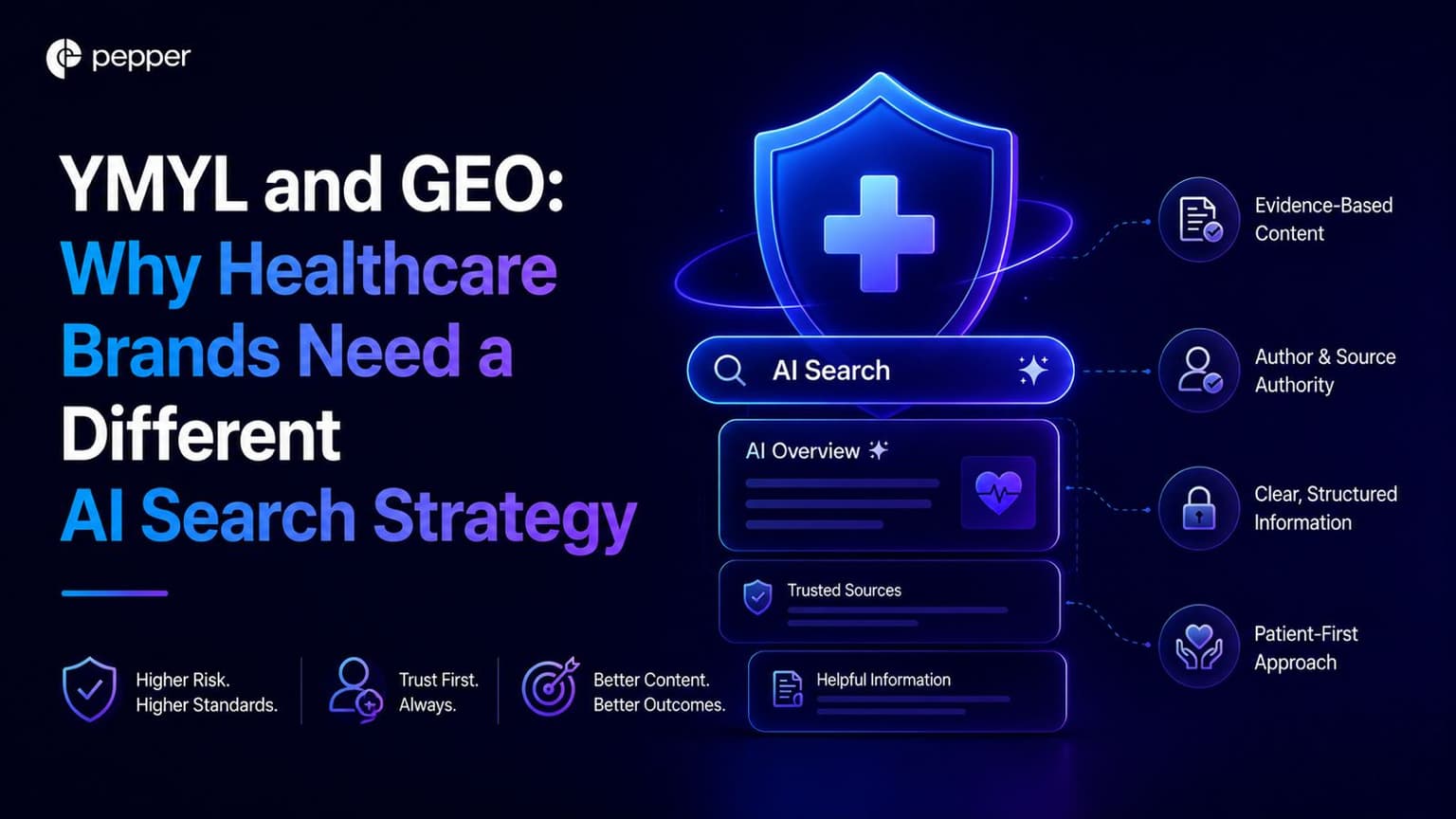
TL;DR: Google holds YMYL content, Your Money or Your Life, to a higher trust bar in AI Overviews, and healthcare clears that bar differently than finance or legal content does. Only 24 percent of healthcare AI Overview citations overlap the organic top 10, meaning ranking well on Google and getting cited by its AI Overview are now separate outcomes. Healthcare condition and symptom queries trigger AI Overviews 93 percent of the time, the highest rate of any YMYL query type, which makes this the category where the gap matters most.
Google has said plainly that it applies “an even higher bar for showing supporting information from reliable and trustworthy sources” to YMYL content. What that bar actually looks like varies a lot by category, and healthcare’s version of it is stricter and stranger than most brands assume.
Here’s the real relationship between YMYL and GEO, backed by Google’s own data on how YMYL content performs in AI Overviews. And here’s why a healthcare brand’s AI search strategy has to look different from a finance or legal brand’s.
Where to Jump In
- YMYL and GEO: What YMYL Actually Covers
- Why Healthcare Behaves Differently Than Other YMYL Categories
- The Ranking-Isn’t-Citation Problem
- What a Healthcare-Specific Strategy Actually Requires
- How Pepper Does It
- FAQ
YMYL and GEO: What YMYL Actually Covers
YMYL stands for Your Money or Your Life, Google’s own classification for content that can significantly affect a reader’s health, financial stability, safety, or major life decisions, and it triggers stricter sourcing standards in both traditional search and AI Overviews. Google’s official YMYL categories span financial security (investments, taxes, loans), health and wellness (illnesses, treatments, pharmaceuticals), physical safety, online safety, content about groups of people, legal and civic matters, major life decisions like education and housing, and shopping or commerce decisions.
Healthcare and finance both sit inside YMYL, but they don’t behave the same way once an AI Overview has to decide what to cite. Treating “YMYL strategy” as one playbook across every category is where most of the confusion starts.
Takeaway: YMYL isn’t a single content rule. It’s a classification that triggers a stricter trust filter, and each category underneath it clears that filter differently.
Why Healthcare Behaves Differently Than Other YMYL Categories
The clearest evidence is in how often each YMYL category actually triggers an AI Overview at all. Semrush’s November 2025 data found 16.04 percent of health keywords triggering AI Overviews overall. That number hides enormous variation by query type: condition and symptom queries hit a 93 percent trigger rate, general health education queries hit 74 percent, while local health queries sat at just 11 percent.
Finance looks structurally different. Only 7.78 percent of finance keywords triggered AI Overviews in the same period. Specific finance sub-categories were moving fast, though: cash management queries jumped from 13 percent to 79 percent coverage, financial planning from 6 percent to 73 percent, tax planning from 0 percent to 63 percent. Legal and government queries triggered AI Overviews just 12.42 percent of the time and were actually trending down slightly.
Takeaway: healthcare’s AI Overview exposure is heavily concentrated in condition and symptom queries specifically, the exact moment a patient is trying to self-diagnose or understand a diagnosis, which is precisely where accuracy matters most and margin for a wrong answer is lowest.
The Ranking-Isn’t-Citation Problem
Here’s the finding that should reshape how a healthcare brand thinks about its own SEO data. Across YMYL categories, the overlap between what ranks in Google’s organic top 10 and what actually gets cited in the AI Overview is surprisingly low. Healthcare sits at 24.0 percent, insurance at 22.4 percent, education at 23.1 percent, and finance at just 11.3 percent.
Finance takes this further still: 65.7 percent of finance AI Overview citations come from sources entirely outside the top 100 organic results. Healthcare is somewhat better on this specific measure, with 22.5 percent of its citations coming from outside the top 100. “Somewhat better” still means roughly one in four citations skips the traditional ranking system almost entirely.
Takeaway: a healthcare brand ranking well on page one has real reason to assume it’s doing something right, and equally real reason not to assume that translates into AI Overview citation. Those are now two separate scorecards, and most SEO teams are only tracking one of them.
What a Healthcare-Specific Strategy Actually Requires
Google is explicit that it applies extra safety and quality systems specifically to protect YMYL categories. That includes core safety guardrails, spam-detection systems tuned against low-quality sources, a higher confidence threshold before an AI Overview fires at all, and a deliberate avoidance of triggering in “data voids” where trustworthy information is scarce. For a healthcare brand, that translates into concrete requirements, not abstract advice.
- Prioritize condition and symptom content first. That’s where 93 percent of health AI Overview triggering already concentrates, and where the highest-quality, most current content pays off fastest.
- Don’t lean on organic rank as a leading indicator. With only 24 percent overlap between top-10 rankings and actual citations, track AI Overview visibility as its own metric, not a byproduct of traditional SEO.
- Expect slower, more conservative movement than other categories. Healthcare and other YMYL verticals shift more cautiously than lower-stakes categories; Google maintains an established pool of trusted sources and adds to it carefully.
- Build for the specific query type, not the category broadly. Educational and explainer content is moving fastest toward AI Overview saturation across YMYL categories generally; local and transactional health queries lag far behind.
How Pepper Does It
Pepper’s platform tracks Citation Analysis specifically against this ranking-versus-citation gap. It shows a healthcare brand exactly which of its top-ranking pages are and aren’t converting into AI Overview citations, and which competitor or third-party domains are winning the citations instead. That diagnostic is the direct answer to the 24-percent-overlap problem above: knowing precisely where the two scorecards diverge, rather than assuming good rankings are already doing the job.
Pepper’s Apollo 24/7 case study shows what closing that gap looks like at scale in this exact category. A network of 100-plus credentialed healthcare content experts, producing content around 400 of Apollo’s own doctors, delivered 200 percent more organic traffic and 77 percent organic revenue growth within a year.
The Piramal case study shows the same discipline applied to finance, another YMYL category with its own distinct citation behavior: 45 percent monthly organic growth while holding to the accuracy a regulated financial category demands.
FAQ
What is the connection between YMYL and GEO?
YMYL stands for Your Money or Your Life, Google’s classification for content that can significantly affect a reader’s health, finances, safety, or major life decisions. YMYL and GEO intersect because Google applies a stricter trust filter to that content before it will surface it in an AI Overview at all. Getting cited depends on clearing that filter with sourced, current, credentialed content, not on ranking well alone.
Why is healthcare treated differently from other YMYL categories?
Healthcare’s AI Overview exposure concentrates heavily in condition and symptom queries, which trigger AI Overviews 93 percent of the time, the highest rate of any YMYL query type. That concentration, combined with the real consequences of a wrong medical answer, means healthcare content needs sharper accuracy and currency than most other YMYL categories.
Does ranking well on Google guarantee a healthcare brand gets cited in AI Overviews?
No. Only 24 percent of healthcare AI Overview citations overlap with the organic top 10. A healthcare brand can rank well and still be largely absent from AI Overview citations, or vice versa.
Which YMYL category has the least overlap between rankings and AI citations?
Finance, by a wide margin. Only 11.3 percent of finance AI Overview citations overlap the organic top 10, and 65.7 percent of finance citations come from sources entirely outside the top 100 organic results.
What should a healthcare brand prioritize first for AI Overview visibility?
Condition and symptom content, since that’s where the large majority of healthcare AI Overview triggering already concentrates. Track AI Overview citation as a separate metric from organic rank rather than assuming one predicts the other.
See How Pepper Can Help
The gap between ranking well and getting cited is exactly the kind of thing a healthcare brand can’t see from its own analytics dashboard alone. See how Pepper’s platform works, or read the full Apollo 24/7 case study to see how the platform, Pepper’s agents, and Pepper’s growth team closed this exact gap.
Latest Blogs
Most advice on this is inference dressed as fact. OpenAI documents exactly one thing clearly, which is access. Here is what is documented, what is inferred, and how to verify the rest for yourself.
Being named in an AI answer and having your page used as its source are different outcomes with different causes and different fixes. The gap between them is the most useful diagnostic in AI search, and most reporting collapses it into one number.
Every platform reports share of voice and almost none of them define it the same way. Here is the definition worth using, the three choices that change the number, and how to measure it yourself without buying anything.
Get your hands on the latest news!