SEO basics: the 2026 beginner’s guide to search engine optimization
The short answer
SEO basics are the practices that make a website easier for search engines to find, understand and recommend. In 2026 that includes AI answers, because Google has now said so directly.
Key takeaways
- SEO is optimising a site so search engines can find it, understand it and recommend it. Five pillars carry the work: keyword and prompt research, on-page, off-page authority, technical, and content.
- AEO and GEO are part of SEO, not separate disciplines. Google published that position in May 2026, and confirmed AI Overviews and AI Mode run on its core Search ranking systems with no separate AI index.
- Most beginner guides are still teaching a pre-AI version of this. So is the version of this page we are replacing, which we wrote in 2023.
- Start with technical and on-page. They are the cheapest to fix and they gate everything else. Off-page authority is slower and matters more.
- Measure three things: whether engines name you, whether they cite your pages, and your slice of category mentions. A single score is not a measurement.
A note on where this comes from. We run organic for more than 250 enterprises and track over 10 million prompts across every major engine at Pepper. In addition, the view below is shaped by that, by the client reviews we sit in every week, and by the conversations we have with operators at the events we run. As a result, this is our read on the fundamentals, not a neutral textbook. Where we think the standard advice is now wrong, we say so.
What is SEO?
Search engine optimization (SEO) is the practice of improving a website so that search engines can crawl it, understand what it is about. And show it to people who are looking for what it offers. It covers what is on your pages, how your site is built, and what the rest of the web says about you.
The definition has not changed. What changed is where the results appear. A search now returns a mix of blue links, an AI Overview. Also, for many buyers an answer inside ChatGPT, Perplexity or Gemini that never touches a results page at all.
That leads to a question we get in almost every kickoff.
Is GEO different from SEO?
For Google, no. In May 2026 Google published its first official guidance on optimising for its AI features and filed it under SEO fundamentals. The position is unusually blunt: AEO and GEO are part of SEO, AI Overviews and AI Mode run on the core Search ranking and quality systems. And there is no separate AI index or AI ranking algorithm. The same guidance mythbusts several things sold hard as AI-specific tactics, including llms.txt files, content chunking and AI-specific rewrites.
We think that is correct, and incomplete. It is correct about Google. But Google is one engine, and the others behave differently enough to matter.
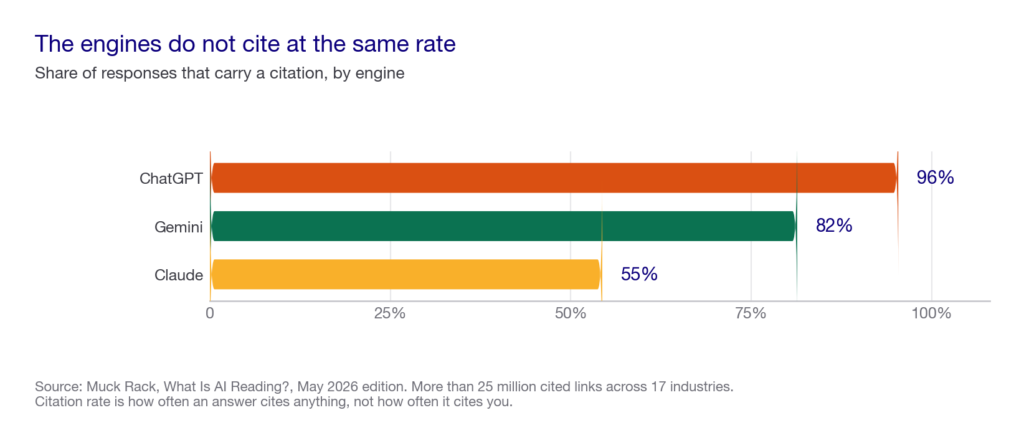
Muck Rack’s May 2026 study of more than 25 million cited links across ChatGPT, Claude and Gemini found ChatGPT carries a citation in 96 percent of responses, Gemini in 82 percent. What is more, claude in just 55 percent (Muck Rack, May 2026). So the same page can be highly visible on one engine and invisible on another. And a single blended visibility number hides that completely.
The practical answer for a beginner: learn SEO fundamentals first, because they are the floor for everything. Then learn where the engines diverge. Anyone selling you a separate AI discipline before you have the fundamentals is selling you the second floor of a building with no first floor. Our explainer on AEO vs GEO vs AIO vs LLMO untangles the acronyms if you need them straight.
Why SEO matters in 2026
Two verified numbers frame the job.
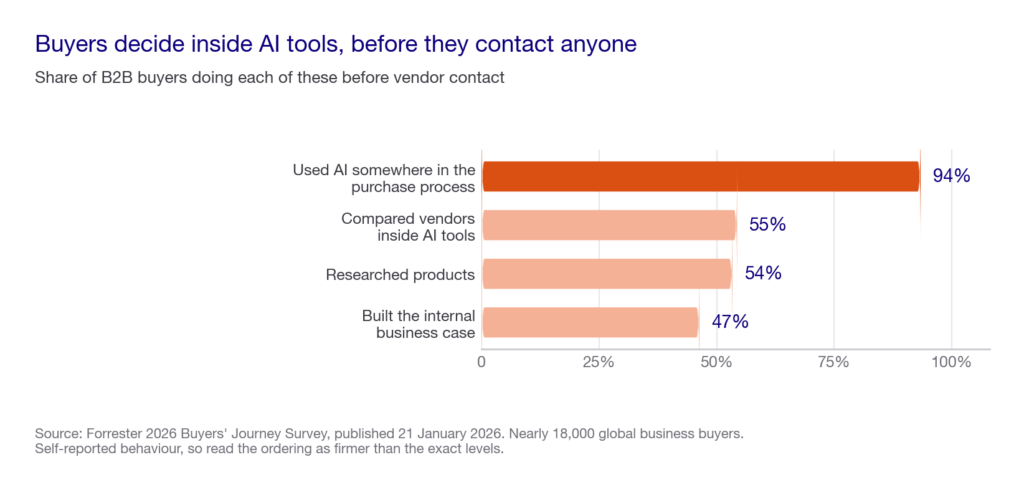
Buyers decide before they contact you. Forrester’s 2026 Buyers’ Journey Survey, published in January 2026 and covering nearly 18,000 global business buyers, found 94 percent used AI somewhere in their most recent purchase. More usefully, it split what they did with it: 55 percent compared vendors inside AI tools, 54 percent researched products. Equally, 47 percent built the internal business case, all before contacting a vendor (Forrester, January 2026).
AI answers are now a large share of the surface. Conductor’s 2026 AEO and GEO benchmarks analysed 13,770 domains across 21.9 million Google searches and found an AI Overview on 25.11 percent of them. Health care ran highest at 48.7 percent and financials at 25.8 percent (Conductor, 2026).
Read those together and the job is not to game one engine. It is to be findable, understandable and consistently described, so the answer holds up wherever a buyer checks it.
See where you show up. Pepper’s GEO platform tracks Brand Visibility, Domain Prompt Presence and Share of Voice across ChatGPT, Perplexity, Gemini, Claude and Google AI Overviews. Your team can log in, connect Search Console and GA4, manage the prompt set and build and run their own agents in the Agent Atlas. And a growth team works the same account alongside you. That means the work still happens in the weeks when nobody internally has time for it. Book a growth audit or see where you show up.
Our methodology: how we built this guide
This is a fundamentals guide, so the standard of proof is different from a product roundup. Here is what we held it to.
| Criterion | Weight | What that means here |
|---|---|---|
| Accuracy against primary sources | 35% | Every statistic traced to a 2026 study, with sample size and method stated |
| Alignment with official guidance | 25% | Where Google or an engine has published a position, we lead with it rather than a vendor’s interpretation |
| Practical sequencing | 20% | Ordered by what a beginner should do first, not by what is most interesting to explain |
| Honest scope | 20% | We say what does not work and what we would skip, including where that costs us |
What we could not verify. Conversion multiples for AI-referred traffic. Several widely quoted figures come from vendor studies with narrow samples, so we have left them out rather than repeat them.
The five pillars of SEO basics at a glance
| Pillar | What it covers | Typical cost to get started | How fast it moves | Where it falls short |
|---|---|---|---|---|
| Keyword and prompt research | The questions people actually type and ask | Free to ~$150/mo for a keyword tool | Immediate, it shapes everything else | A list is not a strategy. It tells you nothing about whether you can win those queries |
| Technical | Crawlability, speed, indexing, site structure | Engineering time, not licence fees | Weeks, and it gates the rest | It removes reasons to skip you. It does not give an engine a reason to pick you |
| On-page | Titles, headings, structure, internal links, schema | Free, it is editing time | Weeks | Ceiling is low on its own. A perfectly structured page with no authority still loses |
| Off-page authority | What other credible sites say about you | Highest, it needs relationships or PR spend | Months, and it compounds | Slowest to move and hardest to fake. Also the one that decides most categories |
| Content | Whether the page actually answers the question | Ongoing, the largest recurring cost | Months | Volume actively hurts. More thin pages is the most common way beginners waste a year |
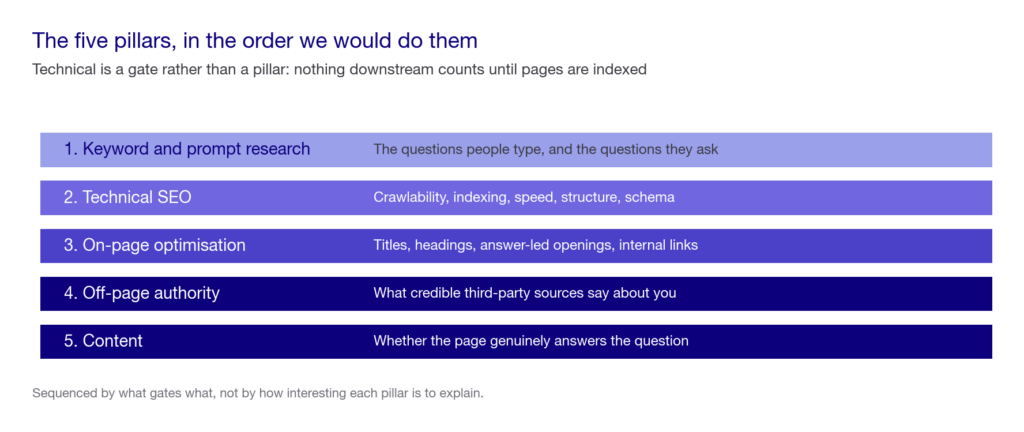
Two of those carry more weight than a beginner guide usually admits. Technical is a gate, not a pillar: if engines cannot crawl and index you, nothing else counts. And off-page authority is where most categories are actually decided, which is the part almost no beginner guide sequences honestly.
The five pillars, in the order we would do them
1. Keyword and prompt research
Keyword research is working out what your audience searches for, and what they ask. AI SEO tools can help identify relevant search terms, topics, and questions, but in 2026 that is two lists, not one.
Keywords are short and typed. Prompts are long, conversational and often contain constraints: “best project management tool for a remote team under 20 people”. So write down 50 to 100 questions a buyer would genuinely ask. That set becomes the thing you measure against later.
Next move: open ChatGPT and Perplexity, ask fifteen of your own questions, and note which brands and sources come back. That is your baseline and it costs nothing.
2. Technical SEO
Technical SEO makes sure engines can reach and read your pages. The beginner-level checks that matter most:
- Indexing. Is the page in Google’s index at all? Check Search Console.
- Crawlability. Does robots.txt accidentally block anything important? Teams block AI crawlers for defensible reasons and then wonder why they are absent from answers. Our guide to robots.txt for AI crawlers covers the user agents.
- Speed and mobile. Slow pages lose people before ranking matters. Our guide to crawlability for AI covers what engines need to reach you.
- Site structure. A logical hierarchy with sensible internal links helps engines understand what is important.
- Schema. Structured data tells an engine what a page is, rather than making it infer.
Google’s 2026 guidance is worth repeating here: llms.txt is not needed for its AI features. For that reason, if a vendor leads with it, ask what else is on the list.
Next move: run your top 20 pages through Search Console and fix indexing errors first. Nothing else moves until they are indexed.
3. On-page optimisation
On-page is everything you control on the page itself.
- Title and meta description. The title carries the primary keyword and is under about 60 characters.
- Headings. One H1. Then H2s that read as real questions or claims, because an engine can lift the answer under a clear heading.
- Answer-led openings. The first two sentences under a heading should answer that heading.
- Internal links. Anchors that describe the destination, never “click here”.
- Images. Descriptive alt text.
Next move: rewrite the first two sentences under each H2 on your most important page so they answer the heading directly.
4. Off-page authority
Off-page is what the rest of the web says about you: coverage, reviews, roundups, community discussion, comparison sites.
This is the pillar beginners underrate and the one that decides most categories. Muck Rack’s May 2026 analysis found earned media accounts for 84 percent of AI citations, with paid and advertorial content at 0.3 percent and journalism alone at 27 percent. Across three editions since July 2025 the earned share has held between 82 and 89 percent.
So if the review sites, roundups and publications in your category do not describe you, there is very little for an engine to cite. Our guide on how to get cited in LLMs covers the mechanics. That is not a content problem you can write your way out of on your own domain.
Next move: list the ten sources that keep appearing when you ask buyer questions. That list is your target, and most brands have never written it down. We work this way across B2B SaaS and other verticals, and it is how Acceldata grew organic traffic sixfold.
5. Content
Content is whether the page genuinely answers the question better than the alternatives. Google’s own guidance asks for useful, original, non-commodity content rather than material manufactured for search systems.
In practice that means depth over volume, a real point of view, and evidence a reader can check. Publishing more thin pages is the most common way beginners waste a year. Our guide to structuring content for AI citation covers the shape that gets lifted.
Next move: take your five most important pages and make each one genuinely the best answer to its question. That beats twenty new posts.
How to measure SEO
Measurement is where most beginners either give up or get misled, so be concrete about it.
See AEO vs SEO for how the two measurement sets sit together. Classic SEO metrics still matter: impressions and clicks in Search Console, keyword rankings, and organic sessions in analytics.
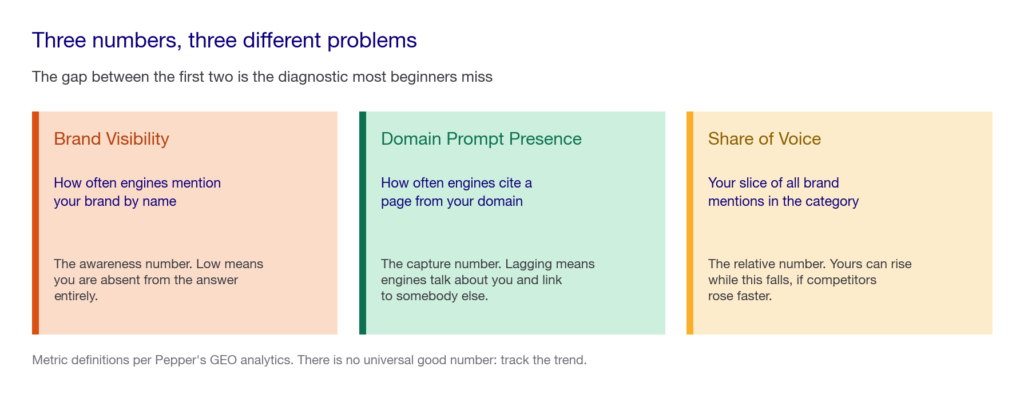
AI search metrics are newer and there are three worth tracking. These are the names Pepper’s platform uses, and they map onto the three questions that actually matter:
- Brand Visibility. How often engines mention your brand by name. The awareness number.
- Domain Prompt Presence. How often engines cite a page from your domain. The capture number.
- Share of Voice. Your slice of all brand mentions in the category. The relative number.
The gap between the first two is the useful diagnostic. High Brand Visibility with low Domain Prompt Presence means engines are talking about you and linking to somebody else, which is an authority problem rather than a content problem. Our Visibility, Citability and Retrievability framework sets out the three levers in full.
Free first-party data exists too. Bing Webmaster Tools shipped an AI Performance report in February 2026 showing which URLs get cited and which queries trigger them. In practice, it is worth connecting even if Bing is not your priority engine.
There is no universal good number. A 30 percent Brand Visibility might be excellent in a fragmented category and poor in a concentrated one. Track the trend and compare against the category leader, not against a benchmark someone sold you.
What does SEO cost?
Beginners ask this early and most guides dodge it, so here is the honest shape.
| Approach | Typical range | What you get |
|---|---|---|
| Do it yourself | Free to about $200 a month in tools | Search Console and analytics are free. A keyword tool is the first paid thing worth buying |
| Freelancer | $500 to $3,000 a month | Usually one pillar done well, most often content or technical |
| Specialist agency | $3,000 to $8,000 a month | Multiple pillars, though rarely all five equally |
| Run as a function | Custom, usually annual | Strategy, execution and accountability for the number, via Pepper’s GEO platform with a growth team attached |
The number matters less than what it buys. So ask whether the fee covers off-page authority or only on-site work. Because off-page is where the answer is usually decided and it is the line item most commonly missing.
How to choose what to work on first
If you take one thing from this guide, take the sequencing. Beginners lose more time to doing the right things in the wrong order than to doing the wrong things.
The framing judgement first. Google’s May 2026 guidance says AEO and GEO are part of SEO, that AI Overviews run on core Search ranking systems. At the same time, that there is no separate AI index. Consequently, the honest read is that fundamentals are the floor, and the engines then diverge above it. Hold both ideas at once: do the fundamentals, then learn where Perplexity behaves unlike AI Overviews.
The scorecard I would use
Score each candidate project out of 100 before you start it, not after. This is the weighting I apply when we take over an account and have to decide what happens in the first month.
| Area | Weight | What a strong first project demonstrates |
|---|---|---|
| Indexability | 25% | The page can actually be crawled and indexed, because nothing downstream counts until it is |
| Query and prompt fit | 20% | It maps to a question your buyers genuinely ask, evidenced by a written prompt set rather than a guess |
| Answerability | 20% | The structure lets an engine lift a clean answer: real headings, answer-led openings, extractable tables |
| Authority support | 15% | Something credible off your domain corroborates the claim, or there is a plan to make that happen |
| Measurability | 10% | You can tell in eight weeks whether it worked, against a baseline you captured first |
| Effort to value | 10% | It is achievable by the people you actually have, not the team you wish you had |
Run this test before you spend anything
It costs nothing and takes an afternoon. Write down 20 to 30 real questions your buyers ask. Not your brand name. Things like “best CRM for a small sales team”, “alternatives to the tool we currently use”, “how much should SEO cost for a startup” and “is SEO still worth it in 2026”.
Then run them through Google, ChatGPT and Perplexity, and answer five questions:
- Where do we appear across those prompts?
- Which competitors appear instead of us?
- Which sources are influencing those answers?
- Why are those sources winning?
- What would we change in the first 90 days?
Run it twice on different days. Engines are probabilistic, so one run on one engine establishes nothing. If the two runs disagree wildly, that is information too.
The weak playbook against the strong one
The weaker sequence, and the one most beginner advice still teaches: pick keywords, publish blog posts, add FAQs, build a few links, wait.
The stronger sequence, and the one we run: demand intelligence, then technical discoverability, then entity and brand clarity, then content, then earned authority, then distribution, then measurement, then attribution.
The difference matters because generative engines assemble an answer from several sources rather than ranking one page. Being crawled, being cited, and actually influencing the answer are three different things, and they need measuring separately.
Red flags
Things a vendor actually says that should end the conversation.
- “We guarantee first-page rankings” or guaranteed AI citations. Nobody controls the output. Google gives the same warning about providers guaranteeing rankings, because third parties have no access to its ranking systems.
- “You need llms.txt.” Google’s 2026 guidance explicitly says you do not, for its AI features.
- “We will publish 40 articles a month.” Volume without a point of view is the tactic Google’s guidance warns against directly.
- A dashboard as the whole proposition. A dashboard shows a gap. Someone still has to close it.
- Branded prompts only. Your own name surfaces your own brand. That is not a test of anything.
- One engine. Winning ChatGPT and vanishing on AI Overviews is winning by luck.
- No stated method for choosing the prompt set. Then the reporting is arbitrary.
Five questions to ask anyone you hire
- “Show me exactly how you measure this.” They should show real prompts, competitors, cited URLs, engines and movement over time. A screenshot of one good answer is not evidence.
- “Take one query where a competitor beats us and explain why.” This separates people who understand retrieval and authority from people reselling software.
- “What will you actually change?” A good answer spans technical, on-page and off-domain authority. If it is only blog production, most of the job is missing.
- “How will I know in 90 days whether this worked?” Listen for a baseline captured up front, not a promise of a report.
- “Which part of your own method do you expect to be obsolete in a year?” The field is moving. A thoughtful answer is a better signal than a confident one.
Reduced to one principle, it comes down to this: fix what stops engines understanding you, then earn the right to be recommended. In that order.
One honest closing note. Very few firms are equally strong across measurement, execution, earned authority and attribution, ours included. The good ones will tell you which is their weakest without being asked. So if a partner claims to be excellent at all four, you have learned something about how they answer questions.
What nobody should promise you
A guaranteed ranking position, or a guaranteed citation in an AI answer. Nobody controls a search engine’s output, and Google says the same about anyone promising rankings.
Be equally wary of a single composite AI visibility score sold as a ranking. Ask a model the same question repeatedly and the answers move. Brand Visibility, Domain Prompt Presence and Share of Voice, tracked across a fixed prompt set over time, are real numbers that can be held to. One screenshot is not.
And nobody should promise clean attribution from an AI citation to closed revenue. The chain from authority to consensus to visibility to branded search to pipeline is observable at every link. But it is not a straight line, and anyone drawing it as one is selling.
You may not need to do anything yet
The answer that costs us the sale, because it is true often enough to say plainly. If your site has fewer than about 20 pages, no organic traffic to speak of. Beyond that, no clear picture of who your buyer is, you do not need an SEO programme yet. As a result, fix the three things that gate everything, which are indexing, page titles and a clear description of what you sell, then spend the next quarter talking to customers instead. SEO compounds, but it compounds on top of a proposition that is already clear. Starting earlier does not speed that up, it just costs more.
Frequently asked questions
What are the basics of SEO?
The five pillars are keyword and prompt research, technical SEO, on-page optimisation, off-page authority and content. Technical work gates everything else because unindexed pages cannot rank, and off-page authority decides most competitive categories over time.
How long does SEO take to work?
Technical and on-page fixes often show movement within four to eight weeks. Authority and content compound over three to six months, and longer in competitive categories. Anyone promising results in two weeks is describing luck rather than a programme.
Is SEO still relevant with AI search?
Yes, and more so. Google stated in May 2026 that AEO and GEO are part of SEO, that AI Overviews run on core Search ranking systems. And that there is no separate AI index. So strong fundamentals remain the floor for AI visibility.
What is the difference between SEO and GEO?
For Google, none: it treats generative engine optimisation as part of SEO. Across other engines the practical work diverges. Because Perplexity cites heavily, AI Overviews summarise, and ChatGPT mixes both, so measurement has to be per engine.
Do I need llms.txt for AI search?
Not for Google’s AI features. Its May 2026 guidance names llms.txt, content chunking and AI-specific rewrites as things site owners can stop doing. Treat any vendor leading with llms.txt as a signal to ask what else is on their list.
How much does SEO cost for a beginner?
Search Console and analytics are free. In addition, a keyword tool is the first paid purchase worth making at roughly $100 to $200 a month. Freelancers typically run $500 to $3,000, and specialist agencies $3,000 to $8,000 monthly.
What should I fix first on a new website?
Indexing, then titles and headings, then a clear description of what you sell. Check Search Console for indexing errors before anything else. Because no other work counts while your important pages are missing from the index.
How do I measure whether SEO is working?
Track impressions, clicks and rankings in Search Console, then Brand Visibility, Domain Prompt Presence and Share of Voice across a fixed prompt set. Compare the trend against the category leader rather than against a universal benchmark, since none exists.
Where to go next
Do the free things first. Connect Search Console, write down 50 buyer questions, run fifteen of them through Google, ChatGPT and Perplexity, and note who gets cited. That is a baseline, and it costs an afternoon.
If the answer turns out to be that everyone in your category is being cited from sources you have never appeared in, you have an authority problem rather than a content problem. And it is worth knowing that before you commission twenty blog posts.
Book a growth audit · See where you show up
Sources and further reading
- Google Search Central. First official AI search optimisation guidance, published 15 May 2026, filed under SEO fundamentals. States that AEO and GEO are part of SEO, that AI Overviews and AI Mode run on core Search ranking systems with no separate AI index, and mythbusts llms.txt, content chunking and AI-specific rewrites.
- Forrester. “Forrester’s 2026 Buyer Insights.” Published 21 January 2026. Nearly 18,000 global business buyers. Link
- Muck Rack. “What Is AI Reading?” May 2026 edition. More than 25 million cited links across ChatGPT, Claude and Gemini, 17 industries. Link
- Conductor. 2026 AEO and GEO Benchmarks. 13,770 domains, 21.9 million Google searches. Link
- Bing Webmaster Tools AI Performance report, public preview February 2026.
Latest Blogs
Most advice on this is inference dressed as fact. OpenAI documents exactly one thing clearly, which is access. Here is what is documented, what is inferred, and how to verify the rest for yourself.
Being named in an AI answer and having your page used as its source are different outcomes with different causes and different fixes. The gap between them is the most useful diagnostic in AI search, and most reporting collapses it into one number.
Every platform reports share of voice and almost none of them define it the same way. Here is the definition worth using, the three choices that change the number, and how to measure it yourself without buying anything.
Get your hands on the latest news!

Similar Posts
Content Creation
11 mins read
What is a SERP? A complete guide to search engine results pages in 2026
Organic Marketing
12 mins read
Google March 2026 Core Update: 10 Things You Need to Know
Organic Marketing
9 mins read