Top AI Search Engines in 2026: The Complete Overview
Your prospects are searching differently now. When they want to evaluate software vendors, compare solutions, or understand complex topics, they’re asking ChatGPT, Perplexity, or Google’s AI Overviews. Not scrolling through ten blue links.
Gartner predicted traditional search volume would drop 25% by 2026 due to AI chatbots.
That shift is here. AI search engines now handle everything from quick fact-checks to deep research sessions, delivering conversational answers with cited sources instead of ranked web pages. Understanding which platforms matter, how they work, and what this means for your visibility is no longer optional.
This guide breaks down the top AI search engines dominating 2026, compares their strengths, and shows you how to think about content strategy in this new landscape.
| 🔥 The “Don’t Scroll Blindly” Highlights ⚡ AI Search Is Not Just Google 2.0: LLMs retrieve, synthesize, and cite. Ranking alone no longer guarantees visibility. 📉 Traffic May Drop. Conversion May Rise: AI Overviews reduce clicks, but citation-driven traffic converts better. 🧠 RAG Is the Real Gatekeeper: Retrieval-Augmented Generation determines what gets surfaced and cited. 🏆 ChatGPT, Perplexity, and Google Play Different Roles: Deep synthesis, research transparency, and mass reach all behave differently. 📦 Structure Beats Volume: Clear headings, direct answers, schema, and freshness signals win citations. 🎯 Visibility Now Means Being Cited: AI search rewards structured, authoritative, machine-readable content. |
What Are AI Search Engines and How Do They Work?
Traditional search engines match keywords to web pages and rank them by relevance signals like backlinks and page authority. AI-based search engines work fundamentally differently.
These platforms use large language models (LLMs) combined with real-time web retrieval to understand what you’re actually asking, then synthesize answers from multiple sources. Instead of showing you links to explore, they give you the answer directly with citations you can verify.
The core architecture powering most AI search engines is Retrieval-Augmented Generation (RAG). Here’s the simplified version: when you ask a question, the system retrieves relevant documents from the web or its knowledge base, then uses an LLM to generate a coherent response based on what it found.
This means AI search engines don’t just find content. They understand it, extract the relevant pieces, and present synthesized answers.
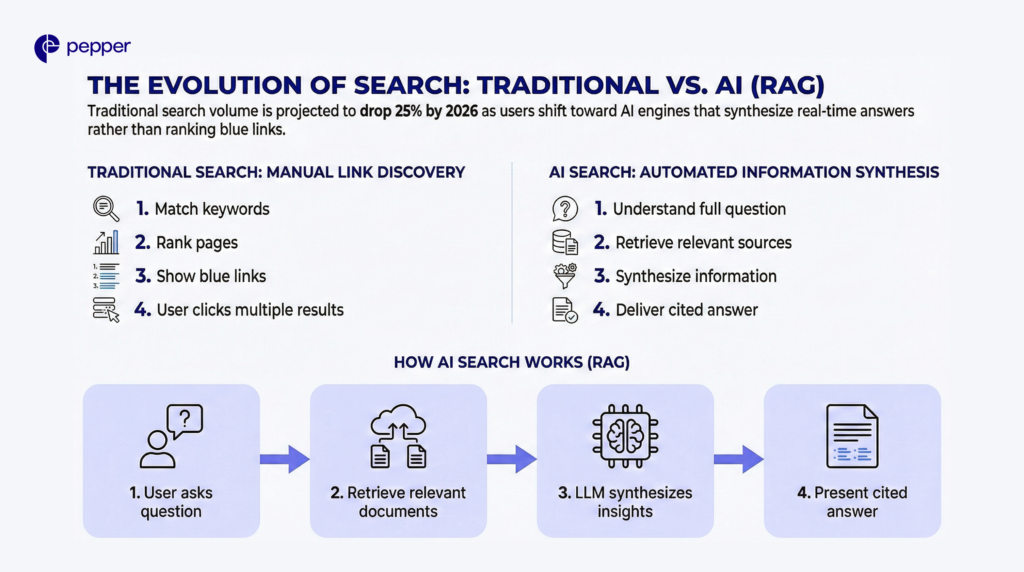
| AI search engines combine LLMs with real-time retrieval to deliver direct answers, not just links. This fundamentally changes what “ranking” means for your content. |
What Are the Top AI Search Engines in 2026?
The AI search landscape has consolidated around a few dominant players, each with distinct strengths and user bases.
ChatGPT Search
ChatGPT leads the market with 800 million monthly active users. OpenAI transformed its chatbot into a full search companion with memory, conversation context, and real-time web access.
ChatGPT excels at complex questions requiring synthesis across multiple sources. Users can ask follow-up questions, refine their search, and get responses tailored to their specific context. For deep explanations and turning research into structured outputs, it’s the strongest option.
Google AI Overviews and Gemini
Google maintains roughly 90% of the global search market and has integrated AI directly into search results. AI Overviews appear at the top of relevant queries, providing quick summaries before traditional results.
For billions of users, this is their primary interaction with AI search. Gemini, Google’s conversational AI, handles deeper queries and integrates across Google’s product ecosystem. If your audience uses Google by default, AI Overviews determine whether they see your content or skip past it.
Perplexity AI
Perplexity has emerged as the research-focused alternative, with over 45 million monthly active users and 170 million monthly visitors. The platform shows 800% year-over-year growth.
What sets Perplexity apart is source transparency. Every answer includes inline citations, letting users verify facts rather than trust blindly. Users spend an average of 23 minutes per session, indicating deep research-oriented usage rather than quick lookups.
Microsoft Copilot
Microsoft’s Copilot integrates Bing search with conversational AI across the Microsoft ecosystem. It searches, reasons, cites, and generates content, whether you’re conducting market research, planning travel, or writing code.
Copilot benefits from tight integration with Microsoft 365, making it particularly useful for enterprise users already in that ecosystem.
Privacy-Focused Options
Brave Search with Leo AI and DuckDuckGo offer AI-powered search without tracking. Brave’s independent index provides results that feel original rather than recycled from Google, while Leo handles summarization and content generation.
For users prioritizing privacy, these platforms deliver AI search capabilities without surveillance trade-offs.
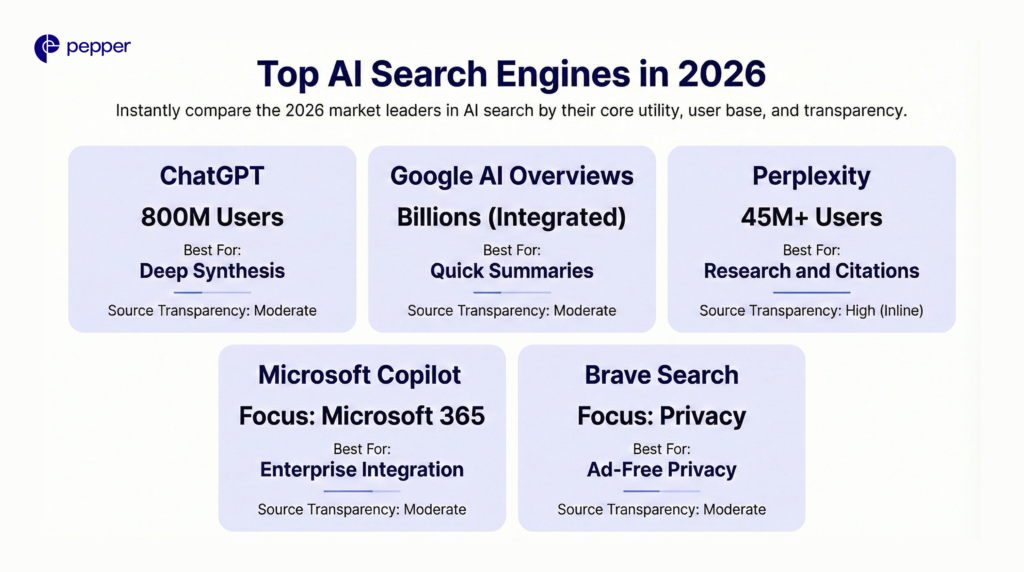
| Platform | Monthly Users | Best For | Source Transparency |
|---|---|---|---|
| ChatGPT | 800M | Deep explanations, follow-up questions | Moderate |
| Google AI Overviews | Billions (integrated) | Quick summaries, familiar interface | Moderate |
| Perplexity | 45M+ | Research, fact-checking, citations | High (inline) |
| Microsoft Copilot | Enterprise-focused | Microsoft 365 integration, productivity | Moderate |
| Brave Search | Privacy-focused | Ad-free, no tracking | Moderate |
How Do AI-Native and AI-Enhanced Search Differ?
The best AI search engine for your needs depends on whether you want a ground-up AI experience or traditional search with AI layered on top.
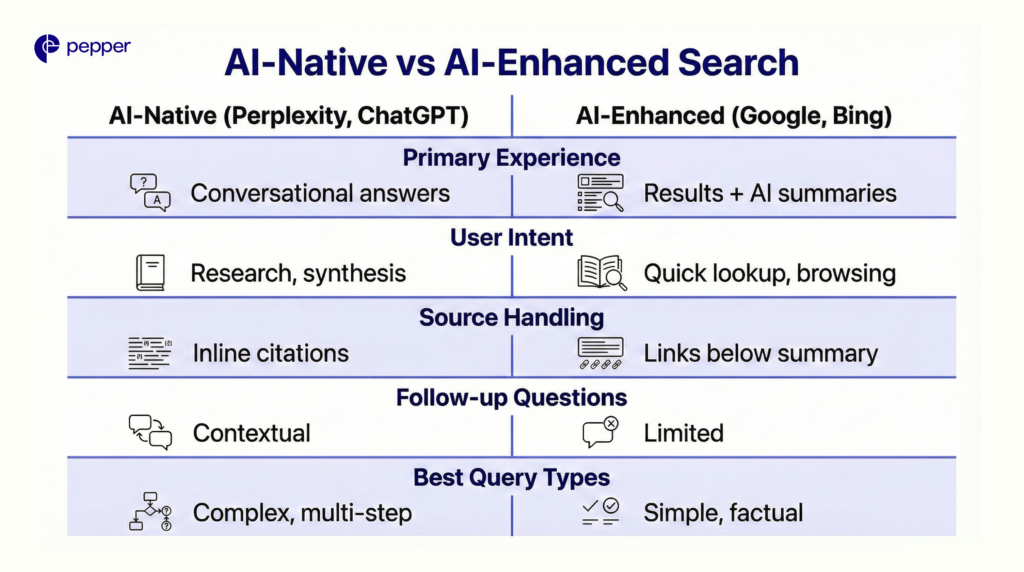
| AI-native platforms treat conversation as the primary interface. AI-enhanced search adds generative layers to traditional results. Your choice depends on whether you want synthesized answers or curated links. |
AI-Native Platforms
ChatGPT and Perplexity were built specifically for conversational search. Every interaction starts with natural language, and the entire experience centers on synthesized answers with citations.
These platforms excel when you need:
- Complex questions requiring synthesis across sources
- Follow-up conversations that build on previous context
- Research sessions rather than quick lookups
- Transparent sourcing for verification
AI-Enhanced Traditional Search
Google Search AI and Bing add generative layers to traditional search infrastructure. You get AI Overviews alongside familiar ranked results.
These platforms work better for:
- Quick factual lookups
- Visual search and image identification
- Queries where you want to browse multiple sources yourself
- Users are comfortable with traditional search patterns
| Aspect | AI-Native (Perplexity, ChatGPT) | AI-Enhanced (Google, Bing) |
|---|---|---|
| Primary Experience | Conversational answers | Results + AI summaries |
| User Intent | Research, synthesis | Quick lookup, browsing |
| Source Handling | Inline citations | Links below the summary |
| Follow-up Questions | Contextual | Limited |
| Best Query Types | Complex, multi-step | Simple, factual |
What Does This Mean for Content Visibility?
The shift to AI search engines creates both challenges and opportunities for content creators and marketers.
The Traffic Impact Reality
When AI Overviews appear on Google searches, click-through rates drop significantly. Research shows searches displaying AI Overviews see CTRs around 8% compared to 15% for traditional results without AI summaries.
Some publishers have experienced dramatic declines. The shift affects informational content most heavily, where AI can directly answer queries without requiring a click.
The Citation Opportunity
Here’s what makes this interesting: traffic from AI sources converts at higher rates. When an AI engine cites your brand in response to a specific query, users arrive pre-qualified and educated about your relevance.
Websites cited within AI Overviews also see higher CTRs than those appearing only in traditional results. The key is getting cited in the first place.
What Gets Cited
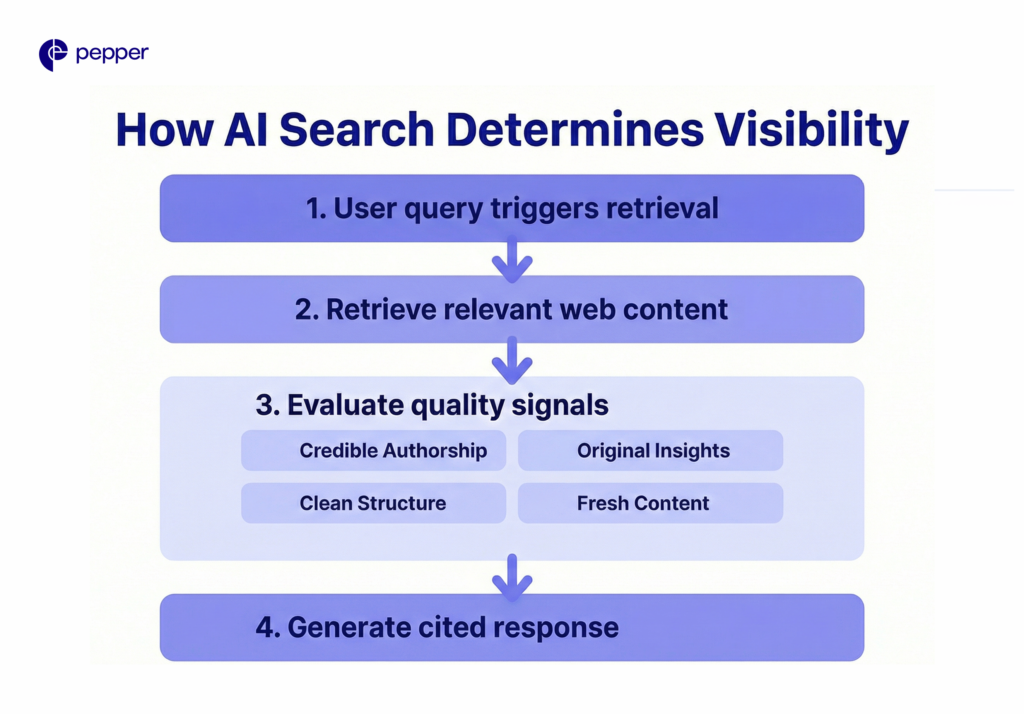
LLMs look for specific signals when selecting sources to cite:
- Credible authorship: Named authors with relevant credentials
- Original content: Firsthand data, proprietary insights, expert commentary
- Clean structure: Semantic HTML, proper headings, organized layout
- Freshness: Recently published or updated content
AI engines show documented “recency bias,” preferring sources that are fresher than traditional search results favor.
How Should You Adapt Your Content Strategy?
The emergence of AI search engines doesn’t mean abandoning traditional SEO. It means adding a new layer of optimization.
Audit Your Current Visibility
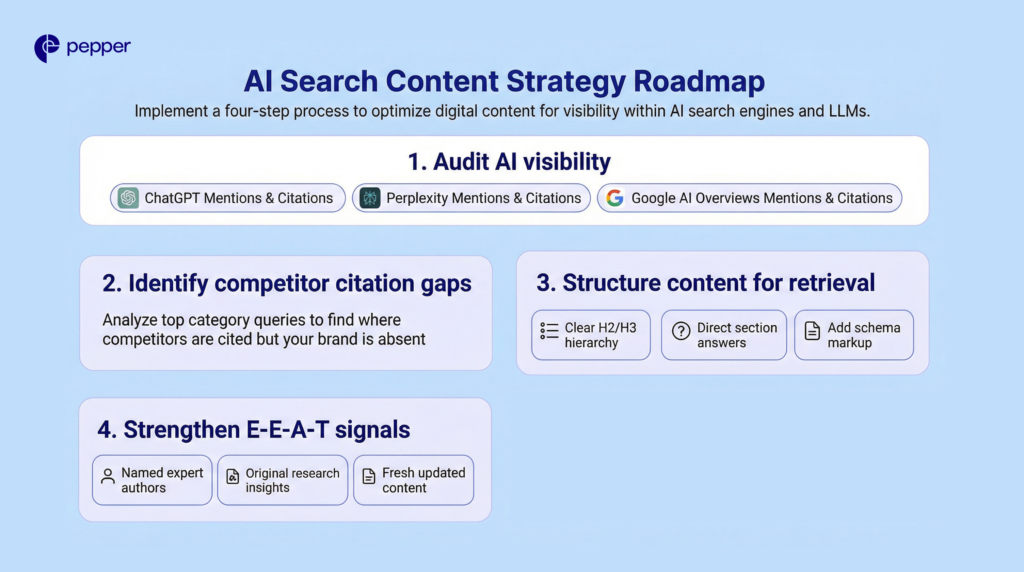
Before optimizing, understand where you currently stand. Run key queries through ChatGPT, Perplexity, and Google AI Overviews. Document which brands appear, where citations link, and whether your content gets mentioned.
Tools like Atlas automate this process, tracking brand presence across LLM platforms and measuring share-of-voice against competitors. This baseline transforms optimization from guesswork into a measurable strategy.
Structure Content for Retrieval
LLMs retrieve content in chunks, not full pages. This means:
- Clear H2/H3 hierarchy that signals topic structure
- Direct answers near the top of sections
- Schema markup (FAQ, HowTo, Product) that machines can parse
- Standalone paragraphs that make sense out of context
Build E-E-A-T Signals
Google’s quality guidelines, Experience, Expertise, Authoritativeness, and Trustworthiness matter for AI search too. Both Google AI Overviews and Perplexity appear to weigh these factors heavily when selecting sources to cite.
This means named authors with credentials, original research, and content that demonstrates genuine expertise rather than rehashed information.
| ✓ AI Search Optimization Checklist Audit current visibility across ChatGPT, Perplexity, and Google AI Overviews Identify the top 10 category queries where competitors appear, but you don’t Add schema markup (FAQ, HowTo) to key pages Ensure named authors with visible credentials Update cornerstone content for freshness signals Structure content with clear H2/H3 hierarchy and direct answers |
What’s Next for AI Search?
The AI search landscape continues evolving rapidly. Agentic AI, where AI systems take actions rather than just providing answers, represents the next frontier.
For content strategy, this means thinking beyond search queries to AI agents that research, compare, and recommend on behalf of users. Your content needs to be not just findable but also machine-readable and trustworthy enough for AI systems to confidently cite.
The brands investing now in structured content, proprietary data, and AI-literate teams are positioning for a search landscape where visibility depends on being cited, not just ranked.
AI search engines have shifted from novelty to a primary research channel for millions of users. ChatGPT, Google AI Overviews, and Perplexity each serve different needs, but all reward content that’s structured, authoritative, and fresh.
Start by auditing your current AI search visibility. Pepper’s Atlas platform tracks brand mentions across LLM platforms automatically, showing exactly where you appear and where competitors dominate. That visibility baseline is the foundation for any optimization strategy tied to real business outcomes.
Book a demo to see your current AI search presence.
Frequently Asked Questions
What is the best AI search engine for research?
Perplexity AI excels for research tasks due to its inline citations and source transparency. Users can verify information directly, making it ideal for fact-checking and deep dives where accuracy matters.
How does Google Search AI differ from ChatGPT?
Google AI Overviews add summaries to traditional search results, maintaining the familiar interface. ChatGPT provides conversational, context-aware responses better suited for complex questions and follow-up discussions.
Will AI search engines replace Google?
Google maintains roughly 90% search market share and has integrated AI directly through AI Overviews. Rather than replacement, expect continued evolution where AI enhances traditional search across all major platforms.
How do AI search engines affect website traffic?
Pages appearing in AI Overviews see lower click-through rates for informational queries where AI provides direct answers. However, traffic from AI citations tends to convert at higher rates because users are pre-qualified.
What content performs best in AI search engines?
Content with clear structure, named expert authors, original insights, and recent publication dates gets cited most frequently. Schema markup and direct answers to specific questions improve retrieval probability.
Are AI search engines accurate?
AI search engines can produce errors or outdated information. Platforms like Perplexity mitigate this with visible citations, allowing users to verify sources. Always cross-reference critical information.
How do I optimize content for Google SEO AI?
Focus on E-E-A-T signals, structured data markup, clear topical organization, and content freshness. Google’s AI Overviews favor authoritative sources with demonstrable expertise and recent updates.
Latest Blogs
Learn how to create compelling content for every stage of your campaign with this guide to mastering Youtube’s Hero, Hub & Hygiene framework.
A curated, category-wise list of the best marketing newsletters in 2026—covering AI, SEO, B2B, creator economy, design, and more. Personal picks from Dhriti Goyal at Pepper.inc
Master the balance of primary and secondary keywords to win in the AI era. Learn how to optimize for LLMs, entity research, and search intent to get cited by AI.
Get your hands on the latest news!