Hero hub hygiene in 2026: a distribution model applied to the wrong problem

The short answer
Hero hub hygiene is a good model being asked to do a job it was never designed for.
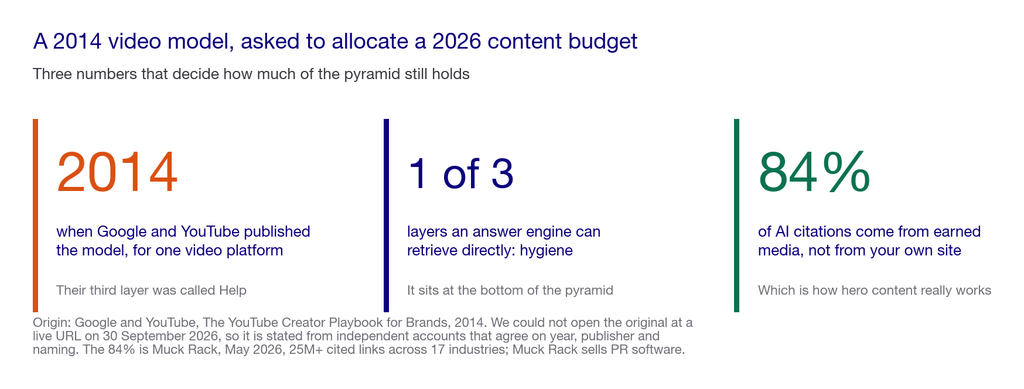
It comes from Google and YouTube’s Creator Playbook for Brands, published in 2014, where Google’s own third layer was called Help rather than hygiene. It was built for one platform, one feed and one goal: turning views into subscriptions through cadence.
Applied to search, and now to answer engines, the three layers do not behave like three tiers of the same thing. They reach an engine by three completely different routes, and only one of them reaches it through your own page.
- Hygiene reaches engines directly. It is an evergreen answer to a real question, which is the unit an engine quotes.
- Hub barely reaches them at all. Episodic, platform-native content is built for a feed, not for retrieval.
- Hero reaches them indirectly, and this is the part nobody says. Its value in AI search is the third-party coverage it generates, not the page itself.
That last point matters because earned media accounts for 84% of AI citations on the largest published study we could find. Hero content that gets written about is doing AI search work. Hero content that only lives on your site is not.
Key takeaways
- The model is a distribution plan, not a content plan. Its cadences describe how often to publish on a feed, which is not the same question as what an engine can use.
- Google’s own name for the third layer was Help. “Hygiene” is a later industry relabel. Both are in circulation and neither is wrong, but the origin is worth knowing before you defend the pyramid in a meeting.
- Only one layer is directly retrievable. Hygiene answers questions. If your plan under-funds it because it sits at the bottom of a pyramid, the pyramid is costing you citations.
- Hero content still matters, through a different mechanism. It earns coverage, and coverage is what engines cite. Budget it as earned media rather than as a video line.
- Hub content is the layer to defend on its own merits. It builds audience and retention, and Pepper’s agentic organic growth engine would not tell you to cut it. Just stop expecting it to produce citations.
A note on where this comes from. We run organic for more than 250 enterprises and track more than 10 million prompts across every major engine. The 2014 origin and the citation study are other people’s and are dated below. The argument about how the three layers reach an engine is ours, shaped by the content plans we inherit and rebuild in client reviews most weeks.
Book a growth audit if you want to see which of your three layers is actually producing citations before you plan next year’s split.
What is hero hub hygiene, and where did it come from?
The model divides content into three layers.
- Hero. Large, infrequent, high-production work aimed at people who have never heard of you. Campaigns, films, launches.
- Hub. Episodic, regular content for an audience that already knows you. Series, newsletters, podcasts, social.
- Hygiene, or Help. Always-on, evergreen content answering the specific questions your customers ask. Guides, documentation, comparison pages.
Google and YouTube published it in 2014, in The YouTube Creator Playbook for Brands. Google’s own third layer was called Help. The word “hygiene” came later, from the industry rather than from Google. Both are in wide use, and the distinction does not change the model. It does tell you what the model was for: video, on one platform, where the goal was turning views into subscriptions.
That context is the whole argument of this page. A cadence that builds a subscriber base on a feed is not a plan for getting quoted. The engine has no feed, no subscriptions and no memory of your last upload.
The three layers reach an engine by three different routes
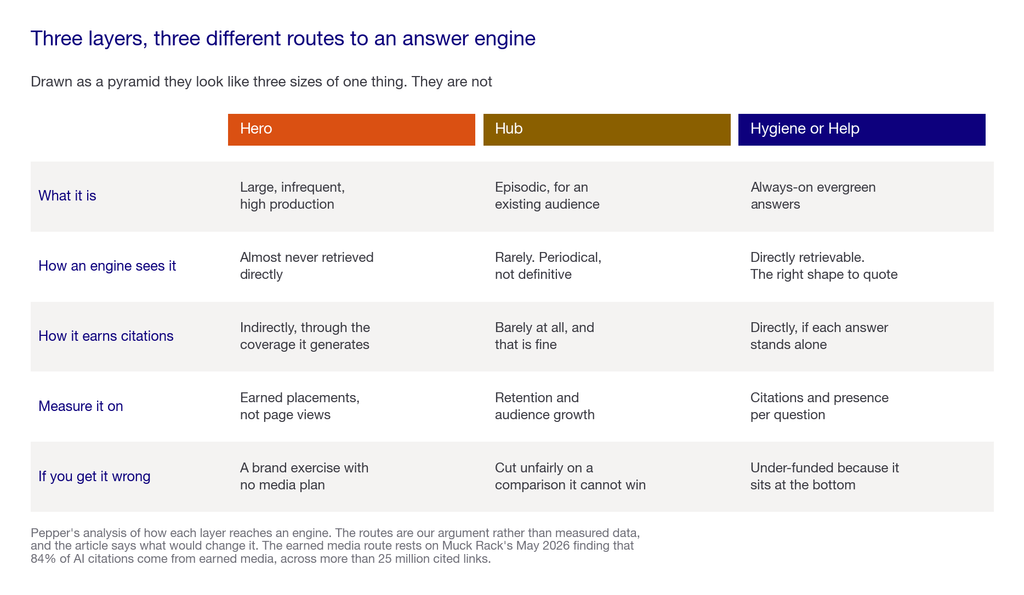
This is the part the pyramid hides. Drawn as three tiers, the layers look like different sizes of the same thing. They are not.
Hygiene: the only layer engines can use directly
An evergreen page answering a specific question is exactly what an answer engine retrieves. The shape is right and the page is indexable. Written properly, each answer stands alone well enough to quote.
So the layer at the bottom of the pyramid is the only one with a direct route. Treat hygiene as cheap filler beneath the interesting work and you have inverted the priority for AI search without noticing.
Volume makes little difference at this layer. What matters is whether each answer survives being lifted out of the page, which our guide to structuring content for answer engines covers properly.
Hub: mostly invisible, and worth keeping anyway
Episodic content serves a feed. An engine rarely reaches for a newsletter issue, a podcast episode or a social series, because each one is periodical rather than definitive.
We are not telling you to cut it. Hub content builds the audience that eventually asks for you by name. Brand familiarity shows up in engine answers even when the episode never does. We are telling you to stop measuring it on citations. It loses that comparison every time, and somebody then uses the loss to kill something useful.
Hero: real value, indirect route
Here is the reframe. A hero campaign almost never gets quoted as a source. It gets written about instead, and what gets written about you is what engines cite.
On Muck Rack’s May 2026 analysis of more than 25 million cited links, earned media accounted for 84% of AI citations and paid or advertorial content for 0.3%, with journalism alone making up 27% of cited sources.
So hero content has a genuine AI search function, and it is not the film. It is the coverage the film generates. A hero project with no earned media plan attached is, for these purposes, a brand exercise. Budget and judge it accordingly.
What this changes about the split
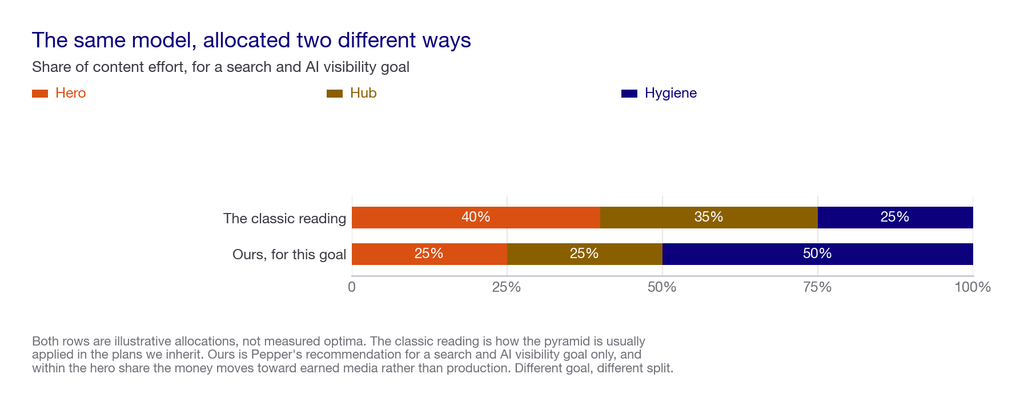
The classic reading puts hero at the top as the prestige tier and hub as the regular commitment. Hygiene becomes the always-on base you fill in around them.
For a search and answer engine goal, we would split effort differently. This is a judgement rather than a finding, and we would say so in the room.
- Hygiene rises. It is the only directly retrievable layer, and most libraries we inherit hold fewer genuinely useful evergreen answers than their page count suggests.
- Hero keeps its budget but changes shape. The money moves from production value toward the earned media that makes the work citable.
- Hub holds, defended on retention and audience rather than on search performance.
Where this falls short: these are our proportions for one goal. For brand awareness in a category where nobody searches yet, the classic reading beats ours. Which industries this applies to decides which case you are in.
The cadence question
The original model prescribes frequency: hero once or twice a year, hub weekly or fortnightly, hygiene continuously. That is a publishing rhythm for a feed.
For hygiene, cadence is the wrong variable entirely. An evergreen answer does not decay on a schedule. It decays when the thing it describes changes, and that could be next week or never.
So we plan the hygiene layer by maintenance triggers rather than by publishing frequency.
- A product changes. Update the pages that describe it, immediately.
- A figure in the page has a date on it. Diarise a re-check for when that date stops being current.
- A competitor page starts being cited instead of yours. That is a signal, not a schedule.
- The question itself changes. Buyers start asking a different version, which you find by running your prompt set rather than by looking at a calendar.
Publish more hygiene content on a weekly rhythm because the model says “daily or consistent”, and you reach four hundred pages nobody can maintain.
Our methodology: how we weighted the three layers
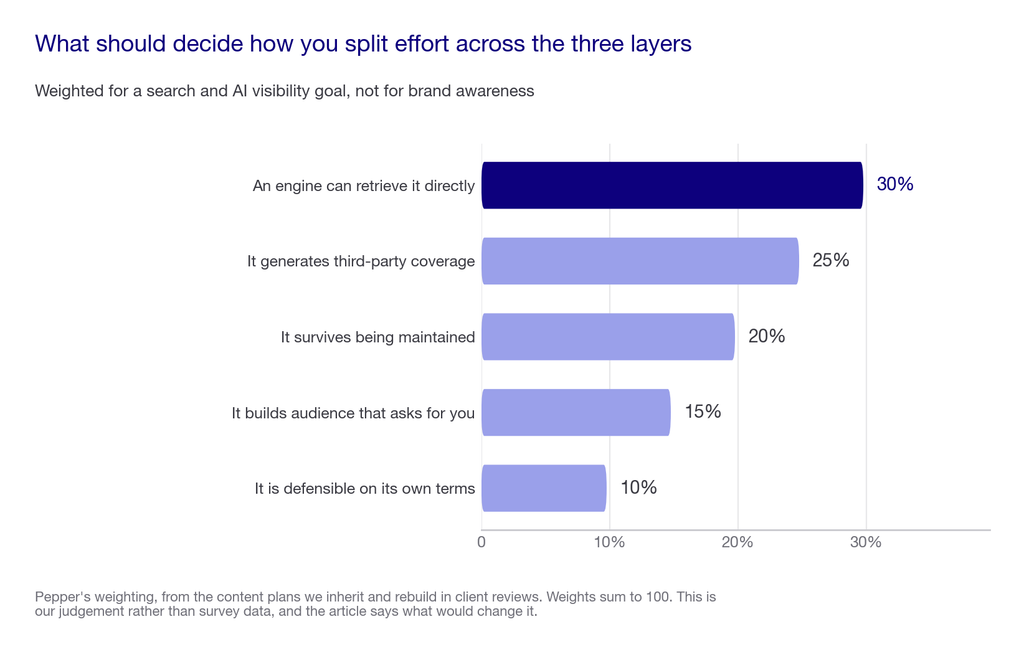
| Criterion | Weight | Why it carries that weight |
|---|---|---|
| Can an engine retrieve it directly | 30 | The unit engines quote is a self-contained answer. A layer that produces nothing of that shape has no direct route, whatever else it is worth. |
| Does it generate third-party coverage | 25 | Earned media is 84% of AI citations on the largest study we could find, which makes coverage the indirect route that returns most per unit of effort. |
| Does it survive being maintained | 20 | Evergreen only counts if somebody updates it. A layer that produces unmaintainable volume costs more than it returns within two years. |
| Does it build audience that asks for you | 15 | Brand familiarity shows up in engine answers even when the specific asset never does. Hard to attribute and real. |
| Is it defensible on its own terms | 10 | Any layer judged only on citations will be cut. Each one needs a measure it can win on. |
Weights sum to 100. Direct retrievability and earned media carry 55 between them, which is a judgement rather than a fact, and it is the judgement this page rests on. We publish our weightings the same way we publish [how we rank GEO agencies](https://www.pepper.inc/blog/geo-agency-ranking-methodology/), so you can argue with them precisely.
What would change these weights. In a category with no third-party coverage at all, earned media drops and direct retrievability rises, because there is nowhere to be cited except your own pages. In a mature brand with heavy existing coverage, the reverse.
Hero hub hygiene at a glance
| Layer | What it is | How an engine sees it | How it earns citations | How to measure it | Cost of getting it wrong |
|---|---|---|---|---|---|
| Hero | Large, infrequent, high production | Almost never retrieved directly | Indirectly, through the coverage it generates | Earned placements, not page views | High. A campaign with no media plan is a brand exercise |
| Hub | Episodic, for an existing audience | Rarely retrieved. Periodical rather than definitive | Barely at all, and that is fine | Retention and audience growth | Medium. Judged on citations, it gets cut unfairly |
| Hygiene or Help | Always-on evergreen answers | Directly retrievable. The right shape to quote | Directly, if each answer stands alone | Citations and presence per question | High. Under-funded because it sits at the bottom |
| The maintenance layer | Keeping hygiene true | Stale pages get replaced by competitors’ | Protects citations you already have | Pages past their re-check date | Highest. This is where libraries quietly rot |
## What this costs
- Re-tiering an existing plan: about a day. Sort what you already publish into the three layers and ask which route each one takes to an engine.
- The hygiene audit that follows: longer. Most libraries have fewer genuinely useful evergreen answers than the page count suggests, and finding out is the uncomfortable part.
- Adding an earned media plan to hero work: this is the real budget change, and it is a reallocation rather than an increase in most plans we see.
- Maintenance: budget it as a standing percentage of the hygiene layer rather than as a project. Libraries that skip this are the ones that need an audit in two years.
For what the broader programme costs, our generative engine optimization cost benchmarks collects 30 published prices.
Where Pepper fits
We are an agentic organic growth engine, and the reason this page exists on our blog is that we spend most of our time on one of the three layers.
- An organic growth partner. A growth team is attached to your account, a senior strategist plus always-on agents, accountable for the number rather than for a publishing calendar.
- Pepper’s GEO platform. Genuinely self-serve and included rather than billed as a separate licence. You log in and set up a workspace. Define your brand profile, competitors and personas, connect GA4 and Search Console, then manage your own themes, prompts and analytics across six engines including ChatGPT, Perplexity, Gemini, Claude and Google AI Overviews.
- The Agent Atlas. Your team builds, versions and runs its own agents, including maintenance agents that flag hygiene pages past their re-check date, and you keep them.
Themes in the platform are the hygiene layer made trackable, and the gap between Brand Visibility and Domain Prompt Presence tells you whether your hero and hub work is producing recognition without citations. For what the combination produces, the Acceldata case study records 6X organic traffic and top-three keywords rising from 85 to more than 300, mostly through B2B SaaS programmes.
Where it falls short: we are a hygiene and earned media business. We are not the right supplier for hero production and we do not pretend to be. Hub content, in the sense of a podcast or a social series, is not something we run. And this page corrects one of our own, published seven months ago by the same author, which is the clearest evidence that our own library needs the maintenance discipline recommended above.
How to choose what to fund across the three layers
I will write this in the first person, because a recommendation nobody will defend is worth nothing.
Start by asking what each layer is for, separately, before allocating anything. The failure I see most often is a plan that funds all three against one goal, usually a pipeline number. It then quietly cuts the two that cannot demonstrate it. Hub content loses that argument every time and it is usually the wrong thing to cut.
So my order is: name the goal for each layer, check which route it takes to an engine, then fund it and measure it on that route. Here is the scorecard I would use on any proposed piece of work, on a 100 point scale.
| Area | Weight | What a fundable piece of work demonstrates |
|---|---|---|
| The route to value is named | 30 | Direct retrieval, earned coverage, or audience. Somebody can say which one before the work starts, and it is written down. |
| It is measured on that route | 25 | A hero campaign judged on citations will look like a failure. Match the measure to the mechanism or you will cut the wrong thing. |
| Somebody will maintain it | 20 | Especially at the hygiene layer. An evergreen page with no owner is a liability with a publish date. |
| It answers a question somebody asks | 15 | Taken from sales calls and support tickets rather than from a content calendar that needed filling. |
| It does not duplicate what exists | 10 | Two pages doing the same job is the most common waste in every library we inherit. |
Five questions I would ask before funding anything, in this order.
- “Which of the three routes does this take?” A stronger answer names one. A weaker one says it will help with everything, which means nobody has thought about it.
- “If this is hero, what is the earned media plan?” Without one, you are funding production and hoping. The coverage is the part that reaches an engine.
- “If this is hygiene, who updates it and when?” A date, an owner and a trigger. Not a vague commitment to review annually.
- “What would make us kill this, and how would we know?” Every layer needs a stopping condition. Hub content without one runs for years on inertia.
- “Does a page like this already exist here?” Ask before the brief, not after the draft.
Red flags, each one something that appears in real plans. A pyramid diagram with no mechanism attached to any layer. A hygiene target expressed as posts per week. A hero budget with no media line. A hub series measured on organic sessions. And any plan that cites the 2014 playbook as evidence for a 2026 allocation without saying what has changed since.
Before you re-plan anything, test where you actually stand. Write 25 real commercial questions your buyers would type. Run each of those 25 prompts three times across every engine you care about, because engines are probabilistic and one run is an anecdote. Then give any fix 90 days before you judge it. Four worked examples for a mid-market B2B software company:
- “best data observability platform for enterprise”
- “how do I monitor data quality across Snowflake and Databricks”
- “what should I look for in a data observability vendor”
- “who competes with Monte Carlo in data observability”
Sort the pages that get cited into the three layers. In most accounts we take over, almost everything cited is hygiene, and that single observation changes the next budget conversation more than any framework does. Checking whether your brand appears in AI search walks through the running part.
And the answer that loses Pepper the sale: if your hygiene layer is already comprehensive, well maintained and getting cited, you do not need more of it and you do not need us to write it. Put the money into earned media, which is the 84%, and where we are one option among many rather than the obvious one.
It comes down to one principle: fund the route, not the tier. Every failed content plan we have inherited, ours included on the page this one replaces, treated the pyramid as a budget split. None of them asked how each layer actually reaches a reader or an engine.
What nobody should promise you
- That hygiene content alone will get you cited. It is the direct route and it still competes with the 84% of citations that come from somewhere other than your site.
- A ratio for the three layers. Ours is a judgement for one goal, and we say so. Anyone offering a universal split has not asked what you are trying to do.
- That hero content is dead. It works, through coverage rather than through the page.
- A publishing cadence that guarantees anything. Cadence was a feed mechanic. An evergreen answer decays when the facts change, not on a schedule.
- A guaranteed citation or position in an AI answer. Engines are probabilistic and nobody controls their ranking systems.
Frequently asked questions
What is hero hub hygiene content?
A three-layer model dividing content into large infrequent campaigns, episodic content for an existing audience, and always-on evergreen answers. It came from Google and YouTube’s Creator Playbook for Brands in 2014, where the third layer was called Help rather than hygiene.
Is the hero hub hygiene model still relevant in 2026?
As a way to name three kinds of work, yes. As a budget split, it needs rethinking, because the three layers reach an answer engine by completely different routes and only the hygiene layer is directly retrievable.
What is the difference between hygiene and help content?
Nothing substantive. Google’s original 2014 framework called the third layer Help. “Hygiene” is a later industry relabel and both terms are in wide use. The distinction matters only when you are tracing where the model came from.
Which content layer matters most for AI search?
Hygiene, for the direct route, because an evergreen answer to a specific question is the unit an engine quotes. Hero matters indirectly through the coverage it generates, and earned media accounts for 84% of AI citations on the largest published study.
How often should I publish hygiene content?
Cadence is the wrong variable. An evergreen answer decays when the thing it describes changes, not on a schedule, so plan maintenance by triggers: a product change, a dated figure, a competitor being cited instead of you, or the question itself shifting.
Does hub content help with SEO or AI search?
Rarely and indirectly. Episodic content is built for a feed rather than for retrieval, so it is seldom quoted. Keep it for retention and audience building, and measure it on those, or it will be cut on a comparison it cannot win.
How should I split budget across hero, hub and hygiene?
There is no universal ratio. For a search and AI visibility goal we would raise hygiene, keep hero’s budget but move it toward earned media, and hold hub on its own merits. For pure awareness in an unsearched category, the classic reading is better.
Where did the hero hub hygiene model come from?
Google and YouTube published it in 2014 in The YouTube Creator Playbook for Brands, as a way to help brands structure video strategy on one platform. That origin explains its cadence advice, which was designed to convert views into subscriptions.
Where to go next
If the hygiene layer is where you are investing, how to structure content for answer engines covers whether each answer survives being quoted, and primary and secondary keywords covers how to decide what each page is for.
To measure any of it, the GEO measurement stack sets out which KPIs mean anything, and the statistics that survive a check at source collects the market numbers with their samples attached.
Sources and further reading
- Google and YouTube, The YouTube Creator Playbook for Brands, 2014. The origin of the three-layer model, where Google’s own third layer is Help. “Hygiene” is a later industry relabel. We could not open Google’s original 2014 playbook at a live URL on 30 September 2026, so the origin is stated from multiple independent accounts that agree on the year, the publisher and the naming, rather than from the primary document. We flag that rather than implying we read it.
- Muck Rack, “What Is AI Reading?”, May 2026 edition. Earned media accounted for 84% of AI citations, paid and advertorial for 0.3%, and journalism alone for 27%, across more than 25 million cited links from ChatGPT, Claude and Gemini in 17 industries. This is the study the previous version of this page quoted without attribution. Muck Rack sells PR and media database software and benefits if this result is true. Not hyperlinked, per our policy on vendor links.
- Google Search Central, “Optimizing your website for generative AI features on Google Search”, last updated 10 July 2026. The position that optimizing for generative AI search is still SEO, which is why the hygiene layer is an SEO discipline rather than a new one.
Further reading on Pepper, each checked live on 30 September 2026:
- How to structure content for answer engines, whether each hygiene answer survives being quoted.
- Primary and secondary keywords, deciding what each page is for.
- The GEO measurement stack, which KPIs mean anything.
- AI search statistics that hold up in 2026, the market numbers with their samples.
A note on scope and on corrections. This page covers how the three layers reach an answer engine and what that changes about allocation. It does not cover passage craft or measurement, both linked. Three things from the previous version are corrected rather than carried over: emoji in the headings, which we no longer publish; three statistics with no source, of which one was Muck Rack’s research used without credit and two we could not verify and have dropped; and no named reviewer, where the SOP requires one. The previous version was published on 2 March 2026 by this page’s author, and the same unsourced statistics block appeared on another Pepper page published four days earlier.
Latest Blogs
Most advice on this is inference dressed as fact. OpenAI documents exactly one thing clearly, which is access. Here is what is documented, what is inferred, and how to verify the rest for yourself.
Being named in an AI answer and having your page used as its source are different outcomes with different causes and different fixes. The gap between them is the most useful diagnostic in AI search, and most reporting collapses it into one number.
Every platform reports share of voice and almost none of them define it the same way. Here is the definition worth using, the three choices that change the number, and how to measure it yourself without buying anything.
Get your hands on the latest news!

Similar Posts

Blogging
14 mins read
Your rankings held and your traffic fell. Here is what happened.

Content Strategy
6 mins read
The Power of Thought Leadership: Elevating Demand Generation Through Content Marketing

Content Strategy
10 mins read