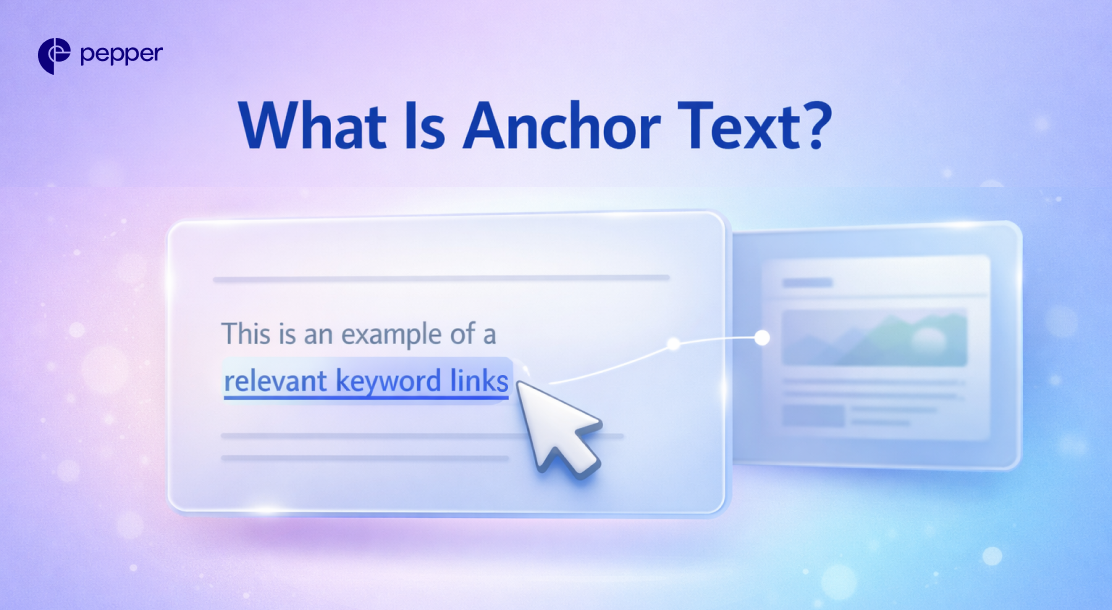
Anchor text is the visible, clickable text within a hyperlink that tells users and search engines what the linked page is about. It appears highlighted (often blue and underlined) and provides contextual signals that influence both user experience and SEO.
Anchor text sits inside the <a> HTML element—the part users actually see and click. While it seems like a small detail, how you write anchor text affects crawlability, page relevance signals, and whether your linking profile looks natural or manipulative to search engines.
Anchor Text Explained
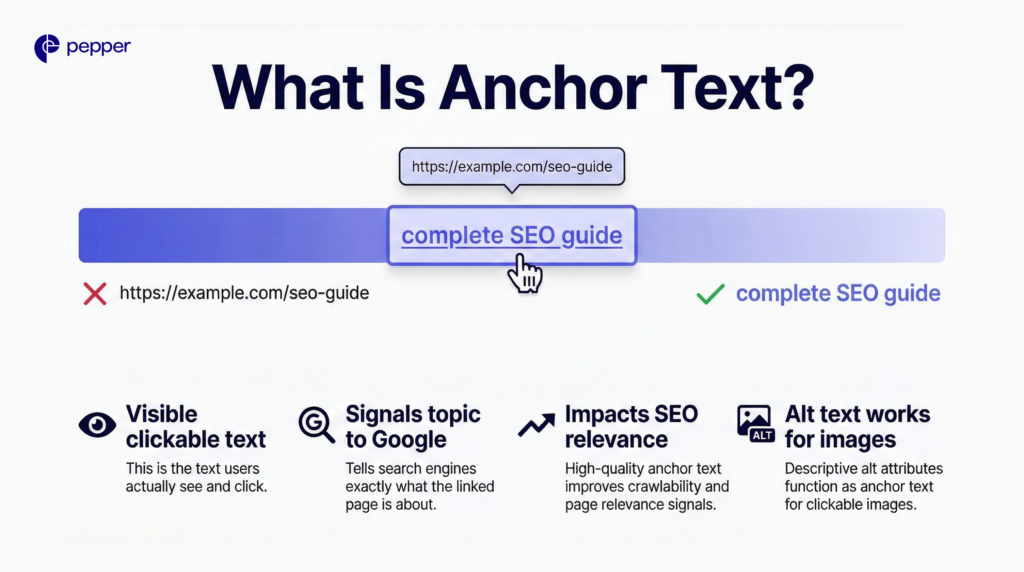
When you create a link, anchor text serves as the label. Instead of displaying a raw URL, such as https://example.com/seo-guide, you show readers something meaningful: “complete SEO guide.”
Google’s documentation states it directly: “Anchor text tells people and Google something about the page you’re linking to.” Search engines use this text—along with surrounding content—to understand the topic and relevance of the destination page.
For images used as links, the image’s alt text functions as anchor text. This makes descriptive alt attributes essential for any clickable image.
Types of Anchor Text
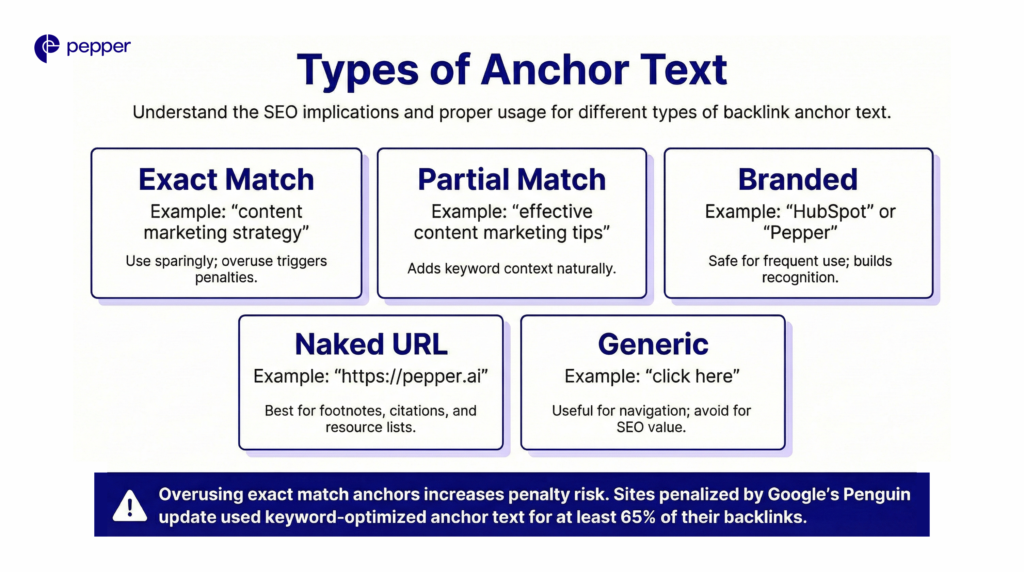
Different anchor text types serve different purposes and carry varying SEO implications:
| Type | Example | When to Use |
|---|---|---|
| Exact match | “content marketing strategy” | Sparingly—overuse triggers penalties |
| Partial match | “effective content marketing tips” | Adds keyword context naturally |
| Branded | “HubSpot” or “Pepper” | Safe for frequent use; builds recognition |
| Naked URL | “https://pepper.ai“ | Footnotes, citations, resource lists |
| Generic | “click here” or “read more” | Internal navigation; avoid for SEO value |
Exact match anchors—where the text matches your target keyword precisely—correlate with rankings but carry risk. Sites penalized by Google’s Penguin update used keyword-optimized anchor text for at least 65% of their backlinks.
Why Anchor Text Matters for SEO
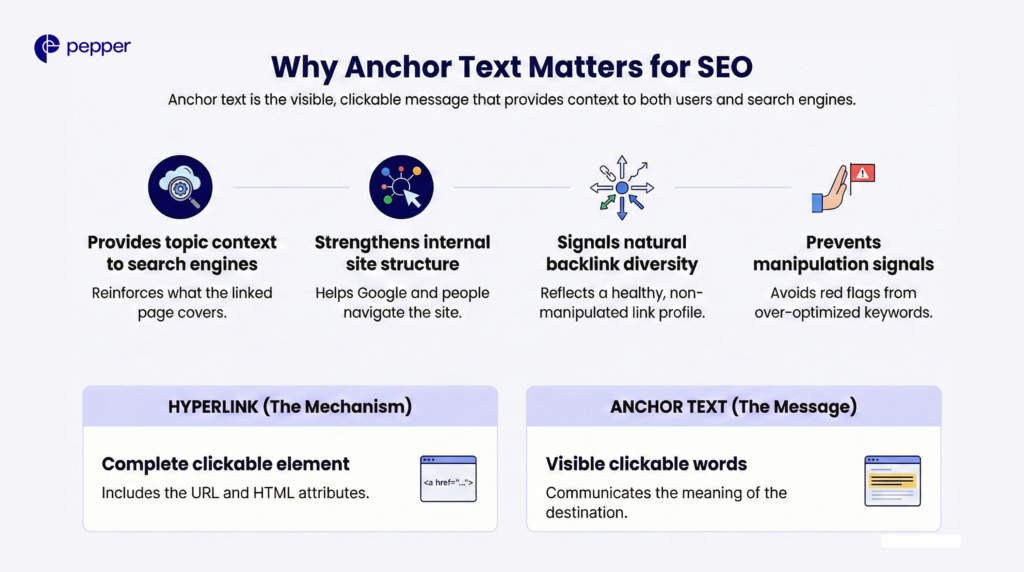
Anchor text provides search engines with context about linked pages. When multiple sites link to your page using similar descriptive text, it reinforces what that page covers.
For internal links, thoughtful anchor text helps Google understand your site structure and how pages relate to each other. Google recommends paying attention to internal link anchors because they help “both people and Google make sense of your site.”
For external backlinks, anchor text diversity signals a natural link profile. If every backlink uses identical keyword-rich anchors, search engines interpret this as manipulation—a red flag since the 2012 Penguin algorithm update.
The balance: use descriptive, relevant anchor text that genuinely helps readers understand where they’re going—without forcing keywords unnaturally.
Anchor Text vs. Hyperlink
These terms are often confused. A hyperlink is the entire clickable element, including the URL and any HTML attributes. Anchor text is specifically the visible words users see and click.
Think of it this way: the hyperlink is the mechanism; anchor text is the message.
Quick Takeaway: Anchor text tells users and search engines what a linked page covers. Use descriptive, varied anchors—exact match keywords sparingly, branded and partial match more freely—to support SEO without triggering penalties.
Frequently Asked Questions
What does anchor text mean in the context of links?
Anchor text is the clickable words within a hyperlink. It describes the destination page and helps search engines understand link context and relevance.
How is anchor text different from a regular URL link?
A URL is the web address itself. Anchor text replaces that URL with descriptive words users see, making links more meaningful and readable.
Does anchor text still matter for SEO today?
Yes. While Google’s algorithm has evolved, anchor text remains a ranking signal. The key is using varied, natural anchors rather than over-optimized exact-match keywords.
What’s the best anchor text ratio for backlinks?
There’s no universal formula, but research suggests keeping exact-match anchors below 50% of your profile. Mix branded, partial match, and natural variations for a healthy distribution.
Latest Blogs
Master the balance of primary and secondary keywords to win in the AI era. Learn how to optimize for LLMs, entity research, and search intent to get cited by AI.
Get your hands on the latest news!

Similar Posts
Artificial Intelligence
6 mins read
LLM Seeding: An AI Search Strategy to Get Mentioned and Cited
Artificial Intelligence
6 mins read
Is Your Brand Visible in AI Search Results? Here’s How to Find Out
Artificial Intelligence
5 mins read