Agent Atlas: Ask One Question, Get the Work Done
TL;DR: This is the most ambitious product we have ever launched. For three editions I have shown you where to find the questions you are losing, the sources AI trusts, and the repetitive work that quietly decides your results. Every one of them still ended the same way, with you going off to do something. Agent Atlas closes that gap for good. You ask in plain language, it reasons across every source you have connected (GEO, Search Console, Analytics, competitive data, your CMS), and then it tells you what to do about the answer and runs the work that carries it out, without you opening a single separate dashboard. It is the chat-first way into everything the last three editions built, and the shift the whole category has been circling: from software that reports the work to an agent that does it.
The launch we have been building toward for eight years
Let me start with what this is, before I tell you how it works, because we do not launch a product and call it our biggest lightly.
Agent Atlas is the platform bet Pepper is making. Everything we have shipped so far helped you see the problem more clearly. This is the first thing we have built that goes and fixes it with you. It is the culmination of eight years running content and SEO for more than 250 enterprises, of ten million tracked prompts, and of a newsletter series that has spent a year walking up to exactly this. If you only look at one thing we ship this year, look at this.
The part of the job nobody counts
Now let me tell you the part of the job nobody puts on a slide, because it is the thing Atlas is built to take off your plate, and it explains more about how a marketing week actually goes than any strategy deck does.
Getting a single answer used to mean opening five things:
- GEO for AI-search visibility
- Search Console for rankings
- Analytics for conversions
- a competitive tool for the landscape
- your CMS for the content itself
You read each one, hold it all in your head, connect the dots, and only then go and trigger the work by hand. The answer was never in one place, so the assembling landed on you.
Now think about how much of your week that is. Not the deciding, which is quick once you can see everything. It is the tab-hopping, the exporting, and the stitching of one screen to another before you can even start. Almost nobody counts that part, and it is most of the job. The work that actually moves the needle, like getting your brand cited in LLMs, keeps waiting behind it.
What is Agent Atlas?
Agent Atlas is the chat-first intelligence layer of Pepper’s GEO platform. It is an AI agent for your organic growth work, and you talk to it. It reaches all of your Pepper GEO platform data, plus everything else you connect, so GEO, SEO and content work sit in one place.
The way you use it is simple. You ask a question in plain language, and it reasons across all of that connected data. It answers with the reasoning behind it, and it offers to do the work for you.
The offer to do the work is the part that matters, and it is the whole reason we built this. A dashboard hands you data and leaves the “so what” to you. Atlas answers, then tells you what to do about it, and every recommendation maps to a specific piece of work it can run for you.
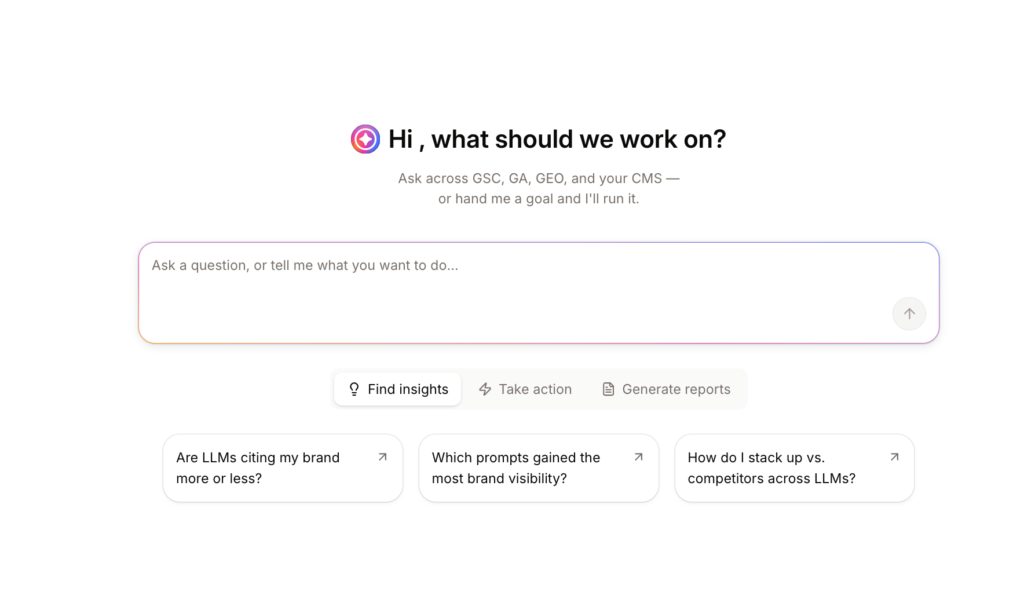
There is no query syntax to learn. You type what you would ask a sharp analyst on your team, a question, a request, or a task, and Atlas works out which data it needs, pulls it, and answers.
It orchestrates across sources, rather than routing to one
Here is the distinction worth getting straight early, because it is the ambitious part of the engineering. A router would send a rankings question to one pipeline and a GEO question to another, and each pipeline would only ever see its own data. Atlas is an orchestrator. It pulls from any combination of sources to answer one question, because the questions worth asking are cross-source by nature.
Think about the ones you actually care about. What should I prioritise this quarter? Where is my biggest opportunity? What is the ROI of fixing these pages? Not one of those can be answered by a single data source. Each needs GEO, Search Console, Analytics, competitive data and your CMS layered together, then scored and ranked into one answer.
That is what Atlas does. It layers the sources, weighs them against each other, and hands you an answer grounded in how organic actually works in AI search, not a spreadsheet you still have to interpret.
Useful on day one, sharper with every source
Atlas reasons over whatever data it can reach, so it is useful before you have connected everything.
Some sources are on automatically. GEO tracking is always on, no connection required, so you can ask about AI-search visibility right away. DataForSEO runs through Pepper’s own credentials, so competitive and backlink signals are there with no action from you.
The rest you connect once. Google Search Console and Google Analytics take a one-time sign-in. Search Console unlocks ranking, click and impression data. Analytics unlocks conversion value, so recommendations start weighting the pages that actually drive business outcomes. Your CMS unlocks page-level content detail, and it lets Atlas publish straight to WordPress. Reading content works across all three supported systems; publishing back starts with WordPress.
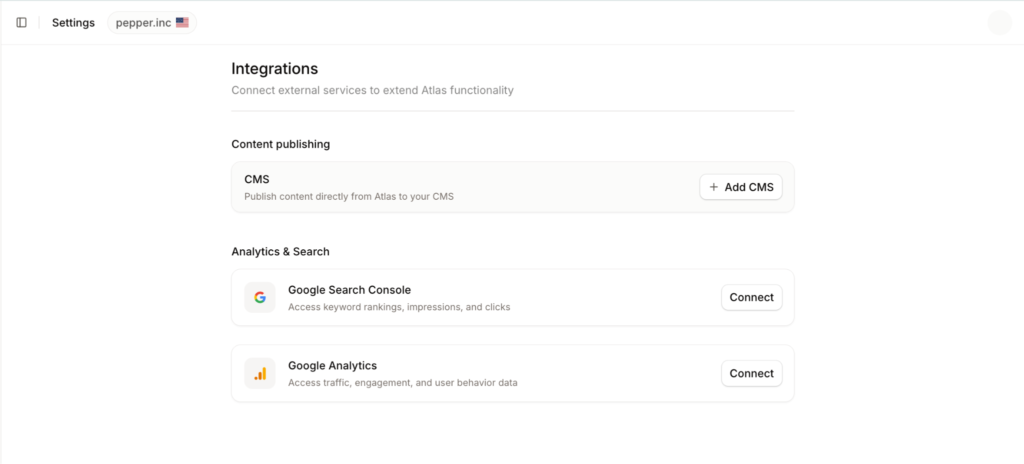
The pattern is simple. On its own, GEO answers AI-visibility questions. Add Search Console and it also sees organic search performance. Connect Analytics too and it can tell the difference between a page that ranks and a page that earns. Connect everything and you get the ranked, prioritised, cross-source answers it was built for.
Chat holds the story, canvas holds the detail
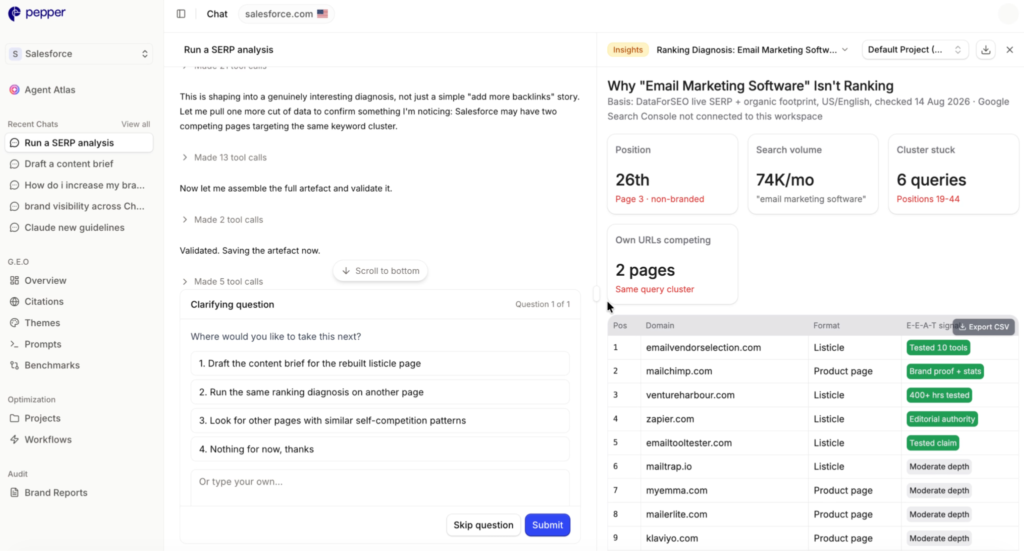
By default the screen is a single centered chat, no split panels. When an answer is richer than a sentence or two, a canvas slides in from the right. It holds the detail while the chat keeps the narrative.
They are two views of one response, not two tools. The chat holds the summary, the reasoning, the recommendations and the action options, which is what you read to understand what happened and what to do. The canvas holds the detailed output, which is what you drill into for specifics. They point at each other, so the chat tells you which tab to open and each tab tells you which question produced it.
For a simple response, a number, a short explanation, a yes or no, no canvas opens at all. The answer lives in the chat where it belongs.
The two shapes an Agent Atlas answer takes
When an answer is more than a sentence, Atlas renders it on the canvas as one of two things.
The first is Insights, the analytical output: a single scrollable page that summarises at the top, details in the middle, and supports at the bottom. It is what you get when you ask which pages should I optimise, or why did traffic drop. You read it top to bottom, because the argument is already ordered for you.
The second is the Workflow Builder. When a task needs a piece of repeatable work you do not have yet, the builder opens on the canvas and Atlas assembles it. This is the same workflow layer from the last edition, reached from chat instead of built by hand.
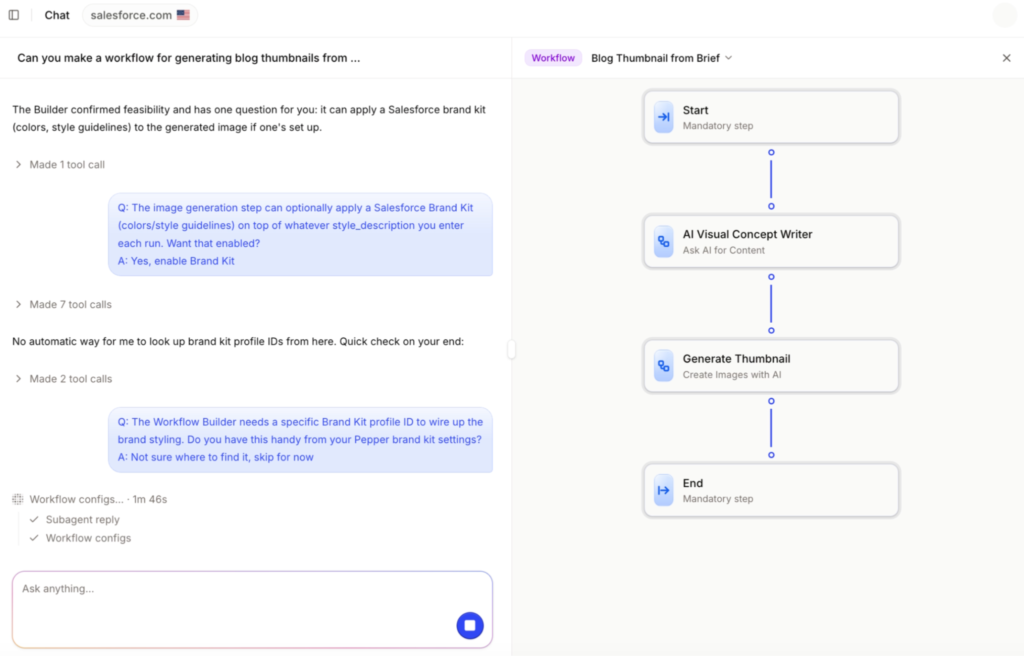
One thing is worth saying plainly, because it changes how you treat what comes back. The artifacts Atlas produces are built and maintained by the agent. You do not hand-edit them, and they are not interactive surfaces you click into. You direct the work through the conversation, and Atlas produces the output.
How those outputs look depends on the run. Bulk outputs usually land in a sheet, to keep them readable. A handful of results might come back as a simple document instead. The sheet is a way to display the run, not a separate thing you manage.
From a question to finished work
Working with Agent Atlas follows a natural rhythm, and it is the same rhythm whether your request triggers no work or a chain of it.
You ask. If a good answer depends on your goal or scope, Atlas asks one focused question first, presented as a short form to fill in, so it resolves the most consequential ambiguity before it runs. It answers, and recommends what to do next. You pick a recommended action, and Atlas runs the work that carries it out. The conversation keeps its memory, so you can refine, follow up, or start a new thread.
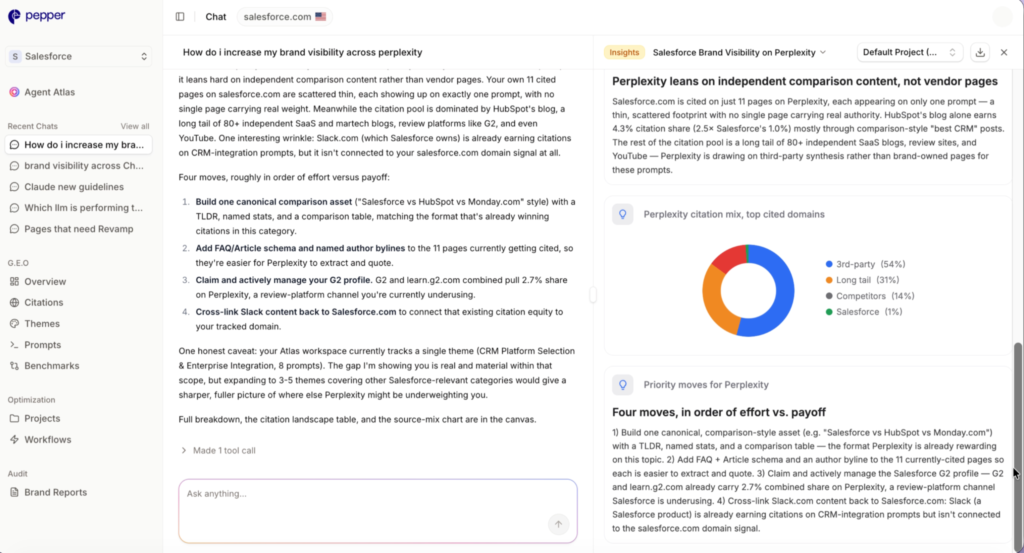
This is where a conversation turns into work. After Atlas delivers its analysis, the next steps appear right in the chat, ordered by estimated impact so the highest-leverage move is first. Each one names the action, the pages or keywords it applies to, and the output you will get back. Selecting one triggers it immediately, with no navigating to another screen and no configuration forms. You can run one, chain several in plain language, or ignore them and ask something else.
That is the loop the whole product is built around:
- You ask a question.
- Atlas answers with the analysis.
- It recommends the highest-impact steps.
- You act with one click.
- You continue, refining or moving on.
Insight to action in one flow, with no context switching in between.
Where the work is kept
There is a version of all this that still fails, and it fails quietly. You get the answer, you run the work, and four months later nobody can find any of it.
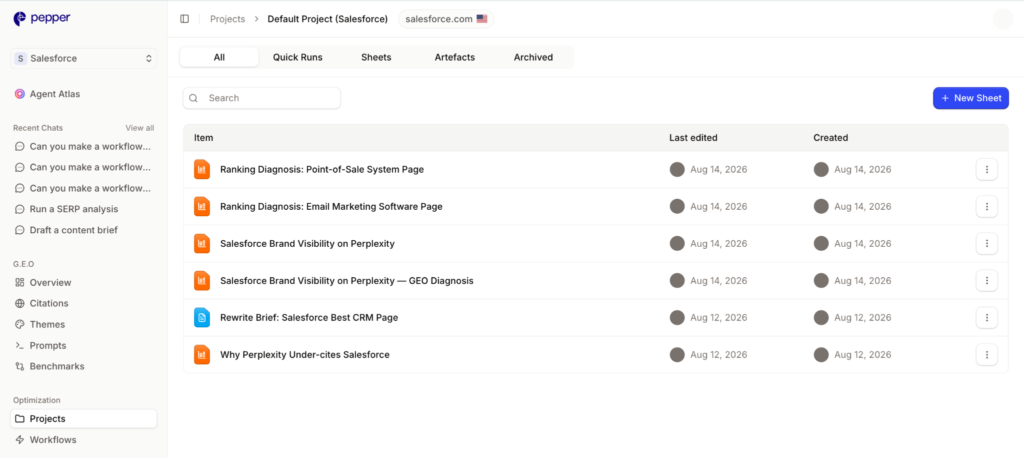
Sessions are the conversations, and they are meant to be ephemeral, the record of one back-and-forth. When you produce something you want to keep and reuse, you add it to a Project, the durable home for the artifacts and workflows you want to run again.
Every session lands on a fresh chat. Its history sits in a sidebar with an auto-generated title, and reopening one restores the whole conversation and everything it produced.
This matters for the same reason it mattered last edition. Organic is a long game, so the unit of real work is almost never one answer. A quarter is a handful of initiatives. A Project keeps the artifacts and workflows for each one together, so the work stays findable by purpose rather than by who ran it or in which week. Moving an artifact into a Project is a deliberate step you take, which is exactly what you want for the things worth keeping.
Start with the question you keep answering by hand
Agent Atlas is built to end in finished work, not in a nicer place to look at data. Three moves come out of it consistently.
Ask the cross-source question you usually avoid. Not the one a single dashboard answers, but the one that needs five of them. Something like: what should I prioritise, given rankings, conversions and AI visibility together? That is the question an AI agent for SEO like Atlas exists for, and the one you have been assembling by hand.
Let the recommendation run. When the answer comes with a next step attached, take the step inside the same conversation. Do not export the insight and start the work somewhere else. The whole point is to not put the tool down between deciding and doing.
Keep the work in a Project. An answer you cannot find in month three is not an asset. The same answer, filed under the initiative it belonged to, is the start of the compounding you keep promising leadership.
Why this is the thing we bet on
For eight years we have run content and SEO for more than 250 enterprises, and the pattern that repeats is this: teams do not lose organic because they cannot see the data. They lose it in the gap between seeing it and acting on it. The exports that never became work. The answer that lived in one person’s tabs and left when they did. Everyone else built a dashboard that shows you the data and leaves the rest to you. We built an engine you can talk to, one that reasons across all of it and does the work with you. That is why this is the most ambitious thing we have shipped, and the one we are willing to be measured on. If you want to see what that looks like in practice, how Acceldata grew organic 6X with Pepper is a good place to start.
FAQ
What is Agent Atlas?
Agent Atlas is the chat-first layer of Pepper’s GEO platform, and the biggest launch in the company’s history. You ask a question in plain language, and it reasons across all of your connected data: GEO, Search Console, Analytics, competitive data and your CMS. It answers with the reasoning behind it, and it offers to run the work that acts on the answer.
How is it different from a dashboard?
A dashboard hands you data and leaves the “so what” to you. Atlas closes that gap. Every answer includes what to do about it, and every recommendation maps to a specific piece of work it can run, so you go from insight to action without switching tools.
Do I have to connect all my data before I can use it?
No. GEO tracking is always on and DataForSEO runs through Pepper’s credentials, so you can start immediately. Connecting Search Console, Analytics and your CMS makes the answers sharper and more business-aware, but Atlas is useful from day one.
What does Atlas hand back when I ask something?
For a short answer, you get a reply in the chat. For an analytical question, it opens an Insights page on the canvas that summarises, details and supports in one scrollable view. When a task needs repeatable work you do not have, the Workflow Builder opens so Atlas can assemble it.
How does Atlas turn an answer into work?
After the analysis, it surfaces recommended actions in the chat, ordered by estimated impact. Each one names the action, the pages or keywords it applies to, and the output you will get. You click one to run it, chain several in plain language, or ask something else.
Ask it the question you have been assembling by hand
The answer you need this quarter is spread across five screens right now, and you are the one stitching them together. Agent Atlas is the place you ask once and get the answer, the recommendation, and the work. It is the biggest step we have taken toward a marketing platform that does the job instead of just reporting on it.
See where you stand at pepper.inc, or book a demo.
Latest Blogs
The research pulls in two directions. Fan-out rewards covering many adjacent questions; absorption research finds longer pages get used. The resolution is that the passage competes, not the page.
Seven documented changes, not seven predictions. Google switched two rich results off, shipped two new AI reports, and added a channel to Analytics. Here is what actually moved and what it means.
Content chunking is the process of splitting a page into smaller pieces so a machine can retrieve one of them. Here is the part most articles get wrong: chunking is something engines do to your page, not something you do to it. You do not choose the chunk size.
Get your hands on the latest news!