AirOps Alternatives: The 2026 Guide for AI Search Teams
Disclosure: Pepper published this guide and appears in it, in a separate category rather than ranked first. Every option carries a “where it falls short” line, including ours. Product claims come from each vendor’s own site and pricing pages, checked 12 August 2026.
The short answer
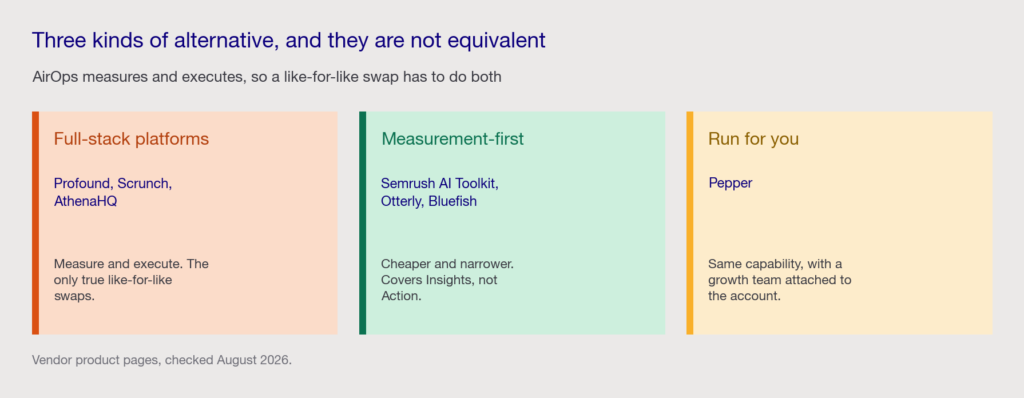
AirOps is an AI search growth platform. It measures where you appear across AI engines, then executes content work against what it finds. And any alternative has to cover both halves, or you have to accept covering one of them somewhere else.
Key takeaways
- AirOps describes itself as “the growth platform for AI Search,” spanning Google, ChatGPT, Claude, Perplexity and Gemini. Two modules matter: Insights for citation and share of voice tracking, and Action for execution.
- The closest like-for-like alternatives are Profound, Scrunch and AthenaHQ. All three now pair measurement with some form of optimisation or content delivery.
- Semrush AI Toolkit and Otterly are measurement-first. Cheaper, and they leave the execution to you.
- The category has converged. Almost everyone measures and almost everyone now ships some execution, so features no longer separate these tools. Who does the work does.
- The most common reason teams leave AirOps is not a missing feature. It is that nobody had time to run it.
A note on where this comes from. And we run organic for more than 250 enterprises and track over 10 million prompts across every major engine. And the view below is shaped by that, by the client reviews we sit in every week. And by the conversations we have with buyers and operators at the events we run. So this is our read on the category, not a neutral directory.
What is AirOps, and what does it actually do?
AirOps is an AI search growth platform. It measures where a brand appears across AI engines, then executes content work against what it finds. So that is one product doing two jobs, and it is why a like-for-like replacement has to cover both.
What AirOps actually is
Worth being precise, because AirOps is frequently miscategorised as a workflow automation tool. It began closer to that, and Grids and Workflows are still in the product. But its current positioning is explicit: “The growth platform for AI Search, Google, Gemini, Perplexity, Claude, ChatGPT.”
Two halves do the work.
Insights is the measurement layer. It reports citation rate, mention rate, share of voice, position and sentiment, broken down by platform, persona and region. Two things distinguish it from a simple tracker: it merges AI citations with Google Search Console and GA4 data at page level. So you can see one page’s performance across AI and classic search together. And its Earned Influence view surfaces the external URLs being cited in your category, scored by influence. So that second one matters, because in most categories the answer is decided on pages you do not own. So that is why how to get cited in LLMs is usually a bigger lever than on-page work.
Action is the execution layer. Citation, page and prompt data feeds agents that draft and refresh content. Quill is the agent that coordinates this. Brand Kit enforces voice and style across outputs.
Published customer results include Angi at a 79 percent higher conversion rate and Chime at a 3x increase in AI search citations.
So AirOps is a direct competitor to Profound and to Pepper, not to Zapier. And any comparison that puts it next to general automation tools has misread the product.
What AirOps costs
AirOps publishes a free tier and its overage rate, and gates the rest.
| Tier | Included | Notes |
|---|---|---|
| Insights (free) | 1,000 tasks, 1 user, 1 brand kit | Genuinely useful for evaluating |
| Solo | 20,000 tasks, 100 tracked prompts | ChatGPT insights only |
| Pro | 75,000 tasks, 250 tracked prompts | Multi-engine: Google, Perplexity, OpenAI, Google AI Studio |
| Pages, Enterprise | Custom | Talk to sales |
Solo and Pro prices are no longer shown publicly (checked 12 August 2026). Overage is listed at 0.025 US dollars per task.
The tier split is the more useful information anyway. Entry-level tracking covers one engine. Your buyers do not use one engine. So if AI visibility is the reason you are buying, the entry tier measures a fraction of the problem.
What are the gaps AirOps leaves?
Four, based on the published product and pricing pages plus recurring themes in public reviews.
Single-engine visibility at the entry tier. Covered above, and the most common reason teams outgrow Solo faster than they planned. In practice, coverage differences between engines are real: see Perplexity vs ChatGPT brand visibility.
Task-based billing is hard to forecast. A task is a single step execution. So one piece of content moving through a multi-step agent consumes many. The relationship between “how much do we want to publish” and “what will this cost” is not intuitive. Teams tend to discover the answer after the fact.
Output is a draft, not a publish. True of every generation platform, not a criticism unique to AirOps. So budget real editorial hours per piece. If your plan assumed otherwise, the plan is the problem.
Someone has to run it. This is the big one. In practice, AirOps is a capable platform that assumes an owner: someone reasonably technical, reasonably available, who keeps the agents and prompt universe current. When that person is reassigned, the platform quietly decays into a subscription.
Modelling what tasks actually cost you
Ten minutes of arithmetic avoids the most common billing surprise in this category.
- Count the steps in one agent run. Research, outline, draft, edit, schema, publish. A moderately complex content agent commonly runs 15 to 40 steps per output.
- Multiply by monthly volume. Forty steps across 500 pages is 20,000 tasks, which is the entire Solo allowance.
- Price the overage. At 0.025 US dollars per task, 40,000 tasks beyond your allowance adds roughly 1,000 US dollars.
- Add a variance buffer. Reruns, failed steps and iteration during build all consume tasks. Teams routinely land 30 to 50 percent above their first estimate in month one.
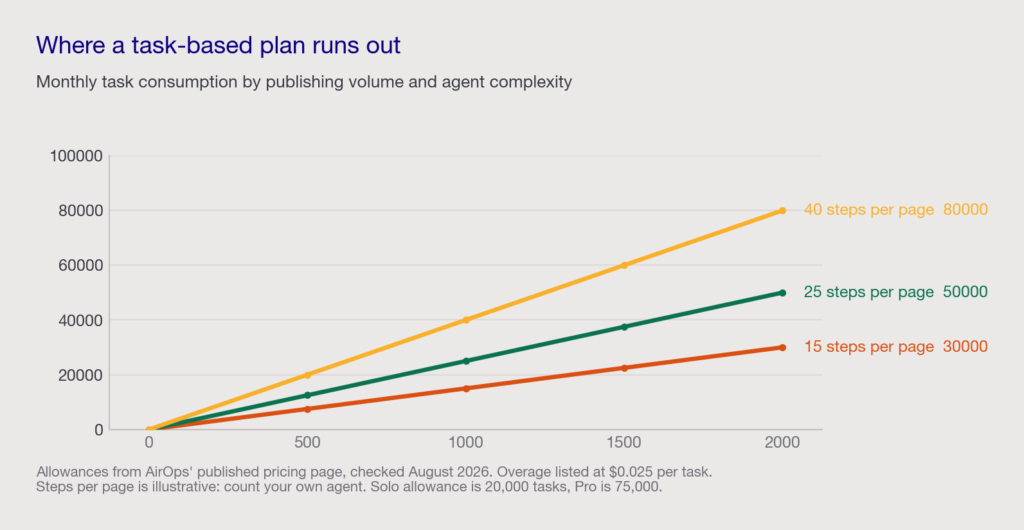
The number that matters is cost per published piece, not cost per month. Work it out, then compare it against a flat-rate platform or a managed model on the same basis. Sometimes AirOps wins that comparison comfortably.
See where you show up. Pepper’s GEO platform tracks Brand Visibility, Domain Prompt Presence and Share of Voice across ChatGPT, Perplexity, Gemini, Claude and Google AI Overviews. And a growth team works the account with you. Book a growth audit or see where you show up.
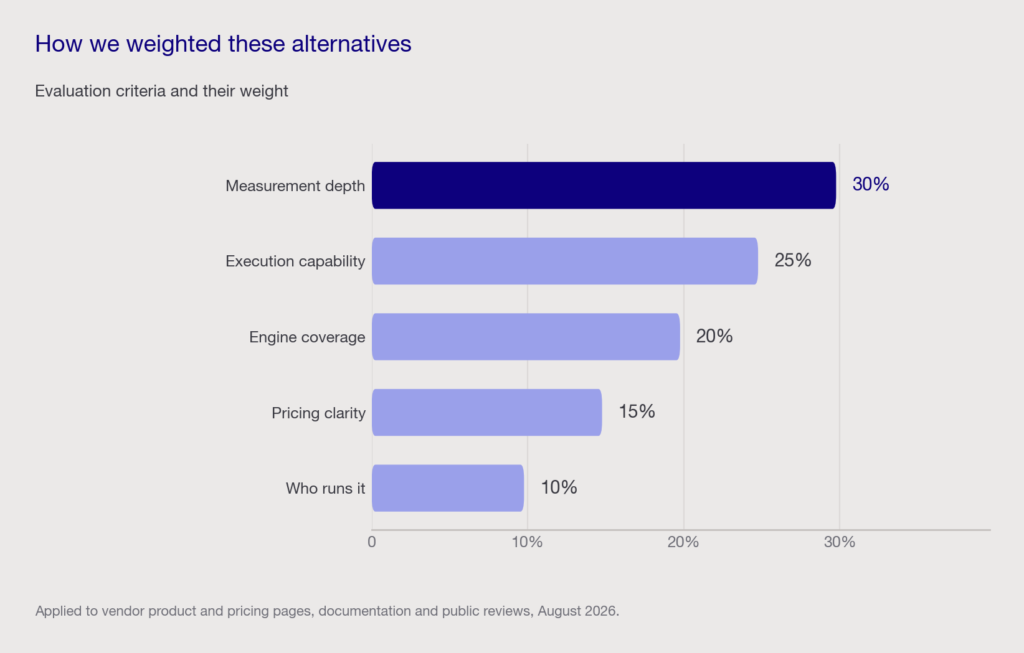
How we evaluated these alternatives
Applied to publicly verifiable information: vendor product and pricing pages, documentation and public reviews. In practice, our full model is set out in the GEO agency ranking methodology.
| Factor | Weight | What we looked for |
|---|---|---|
| Measurement depth | 30% | Citations at URL level, share of voice, sentiment, competitor view |
| Execution capability | 25% | Does it act on findings, or only report them |
| Engine coverage | 20% | Beyond ChatGPT, at the tier you would actually buy |
| Pricing clarity | 15% | Published, predictable, forecastable |
| Who runs it | 10% | Whether the model assumes internal capacity you have |
What we could not verify. Pricing for several vendors. Scrunch, AthenaHQ and Bluefish quote custom or gate rates behind a demo. In practice, Profound publishes tiers, and AirOps publishes a free tier and its overage rate while gating Solo and Pro. Where a price is published we give it with the date checked; where it is not, we say so rather than estimating.
AirOps alternatives at a glance
| Platform | Category | Measures | Executes | Engines | Pricing |
|---|---|---|---|---|---|
| AirOps | AI search growth platform | Yes | Yes | Google, ChatGPT, Claude, Perplexity, Gemini | Free tier; rest gated |
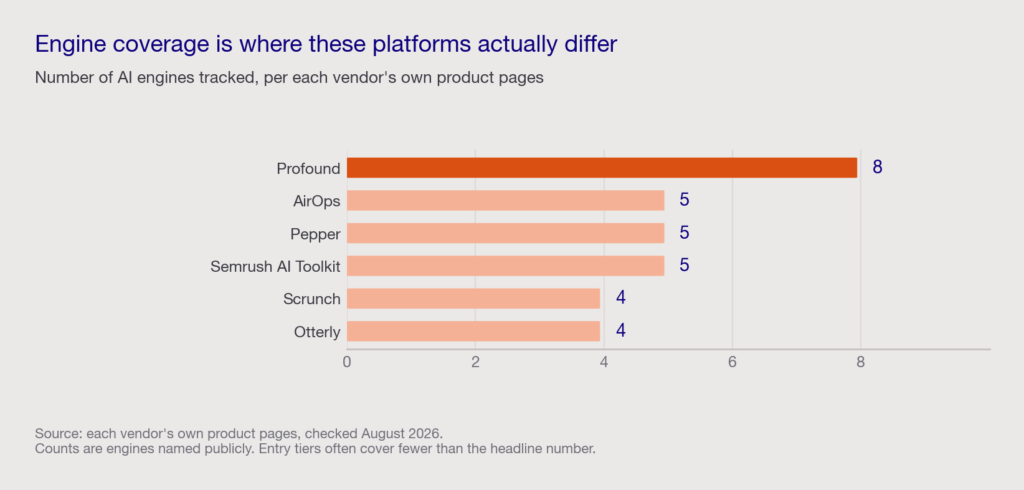
| Profound | AI search platform, enterprise | Yes | Yes, via agents | 8 incl. Grok, Copilot, DeepSeek | From $99/mo |
| Scrunch | AI search platform | Yes | Yes, incl. agent delivery | Multi-engine | Not published |
| AthenaHQ | AI visibility with optimisation | Yes | Recommendations and audits | Multi-engine | Not published |
| Semrush AI Toolkit | Measurement inside an SEO suite | Yes | No | AI Overviews, AI Mode, ChatGPT, Perplexity, Gemini | Suite add-on |
| Otterly | Entry-level monitoring | Yes | Audits only | Multi-engine | Accessible entry tier |
| Bluefish | Enterprise brand monitoring | Yes | Limited | Multi-engine | Not published |
| Conductor | Enterprise SEO with AI visibility | Yes | Partial | Multi-engine | Enterprise, custom |
| Pepper | Platform plus growth team | Yes | Yes, run by our team | ChatGPT, Perplexity, Gemini, Claude, AI Overviews | Custom, annual |
The closest like-for-like alternatives
Profound
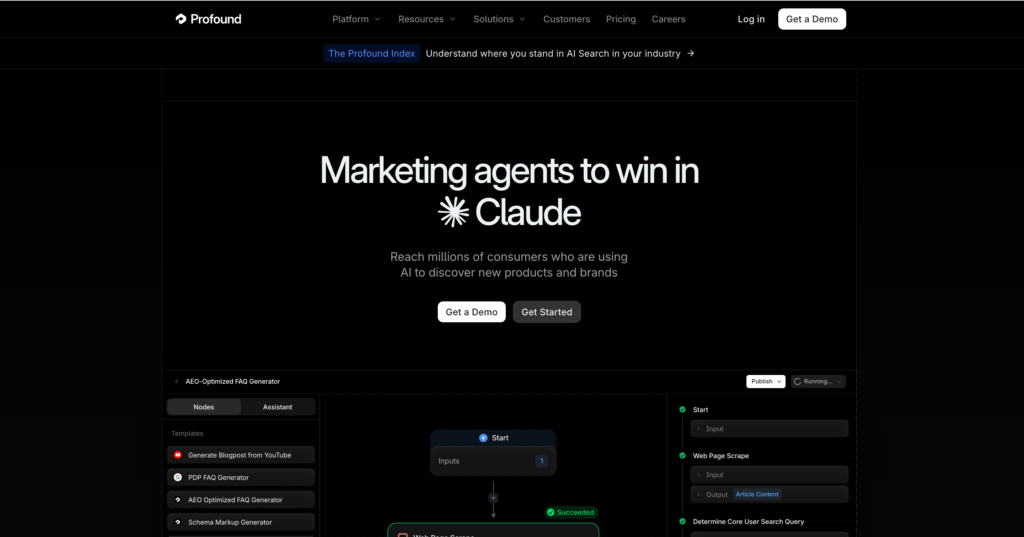
What it is. An enterprise AI search platform. Modules include Prompt Volumes, Answer Engine Insights, Agent Analytics, Aim for prioritisation, and Shopping. It also ships Agents that generate optimised content, so the old shorthand that Profound only measures is out of date.
Engine coverage is the standout. Perplexity, ChatGPT, Claude, Gemini, Grok, Microsoft Copilot, DeepSeek and Google AI Overviews. So that is the broadest set here, and it matters if your buyers are not concentrated on the big three.
Best for. Large organisations that want the deepest measurement available and have a team to act on it. In practice, Profound now publishes pricing, having gated it earlier in 2026: Starter at $99 a month covering ChatGPT only with 50 tracked prompts, Growth at $399 a month across three engines with 100 prompts. And enterprise quoted custom for up to nine engines (checked 17 August 2026).
Where it falls short. The entry tier covers ChatGPT only, so meaningful multi-engine coverage starts at Growth. Execution through agents is newer than the analytics and less proven. Deep analytics create their own workload: a platform that surfaces two hundred prioritised fixes has given you a backlog unless someone is resourced to work it.
We compare the category in more depth in Profound alternatives.
Scrunch
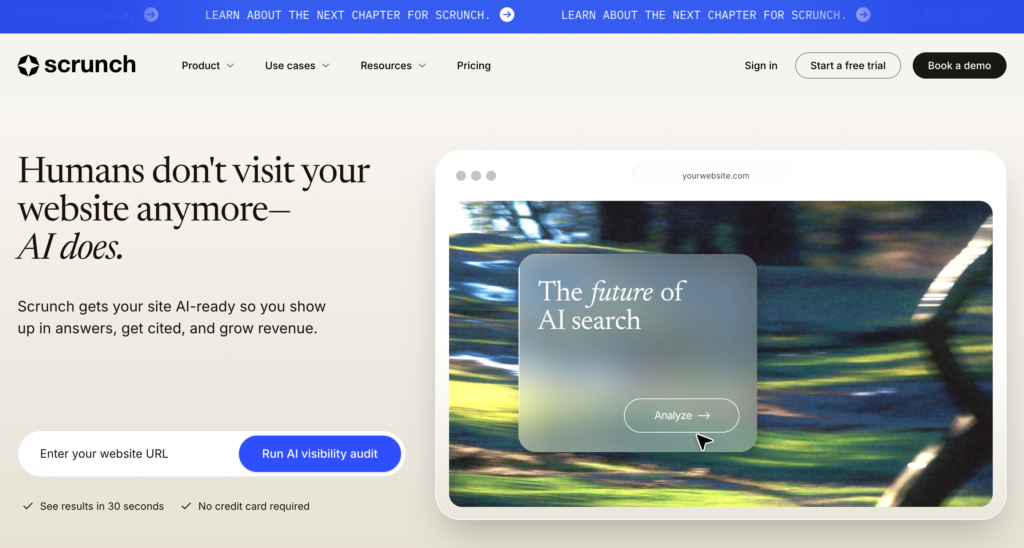
What it is. Four products across monitoring, auditing, optimisation and content delivery. The distinctive piece is its Agent Experience Platform, which serves AI-optimised content to AI agents while leaving the human-facing site unchanged.
Best for. Teams that want persona-based tracking, and brands where how models describe you matters as much as whether they mention you.
Where it falls short. Serving different content to agents than to people is a strategy worth thinking through carefully with your SEO and legal stakeholders before adopting. In practice, pricing is not published.
AthenaHQ
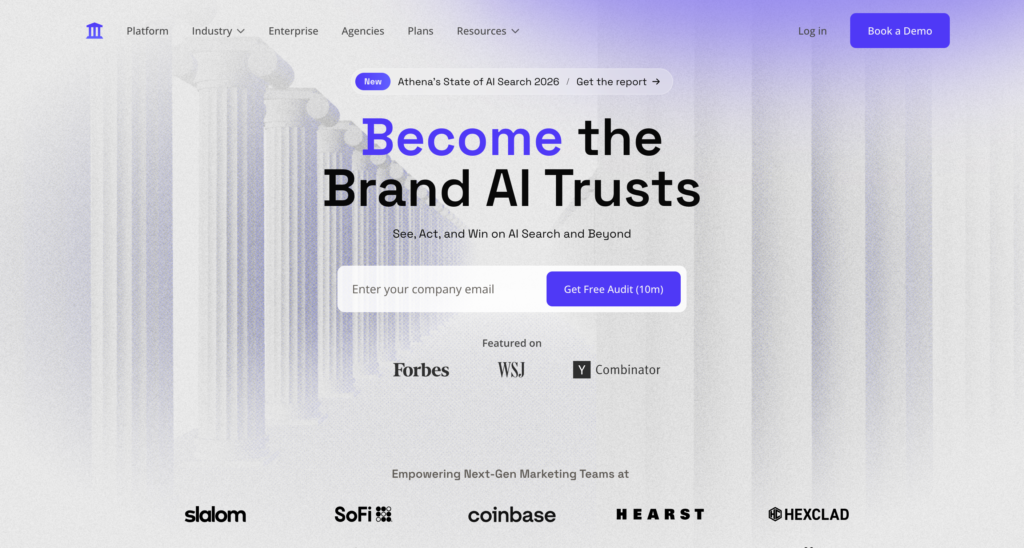
What it is. Brand presence tracking across AI answers, with optimisation built into the platform rather than bolted on. It audits content for citation readiness, checking structure, formatting and authority signals.
Best for. Mid-market teams that want monitoring and a concrete list of what to change, without an enterprise procurement cycle. Compare the wider field in best LLM monitoring tools.
Where it falls short. Lighter enterprise governance than Profound or Conductor. Credit-based pricing models create the same forecasting problem as task-based ones. Recommendations still need someone to implement them.
Measurement-first alternatives
Cheaper, narrower, and honest about it. So buy here only if your execution is handled elsewhere.
Semrush AI Toolkit
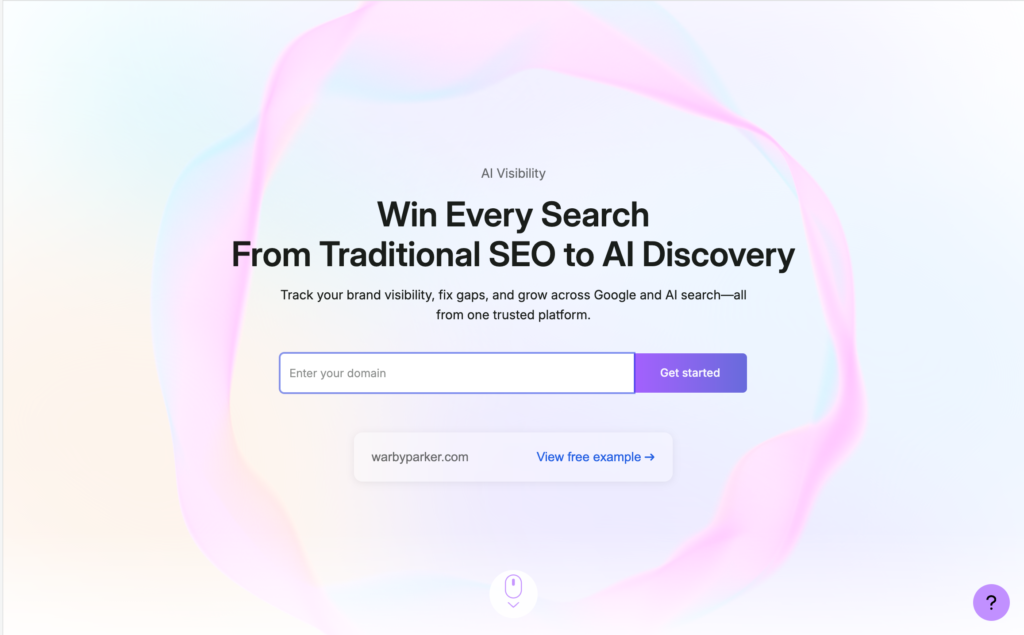
What it is. AI visibility inside the Semrush suite, tracking Google AI Overviews and AI Mode, ChatGPT, Perplexity and Gemini, with share of voice and sentiment reporting.
Best for. Teams already paying for Semrush who want AI visibility beside their existing SEO data.
Where it falls short. It measures and does not optimise or deliver content. As a replacement for AirOps it covers the Insights half and none of the Action half.
Otterly
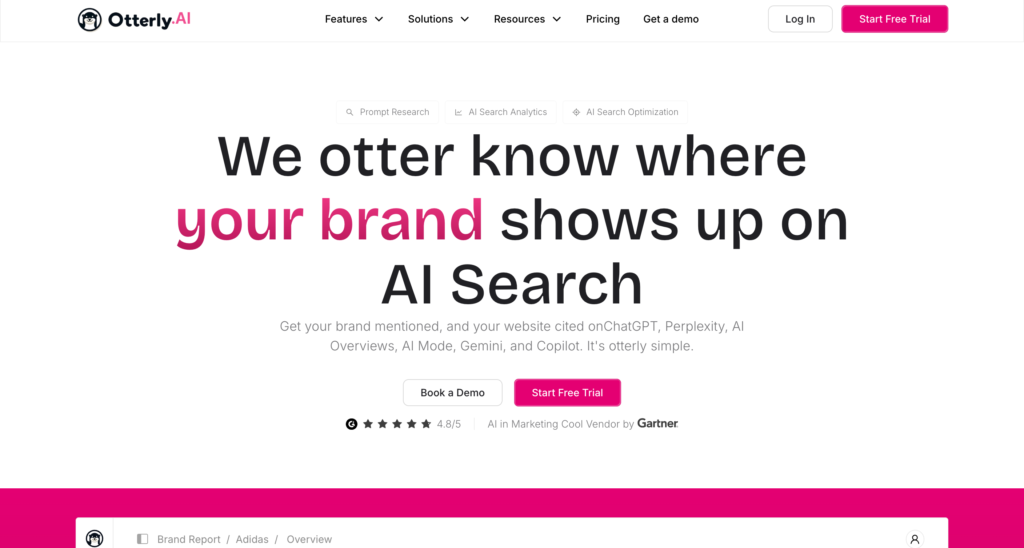
What it is. Accessible AI search monitoring with GEO audits, popular with smaller teams and agencies.
Best for. Establishing a baseline cheaply, or agencies monitoring many clients.
Where it falls short. Shallower analysis and no execution. Good for knowing, not for deciding or doing.
Bluefish and Conductor
Bluefish focuses on enterprise brand monitoring across AI answers, including retail surfaces. Conductor brings AI visibility into an established enterprise SEO platform, which suits organisations that already run their organic programme there. Neither publishes pricing, and both lean measurement-heavy.
If what you actually need is content production
Some teams adopted AirOps mainly to produce content and treat the AI search reporting as a bonus. If that is you, the alternatives are different: Jasper and Writer for governed content at scale, Surfer and Clearscope for optimisation, MarketMuse for planning.
The trade is explicit. You gain editorial depth and lose AI search measurement entirely, so you will need a tracker alongside. See best AEO platforms for how those pair up.
The other answer: stop running it yourself
Every platform above assumes internal capacity. So that assumption is worth testing, because it is the one that most often fails.
Pepper
What it is. Pepper is an agentic organic growth engine. Atlas is the platform underneath, covering GEO analytics and agents built in the Agent Atlas. The capability set is comparable to the platforms above. In practice, the is that a growth team comes with it. So you get the platform and a growth team on the account. Your team can log in, connect Search Console and GA4, manage the prompt set, read the analytics. And build and run agents in the Agent Atlas. In practice, our growth team works the same account alongside you, so the work still happens when your week fills up.
What that covers. Brand Visibility, Domain Prompt Presence and Share of Voice tracked across ChatGPT, Perplexity, Gemini, Claude and Google AI Overviews, against the three levers of Visibility, Citability and Retrievability. Plus the off-site authority work that decides most categories. More than 10 million tracked prompts sit behind the strategy. Eight years, 250 plus enterprises.
Where it falls short. Annual and outcome-pegged rather than monthly. So it is a poor fit for a short experiment or a cheap monitoring trial. Organic only: if you want one partner across paid and lifecycle, this is the wrong shape. And if you have a capable operator in-house who enjoys running the platform, you may simply not need this.
What to ask on any demo in this category
The marketing pages in this category have converged even where the products have not, so a demo is worth structuring. Two pieces of context help.
In May 2026 Google published its first official guidance on optimising for its AI features, filed under SEO fundamentals: AEO and GEO are part of SEO for Google, there is no separate AI index. And llms.txt, content chunking and AI-specific rewrites are explicitly mythbusted. Separately, Bing shipped an AI Performance report in Webmaster Tools in February 2026 showing cited URLs and the queries that triggered them. So that means some first-party citation data is now free. And a vendor who cannot discuss either is working purely from their own dashboard.
Score each shortlisted partner out of 100 using the weights below, before the pricing conversation rather than after it. And a partner who scores well on measurement and badly on execution is a research vendor, whatever the deck says.
The scorecard we would use. Score each vendor out of 100 before the pricing conversation, not after.
| Area | Weight | What a strong platform demonstrates |
|---|---|---|
| Measurement depth | 25% | Cited URLs, competitors and share of voice across a real prompt set, at the tier you would actually buy |
| Execution capability | 25% | Something happens after the finding. Ask to see the output, not the roadmap |
| Engine coverage | 20% | The engines your buyers use, at your tier. Entry tiers routinely cover fewer than the homepage implies |
| Prompt-set methodology | 15% | They can explain how the tracked set was chosen. Otherwise the reporting is arbitrary |
| Pricing predictability | 10% | You can forecast cost per published piece, not just cost per month |
| Who runs it | 5% | Whether the model assumes internal capacity you actually have |
Give each shortlisted partner 20 to 30 real commercial questions your buyers ask. Not branded ones. Things like “best enterprise content marketing platforms”, “best alternatives to our closest competitor”, “which platform should I use for this use case” and “how should a company like ours improve visibility in ChatGPT”.
Then ask them to come back with five answers: where do we appear, which competitors appear instead, which sources are influencing those answers, why are those sources winning. And what exactly would you change in the first 90 days?
Before the demo, run your own test. Take 20 to 30 real commercial questions your buyers ask, not branded ones. And hand the same list to every vendor. So ask each to come back with: where you appear, which competitors appear instead, which sources are influencing those answers, why those sources are winning. And what they would change in the first 90 days. So that last question is where most of the field thins out.
Red flags we would walk away from: a guarantee of citations, since nobody controls a generative engine’s output and Google gives the same warning about guaranteed rankings; tracking that only covers branded prompts; single-engine optimisation; no stated methodology for how the prompt set was chosen; citation counts reported without competitor share of voice; and any plan whose core is publishing hundreds of AI-generated articles, which is the tactic Google’s guidance warns against directly.
Price the switch, not just the subscription. The comparison teams skip is total cost of change: rebuilding agent logic, re-establishing a measurement baseline. And the weeks where two platforms run in parallel. In the accounts we take over, that switching cost is routinely larger than the annual difference in licence fees. So that is why “cheaper” is rarely the right reason to move on its own.
One more thing worth asking about, because almost nobody does. Ask what the platform does in month seven. The first ninety days of any AI search programme are structural: schema, entity clarity, retrievability, the obvious content gaps. So those wins arrive quickly and then stop. What follows is off-site authority work, which is slower, less automatable, and where most platforms have very little to offer. And a vendor with a good answer here is thinking about your outcome. And a vendor who has never been asked will tell you about a feature roadmap.
The distinction that decides it: weak playbook against strong
The weaker playbook in this category runs: find prompts, rewrite blogs, add FAQs, add statistics, hope the engines cite you. And it is cheap to sell and it plateaus in about a quarter.
The stronger model, and the one we run, sequences it: demand intelligence, then technical discoverability, then entity and brand authority, then content, then earned-media authority, then distribution, then visibility measurement, then revenue attribution.
That difference matters because generative engines synthesise an answer from several sources rather than ranking one page. Being retrieved, being cited, and actually influencing the answer are three different things worth measuring separately.
Then five questions that separate the platforms quickly.
- At the tier I would actually buy, which engines are tracked? Entry tiers routinely cover fewer engines than the homepage implies.
- Do you track citations at URL level or only brand mentions? Being named and being cited are different metrics with different remedies.
- What does your execution actually produce, and who reviews it? Every vendor says “agents” now. Ask to see the output.
- How do you handle answer variance? Responses move between runs. A vendor who cannot explain how they separate signal from noise is reporting noise.
- What happens in month seven? After the structural wins, the work becomes off-site authority. Ask what the platform does then.
Reduced to one principle, it comes down to this: choose the partner that treats this as a measurable growth system rather than a new name for content services.
One honest closing note. Very few firms are equally strong across measurement, execution, earned authority and attribution, ours included. The good ones will tell you which is their weakest without being asked. If a partner claims to be excellent at all four, you have learned something about how they answer questions.
What nobody should promise you
A guaranteed number of citations, or a guaranteed position in an AI answer. And nobody controls a generative engine’s output, and Google gives the same warning about providers guaranteeing search rankings, for the same reason.
Be equally wary of a single AI visibility score sold as a ranking position. So ask a model the same question repeatedly and the response set moves. Brand Visibility, Domain Prompt Presence and Share of Voice, tracked across a fixed prompt set over time, are real moving numbers that can be held to. One screenshot is not.
The honest version of what any platform in this category can promise is measurement you can act on. And execution capacity that depends on someone having the time to use it.
When you should stay with AirOps
An alternatives page that never reaches this conclusion is a sales page. Stay if:
- You have an owner who likes the platform and is not going anywhere.
- You are on Pro or above, so multi-engine visibility is actually covered.
- Your task consumption is stable and you have modelled cost per published piece.
- The agents and grids you have built are load-bearing. Rebuilding that logic elsewhere is real work.
- Your gap is capacity rather than capability. Switching platforms does not add hours to anyone’s week.
How to migrate, if you do move
1. Inventory before you cancel. Export agents, prompts, brand kits and knowledge base sources. Screenshot the logic of anything complex. Agent logic is the asset that does not port.
2. Move the measurement baseline first. Get the new platform tracking the same prompt set before you lose access to the old data, or you cannot tell whether the switch helped.
3. Rank by value, not effort. A small number of agents usually produce most of the output. Rebuild those and let the long tail go.
4. So run parallel for one cycle. Compare output on the same brief, not different ones.
5. Cancel on the renewal boundary. Annual contracts rarely refund. Diarise the notice window now.
Frequently asked questions
What is AirOps?
AirOps is an AI search growth platform. In practice, its Insights module tracks citations, share of voice and sentiment across Google, ChatGPT, Claude, Perplexity and Gemini. And its Action module executes content work against those findings using agents coordinated by Quill.
Is AirOps a workflow automation tool?
It includes Grids and Workflows and began closer to that category, but it now positions itself as a growth platform for AI search. Comparing it to general automation tools misreads what it currently sells.
What are the best AirOps alternatives in 2026?
Profound, Scrunch and AthenaHQ are the closest like-for-like options, since all three pair measurement with optimisation. Semrush AI Toolkit and Otterly are cheaper measurement-only options. In practice, Pepper covers the same ground as a managed service.
How much does AirOps cost?
AirOps publishes a free tier with 1,000 tasks and lists overage at 0.025 US dollars per task. Solo and Pro prices are gated, and Pages and Enterprise are quoted custom. By contrast Profound publishes tiers from $99 a month.
What is the difference between AirOps and Profound?
Both measure AI visibility and both now execute. In practice, Profound covers more engines, including Grok, Copilot and DeepSeek, and leans deeper on analytics. In practice, AirOps ties its measurement to Search Console and GA4 at page level and has a longer history in content production.
Why do teams leave AirOps?
Single-engine visibility on the entry tier, unpredictable task-based costs, and output that still needs editing. Underneath those, the most common cause is that nobody had the capacity to run the platform properly.
Do I need a separate content tool as well?
Not usually. AirOps, Profound and Scrunch all ship execution. Add a dedicated content platform only if editorial quality is your bottleneck rather than AI visibility, since running both means paying twice for overlapping capability.
How long does migrating take?
Plan two to four weeks for a straightforward move, and longer where agent logic is complex. Rebuilding that logic dominates the timeline rather than exporting data, so inventory your agents before you commit to a date.
You may not need to switch at all
The answer that costs us the sale. If your agents are working, your task consumption is stable and someone owns the platform, stay where you are. Switching costs more than the licence difference once you count rebuilding agent logic and re-establishing a measurement baseline. And if the real problem is that nobody has time to run any platform, buying a different one will reproduce the problem at a new price.
Where to go next
Before shortlisting anything, answer one question honestly: is your gap capability or capacity? If your current platform tells you what to fix and nobody has time to fix it, a different platform will produce the same outcome more expensively.
Latest Blogs
Healthcare SEO advice has one dominant theme: this is YMYL, so build clinical authority. An analysis of 824,997 health citations shows that advice is correct and badly incomplete. Only 17.3 percent of citations go to authoritative medical sources. Three quarters go somewhere else entirely.
Three questions bring people here and only one of them has a clean answer. Profound no longer publishes prices. The $99 Starter and $399 Growth tiers that most comparison pages still quote, including one of ours, are gone from its pricing page, which now shows a free trial and a custom Enterprise tier. The trial is specified in detail and is genuinely useful: 50 prompts run daily for seven days across three engines, with unlimited seats. On reviews, the counts in circulation range from 140 to over 1,100, so we publish no rating at all.
On 3 August 2026 the IAB published the first industry standard for measuring AI visibility. It splits measurement into two tiers: Directional, which it says supports early signal detection but is unsuitable for budget decisions, and Decision-Grade, which requires rigour on query volume, sample size and reproducibility. We then checked what nine leading citation platforms publish about their own methods. Reproducibility is the requirement almost nobody meets, and our own earlier census of fourteen platforms found not one disclosing run-to-run variance.
Get your hands on the latest news!