The best free GEO and AI search tools let any brand set a baseline for AI visibility without budget. They cover one-time brand diagnostics, limited ongoing tracking, and the platform-native reports from Google, Bing, and analytics suites. Free tools work well for diagnosis and early monitoring, while paid platforms add continuous tracking and optimization. This guide ranks the most useful free options and shows where each one fits.
You no longer need a paid platform to learn whether a brand shows up in AI answers. A growing set of free tools can diagnose AI visibility, track a small set of queries, and surface the platform-native data that Google and Microsoft already give you. So for teams still weighing whether AI search matters to their pipeline, these tools are the logical first step.
The case for starting is clear. In early 2026, 68.01% of US Google searches ended without a click, per SparkToro’s analysis of Similarweb data, as AI Overviews and instant answers kept users on the results page. A free GEO audit quickly shows whether AI engines cite your brand in that new layer, or quietly leave it out.
What’s in This Guide
- What free GEO tools can and cannot do
- How these free tools were evaluated
- The best free GEO and AI search tools
- A free GEO workflow that works
- When to move from free to paid
- FAQ
What Free GEO Tools Can and Cannot Do
A free GEO tool is software that measures some part of a brand’s presence in AI search, such as mentions, citations, or sentiment, at no cost, either as a one-time diagnostic or a limited ongoing tracker. Used together, several free tools can build a complete baseline of AI visibility without any spend.
It helps to stay realistic about the limits:
- Free tools shine at diagnosis. A one-time grader or audit answers the first question: does a brand appear in AI answers, and how do the engines describe it?
- They offer limited ongoing tracking. Some free tiers monitor a handful of prompts or keywords. That is enough to spot big changes, but not enough to run a program.
- They rarely include deep optimization or alerts. Continuous monitoring, historical trends, competitor dashboards, and change alerts usually sit in paid tiers.
- Teams underuse platform-native reports. Google Search Console, Bing Webmaster Tools, and analytics suites all give free, first-party signals that many teams overlook.
So the practical takeaway is simple. Free tools work well for a baseline and early monitoring. After that, a paid platform earns its place once you check AI search weekly rather than occasionally.
Takeaway: Free tools are built for diagnosis and light tracking. They show where a brand stands today, which is exactly what a team needs before it commits budget.
How These Free Tools Were Evaluated
We scored each tool against four weighted criteria, chosen to reflect what a team genuinely gains at no cost. The ranking order follows these weights.
| Criterion | Why It Matters | Weight |
|---|---|---|
| Usefulness of the free tier | How much real insight you get without paying | 35% |
| AI engine coverage | Whether the tool spans several engines or just one | 25% |
| Ease of use and speed to value | How fast a non-technical team gets a usable result | 20% |
| Quality and credibility of data | Whether the output is trustworthy and clearly sourced | 20% |
We also checked vendor claims against independent reporting. Then we judged each tool on the specific job it does well, rather than ranking them as if they were interchangeable. Several entries are free tiers of paid products, and we flag that where it applies so expectations stay accurate.
Takeaway: The most valuable free tools deliver real insight, span more than one engine, and produce credible data fast, without requiring a purchase to be useful.
The Best Free GEO and AI Search Tools
We rank the tools below by how much useful, no-cost insight they provide. A snapshot comes first, then the profiles.
| Rank | Tool | What It Does Free | Engines |
|---|---|---|---|
| 1 | HubSpot AEO Grader | One-time brand diagnostic, scored across five dimensions | ChatGPT, Perplexity, Gemini |
| 2 | Otterly.AI (free tier) | Ongoing tracking of a small keyword set | ChatGPT, Claude, Perplexity, others |
| 3 | Geoptie (free audit) | Site GEO audit and cross-engine brand check | ChatGPT, Perplexity, Claude, Gemini, others |
| 4 | Google Search Console | First-party search and AI-configuration data | Google Search, AI Overviews (partial) |
| 5 | Bing Webmaster Tools | AI performance data and instant indexing | Copilot, Bing-powered surfaces |
| 6 | Google Analytics 4 | AI-referral traffic measurement | All (via referral data) |
1. HubSpot AEO Grader
The HubSpot AEO Grader ranks among the most generous free diagnostics around. It sends a brand’s details to ChatGPT, Perplexity, and Gemini, then runs preset queries. The result is a score out of 100 across five dimensions, including sentiment, share of voice, and market position, with no account required.
Its strengths are credibility and clarity. So the sentiment and competitive snapshot help you set a baseline, and they help you show stakeholders that AI search deserves attention. The limit is simple, though. It gives a one-time snapshot rather than continuous monitoring, and a paid HubSpot tier is required for ongoing prompt tracking.
Best for: Any team running its first check of how AI engines describe the brand.
2. Otterly.AI (free tier)
Otterly.AI offers a genuine free tier. It tracks a small set of keywords across ChatGPT, Claude, Perplexity, and other engines, and it adds automated weekly reports plus a basic GEO audit of on-page factors that affect citation potential. Unlike a one-time grader, it gives you a taste of ongoing monitoring.
The free allowance is naturally limited in prompt volume, and costs scale as you track more. Even so, it is an effective way to begin continuous monitoring without upfront commitment.
Best for: Small and mid-market teams that want light, recurring tracking at no initial cost.
3. Geoptie (free audit)
Geoptie provides a free GEO audit. It examines a site across several dimensions, including technical readability, citation potential, and content structure for AI extraction. It returns a result in under a minute with no signup. It also offers a quick cross-engine brand check across ChatGPT, Perplexity, Claude, and others.
Because it pairs a site-level audit with a brand visibility check, it complements a brand-perception grader well. Its deeper optimization features sit in paid tiers, but the free audit gives a strong technical baseline.
Best for: Teams that want a fast, technical view of whether a site is structured to be cited.
4. Google Search Console
Google Search Console stays an underused free source of first-party data. So far, Google has not released a standalone AI Overviews report for all users. However, its experimental AI-powered configuration lets you filter performance data with natural-language queries, and question-style query analysis helps you find the long-tail prompts that often drive AI Overviews visibility.
It does not isolate AI citations cleanly. Still, as a free, authoritative source of how a site performs in Google’s evolving surfaces, it belongs in every baseline.
Best for: Any site owner who wants first-party Google performance data at no cost.
5. Bing Webmaster Tools
Bing Webmaster Tools is worth setting up alongside Search Console, because Bing powers parts of ChatGPT’s web-connected responses and Microsoft Copilot. Its dashboard includes AI performance data. On top of that, IndexNow lets you submit new content to search engines and AI systems right away, rather than waiting for a crawl.
For brands focused on Copilot visibility, this free, platform-native report is the most direct source available.
Best for: Teams tracking Copilot and Bing-powered AI visibility.
6. Google Analytics 4
Google Analytics 4 does not track AI citations directly. However, it is free and essential for the other half of the picture: measuring the traffic that AI sources refer. So when you combine GA4 referral data with the visibility reports above, you connect AI presence to on-site behavior and outcomes.
This matters because AI-referred visitors behave differently. Traffic from AI sources converts markedly better than other channels, per Adobe data cited by SparkToro. So measuring it is worthwhile even while volumes stay small.
Best for: Any team that wants to measure the quality of AI-referred traffic at no cost.
Takeaway: A complete free stack combines a brand diagnostic, a light tracker, a site audit, and the platform-native reports from Google and Bing. Together they cover diagnosis, monitoring, and traffic measurement.
A Free GEO Workflow That Works
The free tools above work best in sequence, not in isolation. Here is a practical four-step workflow.
- Baseline. Run the HubSpot AEO Grader and a Geoptie audit. Now you know how AI engines describe the brand, and whether the site is structured to be cited.
- Track. Set up Otterly.AI’s free tier on the handful of queries that matter most. Then check ChatGPT and Perplexity individually for those prompts.
- Diagnose. Use the site audit to find structural fixes. Validate structured data, and confirm that AI crawlers can reach key pages.
- Measure. Connect Search Console, Bing Webmaster Tools, and GA4. Now you can relate visibility changes to AI-referred traffic over time.
This loop costs nothing. Yet it produces a clear, evidence-based picture of where a brand stands and what to fix first.
Takeaway: Run the free tools as a sequence: baseline, track, diagnose, measure. The result is a credible AI visibility audit without any spend.
When to Move From Free to Paid
Free tools hit a natural ceiling. So the move to a paid platform tends to make sense once one or more of these becomes true.
- Cadence increases. When you check AI search weekly rather than occasionally, automated recurring tracking and alerts save real time.
- Scope expands. Multiple brands, regions, or large prompt sets quickly outgrow what free tiers allow.
- Reporting matters. Stakeholders want historical trends, competitor dashboards, and exportable reports that free tools rarely provide.
- Optimization becomes the goal. Once the priority shifts from measuring visibility to improving it, a platform that connects insight to execution earns its cost.
At that point, match the platform to your scale and objective. Mid-market and enterprise teams often want measurement and content execution in one system, not monitoring alone. So an integrated platform like Pepper and its Atlas product fits well. Atlas tracks brand visibility across ChatGPT, Perplexity, Gemini, Google AI Overviews, and Claude, and it supports the content work that improves citation. Reviewing case studies is a useful way to gauge what a paid program can achieve before you commit.
Takeaway: Stay on free tools while the goal is diagnosis and light tracking. Move to a paid platform once cadence, scope, reporting, or optimization outgrows what free tiers can do.
FAQ
Are there genuinely free GEO tools?
Yes. The HubSpot AEO Grader is a free one-time diagnostic. Otterly.AI offers a free tier for a small keyword set, and Geoptie provides a free GEO audit. Google Search Console, Bing Webmaster Tools, and Google Analytics 4 are also free, and they provide valuable first-party data.
Can free tools track Google AI Overviews?
Partially. Google Search Console offers experimental configuration to filter AI-related performance, and some free brand checks flag AI Overviews presence. However, comprehensive, continuous AI Overviews tracking with citation detection generally requires a paid platform.
How accurate is a free AI visibility checker?
A free checker gives a reliable point-in-time snapshot of how AI engines describe a brand, which is valuable for a baseline. It suits tracking change over time less well, because AI answers shift and a single snapshot does not capture trends.
How long until GEO improvements show up?
Most brands see measurable changes in AI citation within four to eight weeks of consistent optimization, because AI engines do not recrawl as often as traditional search. Structural and citation-building work tends to show results sooner than broader topical authority.
See How Pepper Can Help
Free tools answer where a brand stands today. When the goal becomes improving that position at scale, Pepper brings AI visibility tracking and content execution into one platform with Atlas, built for mid-market and enterprise teams. Exploring Pepper’s case studies shows how brands have moved from a free baseline to a measurable AI search growth program.
Latest Blogs
SaaS SEO changed in 2026. Buyers now build shortlists inside ChatGPT and Perplexity before they ever reach your site. This playbook covers what still works, what broke, and how to pick a SaaS SEO agency that can do both.
Nine enterprise SEO agencies compared on scope, pricing and AI search capability. Every description was taken from that company’s own website, and every entry carries a where it falls short line, including ours.
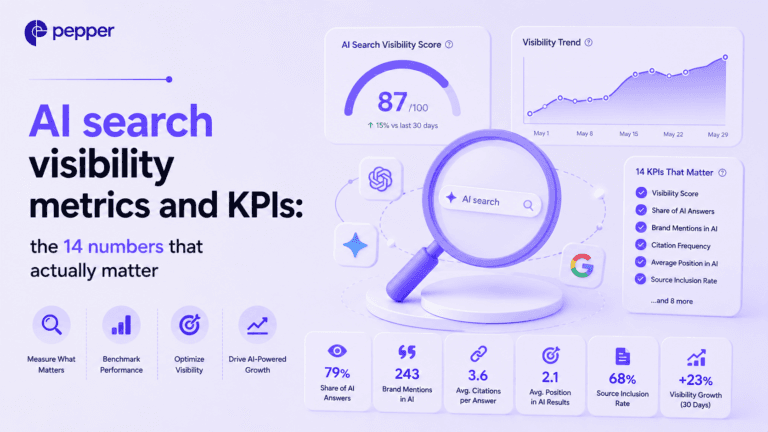
Most AI visibility reporting tracks one number and calls it visibility. It is three. This guide covers the 14 metrics worth tracking, how each is calculated, how to read it, why it might be falling, and where every one of them falls short.
Get your hands on the latest news!

Similar Posts
SEO
15 mins read
SaaS SEO in 2026: the complete playbook and the best SaaS SEO agencies
SEO
18 mins read
Best enterprise SEO agencies, firms and companies in 2026
GEO / AI Search
26 mins read