Best GEO Platforms for Ecommerce Brands in 2026
Disclosure: Pepper published this comparison and Pepper appears in it. Every platform carries a “where it falls short” line, including ours. We have cited primary sources throughout rather than vendor marketing pages, including where that meant replacing a vendor’s version of a statistic with the original research it came from.
The short answer
A GEO platform for ecommerce tracks whether AI assistants name and recommend your products, not just your brand, and connects that visibility to revenue.
Key takeaways
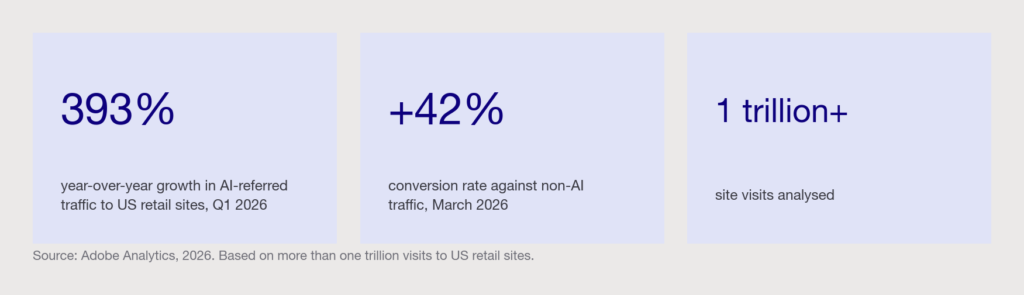
- AI-referred traffic to US retail sites grew 393 percent year over year in Q1 2026, and those visitors convert around 42 percent better than non-AI traffic (Adobe Analytics, based on over one trillion visits).
- Ecommerce GEO is a different problem from B2B GEO. The unit is the SKU, the schema is Product and Offer, and the answer often gets decided on retailer and review sites you do not own.
- Yotpo Discover leads on SKU-level tracking. Alhena leads on revenue attribution. Semrush AI Toolkit is the pragmatic pick if you already pay for Semrush. Profound is the enterprise intelligence layer. Shop Mentions is the cheap Shopify-native baseline.
- Most platforms here measure. Very few do anything about what they find. Budget for the execution, because that is the expensive half.
- Track Brand Visibility and Domain Prompt Presence across a fixed prompt set over time. A one-off score is noise.
A note on where this comes from. And we run organic for more than 250 enterprises and track over 10 million prompts across every major engine. And the view below is shaped by that, by the client reviews we sit in every week. And by the conversations we have with buyers and operators at the events we run. So this is our read on the category, not a neutral directory.
What is a GEO platform for ecommerce?
A GEO platform for ecommerce tracks whether AI assistants name and recommend your products, not just your brand, and connects that visibility to revenue. The unit is the SKU. Because retail answers are frequently decided on retailer listings and review sites, a platform that only watches your own domain is watching the wrong surface.
Why ecommerce GEO is a different problem
Most GEO advice is written for B2B software, where the buyer asks about a category and the model names five vendors. Retail does not work that way, and four differences change what you should buy.
The unit is the SKU, not the brand. “Best running shoes for flat feet under 150 dollars” needs a specific product, in stock, at that price. Brand-level tracking tells you nothing useful here. And a platform that cannot track at product and variant level is measuring the wrong object.
Price and availability are part of the answer. A model recommending a product that is out of stock or mispriced is worse than not recommending it. So this makes feed accuracy and structured data a GEO concern, not just a merchandising one.
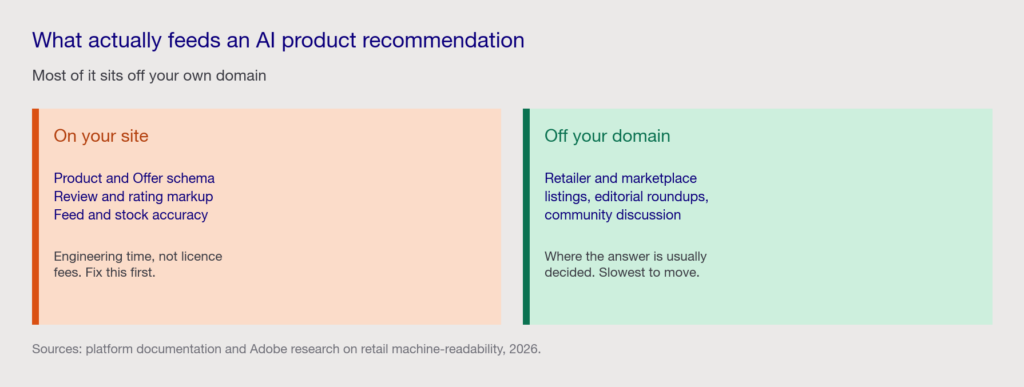
The answer is decided off your domain. For retail, models lean heavily on review aggregators, marketplaces, editorial roundups and comparison sites. Your product detail page is one input among many, and rarely the deciding one. So this is why measurement-only tools disappoint: they show you a gap that lives on someone else’s website.
Agentic checkout is arriving. Assistants are moving from recommending products to transacting. When an agent completes a purchase, machine-readable product data stops being an optimisation and becomes table stakes. Adobe’s own research has flagged that many retail sites are not yet machine-readable enough for this shift.
What actually feeds an AI product recommendation
| Signal | Why it matters | Where it lives |
|---|---|---|
| Product and Offer schema | Lets a model read price, availability, variants reliably | Your PDPs |
| Review and rating data | Models lean heavily on aggregate sentiment | Your site and third parties |
| Retailer and marketplace listings | Often cited above brand sites for retail queries | Amazon, retailer sites |
| Editorial roundups | “Best X for Y” articles are the model’s shortlist | Publications, affiliate sites |
| Community discussion | Real user experience, hard to fake | Reddit, forums |
| Feed accuracy | Wrong price or stock breaks the recommendation | Merchant Center, feeds |
The data on AI shopping, from the primary source
Worth being precise here, because these numbers circulate widely in vendor marketing with the original attribution stripped off.
Traffic. Adobe Analytics found AI-referred traffic to US retail sites grew 393 percent year over year in the first three months of 2026, and had grown more than 1,300 percent since October 2024 when Adobe began tracking it. Growth has moderated as the base has risen: by May 2026 the year-over-year figure was 138 percent. The analysis draws on more than one trillion visits to US retail sites (Adobe Analytics via Digital Commerce 360, June 2026).
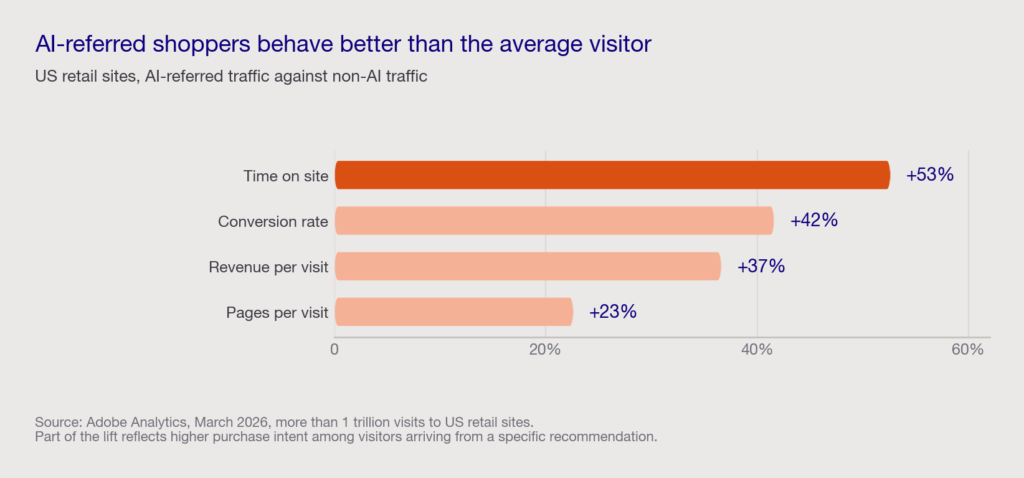
Quality of that traffic. By March 2026, Adobe reported AI-referred traffic converting about 42 percent better than non-AI traffic, with revenue per visit roughly 37 percent higher. So those visitors also spent 53 percent more time on site and browsed 23 percent more pages.
Two honest caveats. First, growth rates off a small base look dramatic, and AI referrals remain a minority of retail traffic. Second, high conversion partly reflects intent: someone arriving from a specific product recommendation is further down the funnel than someone arriving from a broad search. So that is an argument for GEO, but it is a selection effect rather than proof that AI referrals are magic.

The practical read: this is real, it is growing, the traffic is unusually good. And it is still early enough that the brands doing the structural work now are building a lead.
Agentic checkout: what changes when the assistant buys
The shift worth planning for is assistants moving from recommending a product to purchasing it. Adobe has already flagged that AI traffic is growing faster than retail sites are becoming machine-readable, and that gap is the whole opportunity.
When a human reads a recommendation, a good product page can rescue a thin data feed. The shopper sees the photo, reads the description, works out the variant. When an agent transacts, none of that recovery happens. It reads structured data, or it moves on to a competitor whose data it can read.
Three consequences worth acting on now:
Ambiguity becomes disqualifying. A variant structure a human navigates easily, size then colour then width, has to be unambiguous in markup. Anything an agent cannot resolve confidently, it avoids.
Stock and price accuracy become conversion-critical. A stale feed does not merely cost one sale. Repeatedly recommending unavailable products is the kind of signal that reduces how often a product gets surfaced at all.
Returns and shipping policy become ranking inputs. Agents optimise for the buyer’s stated constraints. If delivery windows and return terms are not machine-readable, you are invisible to “arrives by Friday” and “free returns” style queries, which is a large share of retail intent.
None of this needs a platform purchase. It needs your product data to be correct and complete, which is unglamorous engineering work with an unusually clear payoff.
See where you show up. Pepper’s GEO platform tracks Brand Visibility, Domain Prompt Presence and Share of Voice across ChatGPT, Perplexity, Gemini, Claude and Google AI Overviews. And a growth team works the account with you. Book a growth audit or see where you show up.
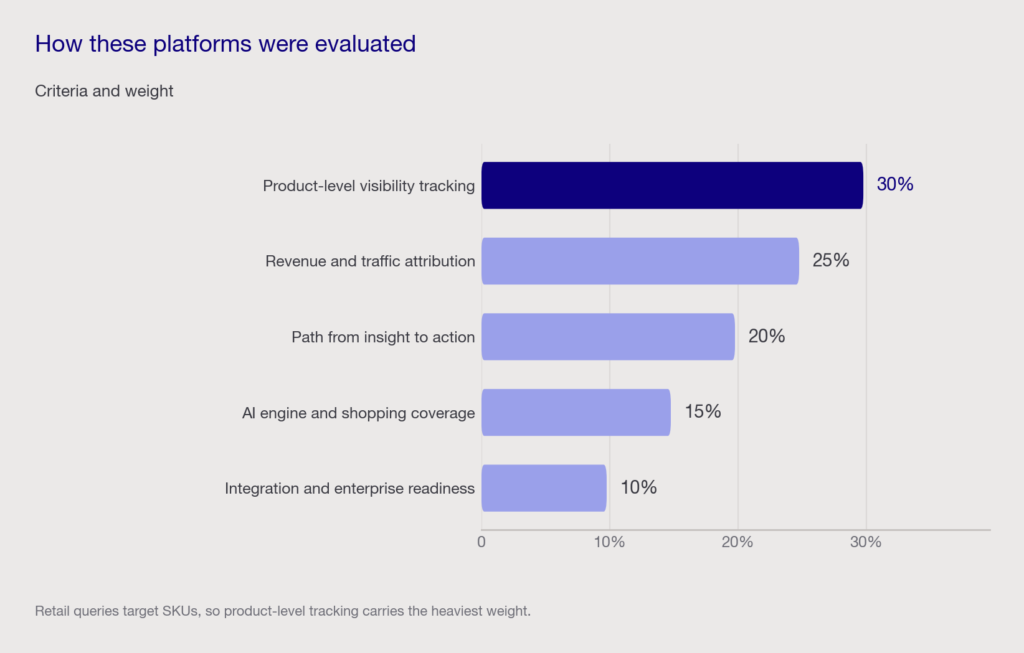
Our methodology: how we evaluated these platforms
Our full weighting model is set out in the GEO agency ranking methodology.
| Criterion | Weight | Why it carries this weight |
|---|---|---|
| Product-level visibility tracking | 30% | Retail queries target SKUs, not brands |
| Revenue and traffic attribution | 25% | Mentions that never reach revenue are vanity |
| Path from insight to action | 20% | A gap you cannot close is not worth measuring |
| AI engine and shopping surface coverage | 15% | Including ChatGPT Shopping and marketplace assistants |
| Integration and enterprise readiness | 10% | Shopify, GA4, feeds, catalog systems |
What we could not verify. Most vendors in this category quote custom. Where pricing is published we say so, with the date checked. Where it is not, we have written “not published” rather than estimating.
Best GEO platforms for ecommerce at a glance
| Platform | Best for | SKU-level tracking | Attribution | Engines | Pricing (Aug 2026) |
|---|---|---|---|---|---|
| Yotpo Discover | Catalog-native product tracking | Strong | Moderate | ChatGPT, Gemini, Google AI Mode | Not published |
| Alhena | Tying AI visibility to revenue | Strong | Strong | ChatGPT, Gemini, Perplexity | Not published |
| Semrush AI Toolkit | Teams already on Semrush | Moderate | Moderate | ChatGPT, Perplexity, Claude, Gemini, DeepSeek | Suite add-on |
| Profound | Enterprise intelligence depth | Moderate | Moderate | 8 incl. Grok, Copilot, DeepSeek | From $99/mo |
| RankZero | Teams wanting the work done for them | Moderate | Moderate | ChatGPT, Perplexity, AI Overviews | Managed retainer |
| Shop Mentions | Shopify stores wanting a baseline | Basic | Basic | ChatGPT, Perplexity, Gemini, Claude | Shopify App Store |
| Pepper | Brands wanting the work done, not shown | Strong | Strong | ChatGPT, Perplexity, Gemini, Claude, AI Overviews | Custom, annual |
The platforms
1. Yotpo Discover
What it does. Built on Yotpo’s ecommerce foundation, Discover monitors how brands appear inside AI shopping experiences including ChatGPT, Gemini and Google AI Mode. Because it sits on catalog, reviews and loyalty infrastructure, it draws on real shopper reviews as the raw material. And product-level granularity is native rather than bolted on.
Best for. Mid-market and enterprise retail brands, particularly those already in the Yotpo ecosystem for reviews and loyalty.
Where it falls short. Engine coverage is narrower than the broadest trackers, with Perplexity and Claude less well served. It measures well and executes little: closing the gaps it identifies is your team’s job.
2. Alhena
What it does. Tracks SKU-level visibility across ChatGPT, Gemini and Perplexity, then connects to your storefront to trace a product appearing in an AI answer through to the revenue it generated. And it is the clearest answer on this list to “did any of this sell anything.”
Best for. Teams under pressure to justify GEO spend in revenue terms.
Where it falls short. A newer entrant with a shorter enterprise track record. Closed-loop attribution always involves modelling assumptions, so interrogate the methodology rather than accepting the number.
3, Semrush AI Toolkit
What it does. Adds AI visibility monitoring across ChatGPT, Perplexity, Claude, Gemini and DeepSeek to the existing Semrush suite, alongside the SEO tooling you already use.
Best for. Teams already paying for Semrush who want AI visibility in the same place as their SEO data.
Where it falls short. Generalist rather than retail-specific. Product-level granularity is weaker than catalog-native tools, and there is no ecommerce revenue attribution to speak of. Convenient rather than best-in-class.
4, Profound
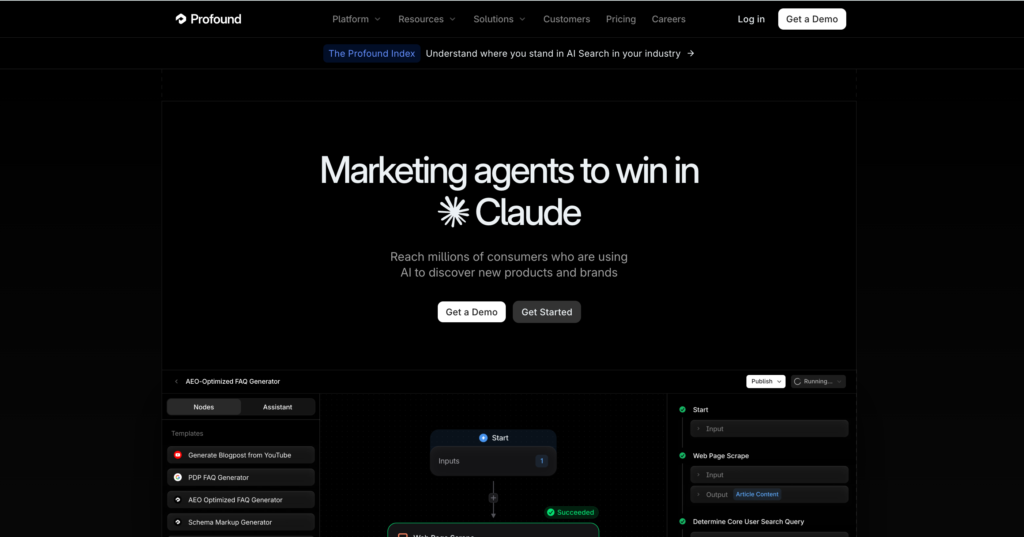
What it does. Enterprise AI visibility with the broadest engine coverage on this list, spanning ChatGPT, Perplexity, Claude, Gemini, Grok, Copilot, DeepSeek and Google AI Overviews, plus a Shopping module and agents that generate optimised content.
Best for. Large retailers with an in-house team able to act on detailed findings.
Where it falls short. Not retail-specialised, so SKU-level work needs configuring. The $99 entry tier covers ChatGPT only, so retail-relevant multi-engine coverage starts higher up. The agent-based execution is newer than the analytics, and deep analytics create their own workload unless someone is resourced to act on them.
5. RankZero
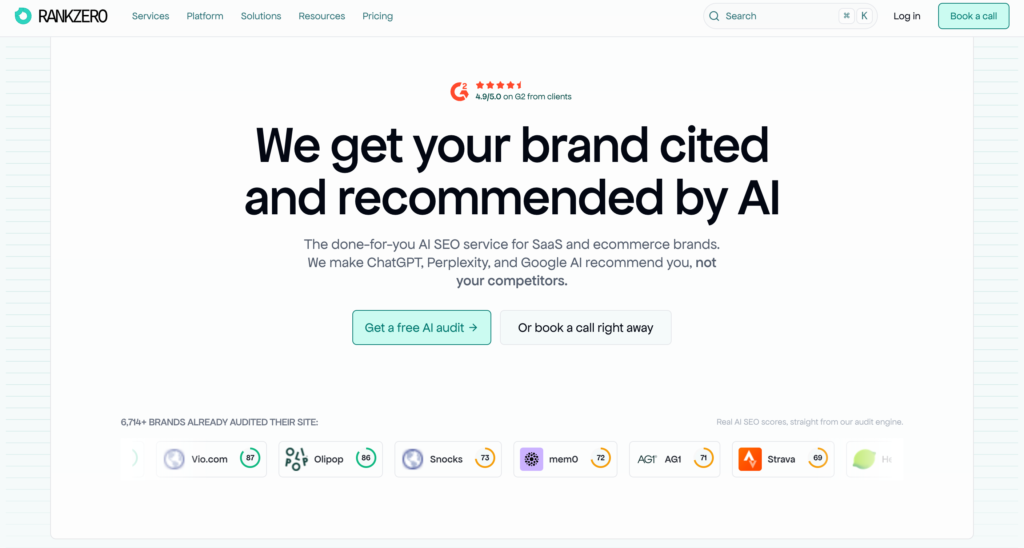
What it does. A done-for-you AI SEO service rather than a tool you run: an AI visibility audit, answer-shaped content, technical work and earned citations, delivered as a managed monthly retainer and tracked in its own engine.
Best for. Lean teams with no capacity to act on a dashboard, who would rather buy the execution.
Where it falls short. Smaller and less proven at enterprise scale, and not retail-specialised, so SKU-level work needs configuring. Because it is a service rather than a platform, you do not get an independent measurement layer you control.
6. Shop Mentions
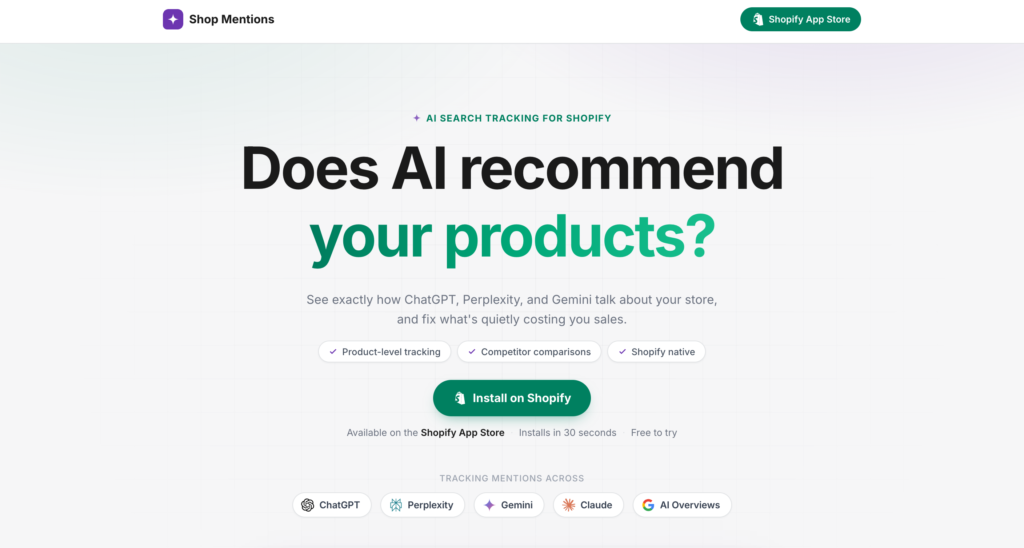
What it does. A Shopify-native app that runs the questions your customers ask against ChatGPT, Perplexity, Gemini and Claude, then shows which brands get recommended, which sources get cited. And where competitors appear and you do not. Intentionally lightweight.
Best for. Smaller Shopify stores wanting a cheap baseline before committing to anything larger.
Where it falls short. Shallow analysis and no meaningful attribution. It tells you whether you appear, not why, and not what to do about it. So treat it as a thermometer.
7. Pepper
What it is. Pepper is an agentic organic growth engine. Atlas is the platform underneath, and a growth team runs the organic function with you. So you get the platform and a growth team on the account. Your team can log in, connect Search Console and GA4, manage the prompt set, read the analytics. And build and run agents in the Agent Atlas. In practice, our growth team works the same account alongside you, so the work still happens when your week fills up. And it is the option on this list where the work happens rather than only the measurement.
Why it is on this list. Every other entry hands you a finding. So for retail, the findings usually point off your domain, at review sites, roundups and marketplace listings. So that is real work, and it is the part a dashboard cannot do.
What it covers. Product schema and feed accuracy, PDP retrievability, off-site authority in the review and editorial sources models actually read. And visibility measured across ChatGPT, Perplexity, Gemini, Claude and Google AI Overviews. More than 10 million tracked prompts sit behind the strategy. Eight years, 250 plus enterprises.
Where it falls short. Custom annual pricing, so it is a poor fit for smaller stores wanting a cheap monthly tool. Organic only. And if you already have a strong in-house team with spare capacity and simply need better data, one of the trackers above is the more sensible purchase.
What to fix before you buy any platform
Some of the highest-return ecommerce GEO work needs no platform at all. And buying before doing it means paying to watch a problem you already know about.
Product and Offer schema on every PDP. See our guides to schema markup and Product schema specifically for the fundamentals. Complete, accurate, including price, currency, availability and variants. So this is the single most common structural gap.
AggregateRating and Review markup. Models weight review signals heavily for retail. If yours are not machine-readable, they are not counted.
Feed hygiene. Price and stock accuracy across Merchant Center and any syndication. And a recommendation for an out-of-stock item is a wasted citation and a bad customer experience.
Crawlability for AI user agents. Check that you are not blocking them, using our guide to robots.txt for AI crawlers. Teams block AI crawlers in robots.txt for good reasons and then wonder why they never get cited.
A named prompt set. Write down the 50 to 100 questions a shopper would actually ask that should surface your products. Without this, every platform you buy will measure a prompt set someone else chose.
Do these five and re-baseline. The remaining gap is what you are actually shopping for.
What a GEO platform costs
Pricing in this category is mostly gated. Here is what is publicly established.
| Engagement type | Typical range | Notes |
|---|---|---|
| Shopify-native app | Low monthly, App Store pricing | Baseline monitoring only |
| Platform, entry tier | From $99 per month | Often a single engine at this level |
| Platform, mid tier | $399 to $1,500 per month | Multi-engine, deeper analytics |
| Full organic function, run for you | Custom, usually annual | Strategy, execution and accountability |
The number matters less than what it buys. So ask whether the fee covers off-domain work, because that is where retail answers are decided, and it is the line item most commonly missing.
How to choose a GEO platform for your store
Retail changes the evaluation, because the unit is the product rather than the brand. And because a meaningful share of the answer is decided on retailer listings, review sites and roundups you do not control.
In May 2026 Google published its first official guidance on optimising for its AI features and filed it under SEO fundamentals. Its position: AEO and GEO are part of SEO for Google, AI Overviews and AI Mode run on the core Search ranking systems. And there is no separate AI index. It also mythbusts several things GEO vendors sell hard, including llms.txt, content chunking and AI-specific rewrites. So for ecommerce we would read that as permission to stop buying AI-specific gimmicks and start fixing product data. Accurate Product and Offer schema, correct price and availability, and machine-readable review signals do more for AI recommendation than any amount of AI-flavoured rewriting.
The scorecard we would use
Score each shortlisted partner out of 100 using the weights below, before the pricing conversation rather than after it. And a partner who scores well on measurement and badly on execution is a research vendor, whatever the deck says.
| Area | Weight | What a strong platform or partner demonstrates |
|---|---|---|
| Product-level visibility | 25% | Tracks at SKU and variant level against your real catalog, not a curated demo |
| Revenue attribution | 20% | Traces a product appearing in an answer through to sessions and revenue, and can explain what is measured versus modelled |
| Path from insight to action | 20% | Something happens after the finding. Otherwise you have bought a backlog |
| Off-domain coverage | 15% | Sees the retailer listings, roundups and review sources that decide retail answers |
| Engine and shopping surface coverage | 10% | Including shopping surfaces and agentic checkout, not just chat |
| Integration readiness | 10% | Shopify or your platform, GA4, feeds, catalog systems |
Test it against your own catalog
Never accept a curated demo. Give each vendor 20 to 30 real shopper questions in your category, with constraints attached. Because that is how people actually shop: “best running shoes for flat feet under 150”, “alternatives to [competitor product]”, “which [category] has free returns”.
Then ask for five answers:
- Which of our products appear, and at what variant level?
- Which competitors appear instead?
- Which sources are influencing those answers?
- Why are those sources winning?
- What would you change in the first 90 days?
Ask them to run it twice, on different days. Research across generative engines finds substantial variation between runs and low overlap in cited sources. If the two runs differ wildly and the vendor is surprised, they are not measuring, they are sampling.
The distinction that decides it: weak playbook against strong
The weaker playbook in this category runs: find prompts, rewrite blogs, add FAQs, add statistics, hope the engines cite you. And it is cheap to sell and it plateaus in about a quarter.
The stronger model, and the one we run, sequences it: demand intelligence, then technical discoverability, then entity and brand authority, then content, then earned-media authority, then distribution, then visibility measurement, then revenue attribution.
That difference matters because generative engines synthesise an answer from several sources rather than ranking one page. Being retrieved, being cited, and actually influencing the answer are three different things worth measuring separately.
Red flags
- “We guarantee your products get recommended.” Nobody controls the output.
- Brand-level tracking sold as product tracking. For retail, brand-level tells you almost nothing.
- Attribution with no stated methodology. Every vendor claims it. Ask what is measured and what is modelled.
- No view of off-domain sources. The answer is frequently decided on a retailer or review site. A platform that cannot see them is watching the wrong surface.
- A dashboard with no path to action, when your team has no spare capacity to act.
- Ignoring feed hygiene. If a vendor never asks about price and stock accuracy, they are not thinking about how recommendations actually fail.
The five questions we would spend the meeting on
- Run this against our live catalog, now. Not the demo account.
- Take one product where a competitor is recommended and explain why.
- What is measured and what is modelled in your attribution?
- How do you handle variant and availability changes? Retail data moves daily.
- What happens after the finding? If the answer is “you fix it”, price the internal hours and add them.
Reduced to one principle: buy the thing that closes the gap, not the thing that photographs it. For most stores the first wins are in product data. And they cost engineering time rather than licence fees.
One honest closing note. Very few firms are equally strong across measurement, execution, earned authority and attribution, ours included. The good ones will tell you which is their weakest without being asked. If a partner claims to be excellent at all four, you have learned something about how they answer questions.
What nobody should promise you
Be wary of a single AI visibility score presented as a ranking. So ask a model the same product question repeatedly and the answers vary. Brand Visibility and Domain Prompt Presence across a tracked prompt set, measured over time, are real moving numbers. And a screenshot is not. In practice, Pepper reports this as three numbers: Brand Visibility (how often engines mention you by name), Domain Prompt Presence (how often they cite a page from your domain) and Share of Voice (your slice of all brand mentions in the category). Visibility rising while Share of Voice falls means competitors rose faster.
Frequently asked questions
What is the best GEO platform for ecommerce in 2026?
It depends on the gap. Yotpo Discover leads on SKU-level tracking, Alhena on revenue attribution, Semrush AI Toolkit for existing Semrush users, Profound for enterprise intelligence depth. And shop Mentions as a cheap Shopify baseline.
How is ecommerce GEO different from regular GEO?
The unit is the product, not the brand. Price and stock accuracy become ranking-relevant, Product and Offer schema matter more than article structure. And recommendations are frequently decided on review sites and marketplaces you do not own.
Can GEO tools track my products inside ChatGPT Shopping?
Coverage varies and is changing quickly. Several platforms track ChatGPT product surfacing, but few offer full shopping-surface visibility. So ask any vendor to demonstrate this specifically against your catalog before signing.
How long until GEO improves product visibility?
Structural fixes like schema and feed accuracy can show movement within four to eight weeks. Off-site authority, meaning reviews, roundups and marketplace presence, compounds over three to six months.
Does AI-referred traffic actually convert?
Adobe Analytics reported AI-referred retail traffic converting about 42 percent better than non-AI traffic in March 2026, with 37 percent higher revenue per visit. Part of that reflects higher purchase intent among visitors arriving from specific recommendations.
Do I need a GEO platform if I already use Semrush?
Possibly not at first. The Semrush AI Toolkit covers multi-engine monitoring adequately for many mid-market retailers. Add a catalog-native tool when you need genuine SKU-level granularity or revenue attribution.
Will blocking AI crawlers protect my product data?
It will also remove you from the answers. If discovery through AI assistants matters to you, blocking is a trade rather than a defence. Decide deliberately and check what your robots.txt currently does.
What is the cheapest way to start?
Fix schema, reviews markup and feed accuracy first, since these cost engineering time rather than licence fees. Then add a low-cost tracker such as Shop Mentions or a Semrush add-on to establish a baseline before committing further.
You may not need a platform yet
The answer that costs us the sale. If your Product and Offer schema is incomplete, your feed has price or stock drift, or your review markup is not machine-readable, do not buy anything yet. So those fixes cost engineering time rather than licence fees, and they move AI recommendation more than any tracker will. Re-baseline after, then decide whether you still have a measurement problem.
Where to go next
The useful first step is a baseline rather than a platform demo: the 50 to 100 shopper questions that should surface your products, where you stand on them today. And which sources get cited instead of you.
Related reading: AI search for ecommerce and GEO for AI shopping assistants.
That baseline tells you whether you have a schema problem, an authority problem, or a problem no tool on this page can fix.
Latest Blogs
You can check if your brand appears in AI search in about twenty minutes, on two engines, without paying for anything. The method is simple and the result is noisier than most people admit. In one 2026 pilot, ChatGPT searched the web on only 42% of buying prompts, so on the rest there was no retrieval event at all. In another, rewording a question changed the answer more than 23% of the time. This article gives you the check, then gives you the four reasons it can lie, so you can tell a real absence from a bad sample.
A blog traffic drop has five plausible causes and AI search is the most interesting one, which is exactly why people reach for it first. It is also the only one you cannot measure directly, so it should be diagnosed last, by elimination. The first check takes ten minutes and costs nothing: put clicks and impressions on the same chart. In one 2026 study of 53 brands, clicks held flat at around 400,000 while impressions more than doubled, so clickthrough halved without a single visitor being lost. Work through the other four before you conclude anything about AI.
Google publishes one eligibility rule for AI Mode, and in May 2026 it published what AI Mode users actually do. Both matter more than the fan-out arithmetic the category quotes.
Get your hands on the latest news!

Similar Posts
GEO / AI Search
17 mins read
How to check if your brand appears in AI search, and whether to believe what you see
GEO / AI Search
17 mins read
Why did my blog traffic drop? Work through five causes, in order
Artificial Intelligence
13 mins read